Circle Theorems Worksheets
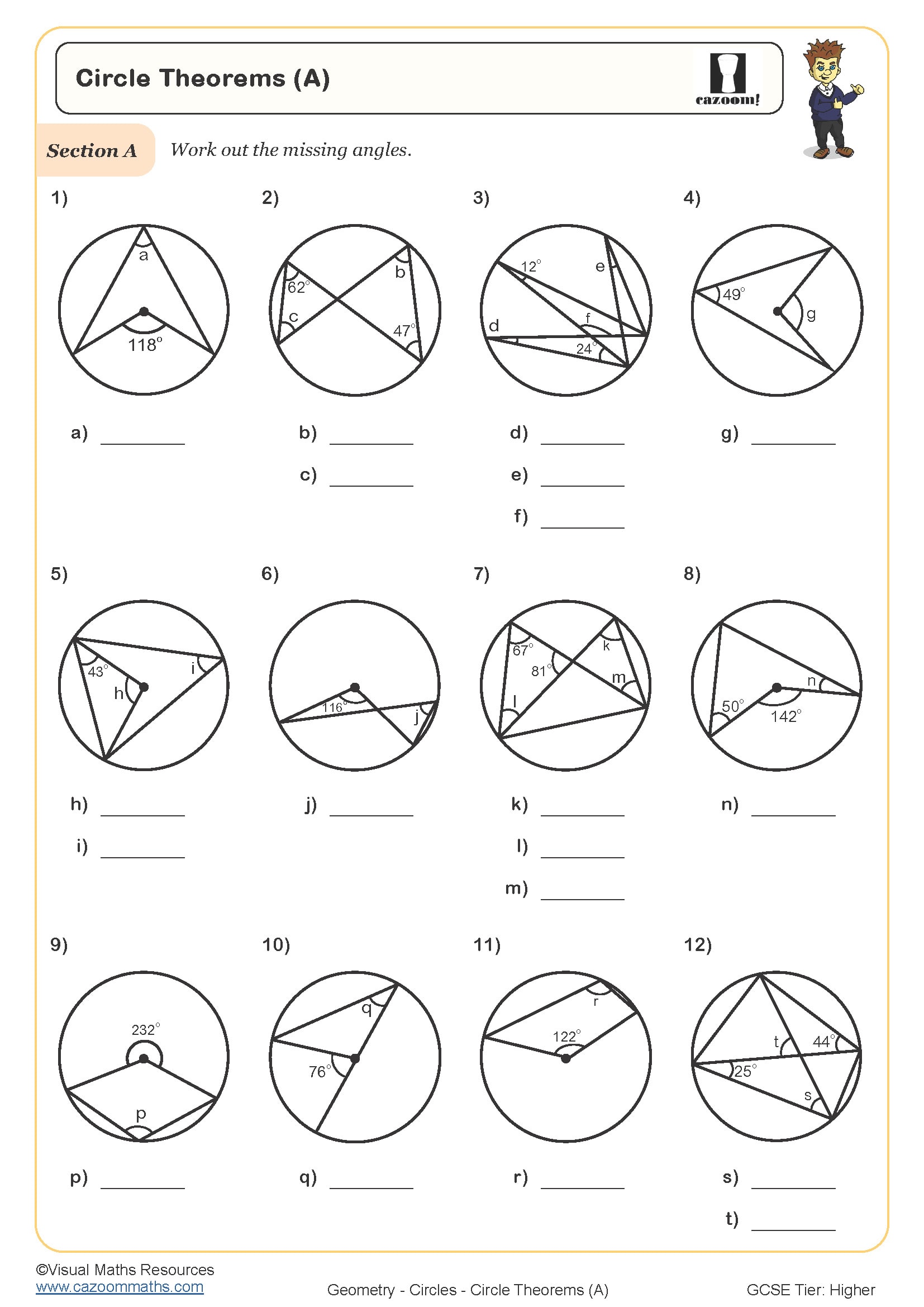
Circle Theorems (A)
Year groups: 10, 11
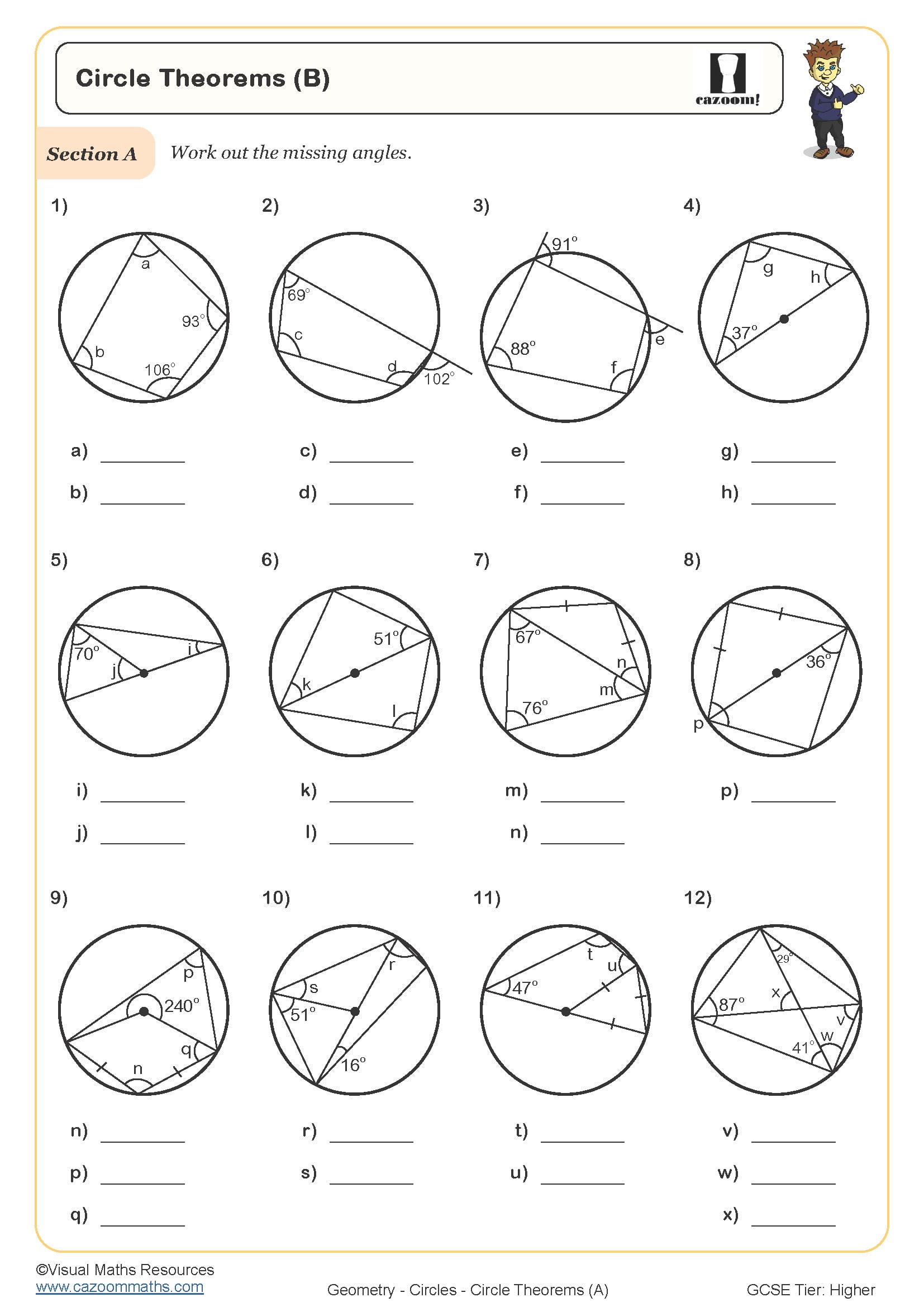
Circle Theorems (B)
Year groups: 10, 11
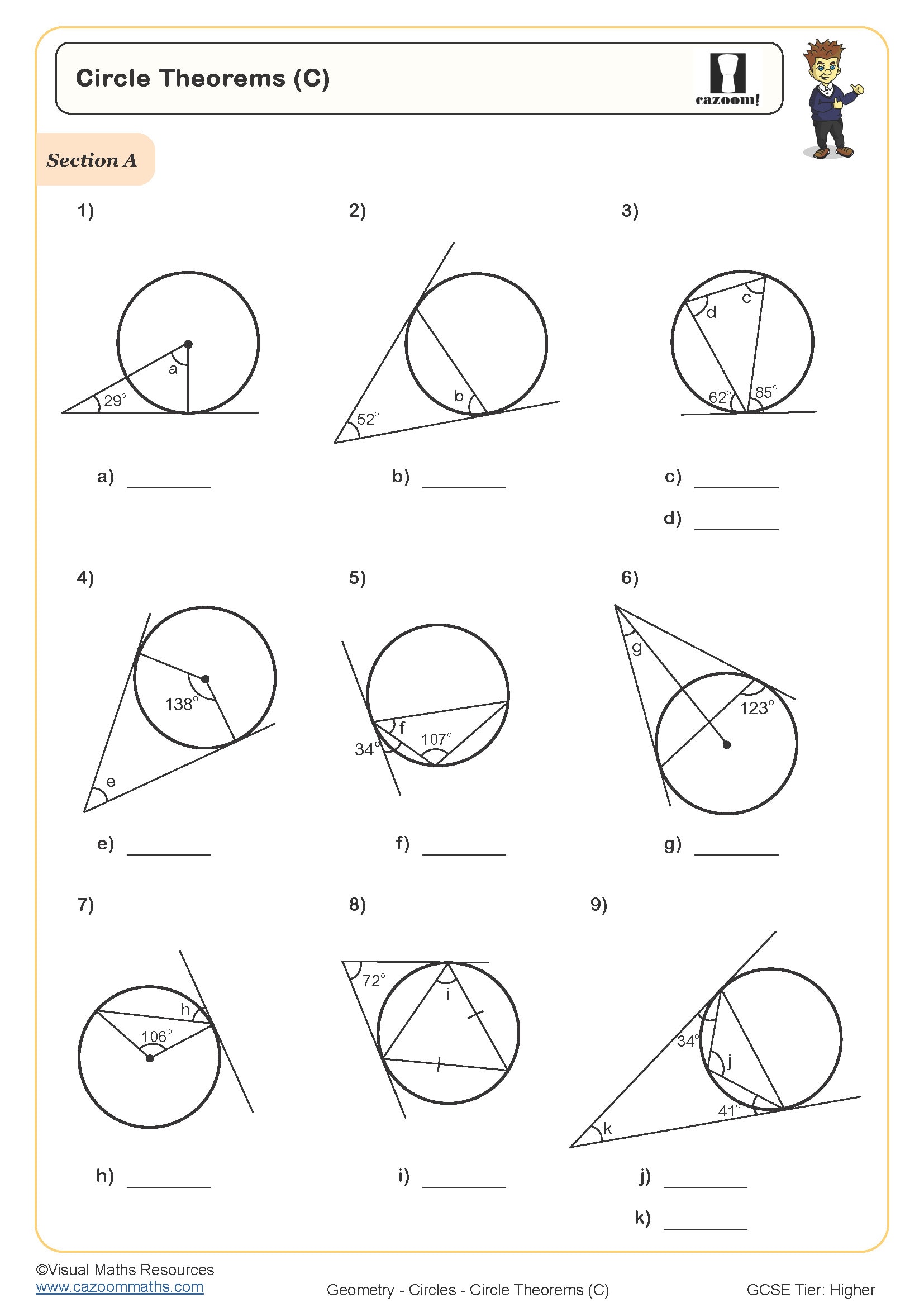
Circle Theorems (C)
Year groups: 10, 11
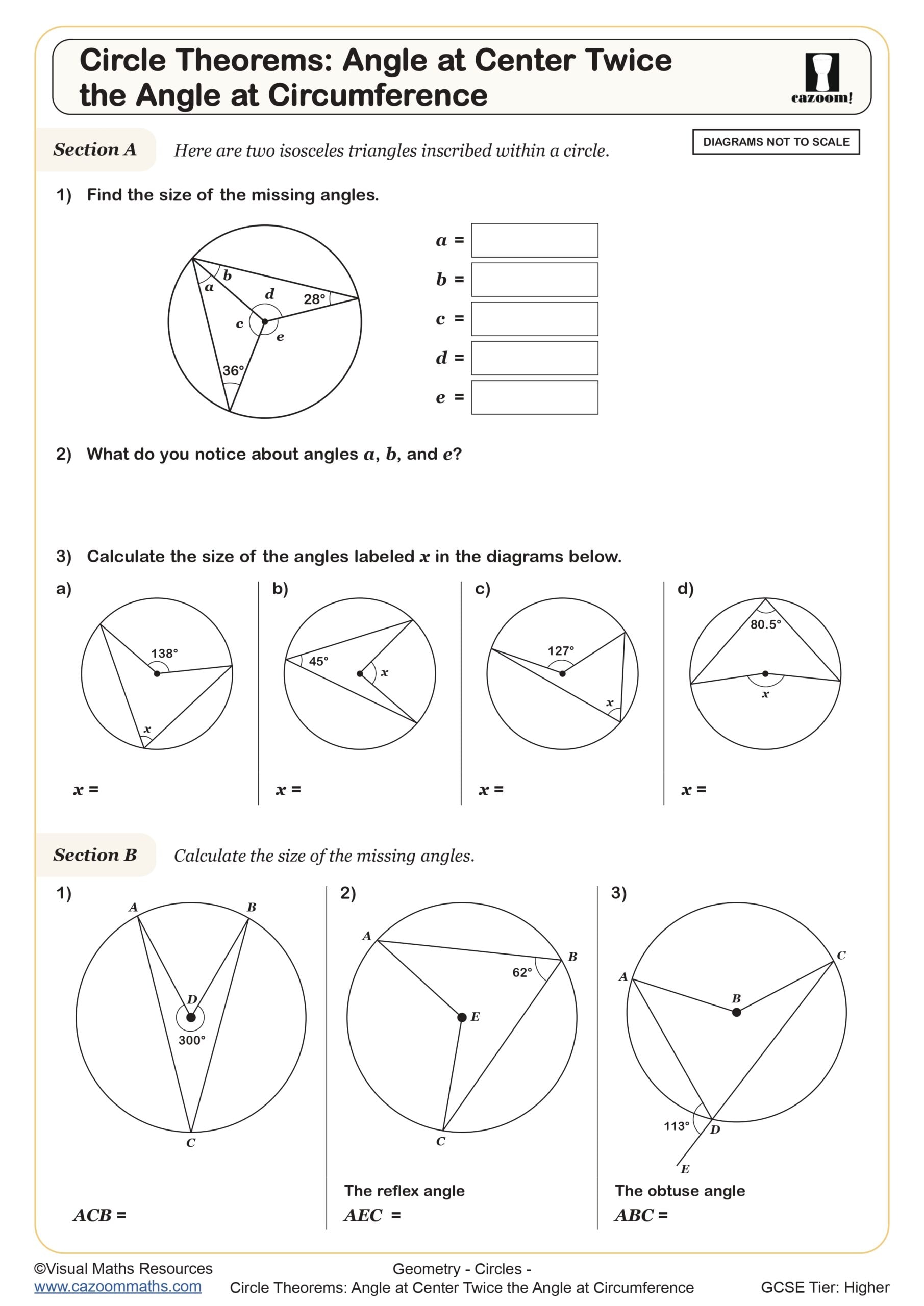
Circle Theorems: Angle at Center Twice the Angle at Circumference
Year groups: 10, 11
Circle Theorems: Angle Notation
Year groups: 10, 11
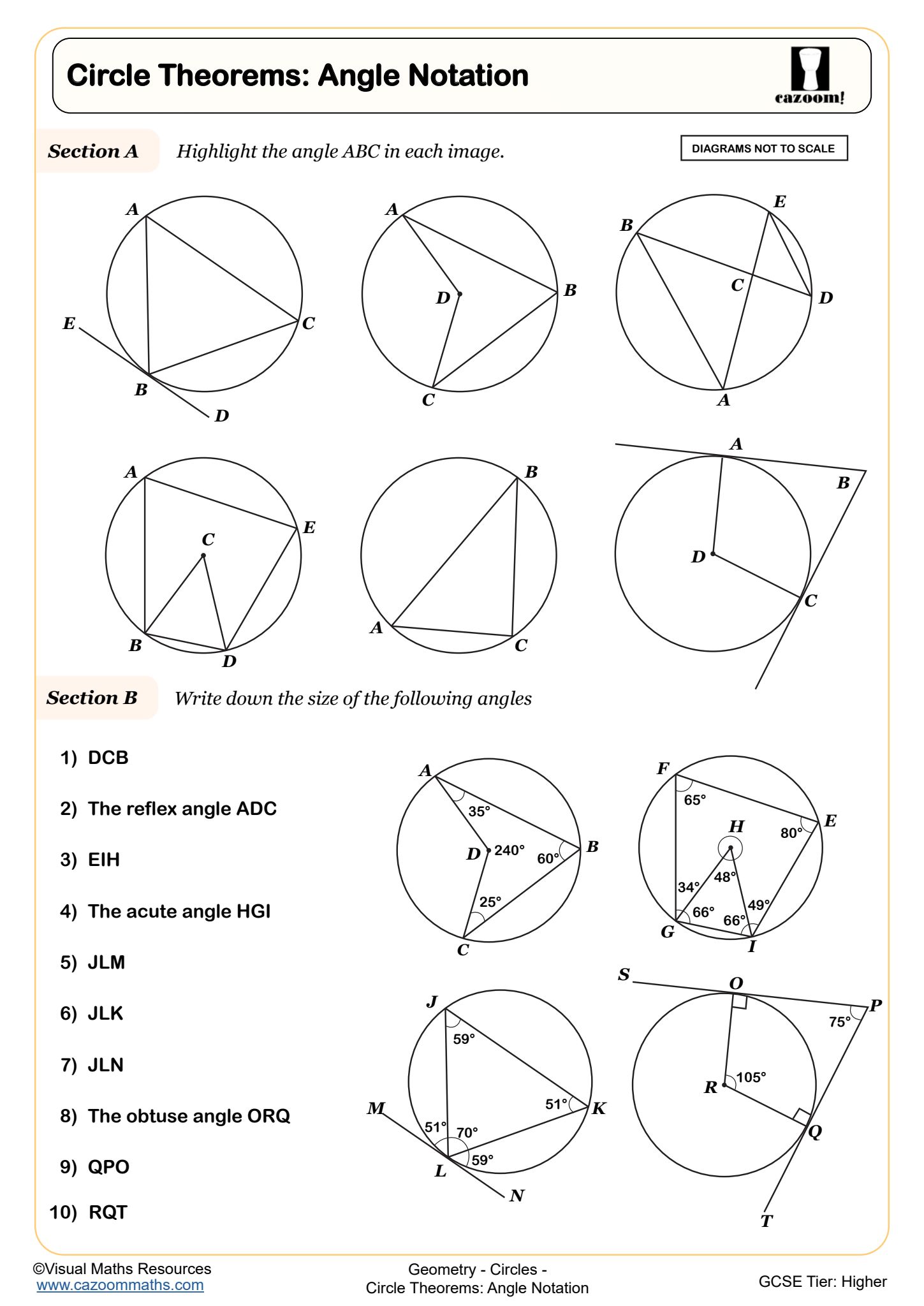
Circle Theorems: Cyclic Quadrilaterals
Year groups: 10, 11
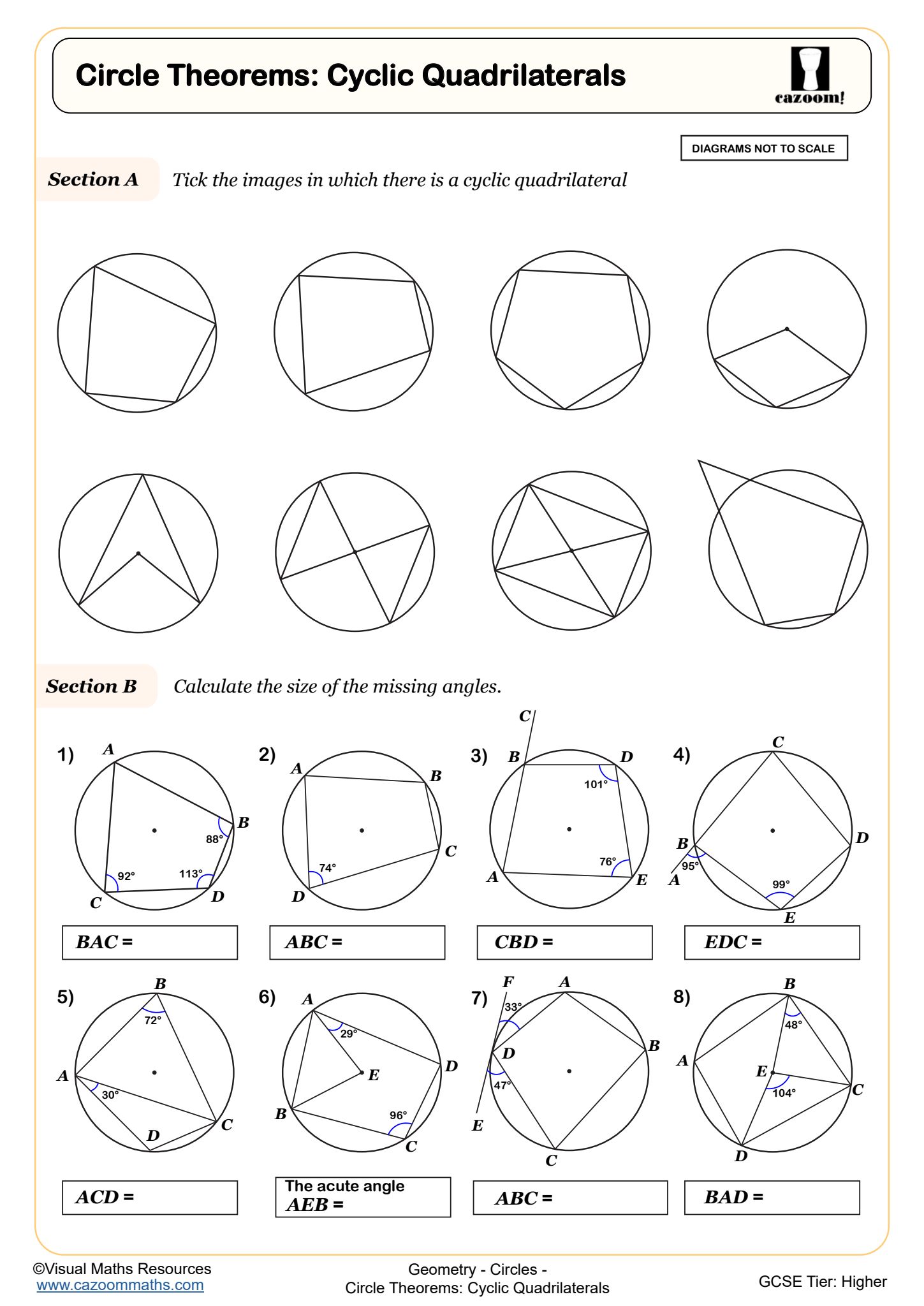
Circle Theorems: Triangles in Circles
Year groups: 10, 11
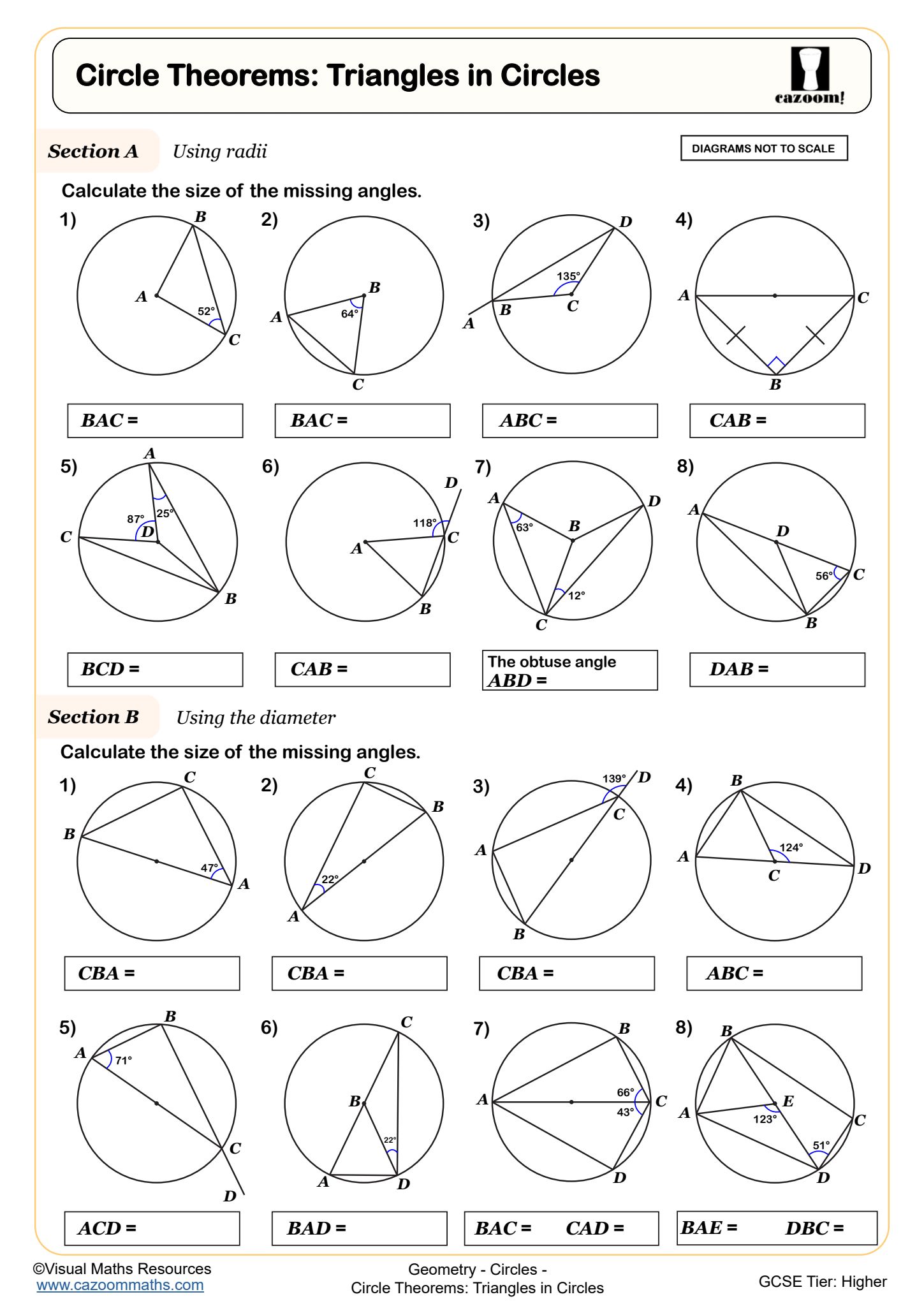
Learning the Circle Theorems
Year groups: 10, 11
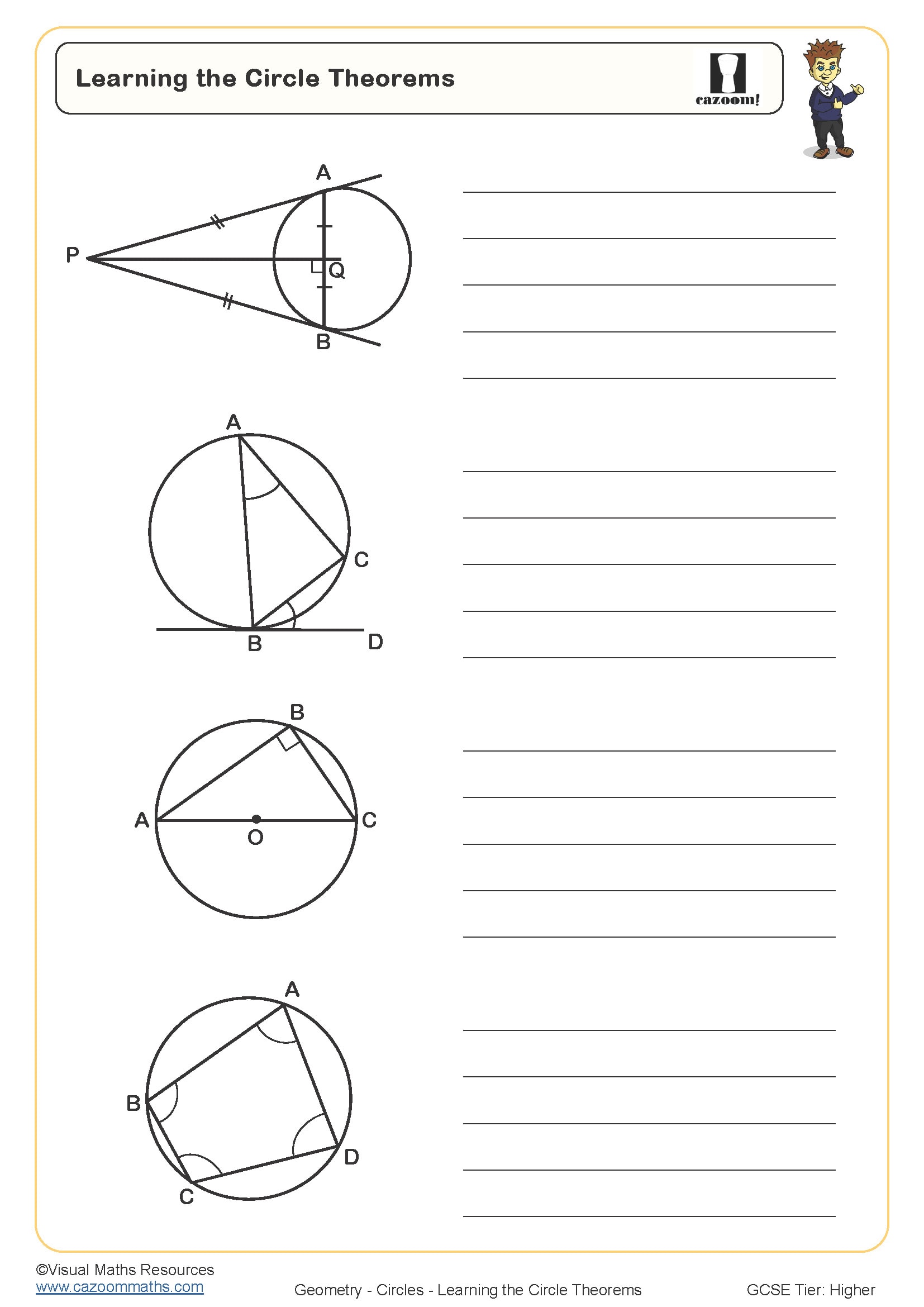
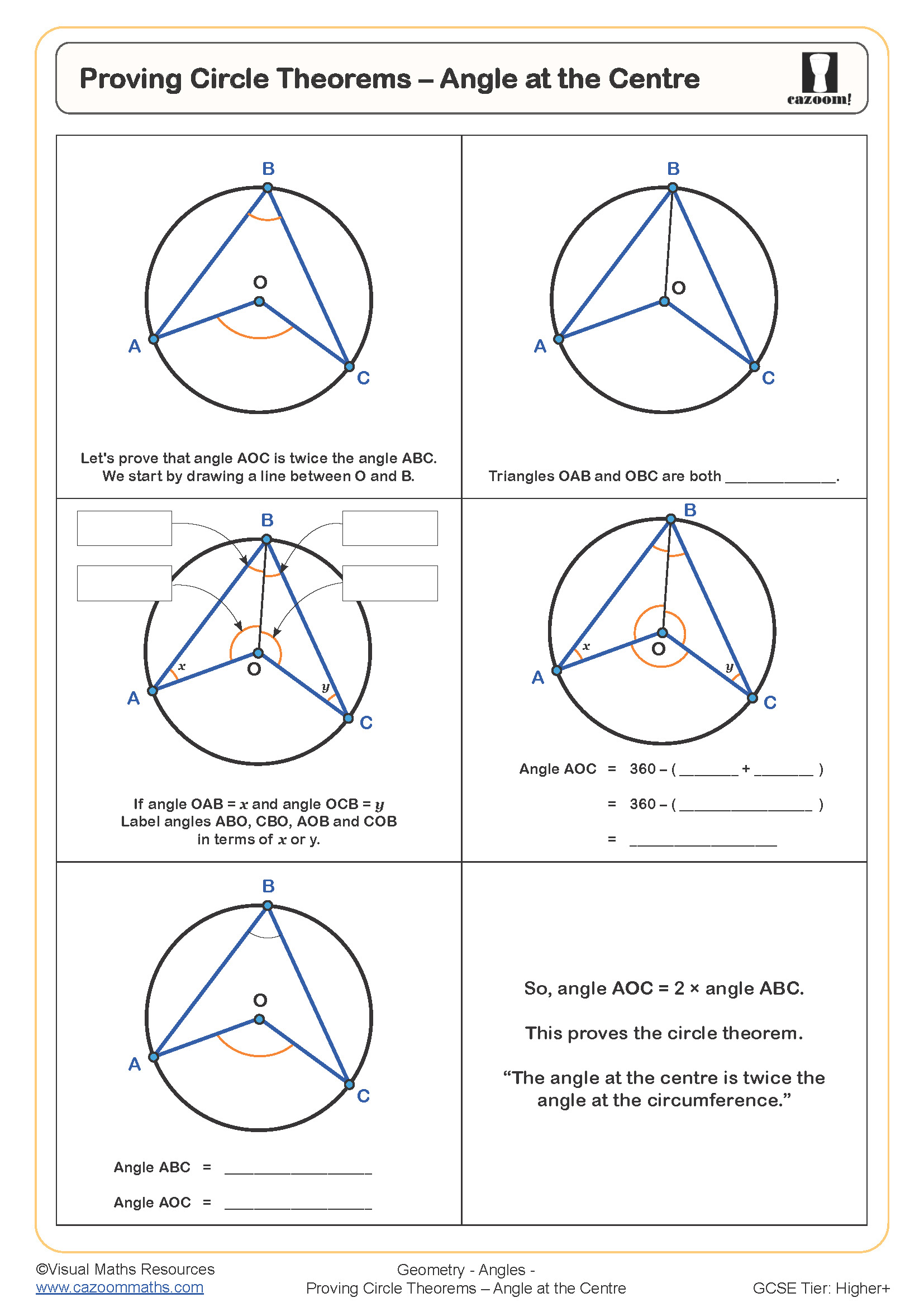
Proving Circle Theorems - Angle at the Centre
Year groups: 10, 11
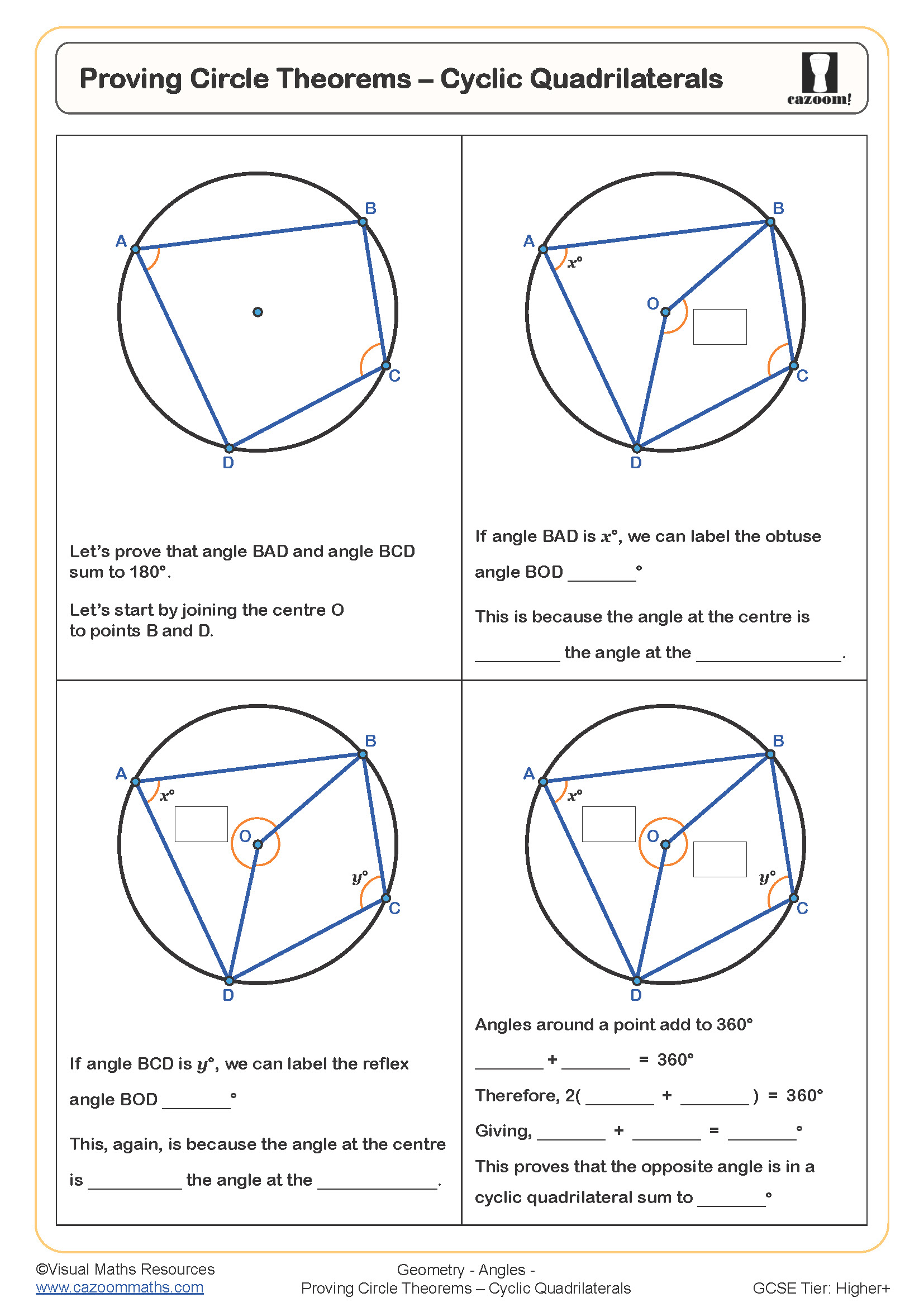
Proving Circle Theorems - Cyclic Quadrilaterals
Year groups: 10, 11
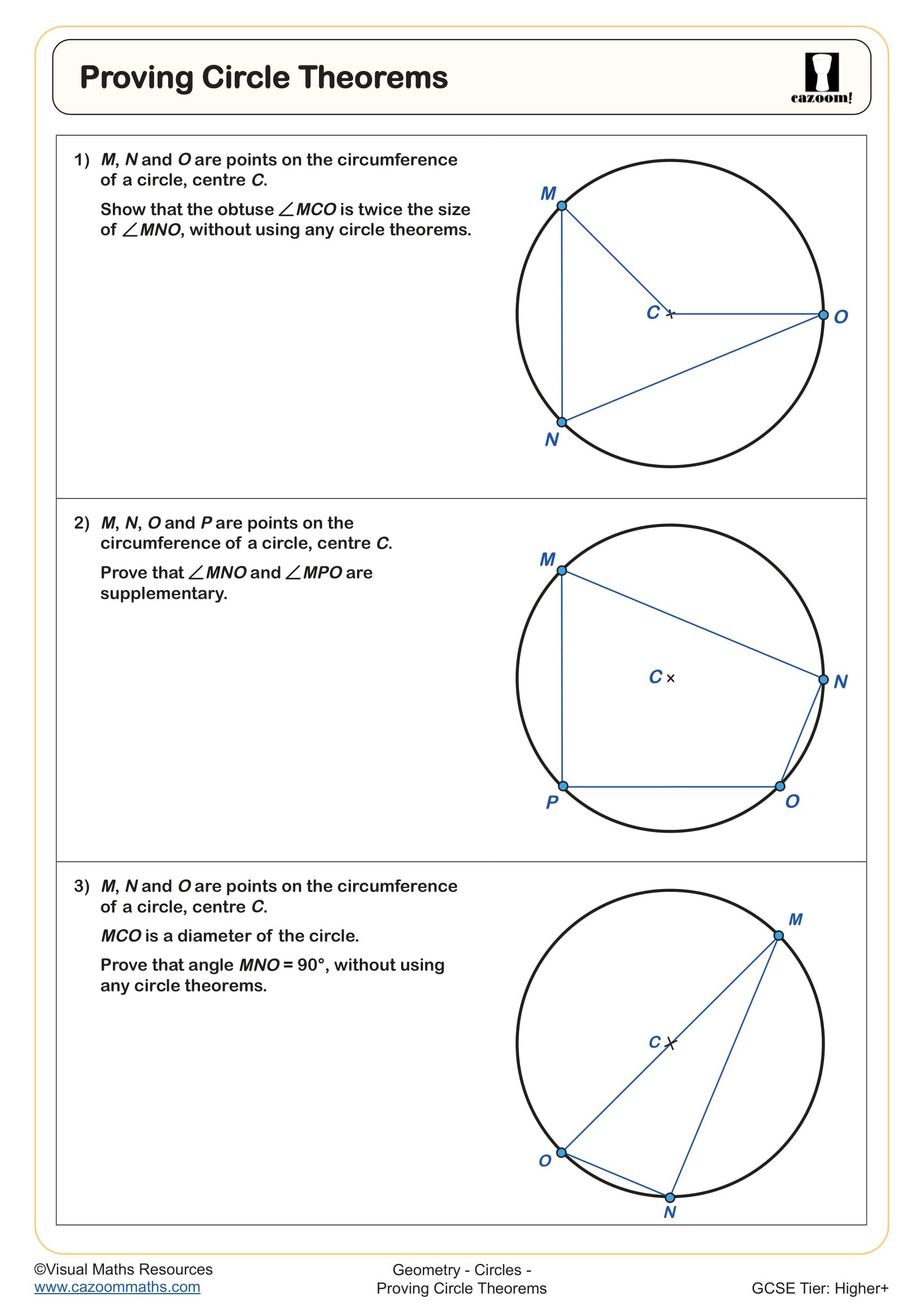
Proving Circle Theorems
Year groups: 11
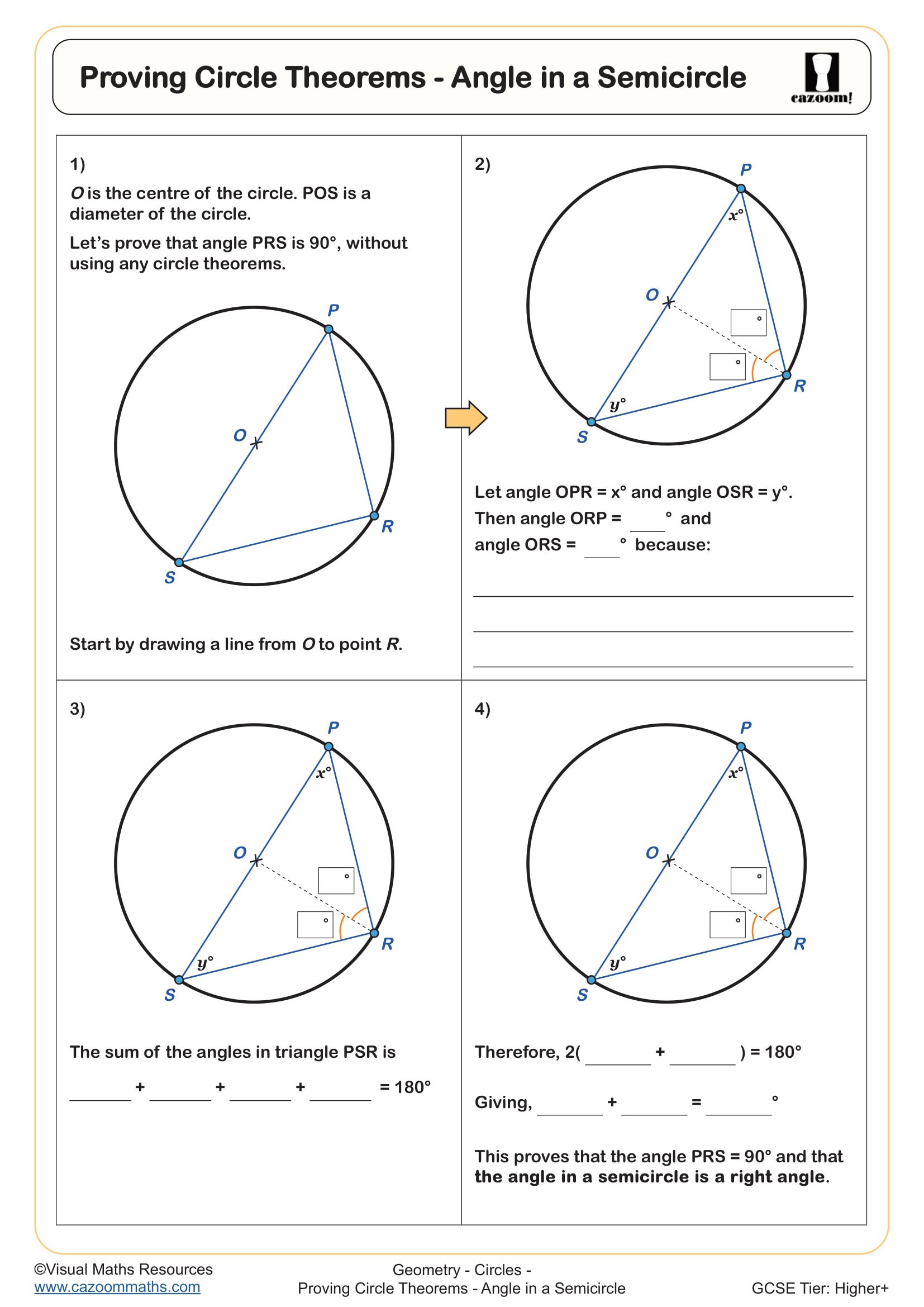
Proving Circle Theorems - Angle in a Semicircle
Year groups: 11
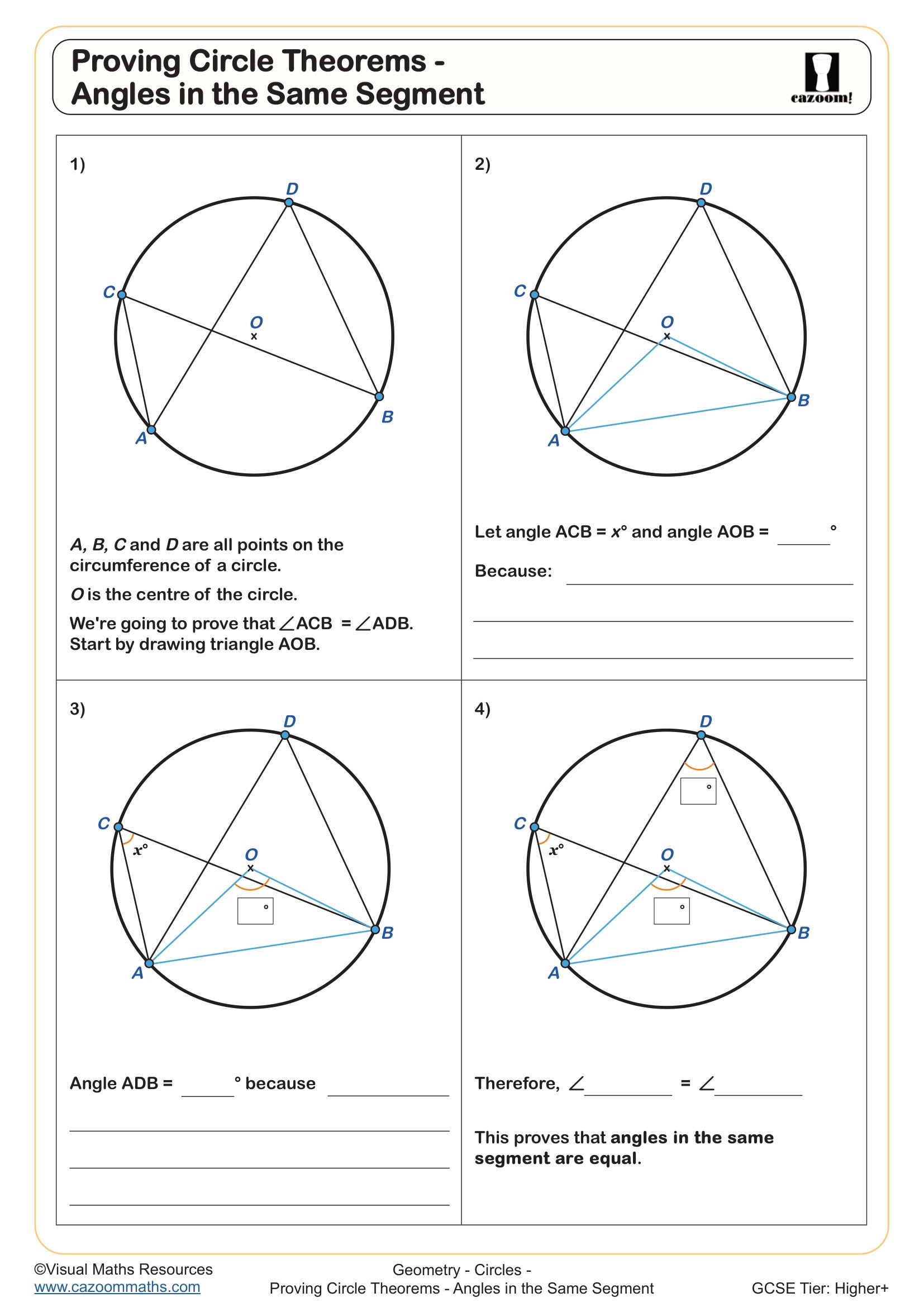
Proving Circle Theorems - Angles in the Same Segment
Year groups: 11
All worksheets are created by the team of experienced teachers at Cazoom Maths.
What are the main circle theorems students need for GCSE?
Students need to know seven circle theorems for GCSE: the angle at the centre is twice the angle at the circumference; angles in the same segment are equal; the angle in a semicircle is 90°; opposite angles in a cyclic quadrilateral sum to 180°; the tangent and radius meet at 90°; two tangents from an external point are equal in length; and the alternate segment theorem. These appear across both Foundation and Higher tier papers, with Foundation focusing on straightforward applications and Higher requiring multi-step proofs.
Exam mark schemes specifically require students to state which theorem they've used, yet many lose marks by showing correct numerical work without naming the theorem. Teachers notice that students often calculate angles correctly but fail to justify their reasoning with the appropriate geometric property, particularly when combining multiple theorems in one diagram where the angle notation becomes more complex.
Which year groups study circle theorems?
Circle theorems are taught in Year 10 and Year 11 as part of the Key Stage 4 geometry curriculum. Most schools introduce the basic theorems in Year 10, focusing on angle at the centre, angles in the same segment, and the semicircle theorem before progressing to cyclic quadrilaterals and tangent properties. This topic builds directly on the angle properties and proof skills developed through Key Stage 3.
The progression across KS4 moves from identifying single angles using one theorem to solving problems requiring multiple theorems applied sequentially. Year 11 students typically encounter more demanding exam-style questions involving algebraic expressions for angles, where they must form and solve equations using circle theorem properties. Higher tier students also work with the alternate segment theorem and construct formal two-column proofs, linking circle geometry to the algebraic reasoning expected at GCSE.
Why do cyclic quadrilaterals cause so many problems?
Cyclic quadrilaterals confuse students because they must identify which angles are opposite (sum to 180°) and which are not, particularly when the quadrilateral is oriented unusually or when diagonals are drawn. The key property states that opposite angles in a cyclic quadrilateral add to 180°, but students frequently add adjacent angles instead or apply the property to quadrilaterals where not all vertices touch the circle. Teachers find that explicitly labelling vertices and having students trace opposite pairs with different colours significantly reduces this error.
This theorem connects directly to engineering and architecture, where circular structures require precise angle calculations. Bridge designers use cyclic quadrilateral properties when calculating the geometry of arched supports, ensuring that structural elements meet at specific angles to distribute weight safely. Understanding how angles in circular frameworks relate helps students see why precision in geometric proof matters beyond the exam hall.
How should teachers use these circle theorems worksheets?
The worksheets scaffold learning by presenting theorems individually before combining them in multi-step problems. Early questions focus on direct applications with clearly marked diagrams, whilst later questions remove some given information, requiring students to deduce missing angles using prior knowledge. The answer sheets show not just the final angle but which theorem justifies each step, modelling the reasoning that examiners expect students to demonstrate.
Many teachers use these worksheets for targeted intervention with students who calculate correctly but struggle to articulate their geometric reasoning. The resources work effectively for homework following initial teaching, allowing students to consolidate one theorem at a time before attempting mixed problems. In revision sessions, teachers often assign different theorems to pairs of students who then teach their theorem to another pair, using the worked solutions as a teaching guide to ensure accurate explanations of triangles in circles and angle relationships.