Combining Transformations Worksheets
All worksheets are created by the team of experienced teachers at Cazoom Maths.
What makes a combined transformations worksheet effective for GCSE preparation?
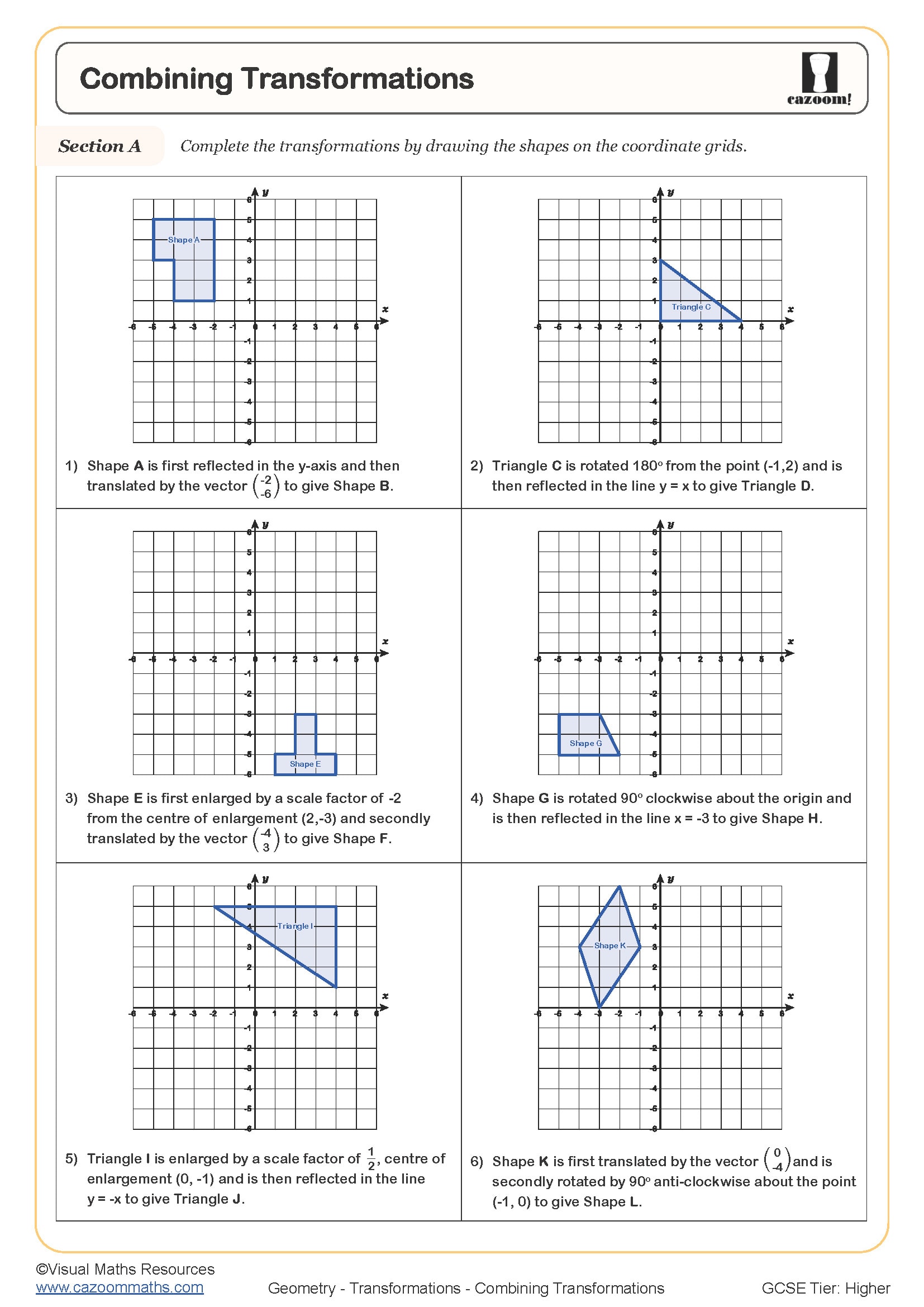
An effective combined transformations worksheet requires students to work with sequences of at least two transformations, progressing from straightforward combinations like translation then reflection to more demanding sequences involving rotations about different centres or enlargements with negative scale factors. Questions should include both describing transformations that have been performed and applying given sequences, mirroring the range of question types students encounter in GCSE papers.
Teachers frequently observe that students lose marks by describing transformations incompletely, particularly when writing 'reflection in the y-axis' without checking whether the mirror line is actually y = 0 or another horizontal line. The strongest worksheets require full geometric descriptions including centres of rotation with coordinates, scale factors with centres of enlargement, and precise equations for lines of reflection, reinforcing the exam specification that vague descriptions receive no credit.
Which year groups study combining transformations?
Combining transformations appears in the KS4 curriculum for Year 10 and Year 11 students following the Higher tier GCSE pathway. This topic typically follows secure understanding of individual transformations taught at KS3, where students learn to perform and describe single reflections, rotations, translations and enlargements. The National Curriculum expects Higher tier students to analyse transformation combinations systematically, recognising equivalent single transformations where applicable.
Across Year 10 and Year 11, the complexity increases as students encounter transformations involving fractional and negative scale factors alongside rotations about points other than the origin. By Year 11, exam-style questions often embed combined transformations within problem-solving contexts, asking students to determine whether particular sequences are commutative or to find missing transformation details when only the original and final positions are shown, requiring strong spatial reasoning and algebraic thinking.
How do rotations and reflections interact in combined transformations?
When combining rotations and reflections, the order matters significantly because these transformations are generally non-commutative. A reflection followed by a rotation produces a different result than the same rotation followed by the same reflection, which students discover through practical grid work. Teachers report that students benefit from colour-coding intermediate images when working through three or more transformations, creating a clear visual record of each step that makes error-checking systematic rather than guesswork.
This mathematical behaviour connects directly to crystallography and molecular symmetry in chemistry, where scientists analyse how crystal structures transform under different symmetry operations. Engineers designing robotic arms also apply transformation sequences to calculate precise movements in three-dimensional space, using matrix representations of rotations and reflections that GCSE students will encounter if they progress to A-level Further Maths. Understanding that transformation order affects outcomes prepares students for these STEM applications beyond the classroom.
How should teachers use these worksheets in lessons?
The worksheets work effectively as structured practice following teacher demonstration of transformation sequences, with the answer sheets enabling students to self-check their coordinate work immediately rather than waiting for teacher marking. Starting with questions where students describe transformations that have already been applied helps build the analytical skills needed before attempting to perform given sequences. Many teachers find that providing mini-whiteboards alongside the worksheets allows students to sketch intermediate steps before committing answers to paper, reducing anxiety about making mistakes.
These resources suit intervention sessions particularly well, as the complete worked solutions allow students who missed initial teaching to work independently through examples with support. For homework, the worksheets provide focused practice that doesn't overwhelm students with excessive question numbers, whilst paired work in lessons encourages mathematical discussion about why certain transformation sequences produce unexpected results. The PDF format means teachers can display selected questions under a visualiser when addressing common errors with the whole class.