Congruence Worksheets
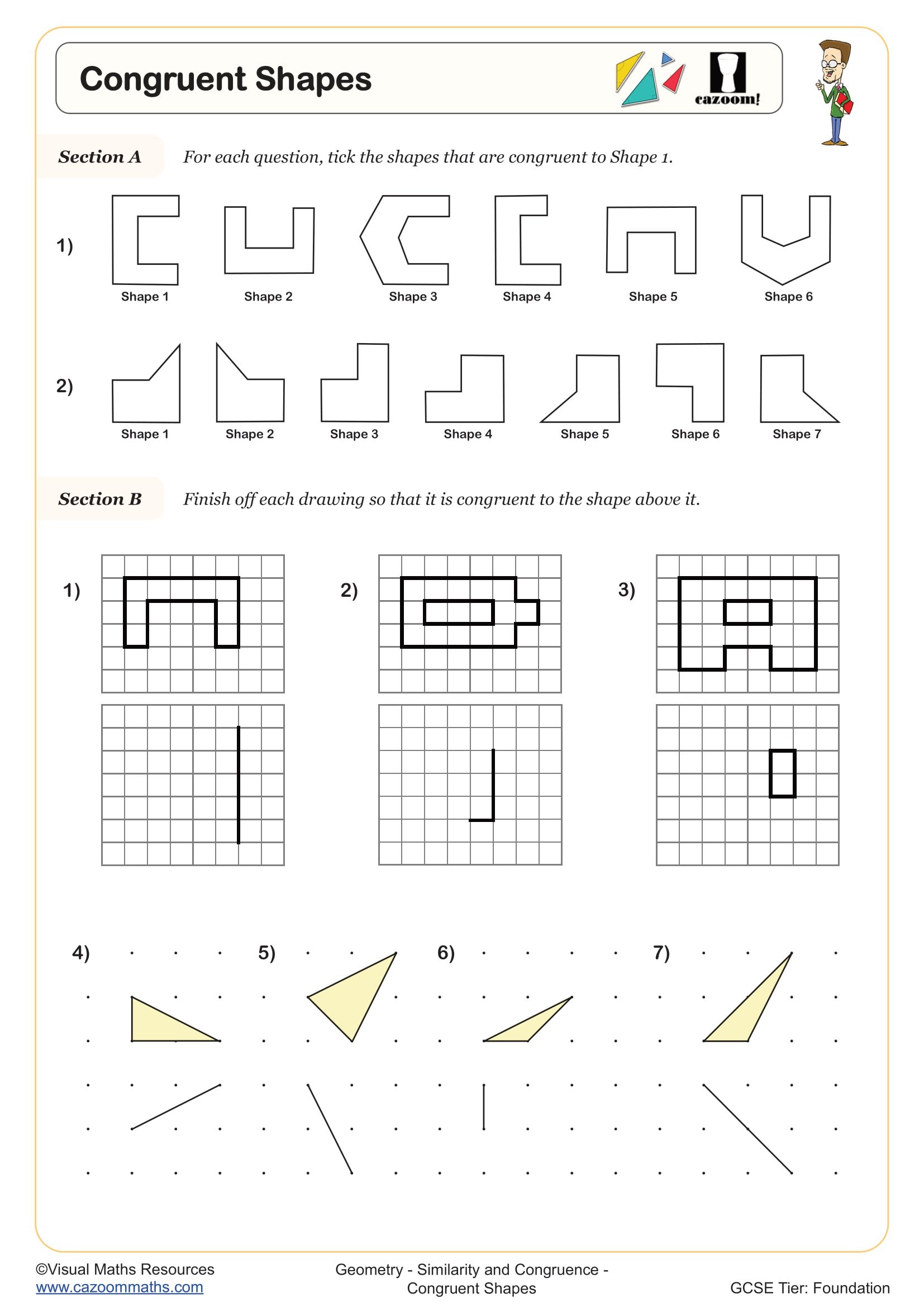
All worksheets are created by the team of experienced teachers at Cazoom Maths.
What are congruent shapes in maths?
Congruent shapes are identical in size and shape, meaning corresponding sides and angles are exactly equal. Two shapes are congruent if one can be mapped onto the other through transformations (translation, rotation, reflection) without any change in dimensions. This concept appears in the National Curriculum from Year 7 onwards, initially through identifying congruent shapes and progressing to formal proof methods at GCSE.
A common misconception is confusing congruence with similarity - students often think shapes are congruent when they're merely the same shape but different sizes. Teachers regularly observe students who correctly measure corresponding sides but fail to check that all pairs match, leading to incorrect conclusions. At GCSE, exam mark schemes specifically require students to demonstrate that all necessary conditions for congruence are met, not just that shapes 'look the same'.
Which year groups study congruence?
These congruent shapes worksheets cover Year 7, Year 8, Year 9, and Year 10, spanning both KS3 and KS4. Congruence first appears in Year 7 as recognising and describing congruent shapes through informal comparison, building on primary understanding of identical shapes. Students develop their geometric vocabulary and begin connecting congruence to transformations.
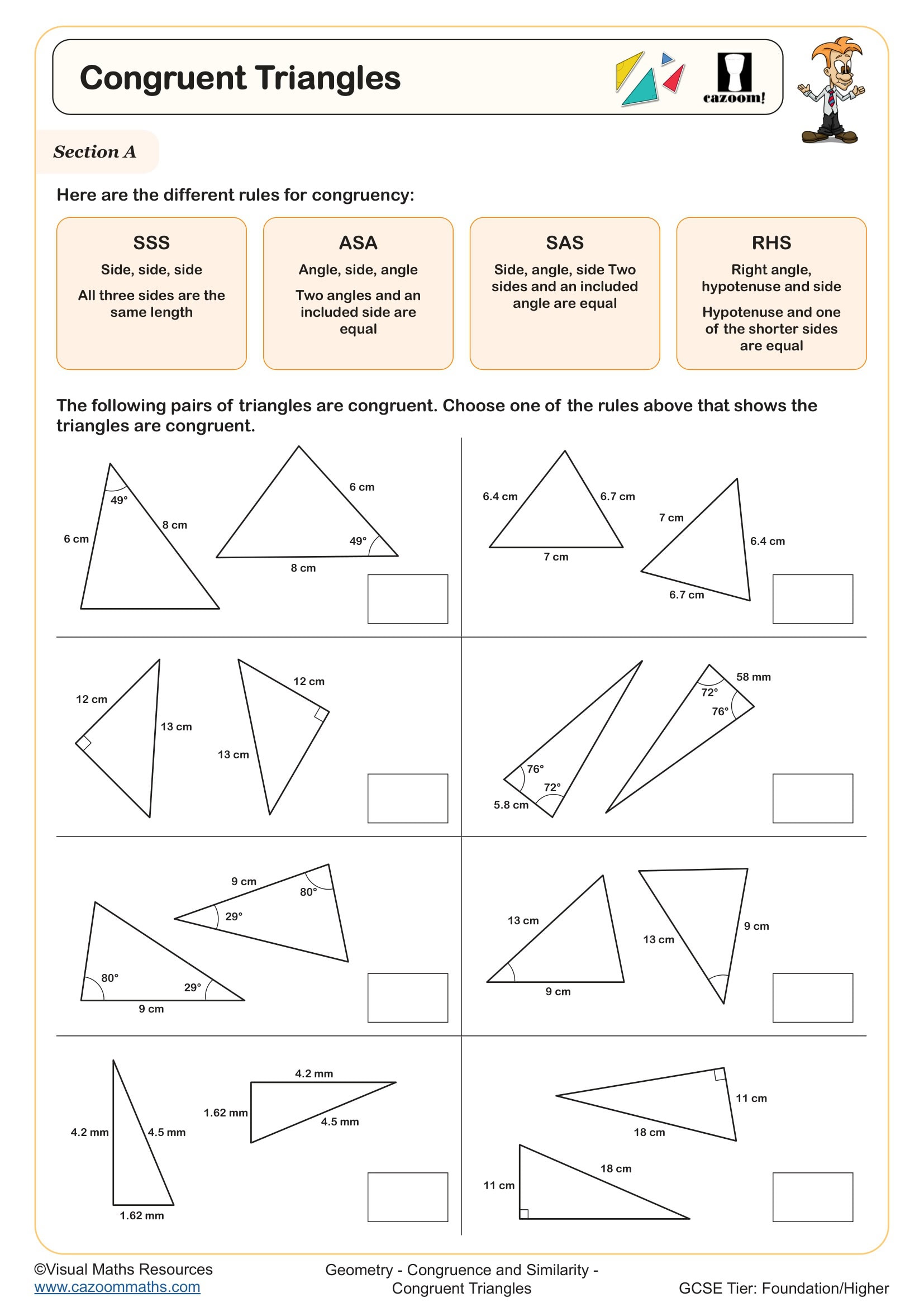
Progression involves increasing formality and rigour. Year 8 and 9 students work with congruence criteria for triangles (SSS, SAS, ASA, RHS), whilst Year 10 students apply congruence in geometric proof and problem-solving contexts. Teachers notice the jump from identifying congruent shapes visually to justifying congruence mathematically challenges many students, particularly when working with shapes in non-standard orientations or when determining whether given information is sufficient to prove congruence.
What are the four congruence conditions for triangles?
The four triangle congruence conditions are SSS (three sides equal), SAS (two sides and the included angle), ASA (two angles and the included side), and RHS (right angle, hypotenuse, and one other side). These criteria establish when two triangles must be congruent without checking all six measurements. Students must understand that the order matters - having two sides and any angle (not the included angle) doesn't guarantee congruence, a subtlety that frequently causes errors.
These congruence conditions underpin structural engineering and computer graphics. When engineers design trusses for bridges or buildings, they rely on triangle congruence to ensure identical components will fit precisely. In CAD software and 3D modelling, algorithms use congruence criteria to verify that manufactured parts match specifications exactly. Students who grasp these conditions develop spatial reasoning skills applicable across STEM fields, from architecture to robotics, where precise replication of geometric components is essential.
How do these congruence worksheets help students learn?
The worksheets progress from visual identification of congruent shapes through to applying formal congruence criteria, building confidence systematically. Questions include measuring corresponding sides and angles, determining which transformations map one shape onto another, and deciding whether given information proves congruence. Answer sheets allow students to check their reasoning immediately, helping them identify whether errors stem from measurement, transformation understanding, or logical application of criteria.
Teachers use these resources flexibly across different settings. They work well for paired discussion activities where students must justify their congruence decisions to a partner, strengthening mathematical reasoning. The worksheets suit intervention sessions for students who confuse congruence with similarity, and serve as effective homework to consolidate classroom teaching on transformations. Many teachers find them valuable before introducing formal geometric proof, as confident identification of congruence provides the foundation for writing rigorous mathematical arguments at GCSE.