Cylinders and Spheres Worksheets
All worksheets are created by the team of experienced teachers at Cazoom Maths.
What formulas do students need for cylinders and spheres?
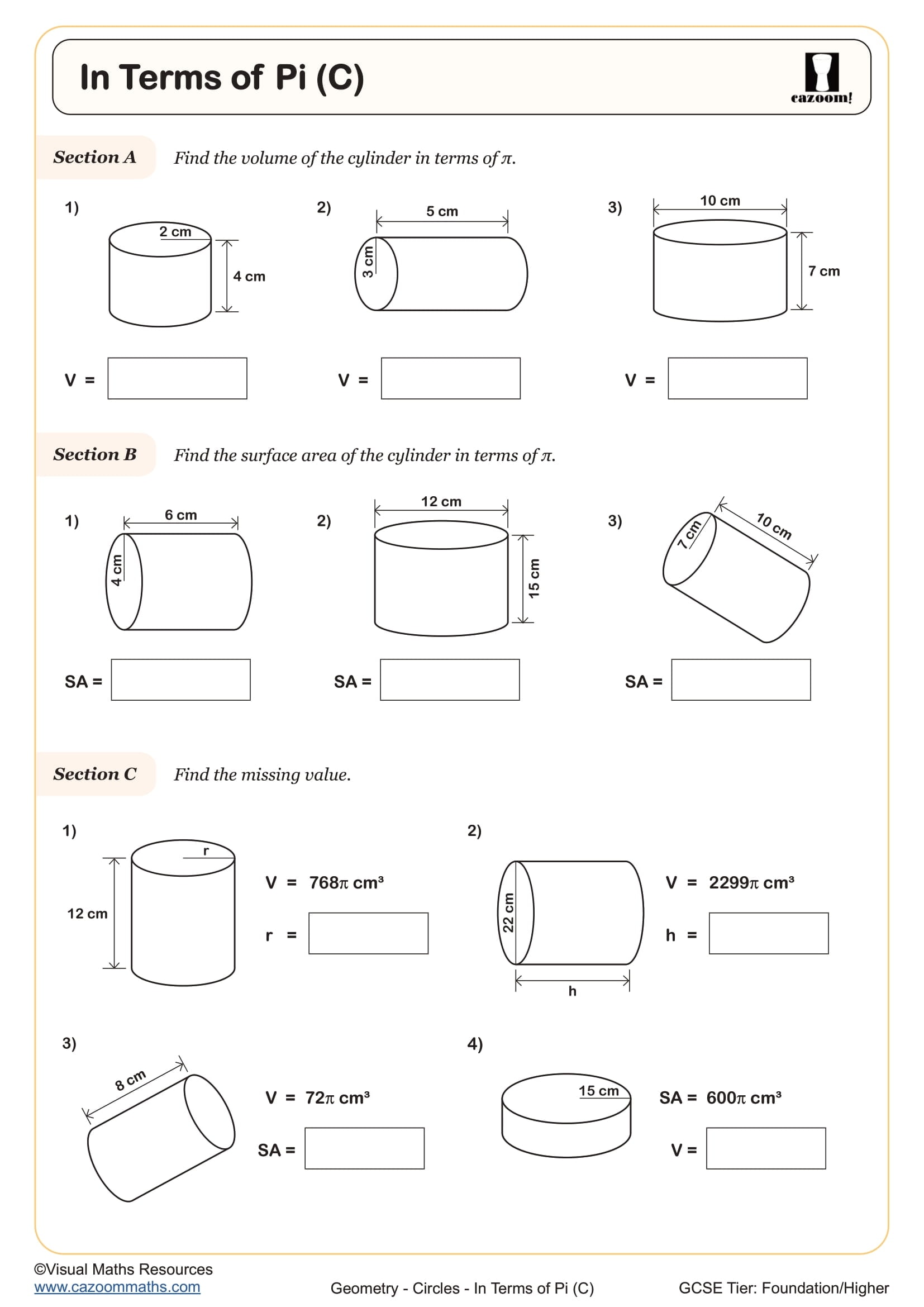
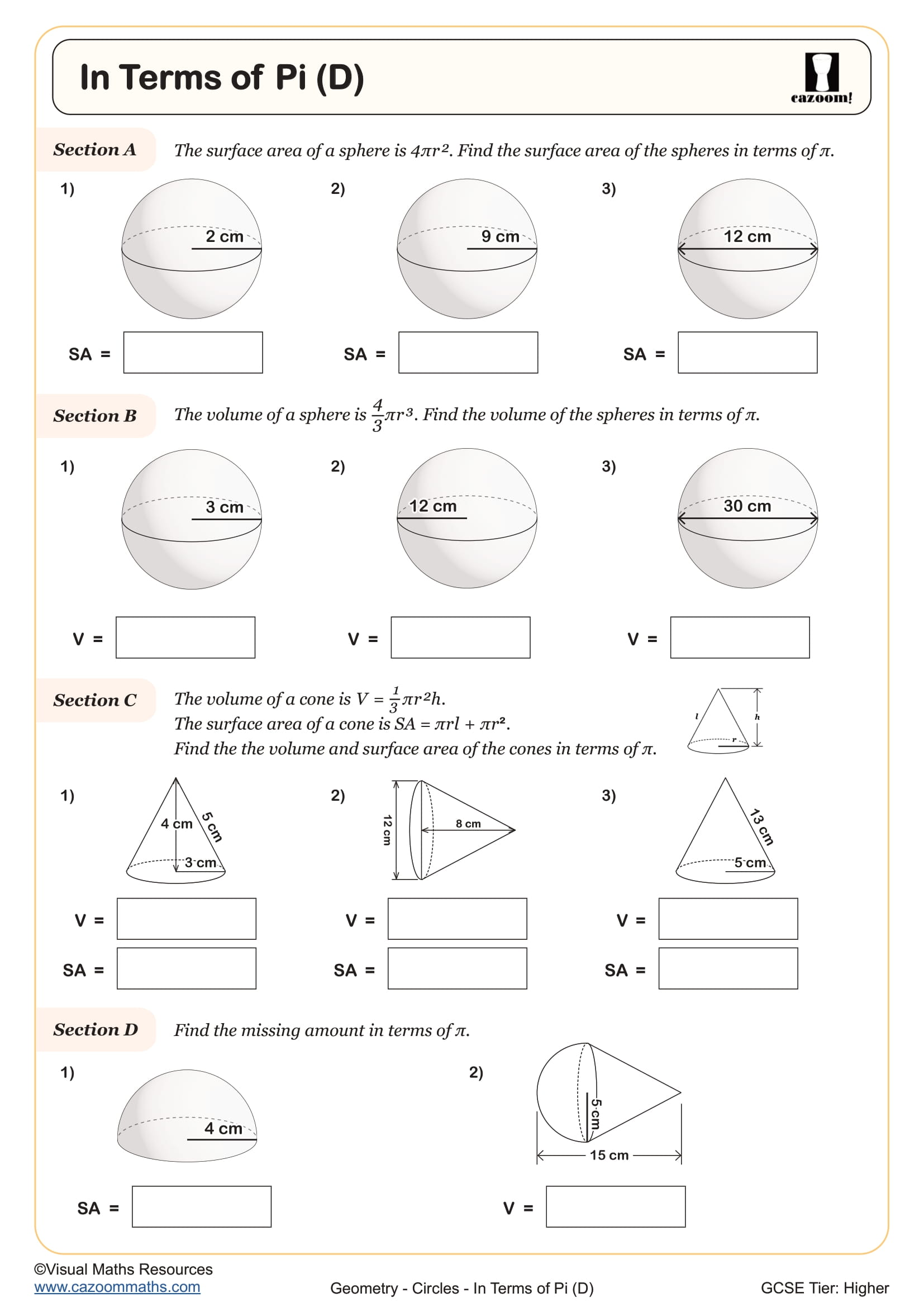
For cylinders, students use volume = πr²h and curved surface area = 2πrh, plus 2πr² for the two circular ends if calculating total surface area. For spheres, they need volume = 4/3πr³ and surface area = 4πr². These appear on GCSE formula sheets, but students still need to recognise which formula applies to each question and manipulate them confidently, particularly when working backwards from a given volume to find radius.
Exam mark schemes penalise students who substitute incorrectly, such as using diameter instead of radius or confusing height with radius in cylinder problems. A common error involves calculating πr²h correctly but then doubling it unnecessarily, thinking they need to account for both ends. Students also lose marks when they round too early in multi-step problems rather than keeping π in their working until the final answer.
Which year groups study cylinders and spheres?
These worksheets cover Years 9, 10, and 11, spanning both Key Stage 3 and Key Stage 4. Students typically meet cylinders in Year 9 as an extension of circle work, then encounter spheres and hemispheres in Year 10 when tackling more complex 3D geometry. By Year 11, these shapes appear in problem-solving contexts and combined with other topics such as ratio, density, or reverse percentage calculations for GCSE preparation.
The progression builds from straightforward substitution into formulas with integer or simple decimal values, through to problems requiring algebraic manipulation, such as finding radius when given volume, or comparing volumes of different shapes. Higher-tier students work with spheres inscribed in cylinders or hemispheres combined with cones, requiring them to visualise composite solids and break calculations into manageable steps.
Why is the sphere volume formula 4/3πr³?
The formula 4/3πr³ for sphere volume derives from calculus, specifically by rotating a semicircle around its diameter and integrating. Whilst secondary students don't prove this formula, understanding that it relates to the circular cross-sections through the sphere helps them remember it's a cubic measure (radius cubed) like all volumes. The 4/3 coefficient distinguishes it from cylinder volume, where the formula involves r² multiplied by height.
Spheres appear throughout STEM contexts, from calculating the volume of ball bearings in engineering to determining medication dosages based on spherical capsule volumes in pharmaceuticals. In physics, students use sphere surface area when calculating heat loss from spherical objects or radiation from stars. Meteorology uses these calculations to estimate raindrop volumes, whilst manufacturing relies on sphere geometry for everything from ball bearing production to designing storage tanks that minimise surface area for a given volume, reducing material costs.
How do these worksheets help students practise effectively?
The worksheets include carefully structured questions that build from substitution practice through to multi-step problems requiring students to select appropriate formulas and interpret their results. Students work with diagrams showing dimensions clearly marked, helping them identify radius versus diameter and recognise when they're calculating volume or surface area. The answer sheets show final answers, allowing students to identify calculation errors and revisit their formula application if their answer doesn't match.
Teachers often use these worksheets for targeted intervention with students who struggle to remember which formula applies to which measurement, or for homework following lessons introducing these shapes. They work well as timed practice sessions before assessments, helping students build speed and accuracy with formula substitution. Some teachers assign different questions to pairs of students, then have them compare methods, which highlights where misconceptions about radius, diameter, or formula selection occur and allows peer discussion to address these gaps.