Density Worksheets
All worksheets are created by the team of experienced teachers at Cazoom Maths.
What is the formula for calculating density?
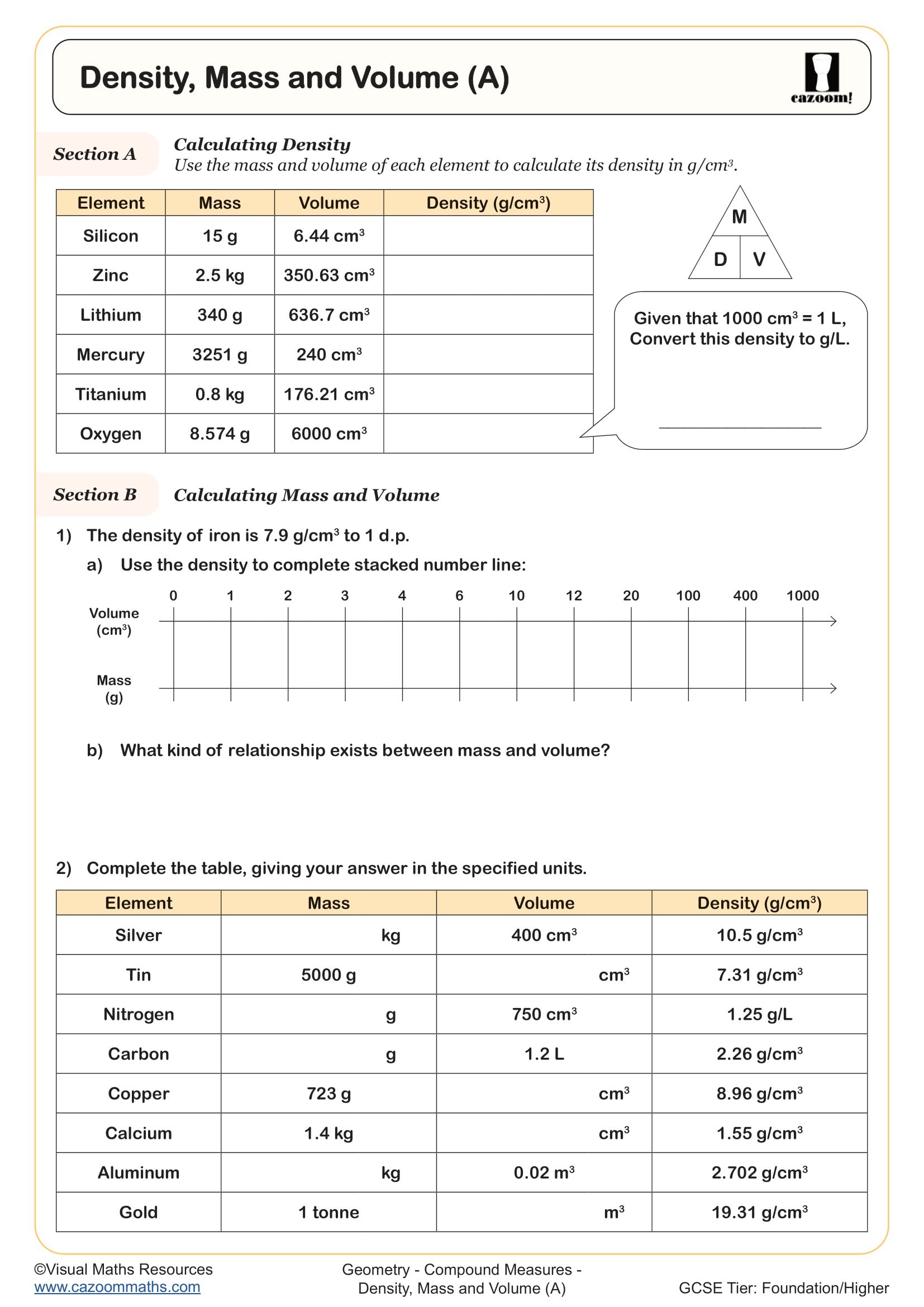
The density formula is density = mass ÷ volume, often written as D = M/V or ρ = m/V in higher-level work. Students need to understand that density measures how much mass is packed into a given volume, with common units being g/cm³ for solids and kg/m³ for larger objects. This formula appears in both Science and Maths GCSEs, where students must select and apply it appropriately.
A common error occurs when students attempt to multiply mass and volume instead of dividing, or forget to convert units before calculating. Exam mark schemes frequently penalise missing or incorrect units, and students lose marks when they round too early in multi-step problems. The worksheets provide structured practice in rearranging the formula triangle to find any of the three values, which strengthens algebraic manipulation skills alongside the scientific concept.
Which year groups study density in maths?
Density appears in the curriculum for Year 9, Year 10 and Year 11, bridging KS3 and KS4 Mathematics and Science. At KS3, students typically encounter density through volume calculations and simple substitution into the formula, often linked to measures and compound units. This foundational work prepares students for the more demanding problem-solving required at GCSE level.
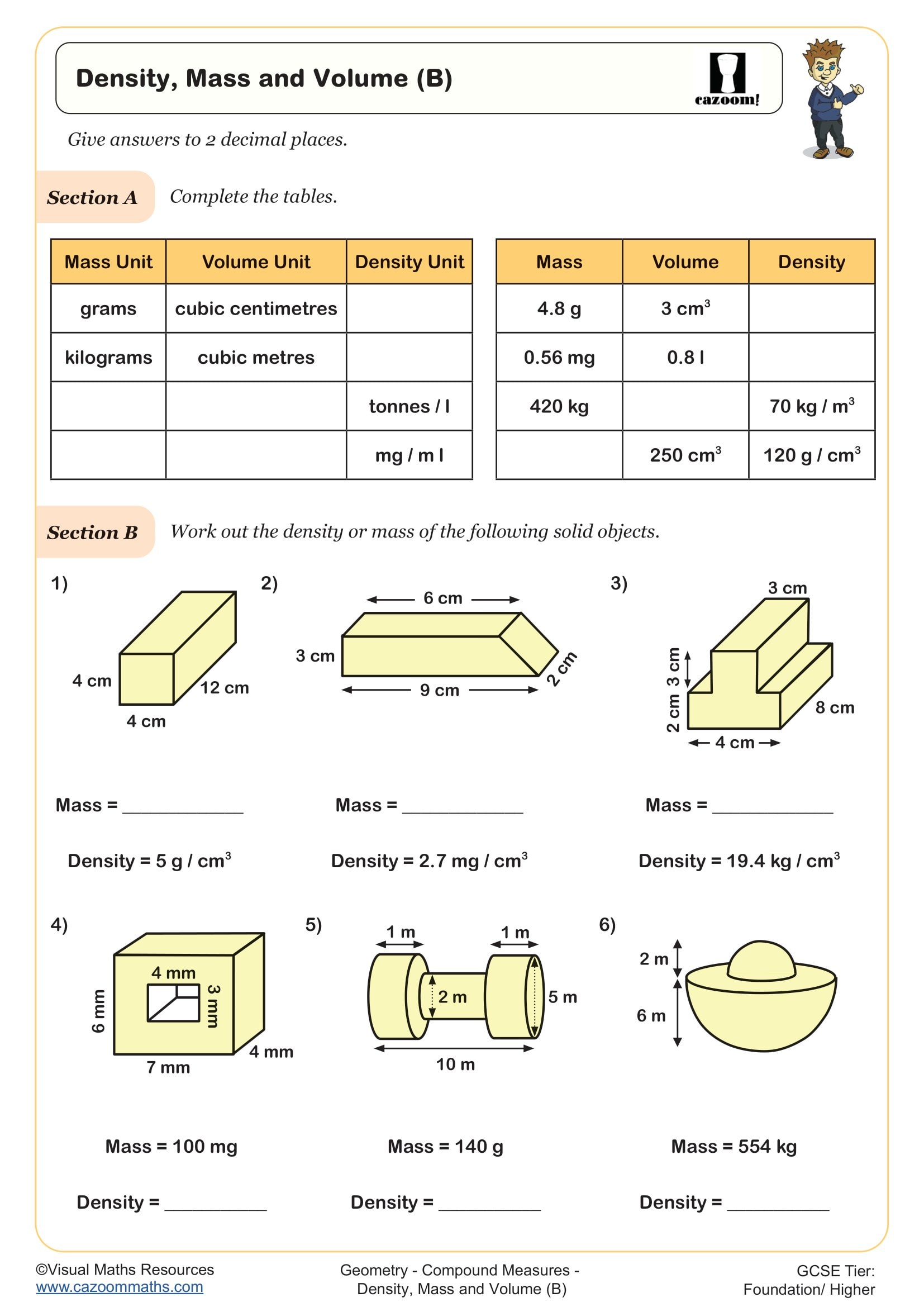
The progression across year groups builds complexity through the shapes involved and the number of calculation steps. Year 9 students generally work with regular 3D shapes where volume formulas are straightforward, whilst Year 10 and 11 tackle composite solids, mixtures of materials with different densities, and problems requiring algebraic rearrangement before numerical calculation. Higher tier GCSE questions may combine density with ratio, proportion or problem-solving in unfamiliar contexts that test conceptual understanding rather than just formula recall.
How do you calculate the density of mixtures?
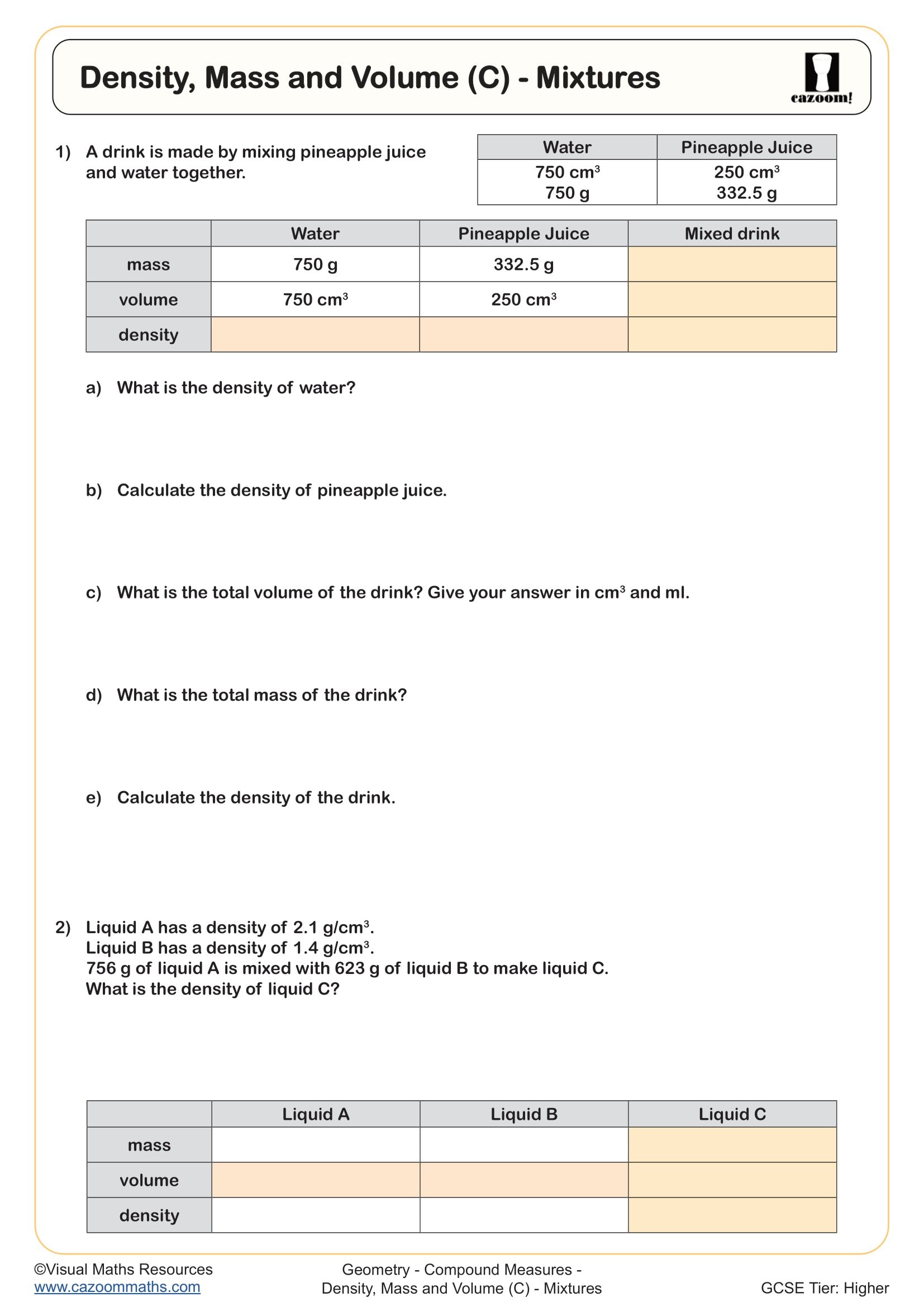
Calculating the density of mixtures requires finding the total mass and total volume of all components, then dividing total mass by total volume. Students must recognise that you cannot simply average the individual densities, which is a frequent misconception. Instead, they need to work with the absolute quantities: if object A has mass 200g and volume 50cm³, and object B has mass 300g and volume 100cm³, the mixture density is 500g ÷ 150cm³ = 3.33 g/cm³.
This skill connects directly to materials science and engineering, where manufacturers must predict the properties of alloys, composite materials and concrete mixtures. Aerospace engineers calculate the density of fuel mixtures to optimise aircraft performance, whilst construction professionals determine whether materials will float or sink in different conditions. Understanding mixture density also underpins environmental science calculations, such as determining whether oil spills will float on seawater or how pollutants disperse through different density layers in the atmosphere.
How can these density worksheets be used in lessons?
The worksheets provide structured progression from basic formula substitution through to complex problem-solving, with questions arranged in order of difficulty. Answer sheets show complete working, making them suitable for self-assessment or peer marking, which helps students identify where their method differs from the expected approach. Teachers can use individual questions as worked examples on the board, demonstrating the systematic method that examiners reward.
Many teachers deploy these resources for intervention sessions with students who struggle with Science calculations, as the mathematical approach clarifies the underlying structure. They work effectively as homework to consolidate lessons on volume or measures, and pairs of students benefit from discussing which formula rearrangement applies to each question type. The worksheets also serve as focused revision material before GCSE mock exams, particularly for students targeting grade boundaries where calculation accuracy makes the difference between grades.