Describing Transformations Worksheets
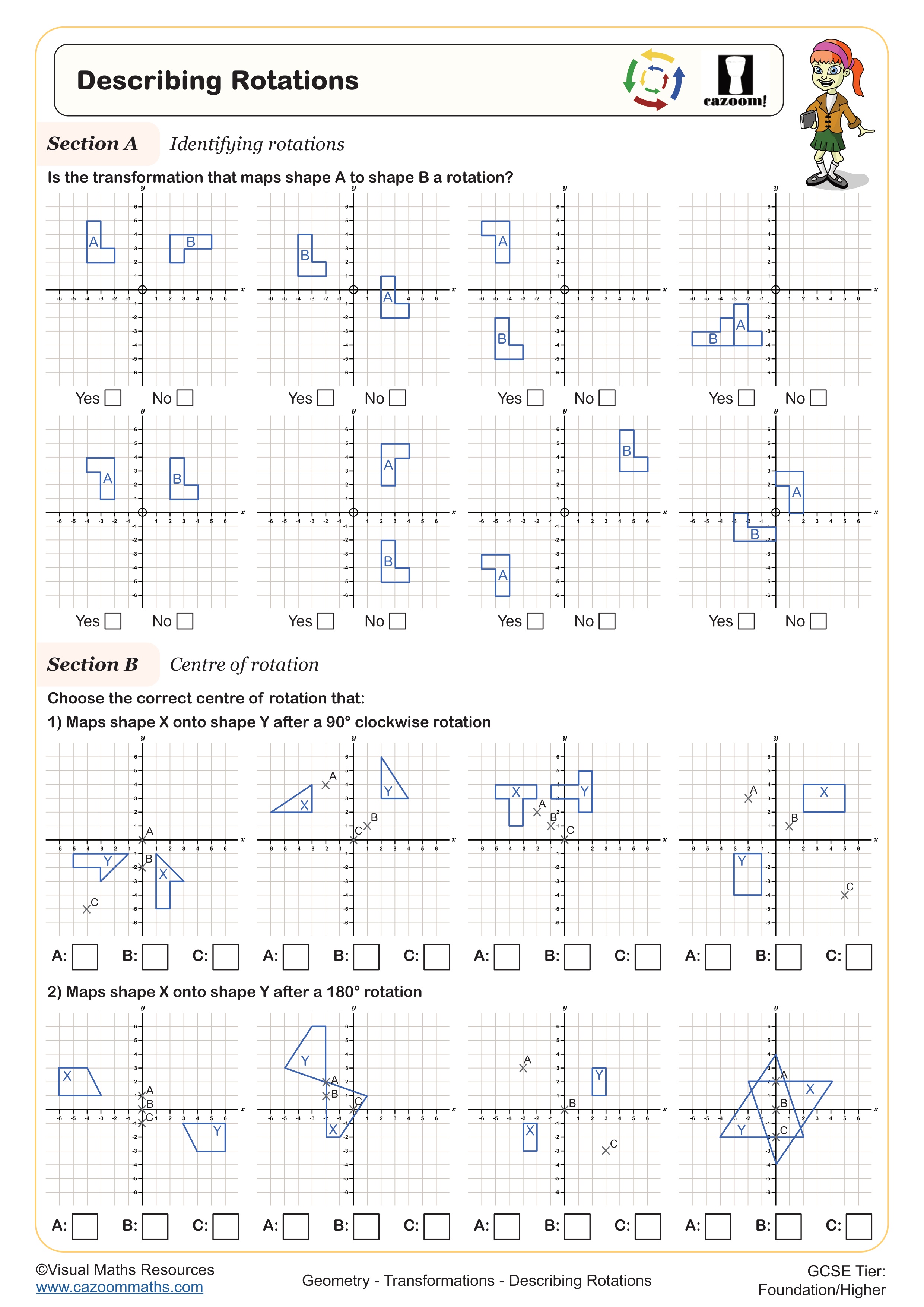
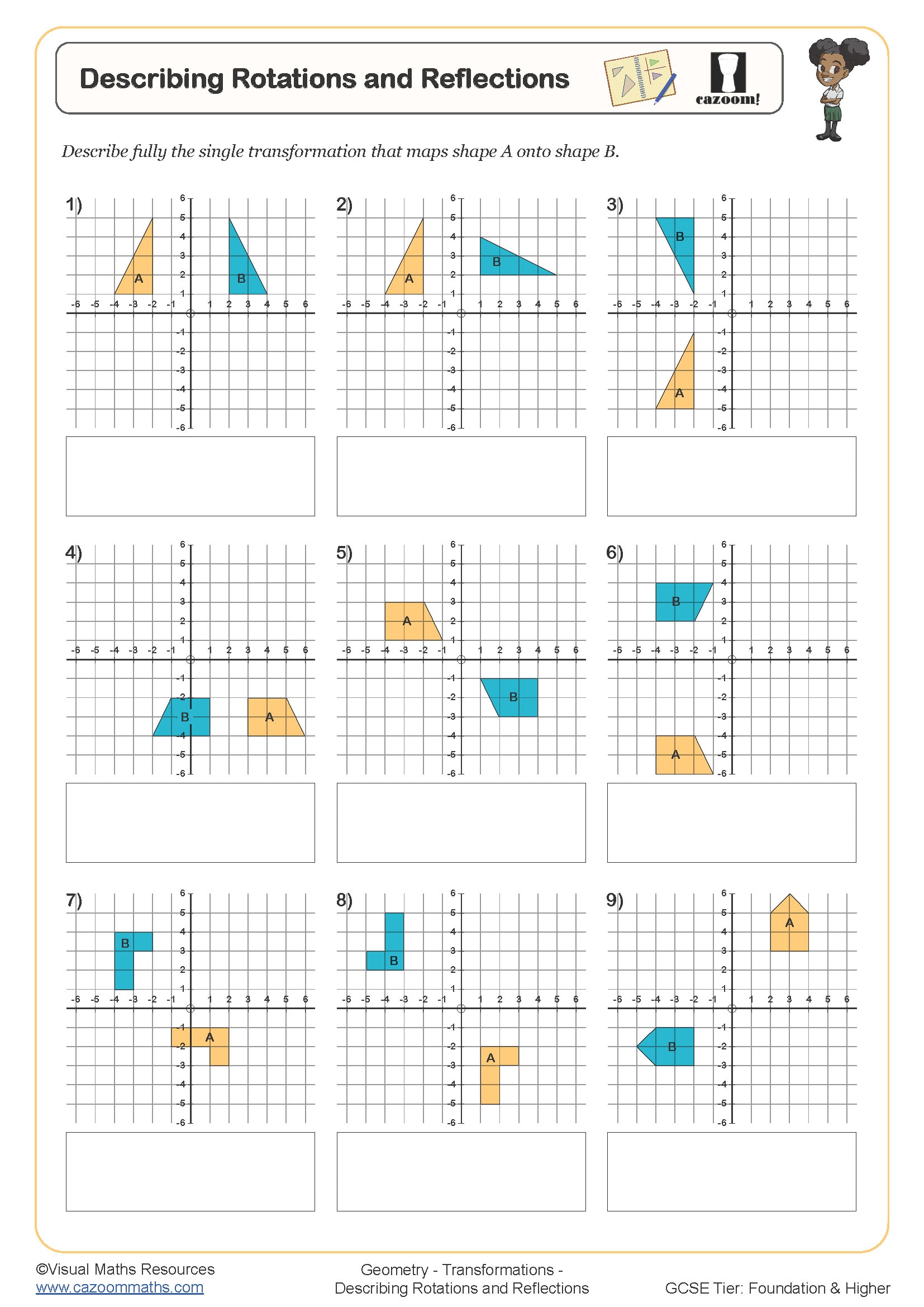
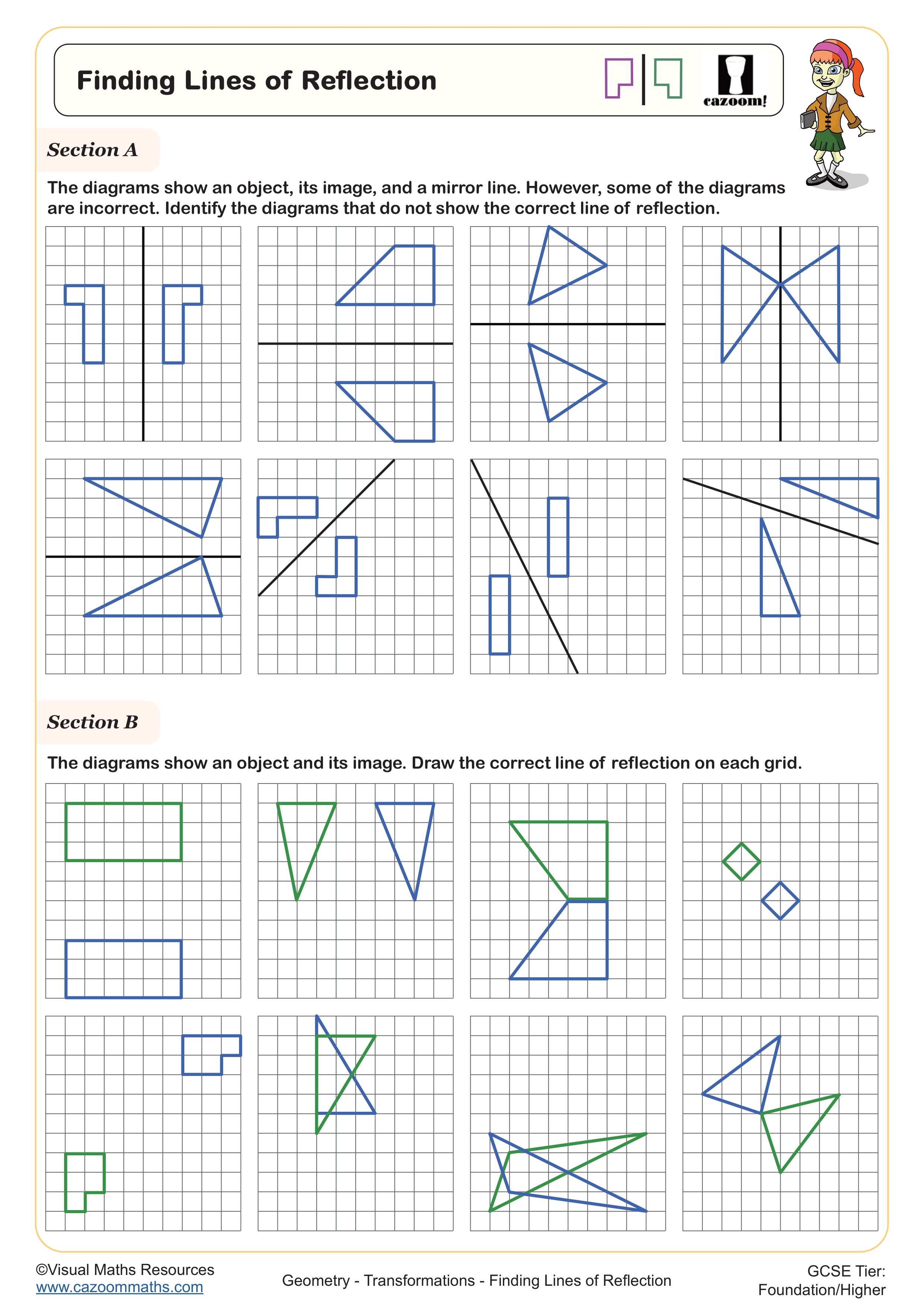
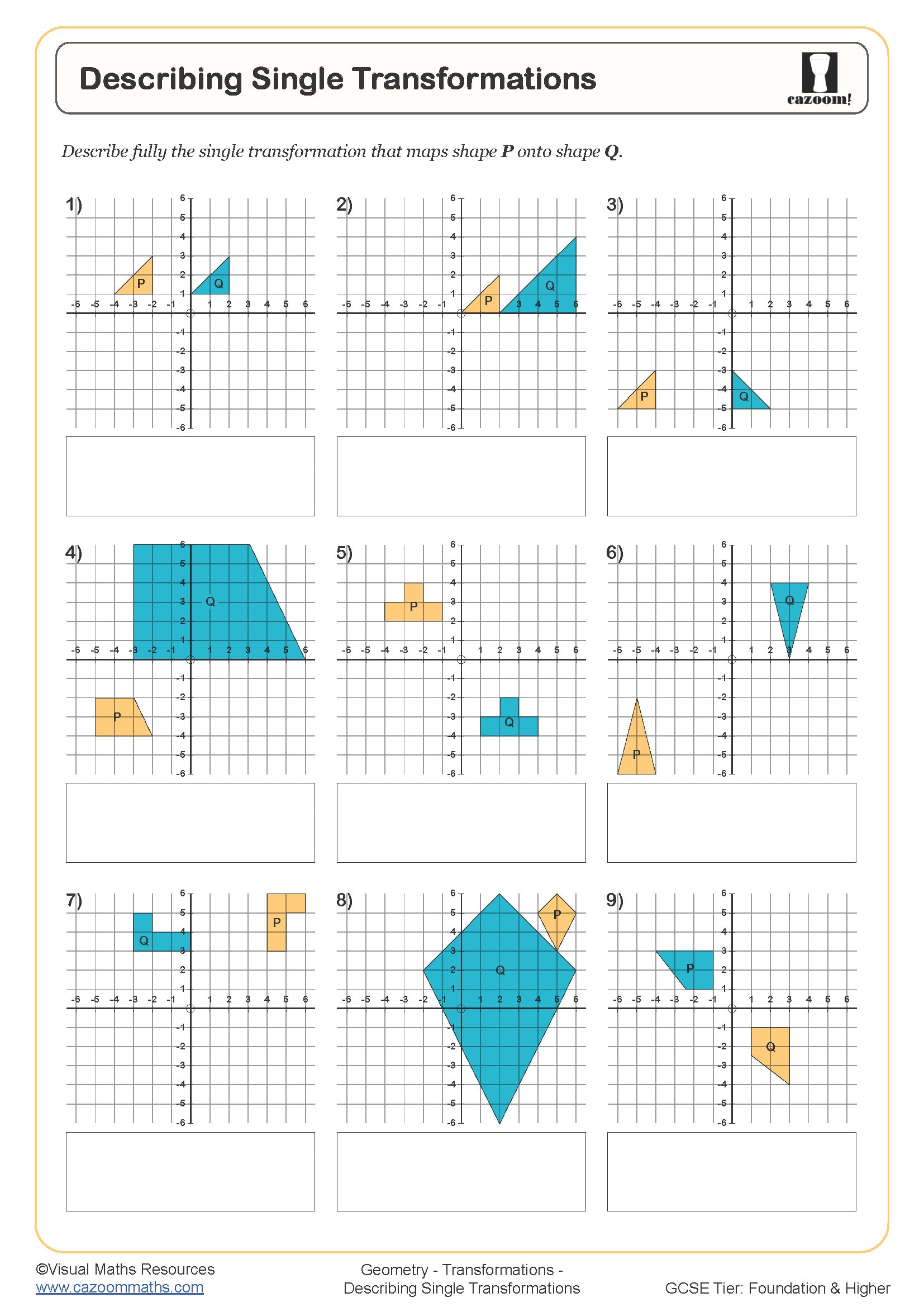
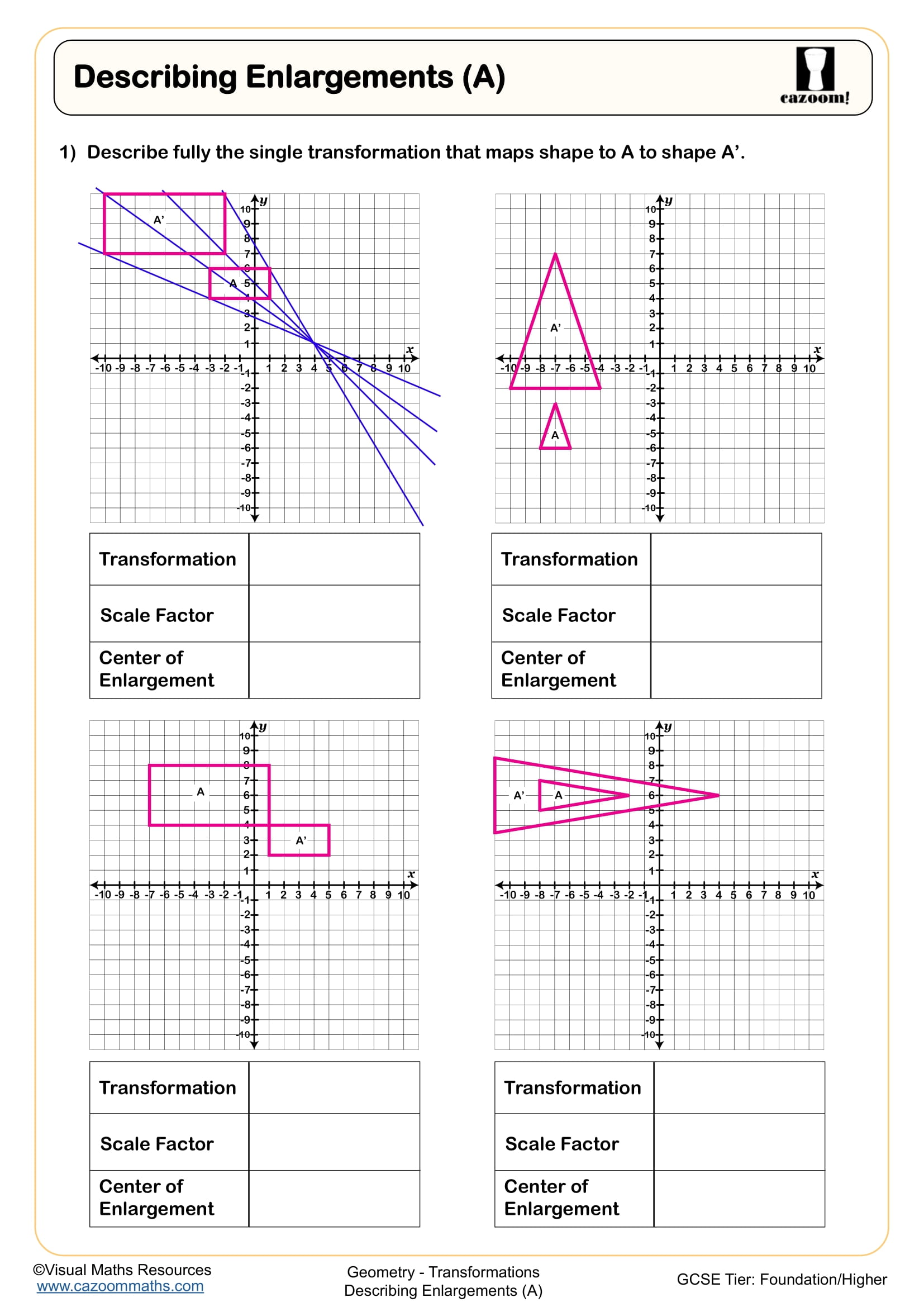
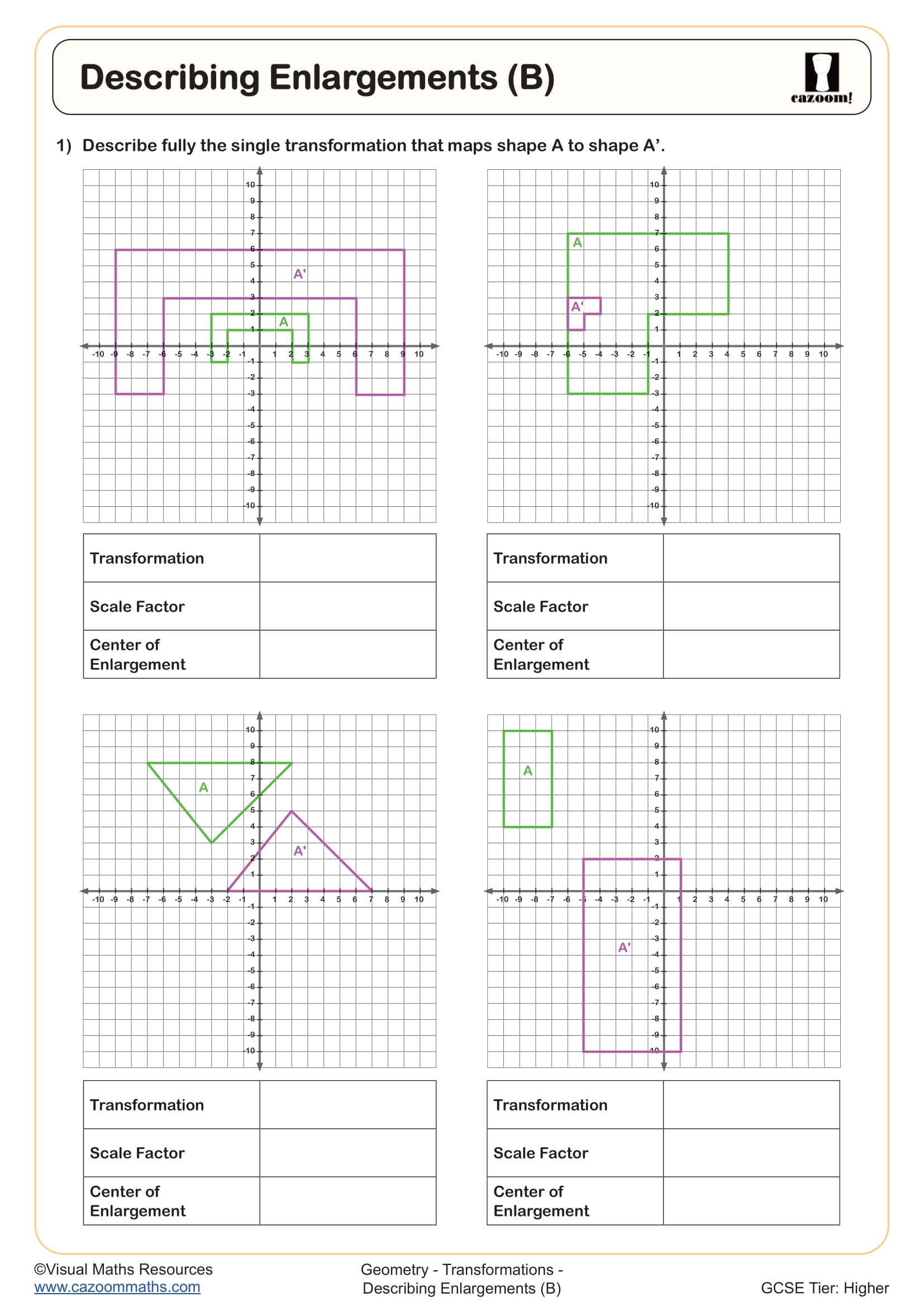
All worksheets are created by the team of experienced teachers at Cazoom Maths.
What are the key elements students must include when describing transformations?
When describing transformations, students must identify the type of transformation and provide all specific details required for each. For translations, this means stating the column vector; for reflections, the equation of the mirror line; for rotations, the centre, angle, and direction; and for enlargements, the scale factor and centre. This forms part of the KS3 and KS4 geometry curriculum and appears regularly in GCSE exams.
Exam mark schemes are particularly strict about complete descriptions. Students frequently lose marks by stating 'rotation 90 degrees' without specifying the centre point or direction, or by writing 'reflection' without identifying the mirror line. Many teachers find that students who can perform transformations confidently still omit crucial details when describing them, making targeted practice with these worksheets valuable for bridging this gap.
Which year groups study describing transformations?
These worksheets cover Years 9, 10, and 11, spanning both KS3 and KS4. The National Curriculum introduces transformations in KS3, where students learn to describe translations, reflections, and rotations on coordinate grids. By KS4, expectations increase to include combined transformations and more complex scenarios involving enlargements with fractional or negative scale factors.
Progression across these year groups moves from describing single transformations with clear visual cues to identifying transformations from before-and-after coordinates alone. Year 11 students encounter exam questions where they must work backwards, determining transformation details from limited information or describing sequences of transformations. This increasing complexity requires students to develop both geometric intuition and precise mathematical vocabulary simultaneously.
How do students identify the centre of rotation accurately?
Finding the centre of rotation requires students to identify the invariant point around which the shape turns. The most reliable method involves drawing perpendicular bisectors of lines connecting corresponding points on the original and rotated shapes. Where these bisectors intersect marks the centre of rotation. Students can verify this by tracing the original shape on transparent paper and checking the rotation pivots correctly around this point.
This skill connects directly to computer graphics and animation, where rotation transformations form the foundation of 2D and 3D modelling. Game developers and graphic designers use rotation matrices based on precisely defined centres, making this mathematical concept essential for careers in digital media and software engineering. Understanding rotation centres also appears in mechanical engineering, where gears and rotating components must be designed with exact pivot points for proper function.
How can teachers use these worksheets most effectively?
These worksheets work particularly well for consolidating understanding after initial teaching, as they require students to apply knowledge rather than simply follow procedures. The scaffolded approach typically starts with clearly marked grids and distinct transformations before progressing to more challenging scenarios. Having answer sheets allows teachers to use them for peer assessment or self-checking, encouraging students to identify where their descriptions might be incomplete.
Many teachers deploy these resources during intervention sessions with students approaching GCSE retakes, as describing transformations questions often determine grade boundaries. They're equally effective as homework following classwork on transformations, or as starter activities to maintain skills between units. Paired work proves valuable here, with one student describing a transformation while their partner attempts to recreate it, revealing immediately whether the description contains sufficient detail.