Drawing and Measuring Angles Worksheets
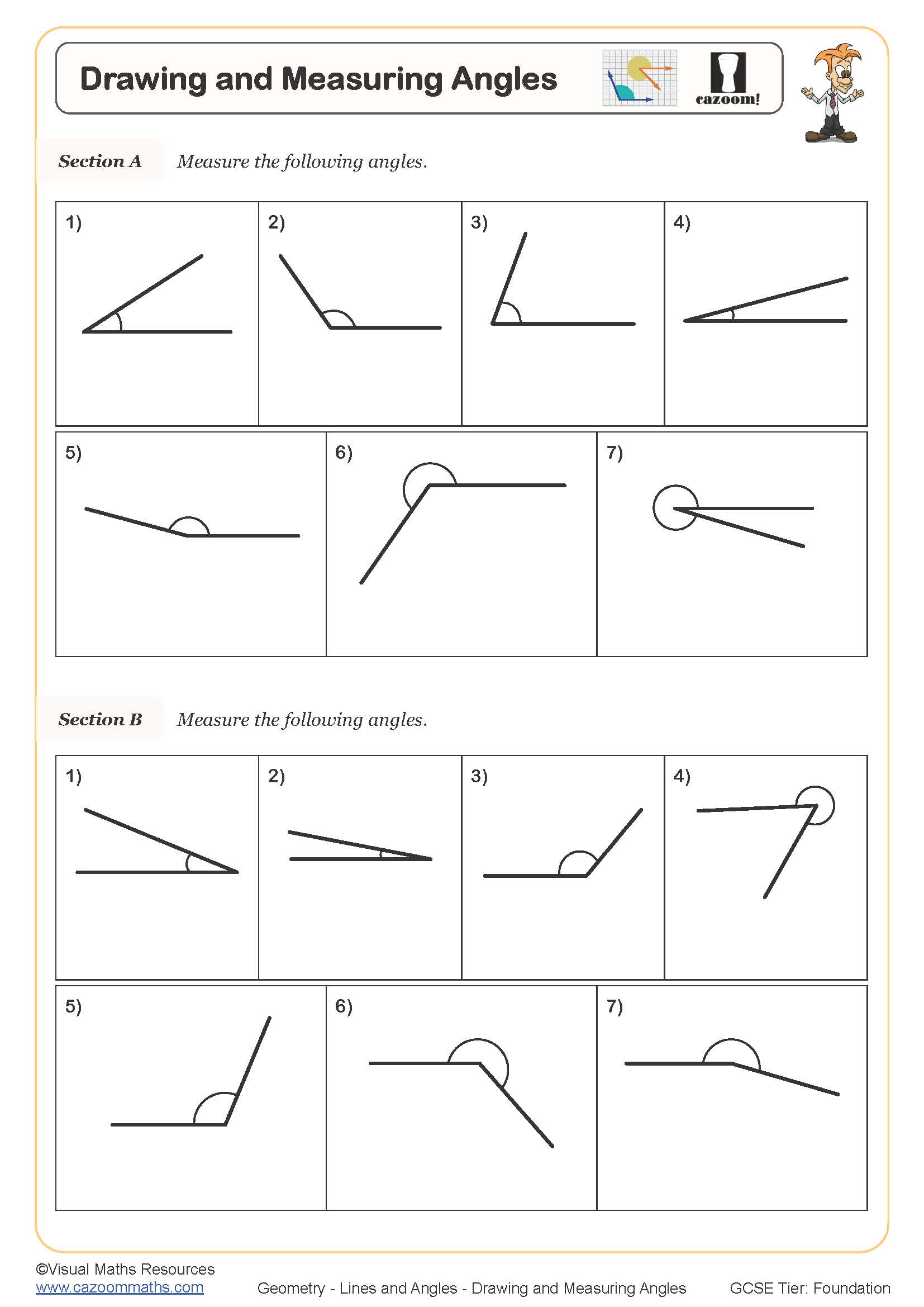
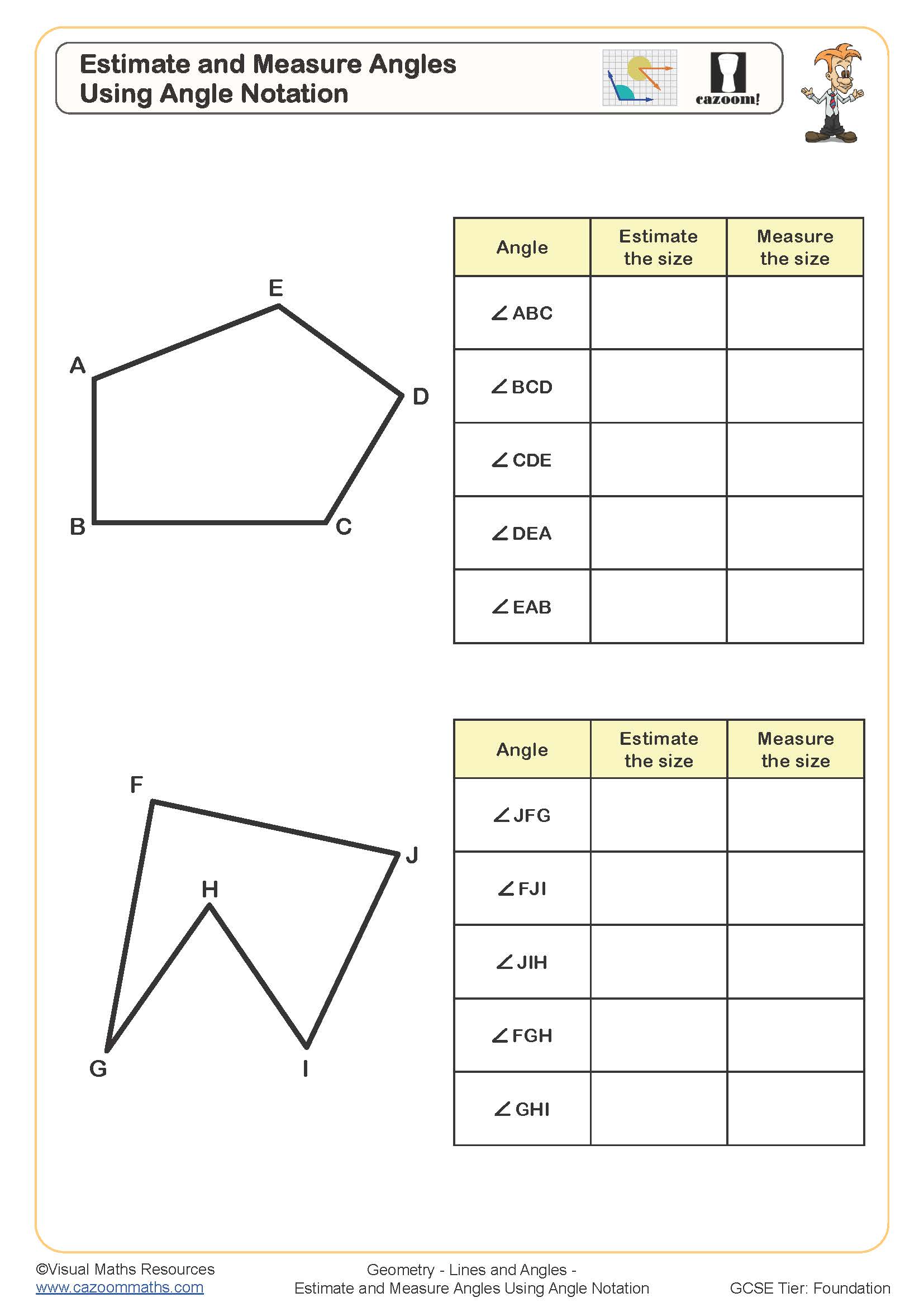
All worksheets are created by the team of experienced teachers at Cazoom Maths.
What Are the Common Mistakes When Drawing and Measuring Angles?
The most persistent error occurs when students place the protractor's baseline along the wrong arm of the angle or fail to align the centre mark with the vertex. Many students also read the inner scale when they should read the outer scale, or vice versa, leading to angles that are 'mirror images' of the correct measurement (for example, reading 120° as 60°).
When drawing angles, students often forget to mark the angle clearly or draw lines that are too short to measure accurately. Exam mark schemes explicitly penalise measurements that are more than 2° out, so precision matters. Teachers find that having students estimate first (Is this acute or obtuse? Is it close to 90° or closer to 45°?) reduces careless errors and helps catch wrong-scale readings before they record an answer.
Which Year Groups Cover Drawing and Measuring Angles?
These worksheets support Year 7 and Year 8 students working within the KS3 National Curriculum geometry strand. The skill is introduced in Year 7, where students learn to measure and draw angles using a protractor, working initially with acute, obtuse, and right angles before progressing to reflex angles.
By Year 8, the focus shifts towards applying these skills in more complex contexts. Students measure and construct angles within polygons, parallel line diagrams, and bearings problems. The worksheets reflect this progression, with Year 7 materials concentrating on accurate protractor technique and Year 8 tasks embedding angle measurement within multi-step geometric problems that prepare students for GCSE.
How Do You Measure a Reflex Angle?
A reflex angle measures between 180° and 360°, so it cannot be measured directly with a standard 180° protractor. Instead, students measure the acute or obtuse angle on the 'inside' and subtract that measurement from 360°. For example, if the smaller angle measures 85°, the reflex angle is 360° - 85° = 275°.
This skill connects directly to navigation and engineering. Ships and aircraft use bearing systems where angles are measured clockwise from north, often requiring reflex angle calculations. Construction workers and architects use reflex angles when designing curved structures or determining angles of rotation for machinery. Understanding that a full turn equals 360° and being able to partition this into component angles is fundamental to these professional applications.
How Do These Worksheets Help Students Improve Their Protractor Skills?
The worksheets provide repeated practice with clear diagrams where students must position the protractor correctly and choose the appropriate scale. Each question requires students to apply the same systematic approach: align the centre, position the baseline, and read the correct scale. This repetition builds the muscle memory and procedural fluency that many students lack when they only measure angles occasionally.
Teachers use these worksheets for targeted intervention with students who consistently lose marks on construction tasks in assessments. They work well as homework because the answer sheets allow students to identify their own errors and self-correct. In paired work, one student can draw an angle while their partner measures it, creating immediate feedback and discussion about accuracy. The worksheets also suit cover lessons, as the task is self-contained and doesn't require teacher demonstration once students know the basic technique.