Enlargement Worksheets
Enlargement (A)
Year groups: 8, 9
-Worksheet.jpg?w=3840)
Enlargement (B)
Year groups: 8, 9
-Worksheet.jpg?w=3840)
Enlargement (C)
Year groups: 10, 11
-Worksheet.jpg?w=3840)
Enlargement with Fractional Negative Scale Factors
Year groups: 10, 11
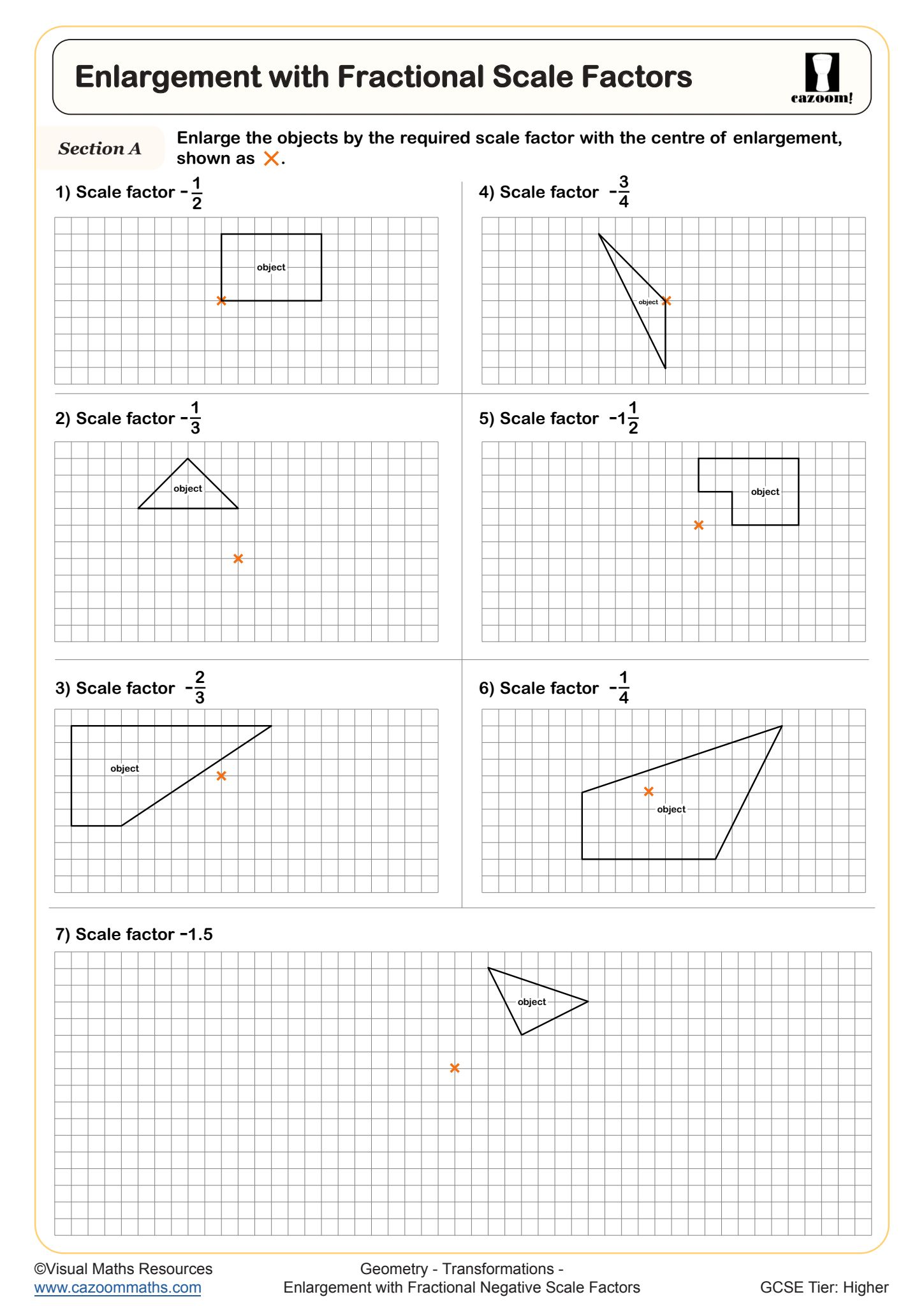
Enlargement with Fractional Scale Factors (A)
Year groups: 10, 11
-Worksheet.jpg?w=3840)
Enlargement with Fractional Scale Factors (B)
Year groups: 10, 11
-Worksheet.jpg?w=3840)
Enlargement with Negative Scale Factors
Year groups: 10, 11
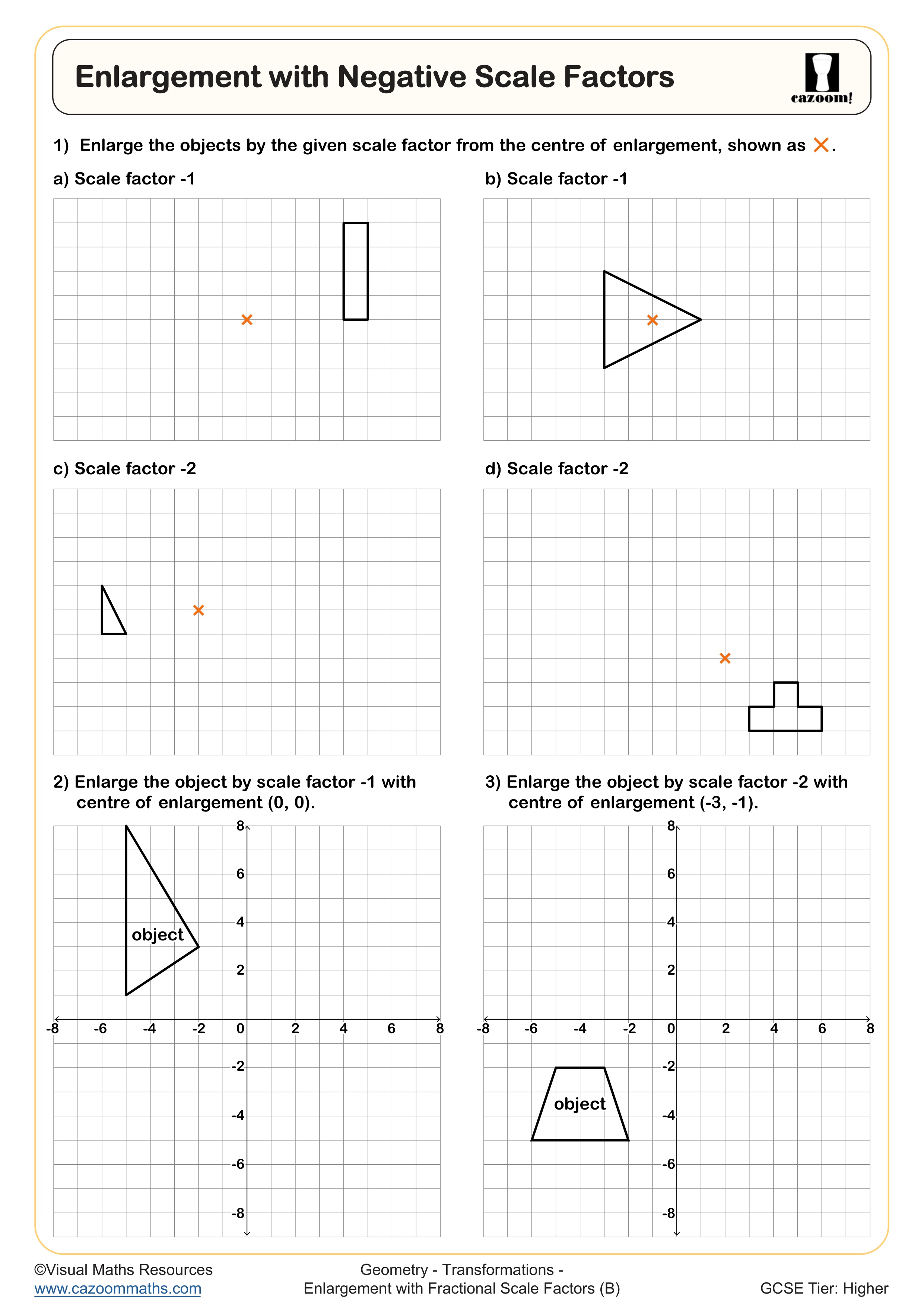
Enlargements on Axes
Year groups: 10, 11
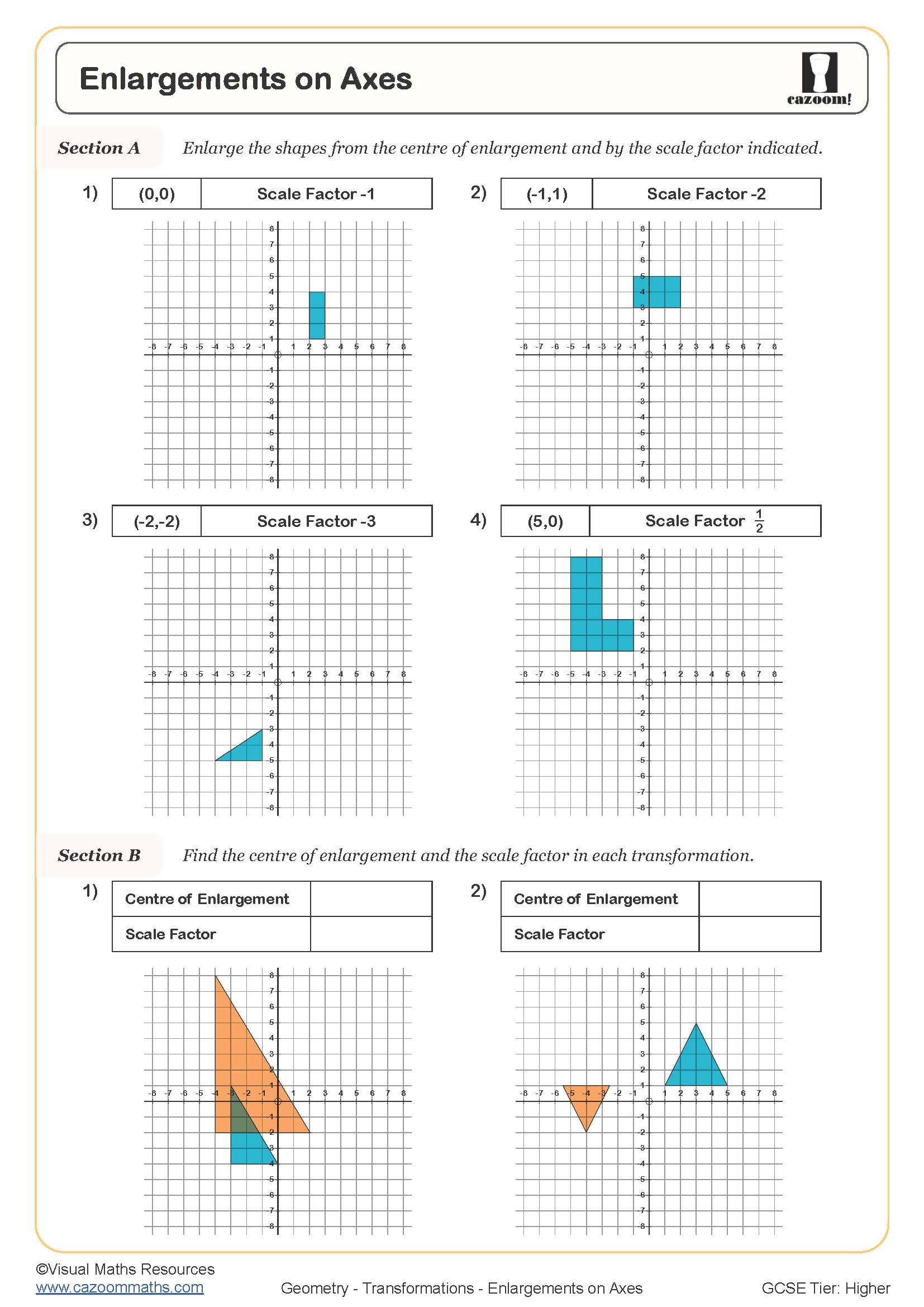
Enlargements Using Column Vectors
Year groups: 10, 11
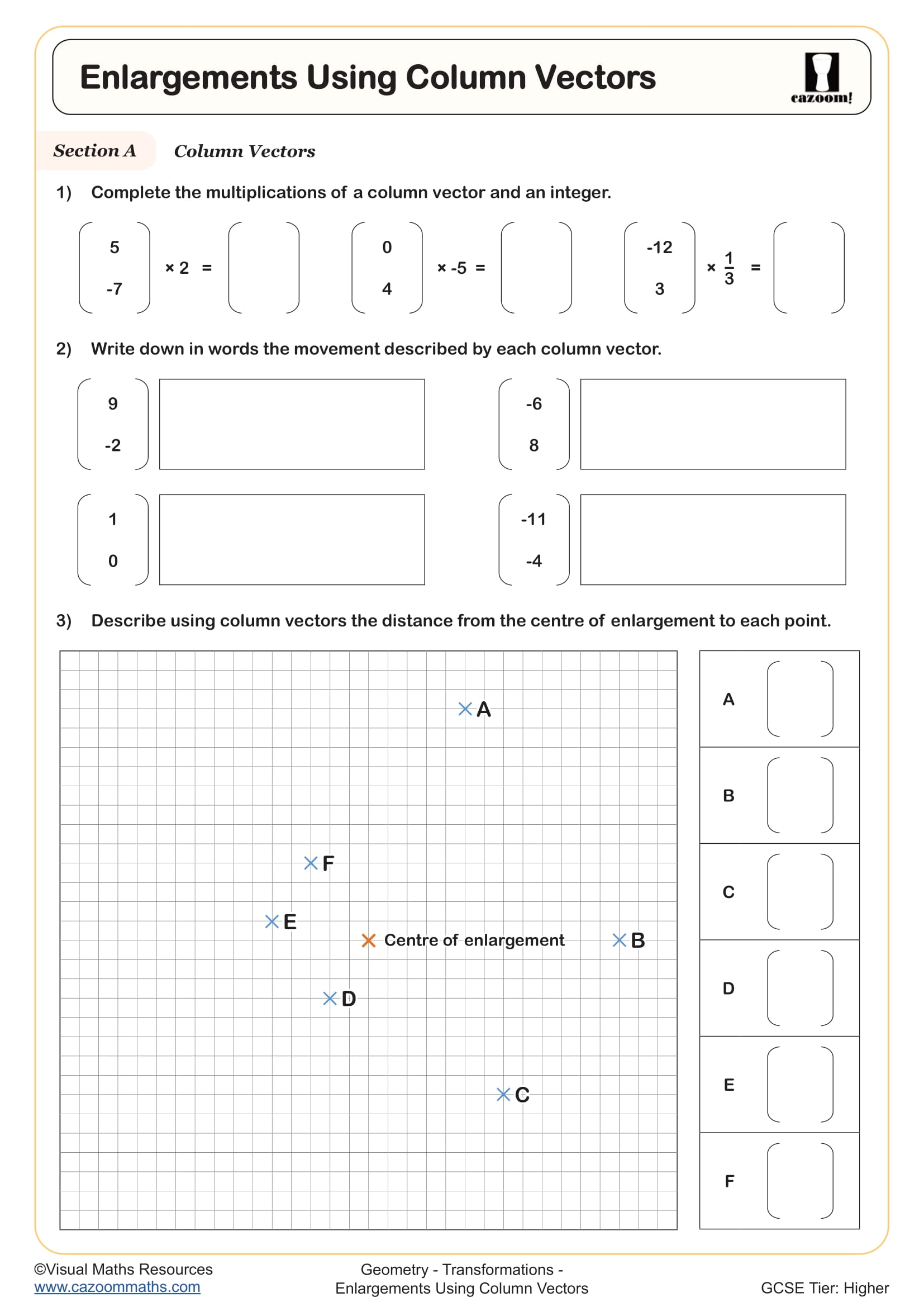
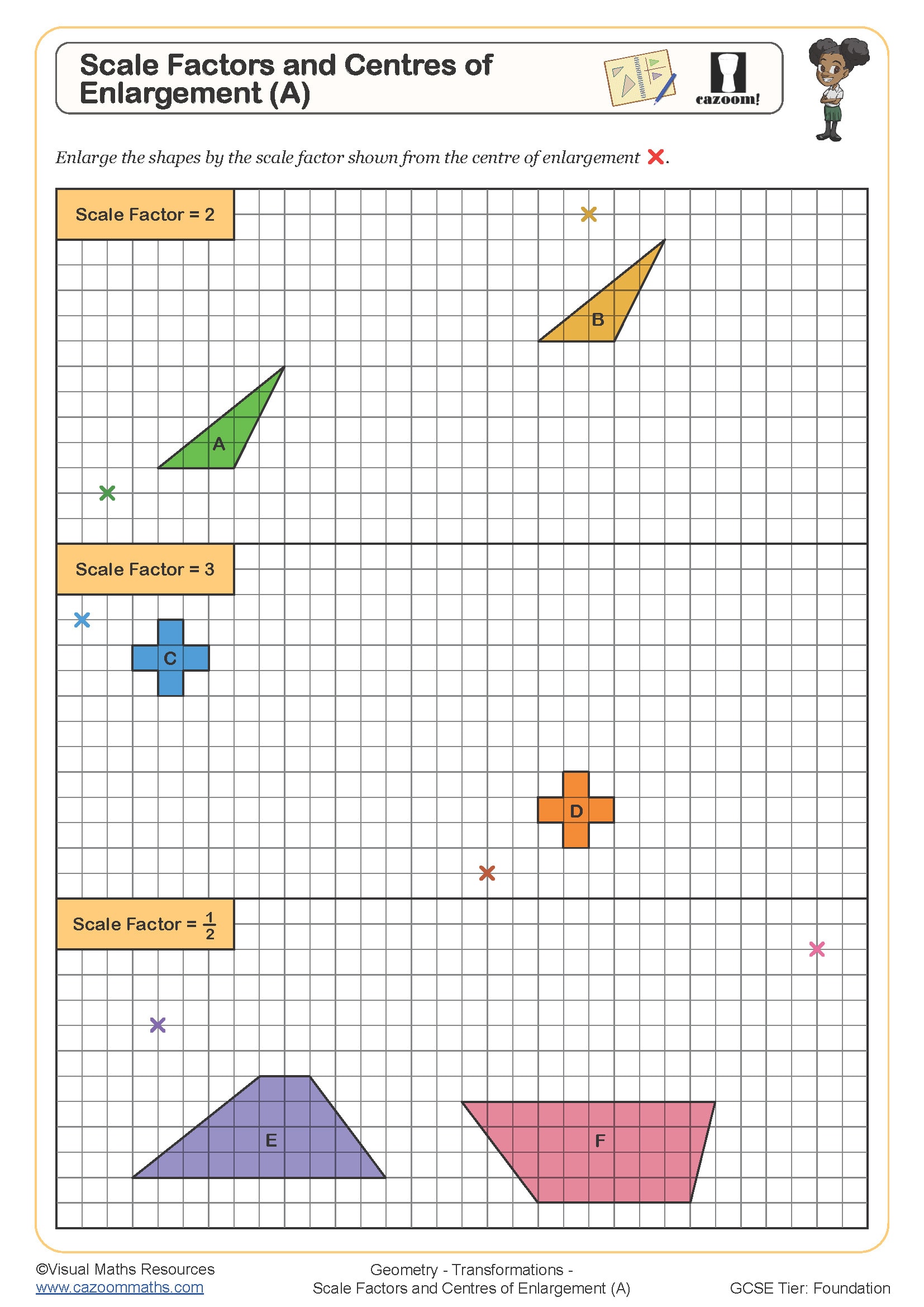
Scale Factors and Centres of Enlargement (A)
Year groups: 10, 11
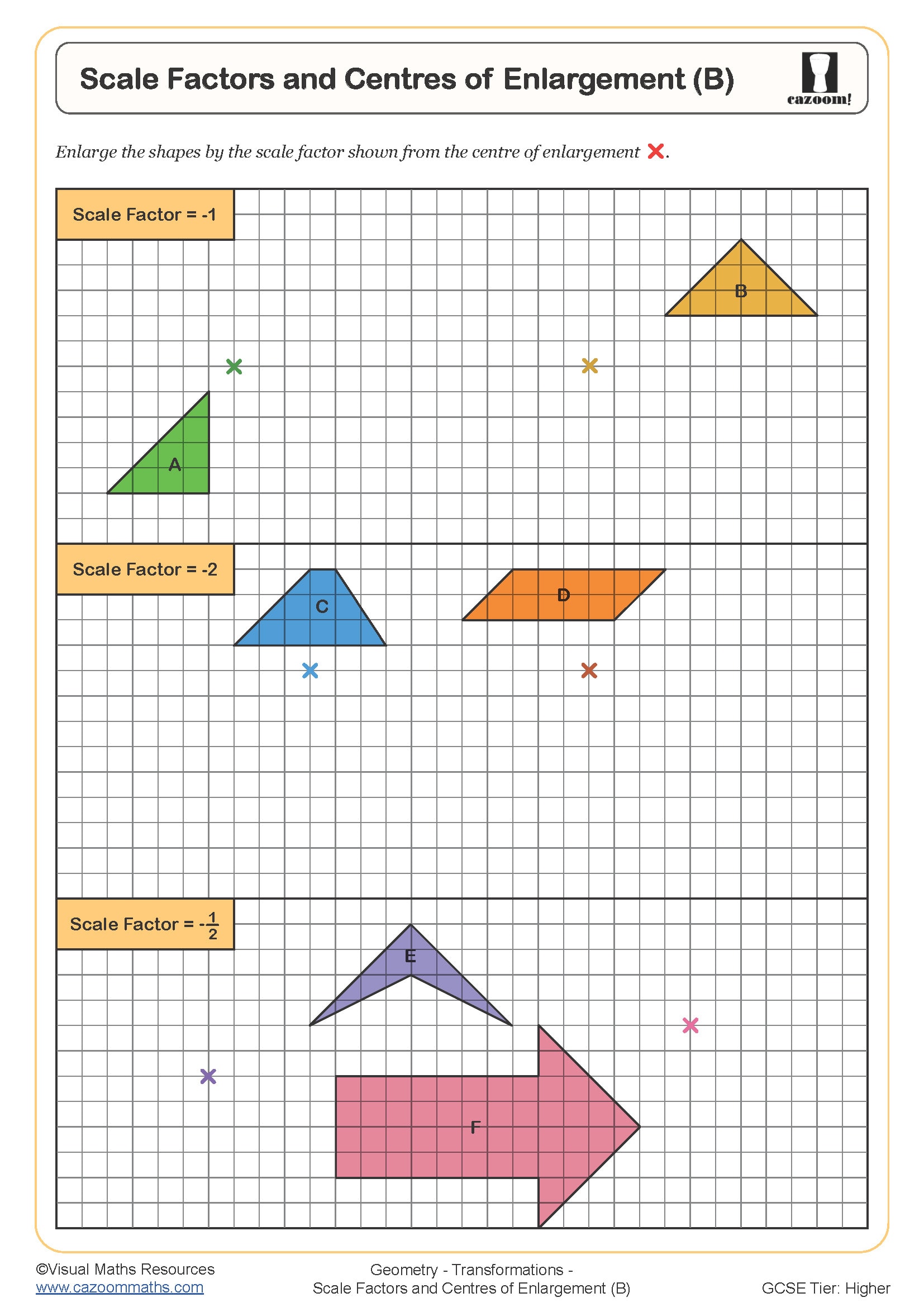
Scale Factors and Centres of Enlargement (B)
Year groups: 10, 11
All worksheets are created by the team of experienced teachers at Cazoom Maths.
What makes a good enlargement worksheet for KS3 students?
A quality enlargement worksheet should start with positive integer scale factors using simple centres of enlargement, typically at the origin or grid intersections. Students need clear grid backgrounds and shapes positioned to avoid fractional coordinates initially, allowing them to focus on the core concept of scaling.
Teachers notice that students often multiply coordinates incorrectly when the centre isn't at the origin, forgetting to subtract the centre coordinates first. Effective worksheets include worked examples showing this vector method: finding the distance from centre to each vertex, multiplying by the scale factor, then adding back to the centre coordinates.
How do enlargement worksheets progress from KS3 to KS4?
KS3 enlargement worksheets focus on positive scale factors with clear grid references, while KS4 materials introduce fractional and negative scale factors. Year 7 students typically work with scale factors of 2, 3, and simple fractions like 1/2, progressing to more complex transformations.
By Year 10, students tackle negative scale factors that create rotated images and fractional enlargements producing smaller shapes. Teachers report that the jump to negative scale factors causes confusion, as students expect enlargements to always increase size. GCSE questions often combine enlargements with other transformations, requiring secure understanding of coordinate manipulation.
Why do students find fractional enlargement challenging?
Fractional enlargement worksheet problems reveal the common misconception that "enlargement" must make shapes bigger. Students often struggle when scale factors like 1/3 or 0.5 produce smaller images, contradicting their intuitive understanding of the term "enlargement".
The mathematical reasoning becomes clearer when teachers emphasise that enlargement describes the transformation type, not necessarily the size change. Students benefit from seeing fractional scale factors in real-world contexts, such as architectural scale drawings where buildings are reduced to fit on paper, or map-making where large areas are scaled down proportionally.
How can teachers use these enlargement worksheets effectively in lessons?
Teachers achieve better results by starting each lesson with a quick revision of coordinate basics before introducing enlargement concepts. The enlargement worksheet pdf with answers format allows for immediate self-assessment and peer marking, which helps identify misconceptions quickly during guided practice.
Many teachers use the answer sheets to create worked examples on the board, talking through each step of the coordinate transformation. This approach works particularly well for mixed-ability classes, as stronger students can work independently while teachers provide additional support to those struggling with the vector method of finding enlarged coordinates.