Loci Worksheets
All worksheets are created by the team of experienced teachers at Cazoom Maths.
What are loci in maths?
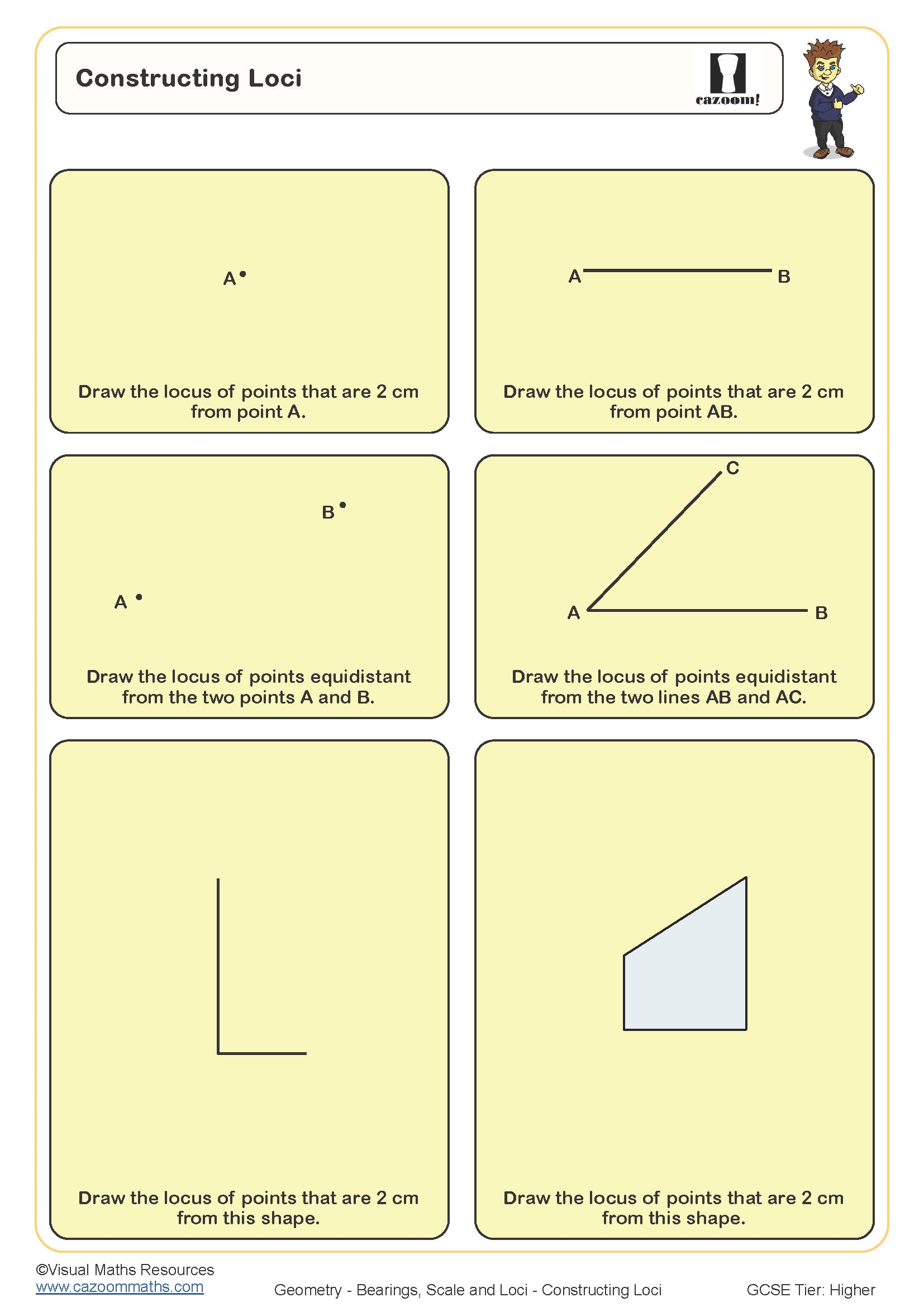
A locus (plural: loci) is the set of all points that satisfy a particular rule or condition. In geometry, students learn to construct and describe four fundamental loci: points equidistant from two fixed points (the perpendicular bisector), points equidistant from two intersecting lines (the angle bisector), points a fixed distance from a point (a circle), and points a fixed distance from a line (parallel lines). At KS3 and KS4, loci questions combine construction accuracy with clear mathematical descriptions.
Students often lose marks in exams by describing a locus vaguely, writing 'a curved line' instead of 'the perpendicular bisector of AB' or 'an arc of radius 5 cm centred at point C'. Exam mark schemes expect precise language that identifies both the type of locus and the specific measurements or points involved. Teachers notice that students who practise labelling their constructions clearly during classwork are far more confident describing loci under exam conditions.
Which year groups study loci?
Loci appears in the National Curriculum for Year 9 and Year 10, sitting within the geometry strand. Students typically encounter basic constructions in Year 8 (perpendicular bisectors, angle bisectors) before formally studying loci as a topic in Year 9, where they learn to recognise and describe the four standard loci. The topic continues into Year 10 when students tackle compound loci problems that require shading regions satisfying multiple conditions simultaneously.
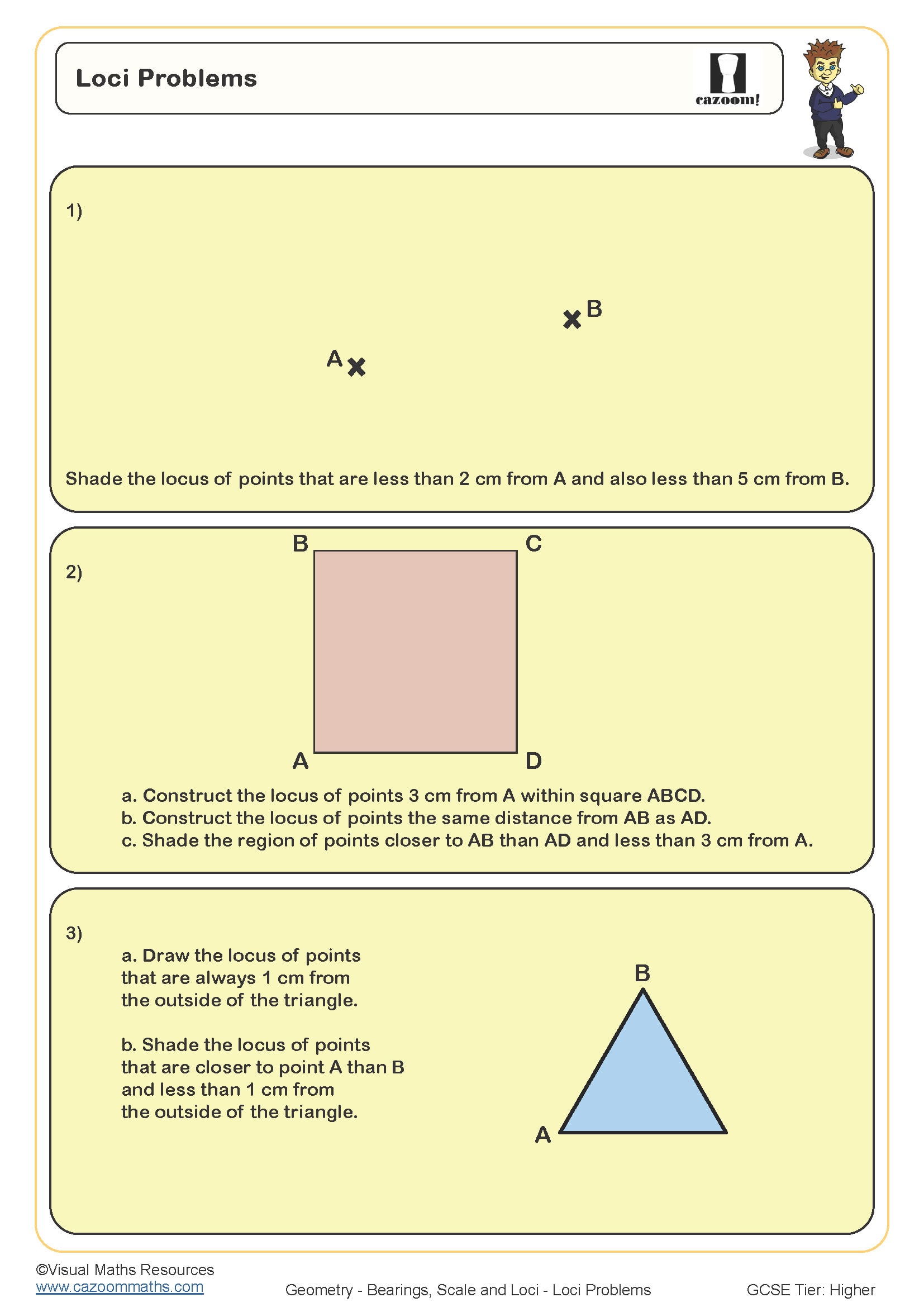
The progression involves increasing complexity in the conditions and the number of constraints. Year 9 work focuses on single-condition loci with clear geometric descriptions, while Year 10 introduces problems involving inequalities (such as finding regions closer to one point than another) and combining loci with scale diagrams. GCSE questions often embed loci within real-world contexts, requiring students to interpret practical situations geometrically before constructing the relevant loci.
How do perpendicular bisectors relate to loci?
The perpendicular bisector of a line segment is the locus of all points equidistant from the two endpoints of that segment. Students construct it by drawing arcs of equal radius from each endpoint, then joining the intersection points to create a line that cuts the original segment at 90 degrees. This construction appears frequently in compound loci problems, where students must identify regions closer to one point than another by determining which side of the perpendicular bisector satisfies the condition.
Perpendicular bisectors have practical applications in mobile phone network planning, where engineers position masts so that coverage areas don't overlap inefficiently. If two masts serve a region, the perpendicular bisector of the line joining them determines the boundary where signal strength from each mast is equal. Students sometimes encounter simplified versions of this in GCSE problem-solving questions, where they must position facilities or determine service boundaries based on equal distances from fixed locations.
How do these worksheets help students master loci?
The worksheets guide students through systematic construction practice, starting with identifying which type of locus applies to a given condition before moving to accurate constructions using compasses and rulers. Each question requires students to both draw the locus and write a clear description, reinforcing the connection between visual representation and precise mathematical language. The answer sheets show correctly constructed loci with appropriate labels and construction marks visible, helping students check their technique and accuracy.
Many teachers use these worksheets during intervention sessions with students who find spatial reasoning challenging, as the structured approach breaks down complex problems into manageable steps. They work well for homework when students have access to geometry equipment, and pairs can check each other's constructions against the answer sheets during lessons. The worksheets suit both initial teaching of the topic and focused GCSE revision for students who need to rebuild confidence with geometric constructions under timed conditions.