Metric Conversions Worksheets
All worksheets are created by the team of experienced teachers at Cazoom Maths.
What are the metric conversion rules students need to know?
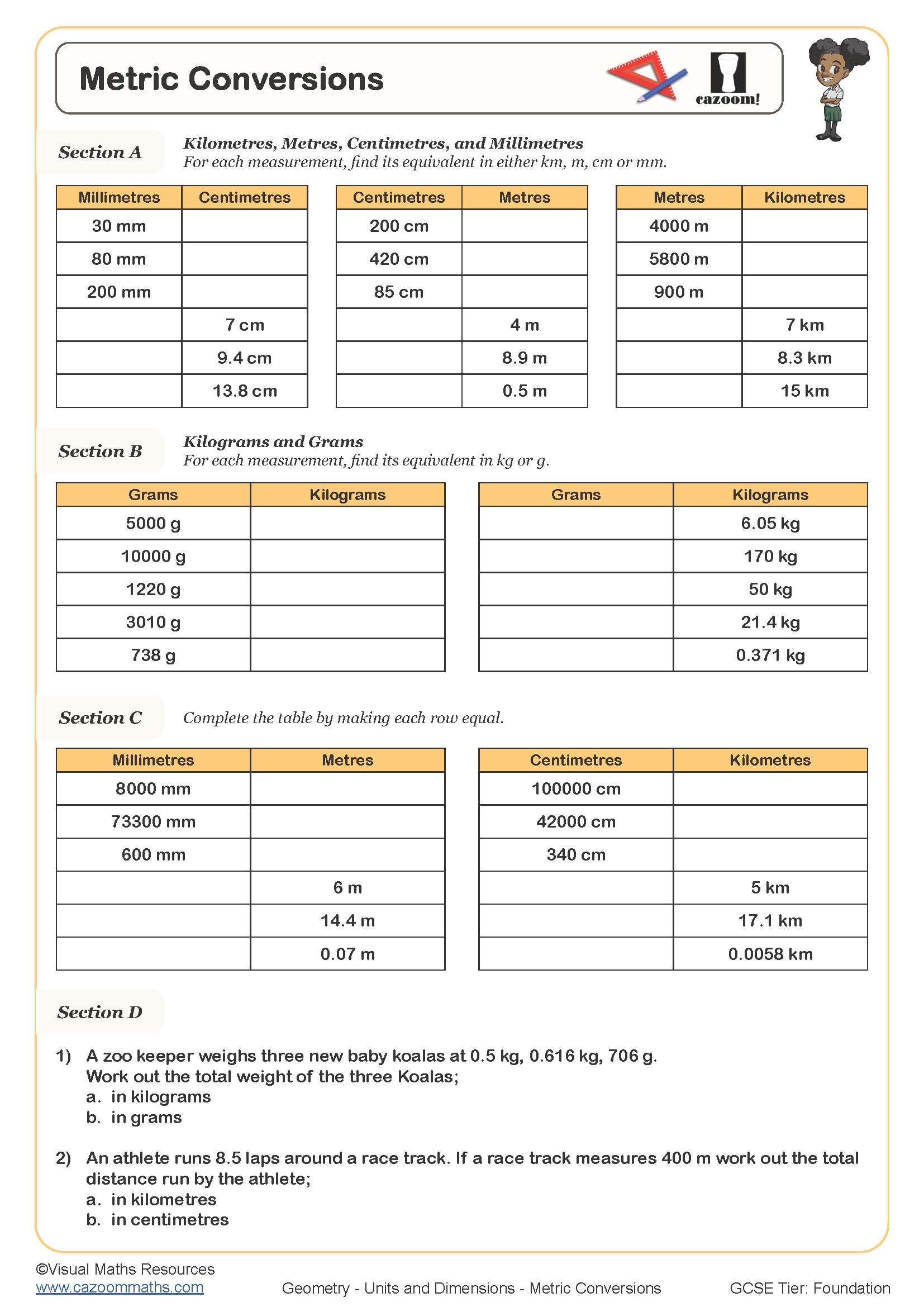
Students need to memorise the conversion factors between metric units: 1000 millimetres in a metre, 100 centimetres in a metre, 1000 metres in a kilometre for length; 1000 milligrams in a gram, 1000 grams in a kilogram for mass; and 1000 millilitres in a litre for capacity. The National Curriculum expects students to work confidently with these relationships from Year 7 onwards, applying them to increasingly complex contexts through KS3 and into GCSE.
A common error occurs when students forget whether to multiply or divide. Teachers often see students converting 3500 grams to kilograms and writing 3,500,000 because they've multiplied by 1000 instead of dividing. The mark scheme on Foundation GCSE papers typically awards method marks for showing the conversion step separately, so teaching students to write out '3500 ÷ 1000 = 3.5 kg' helps them avoid calculation errors and secure marks even if they make a subsequent mistake.
Which year groups study metric conversions?
These worksheets cover Year 7 through to Year 10, spanning both KS3 and KS4. Students first encounter metric conversions formally in Year 7, where they practise converting between standard units like metres and centimetres or litres and millilitres. The topic appears throughout the secondary curriculum because it underpins measurement work in geometry, data handling and problem-solving contexts.
Progression across these year groups becomes more demanding in application rather than calculation. Year 7 students typically convert single measurements, whilst Year 9 and 10 students must convert within multi-step problems involving area (where they might convert square centimetres to square metres) or capacity calculations where they work with real-world contexts like fuel consumption or medicine dosages. Higher tier GCSE questions may combine conversions with ratio or proportion, expecting students to recognise when conversion is needed without explicit prompting.
How do students convert between area and volume units?
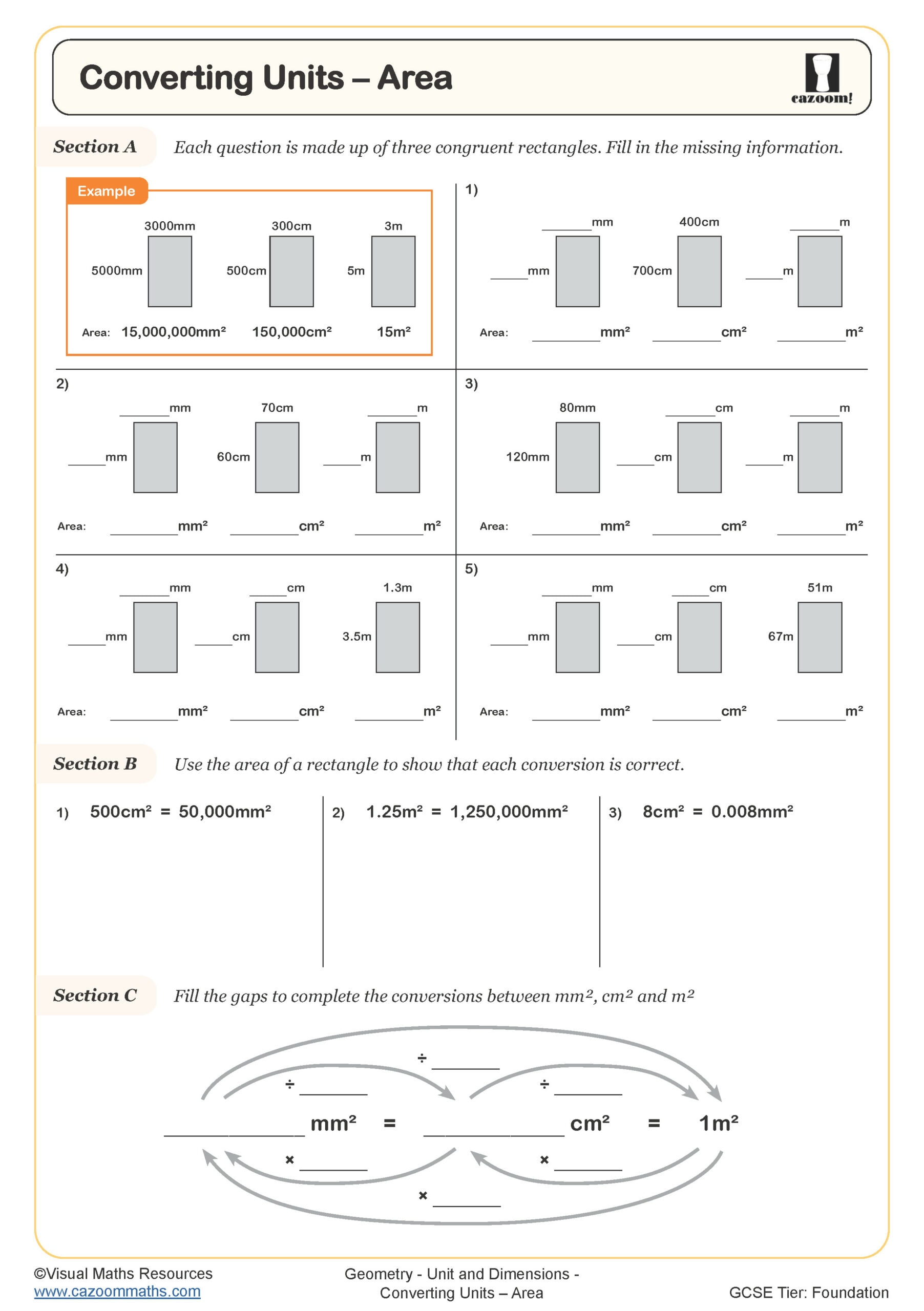
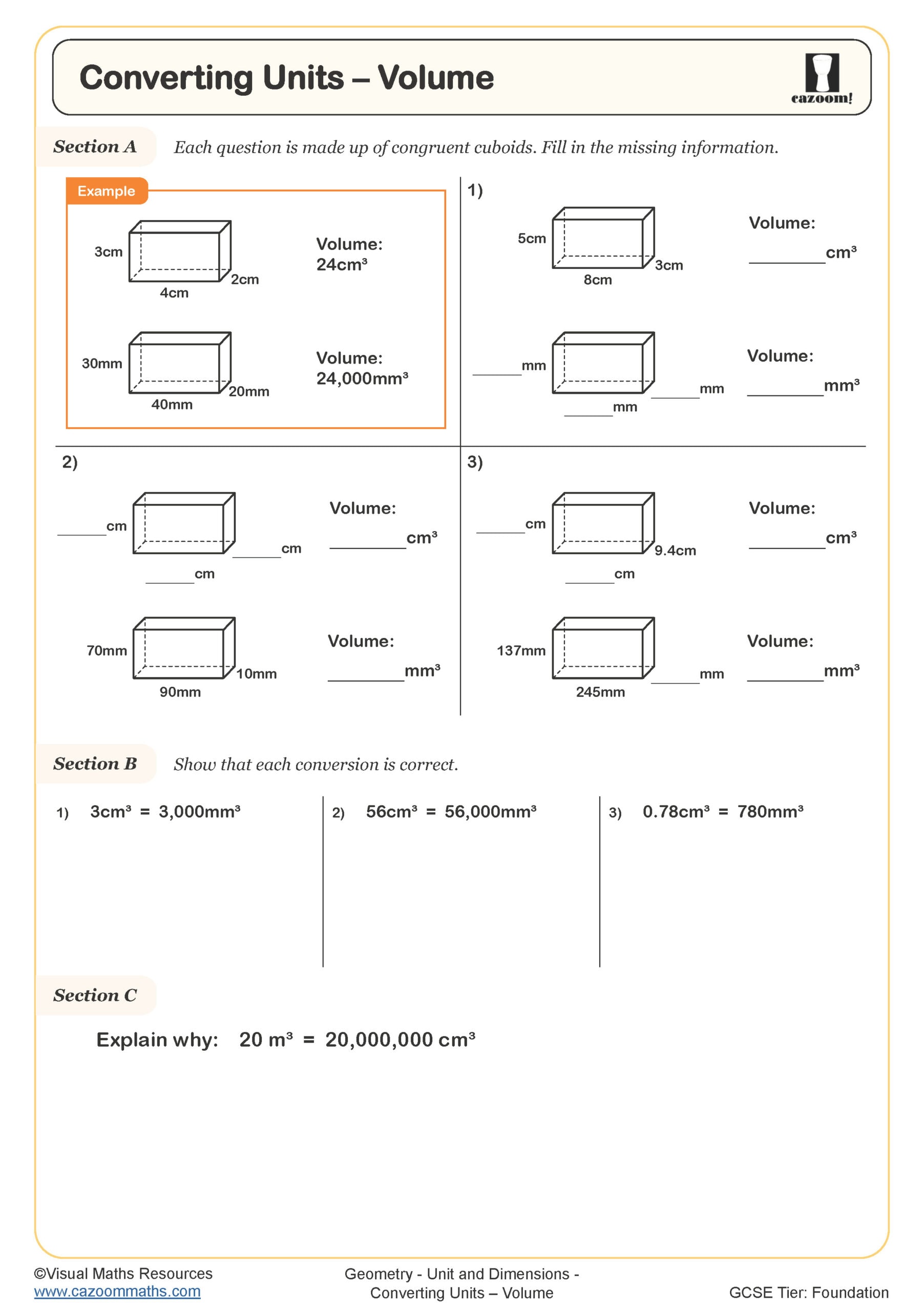
Converting area units requires squaring the linear conversion factor, whilst volume units need cubing. To convert square centimetres to square metres, students must divide by 100 × 100 = 10,000 (not just 100), because both dimensions of the area are being converted. Similarly, cubic centimetres to cubic metres requires dividing by 1,000,000 (100³). This concept frequently trips up GCSE students who apply linear conversion factors to area or volume measurements and lose marks in geometry questions.
This skill connects directly to real-world STEM applications. Civil engineers convert between square metres and hectares when planning land use, whilst manufacturing specifications might list material thickness in micrometres but calculate surface area in square millimetres. Medical dosing often works in milligrams per kilogram of body mass, requiring healthcare professionals to convert patient weight and calculate medication volumes in millilitres, where errors in conversion factors could have serious consequences.
How should teachers use these metric conversion worksheets?
The worksheets build fluency through repeated practise with varied question types, moving from straightforward single-step conversions to problems embedded in context. Having complete answer sheets allows students to self-check their work during independent practise, which helps them identify whether errors stem from the conversion step itself or from subsequent calculations. Teachers can use the answers to quickly diagnose whether whole-class misconceptions need addressing or whether individual students need further support.
Many teachers use these worksheets as starter activities to refresh conversion skills before teaching related topics like perimeter, area or density. They work well for intervention groups where students have gaps in their understanding of place value and decimals, since conversion errors often reveal underlying number sense issues. For homework, the structured practise helps students build confidence with a skill they'll need across GCSE papers, whilst the answer sheets allow parents to support their children's learning without needing to remember conversion factors themselves.