Nets Worksheets
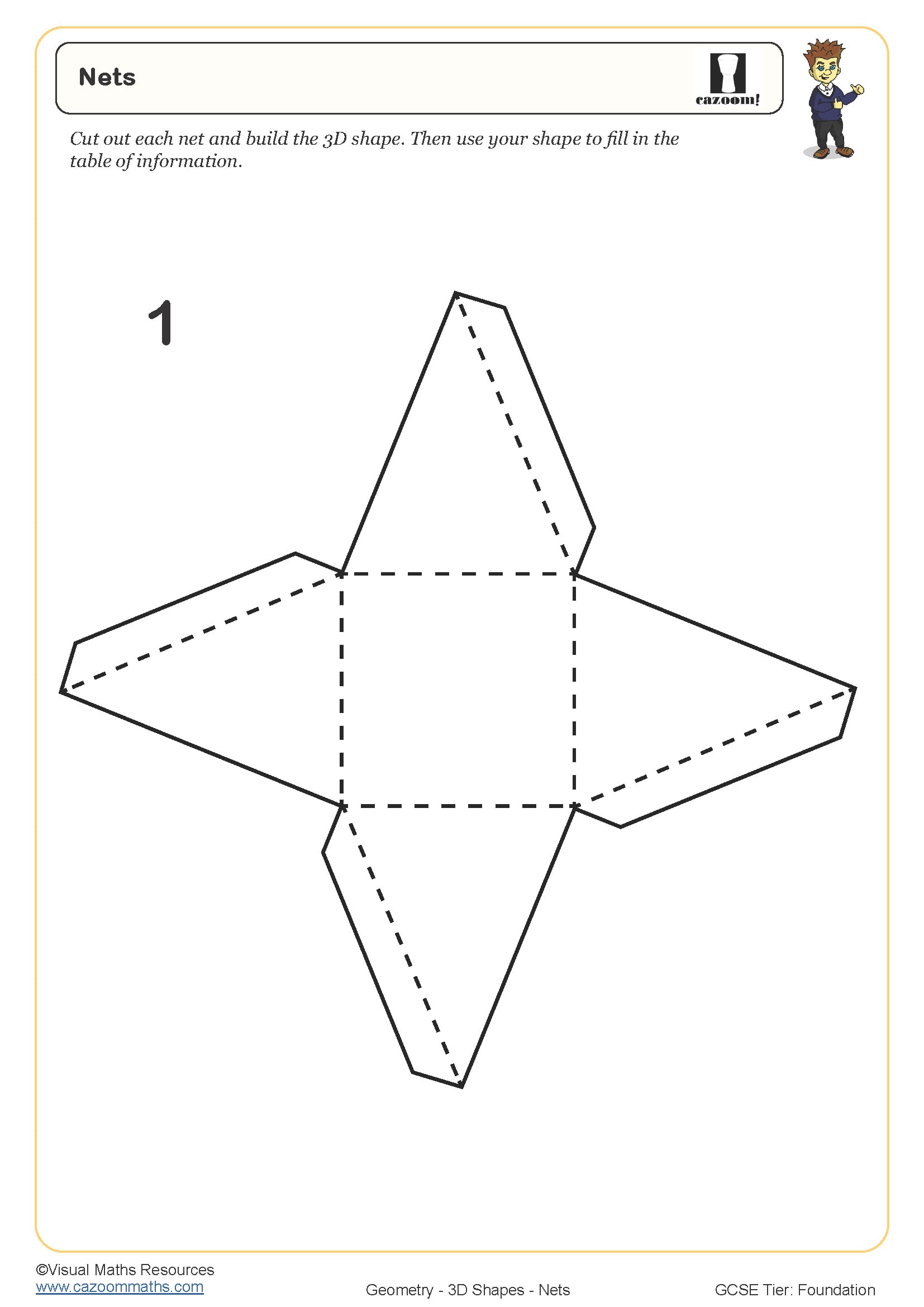
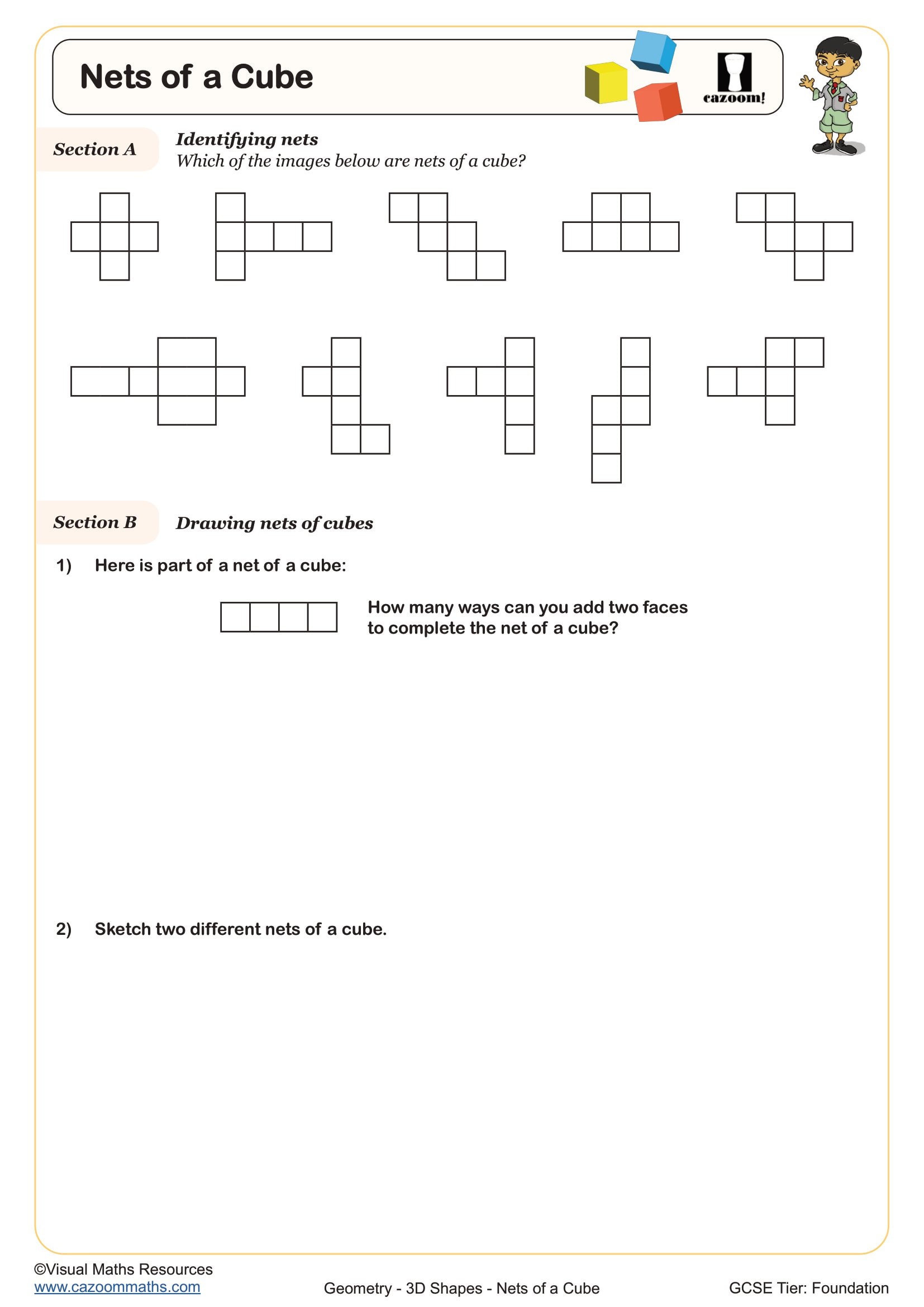
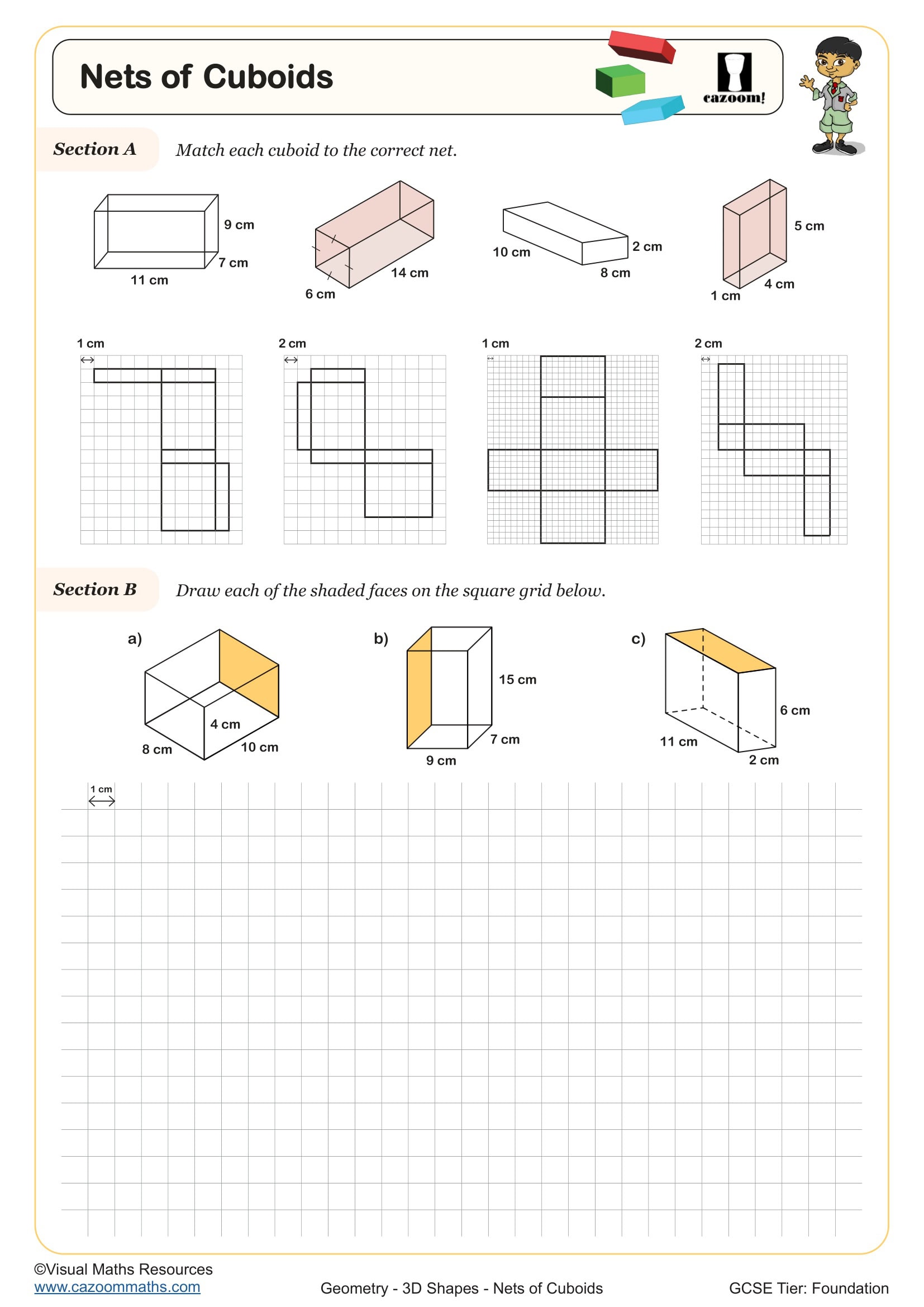
All worksheets are created by the team of experienced teachers at Cazoom Maths.
What are nets in maths?
A net is a two-dimensional pattern that can be folded along its edges to form a three-dimensional shape. When teaching nets at KS3, students learn that the same solid can have multiple different nets. For example, a cube has 11 distinct nets, whilst a square-based pyramid has several possible arrangements depending on where the triangular faces are positioned relative to the base.
Teachers often observe that students mistakenly believe any arrangement of the correct number of faces will form the solid. A common error with cube nets is placing faces in positions that would overlap when folded, or leave gaps in the structure. Encouraging students to physically cut out and fold paper nets helps them understand why certain arrangements work whilst others don't, building the mental rotation skills needed for GCSE problem-solving.
Which year groups study nets?
These worksheets cover nets as taught in Year 7 and Year 8 within the KS3 geometry curriculum. The National Curriculum requires students to identify properties of 3D shapes including nets, which forms part of their broader understanding of spatial reasoning. This topic typically follows work on 2D shape properties and prepares students for calculating surface area and volume in upper Key Stage 3.
In Year 7, students generally focus on recognising and sketching nets of common solids like cubes, cuboids and prisms. By Year 8, the complexity increases as students work with pyramids, more elaborate prisms, and begin connecting nets to surface area calculations. This progression ensures students develop both visualisation skills and the algebraic thinking needed when nets include measurements and require area calculations.
How do nets connect to surface area?
Understanding nets provides the foundation for calculating surface area because a net shows all the faces of a 3D shape laid flat in their actual size. When students can accurately draw or identify a net, they can calculate the area of each individual face and sum these to find the total surface area. This visualisation skill becomes particularly important when working with composite shapes or irregular solids where the arrangement of faces isn't immediately obvious.
In packaging design and manufacturing, engineers use nets extensively to minimise material waste and calculate costs. A cardboard box manufacturer must design nets that use the least possible material whilst maintaining structural integrity. Similarly, architects creating scale models unfold their 3D designs into nets to ensure accurate construction. This connection to real-world STEM applications helps students understand why spatial reasoning matters beyond the classroom, particularly in careers involving design, construction and product development.
How can teachers use these nets worksheets effectively?
The worksheets provide scaffolded practice that moves from identifying correct nets among several options to drawing nets independently with accurate measurements. This structure allows teachers to assess whether students genuinely understand the concept or are simply guessing. The included answer sheets show correct net arrangements, which proves valuable when students check their own work or when teachers need to quickly identify common errors across a class.
Many teachers find these resources effective for small group intervention with students who struggle with spatial reasoning, as the visual nature of the topic lends itself well to discussion and collaborative problem-solving. The worksheets work equally well as homework to reinforce classroom learning or as starter activities where students sketch quick nets from memory. Some teachers also use them alongside physical net-building activities, with students comparing their paper answers to actual folded models to self-correct misconceptions about which arrangements are geometrically possible.