Pressure Worksheets
All worksheets are created by the team of experienced teachers at Cazoom Maths.
What is the formula for calculating pressure in maths?
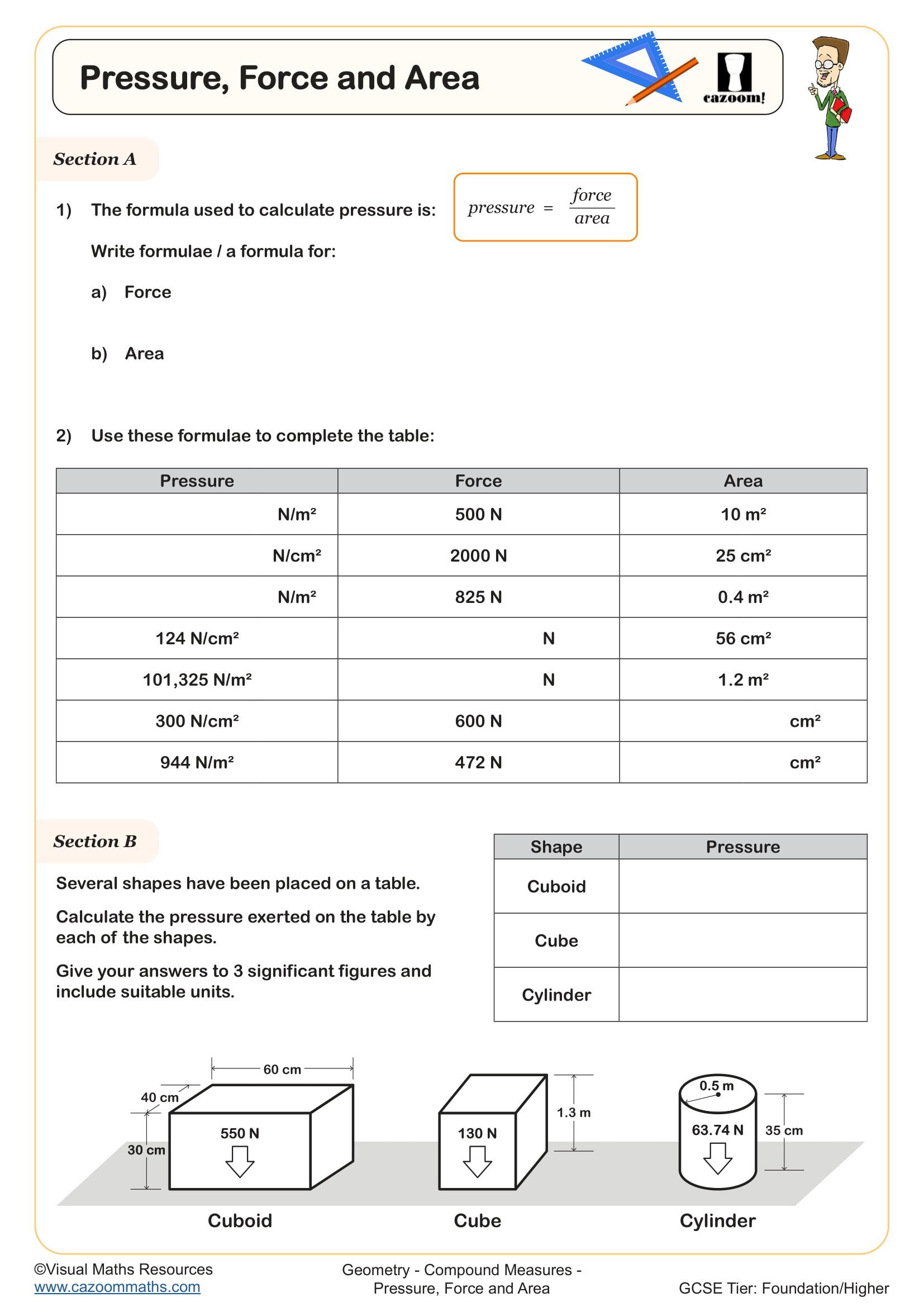
The pressure formula used in GCSE maths is pressure = force ÷ area, where pressure is measured in pascals (Pa) or newtons per square metre (N/m²), force in newtons (N), and area in square metres (m²). This appears in both Foundation and Higher tier papers, typically within problem-solving contexts that require students to manipulate the formula triangle or use algebraic rearrangement.
Students commonly lose marks by forgetting to convert area measurements into square metres before calculating, particularly when dimensions are given in centimetres or millimetres. Exam mark schemes expect clear unit conversions shown as working, not just the final answer. Teachers often find that practising area conversions separately before tackling pressure problems helps students avoid this error in assessments.
Which year groups study pressure in maths?
Pressure calculations appear in the Year 10 and Year 11 curriculum as part of KS4 maths, where they're classified under problem-solving with formulae rather than pure geometry. This topic connects to the ratio and proportion strand of the National Curriculum, requiring students to understand inverse relationships and work confidently with compound measures.
The complexity increases as students progress from straightforward substitution problems in Year 10 to multi-step questions in Year 11 that might involve calculating the area of composite shapes before finding pressure, or working backwards from a given pressure to determine dimensions. Higher tier papers may combine pressure calculations with reverse percentages or simultaneous equations.
How do you calculate area when working with pressure?
Calculating area for pressure problems requires students to identify the contact surface between objects and apply appropriate area formulae for rectangles, circles, or composite shapes. The challenge lies in determining which surface area matters, particularly when objects have multiple faces or irregular contact points. Questions often specify the shape explicitly, but students must sometimes infer this from diagrams or context.
Pressure calculations have direct applications in engineering and construction contexts. Architects calculate floor loading pressure to ensure buildings can safely support furniture and occupants, whilst engineers design foundations by calculating how much pressure the structure exerts on the ground beneath. Understanding that larger contact areas reduce pressure explains why snowshoes prevent sinking into snow and why sharp knives cut more effectively than blunt ones, both everyday examples of pressure principles students encounter.
How do these pressure worksheets support GCSE preparation?
The worksheet provides systematic practise with pressure problems that mirror GCSE question styles, including those requiring formula rearrangement and multi-step solutions. Questions build from direct substitution to more complex scenarios where students must extract information from worded contexts and determine which values to use. The structured approach helps students develop the problem-solving stamina needed for exam conditions.
Teachers use these worksheets effectively during targeted intervention sessions with students who struggle with formulae, as homework to consolidate classwork, or as timed practise to build exam technique. The complete answer sheets allow for peer marking activities where students explain their methods to each other, identifying where different approaches lead to the same answer. This works particularly well in mixed-ability pairings during revision periods.