Problem Solving Using Trigonometry Worksheets
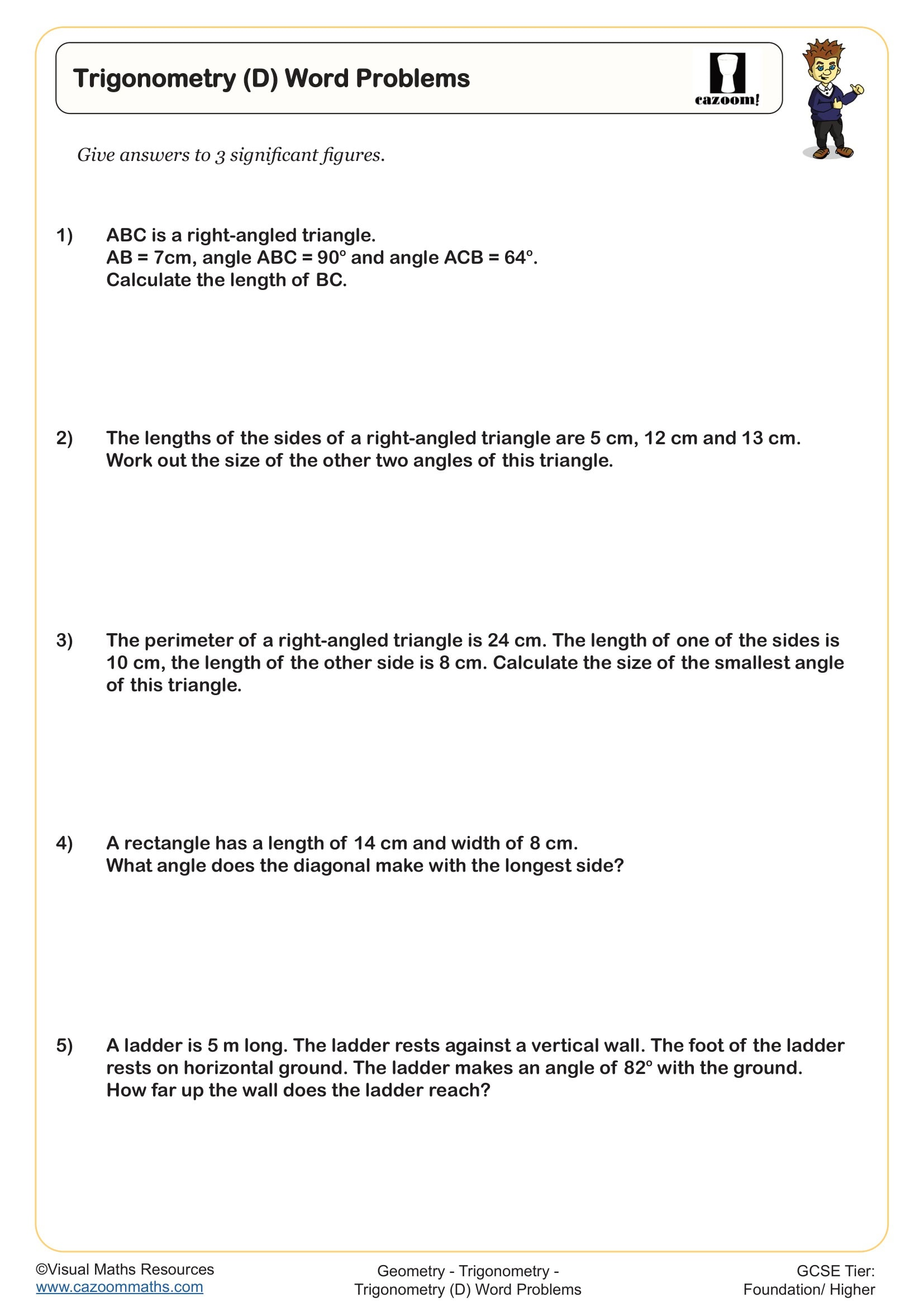
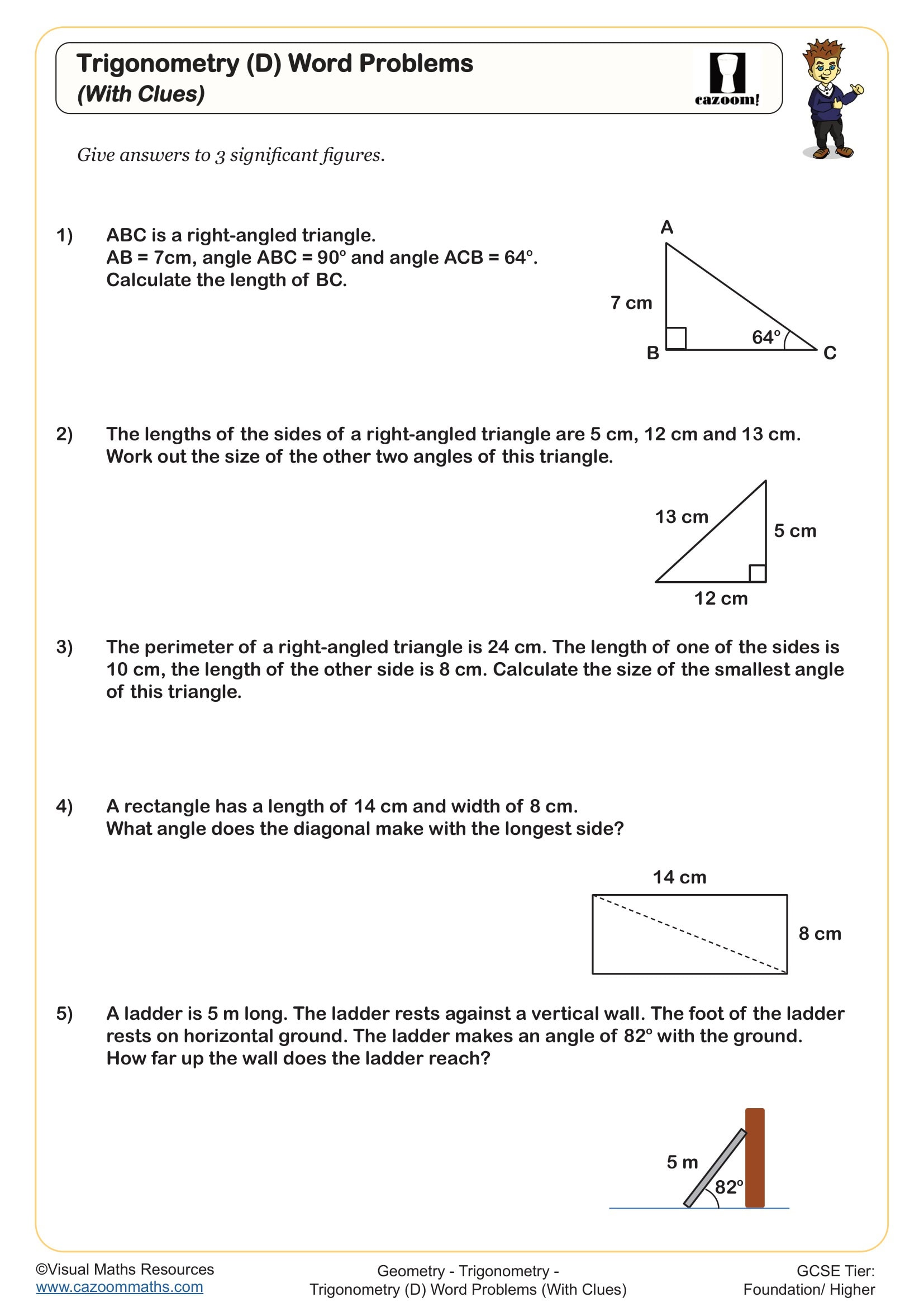
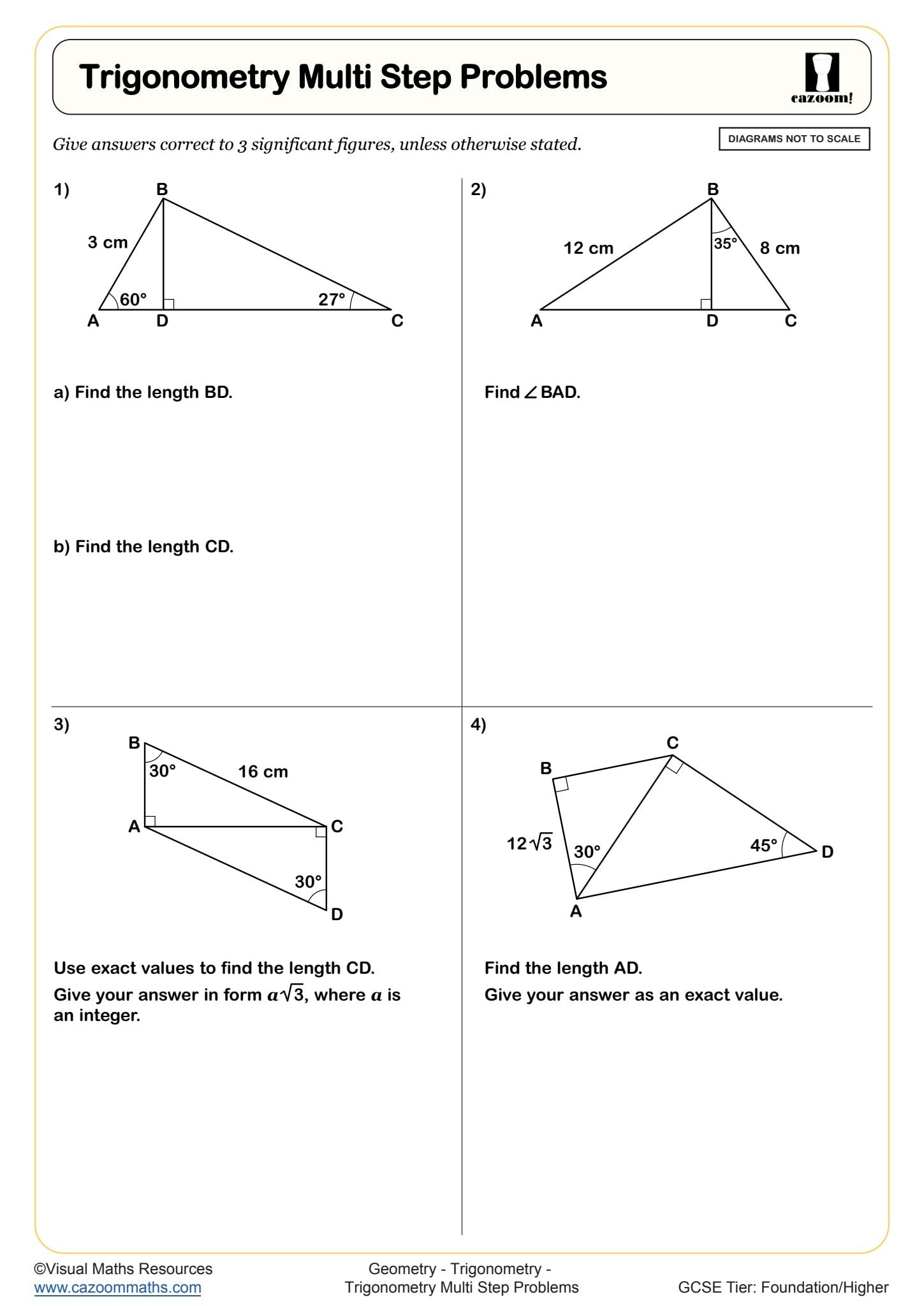
All worksheets are created by the team of experienced teachers at Cazoom Maths.
What is problem solving using trigonometry?
Problem solving using trigonometry involves applying sine, cosine and tangent ratios to contextualised situations rather than simply finding missing sides or angles in labelled diagrams. Students must interpret written scenarios, sketch appropriate right-angled triangles, identify which trigonometric ratio to use, and often perform multiple calculations to reach a final answer. This appears throughout GCSE mathematics, particularly in higher tier papers where problems combine trigonometry with Pythagoras' theorem, bearings or compound shapes.
A common error occurs when students misidentify the hypotenuse in angles of depression problems. Many assume the horizontal distance is the hypotenuse when it's actually the adjacent side, leading to incorrect ratio selection. Exam mark schemes consistently penalise students who fail to draw a clear diagram first, as this foundational step prevents such misinterpretations and helps organise multi-stage solutions.
Which year groups study trigonometry problem solving?
These worksheets cover Years 8, 9, 10 and 11, spanning Key Stage 3 and Key Stage 4. Trigonometry problem solving typically begins once students have mastered basic SOHCAHTOA applications in Year 9, though some Year 8 classes encounter simpler contextual problems. The National Curriculum expects students to solve problems involving angles of elevation and depression by the end of Key Stage 4, with this content appearing on both foundation and higher GCSE papers.
Progression across year groups moves from single-step problems with clearly defined triangles in Year 9 to complex scenarios requiring multiple trigonometric calculations or combining trigonometry with other topics by Year 11. Year 10 students typically work on bearings problems and indirect measurement, whilst Year 11 classes tackle exam-style questions where the solution pathway isn't immediately obvious and requires strategic thinking about which calculation to perform first.
How are angles of elevation and depression used in real situations?
Angles of elevation and depression describe the angle between a horizontal line and the line of sight to an object either above or below the observer. An angle of elevation looks upward (such as viewing the top of a building from ground level), whilst an angle of depression looks downward (such as a pilot viewing a runway). Both create right-angled triangles where trigonometric ratios calculate distances or heights that cannot be measured directly.
Surveyors, architects and civil engineers use these calculations daily when planning construction projects. For instance, determining the height of a bridge support from a known distance involves measuring the angle of elevation and applying tangent ratios. Aviation relies heavily on angles of depression for approach paths, whilst telecommunications engineers calculate tower heights and signal ranges using these principles. Students who grasp this application understand why trigonometry extends far beyond the classroom into critical STEM professions.
How do these worksheets build problem-solving skills?
The worksheets scaffold learning by presenting problems with increasing complexity, starting with scenarios where the triangle is partially sketched and progressing to word problems requiring students to construct their own diagrams. Many include partially worked examples showing how to extract information from text, draw accurate diagrams, and set up equations correctly. This structured approach helps students develop the analytical skills needed to break down unfamiliar problems into manageable steps.
Teachers use these resources for targeted intervention with students who can perform calculations but struggle with application, or as homework following lessons on contextual trigonometry. They work particularly well for paired discussion, where students explain their diagram choices and calculation strategies to each other. During GCSE revision, the worksheets help identify whether difficulties stem from trigonometric technique or from problem interpretation, allowing teachers to address the actual barrier to progress rather than simply revisiting basic ratios.