Properties of 3D Shapes Worksheets
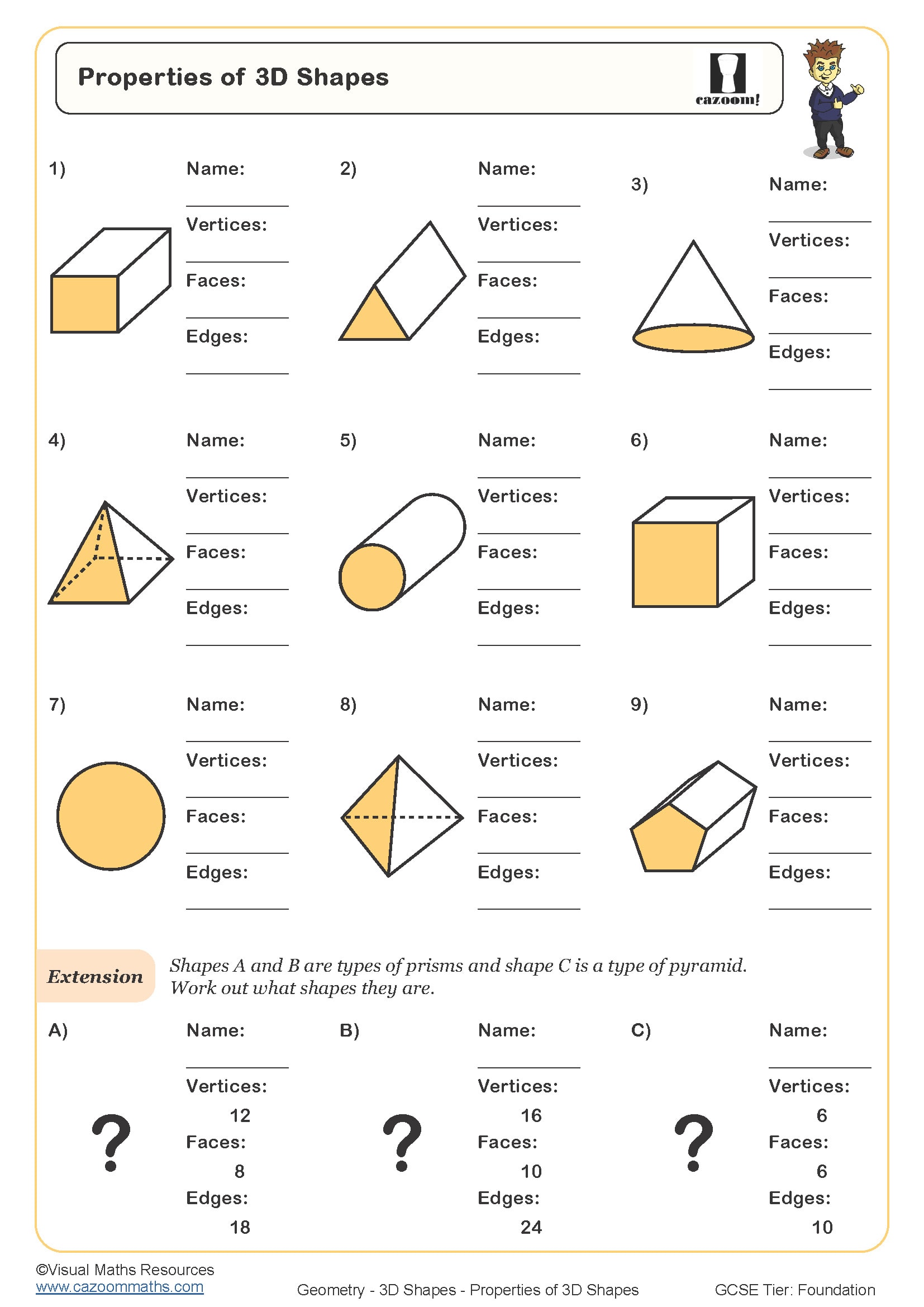
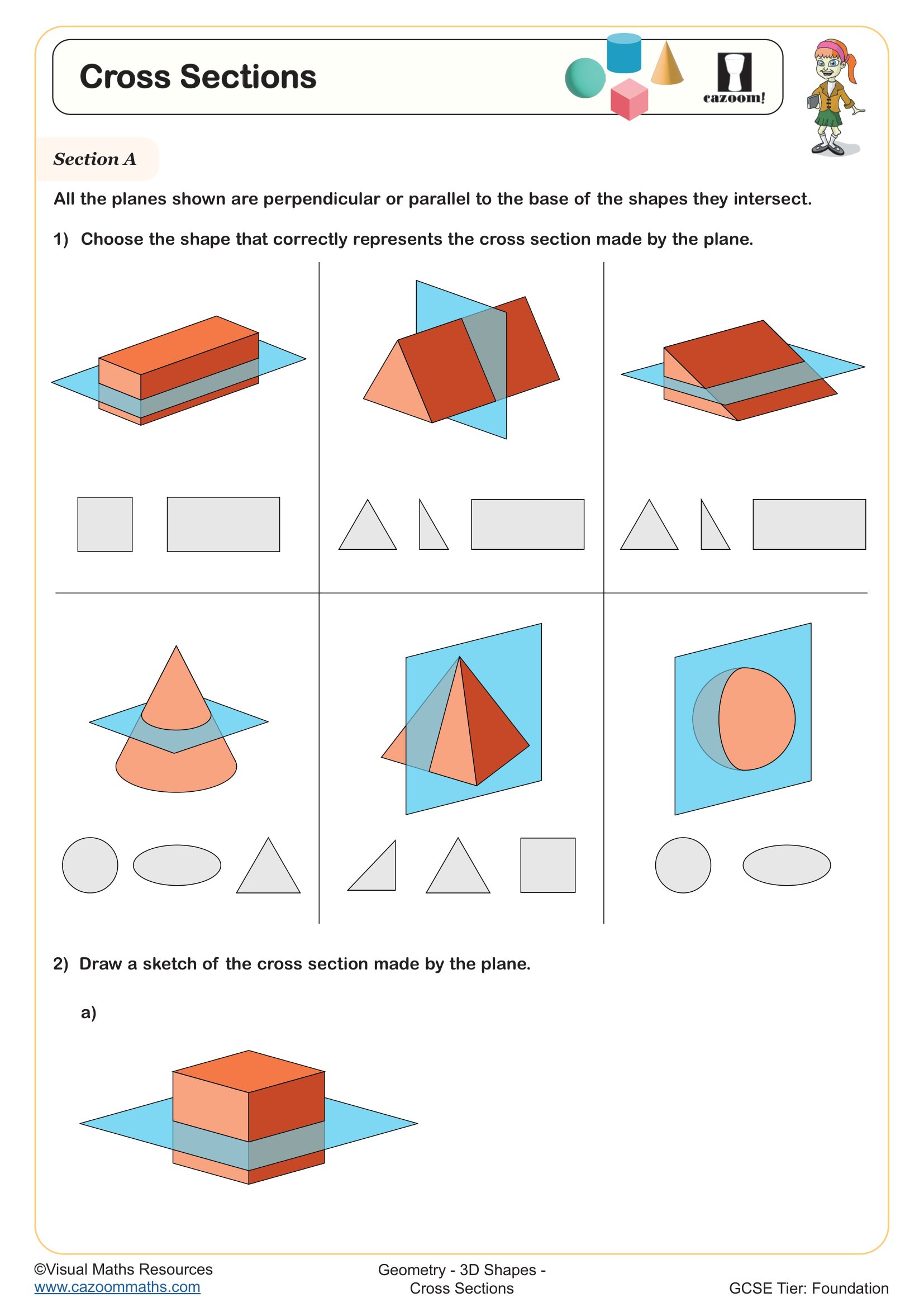
All worksheets are created by the team of experienced teachers at Cazoom Maths.
What properties do students need to identify in 3D shapes?
Students need to identify and count faces (the flat surfaces), edges (where two faces meet), and vertices (the points where edges meet) for various three-dimensional shapes including cubes, cuboids, prisms, pyramids, cylinders, cones, and spheres. The National Curriculum expects KS3 students to also recognise properties such as which faces are parallel, perpendicular, or congruent, and to understand how cross-sections appear when shapes are sliced.
A common error occurs when students attempt to apply Euler's formula (F + V = E + 2) without understanding which shapes it applies to. Students often incorrectly try using it for cylinders, cones, or spheres, when it only works for polyhedra. Exam mark schemes regularly penalise students who count the curved surface of a cylinder as a single face without acknowledging the two circular faces at each end.
Which year groups study properties of 3D shapes?
These worksheets cover properties of 3D shapes across Years 7, 8, and 9 within Key Stage 3, building on the shape recognition work begun in primary school. At KS3, students move beyond basic naming to analysing and comparing properties systematically, preparing for GCSE geometry topics including surface area, volume, and plans and elevations.
The progression across these year groups typically moves from identifying and naming properties in Year 7, to using properties to classify and compare shapes in Year 8, and finally to applying this knowledge in problem-solving contexts in Year 9. Students increasingly work with more complex polyhedra and need to visualise cross-sections, which many find challenging without physical models or dynamic geometry software to support their spatial reasoning.
How do prisms and pyramids differ in their properties?
Prisms have two congruent polygonal faces (bases) connected by rectangular faces, with the cross-section remaining constant throughout the shape's length. Pyramids, by contrast, have one polygonal base with triangular faces meeting at a single apex. This fundamental difference affects all their properties: a triangular prism has 5 faces, 9 edges, and 6 vertices, whilst a triangular-based pyramid (tetrahedron) has 4 faces, 6 edges, and 4 vertices.
Understanding these distinctions matters beyond the classroom. Structural engineers and architects select prisms for load-bearing columns and beams because forces distribute evenly through their constant cross-section, whilst pyramids appear in roof structures where weight needs to channel down to a central point. Students who grasp why these shapes have different properties find GCSE surface area and volume questions significantly more manageable, as they can visualise what they're calculating rather than just applying formulae.
How do these worksheets build confidence with 3D shape properties?
The worksheets provide structured practice that moves from identifying individual properties to comparing multiple shapes and spotting patterns. Students encounter varied question styles including labelling diagrams, completing property tables, and solving problems where they must work backwards from given properties to identify the shape. This scaffolded approach helps students develop the systematic thinking needed for GCSE geometry.
Teachers find these worksheets particularly valuable for intervention sessions with students who struggle to visualise 3D shapes from 2D diagrams. The answer sheets allow students to self-assess during independent work or homework, whilst pairs can check each other's property tables to identify counting errors before they become embedded. Many teachers use selected questions as starter activities to reactivate prior knowledge before tackling volume or surface area calculations.