Pythagoras and Trigonometry Worksheets
All worksheets are created by the team of experienced teachers at Cazoom Maths.
What is the difference between Pythagoras' theorem and trigonometry?
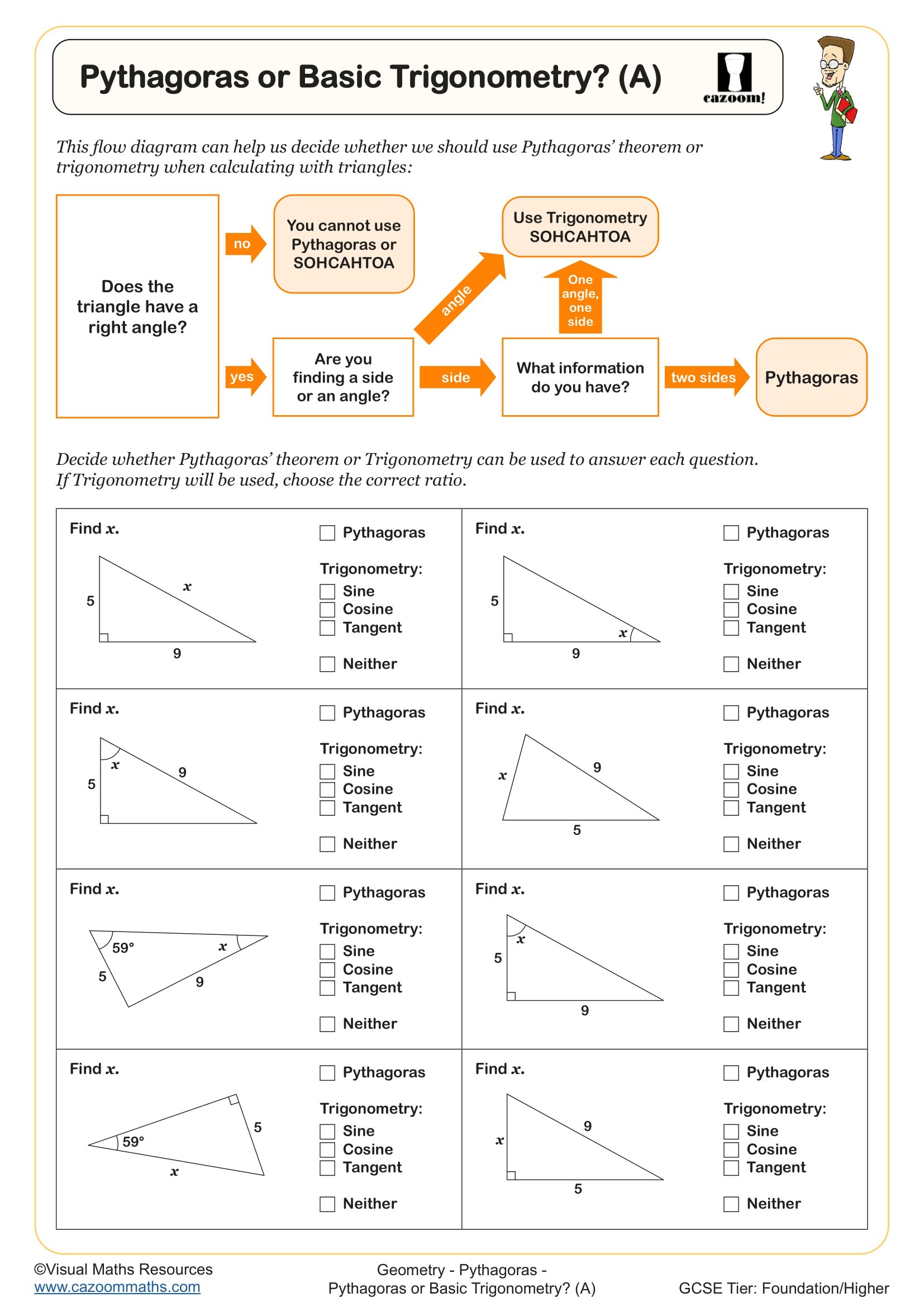
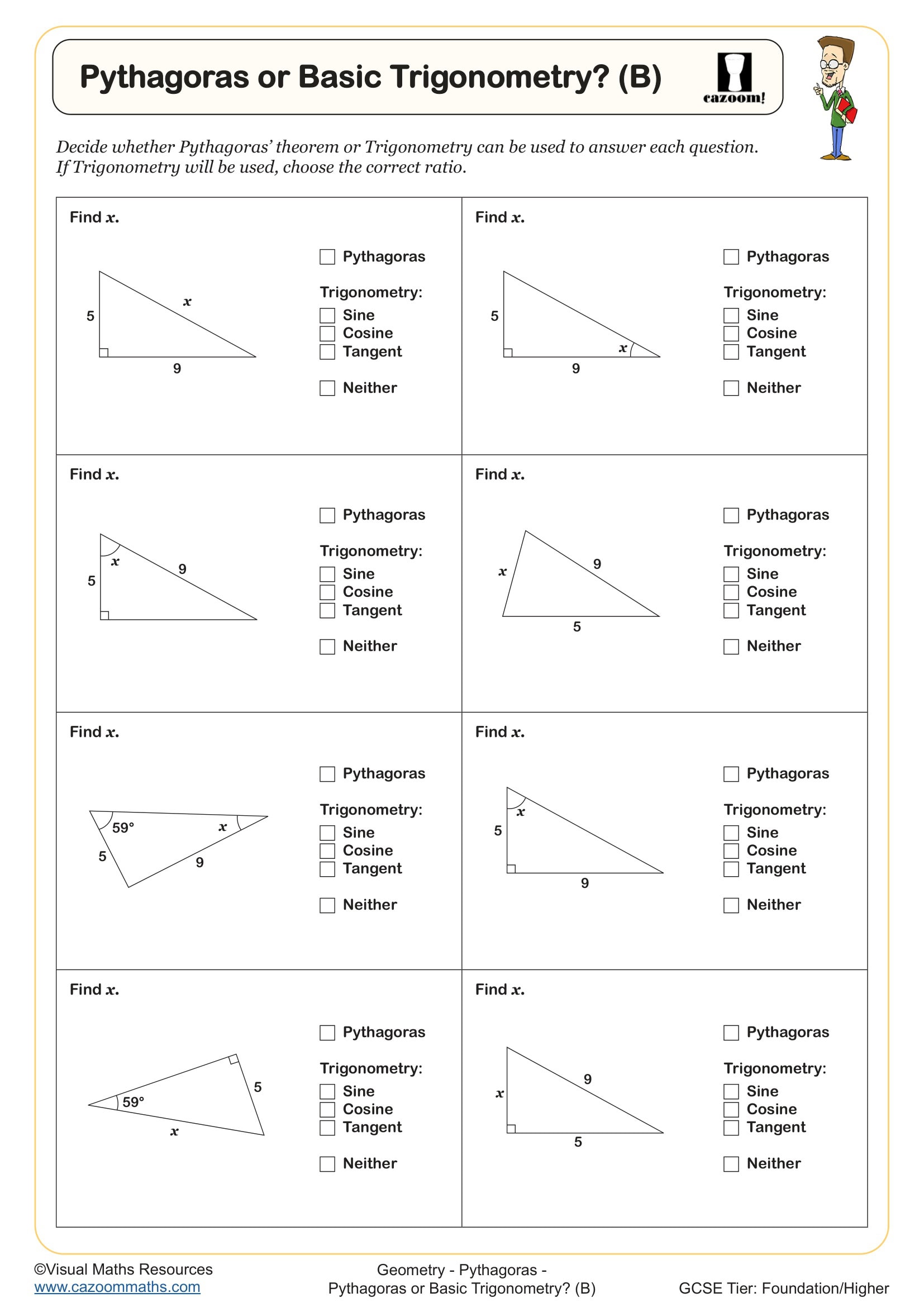
Pythagoras' theorem calculates missing sides in right-angled triangles when two sides are known, using the relationship a² + b² = c². Trigonometry extends this by introducing sine, cosine, and tangent ratios, which allow students to find missing sides or angles when they know one side and one angle, or two sides. Both appear in the GCSE Foundation and Higher tier papers, though trigonometry questions become more complex at Higher tier.
Students often attempt to use Pythagoras when an angle is involved, or reach for trigonometry when they actually have two sides and need the third. Exam mark schemes expect students to clearly identify the right-angled triangle within diagrams, label sides correctly as opposite, adjacent, or hypotenuse, and select the appropriate method. This decision-making process is where many marks are lost, even when students can execute the calculations accurately.
Which year groups study Pythagoras and trigonometry?
These worksheets are designed for Year 10 and Year 11 students working at KS4 level. Pythagoras' theorem is typically introduced in Year 10, often shortly after or alongside work on surds, since exact answers frequently require leaving values in surd form. Basic trigonometry follows once students are confident with Pythagoras, building towards more demanding problem-solving by Year 11.
The progression across these year groups moves from straightforward calculations in isolated right-angled triangles to multi-step problems requiring students to identify triangles within complex diagrams, work with bearings, or find angles of elevation and depression. Year 11 content often combines Pythagoras and trigonometry with other topics, such as calculating the height of a 3D shape or finding the shortest distance in geometric problems. Higher tier students also encounter exact trigonometric values and sine/cosine rules for non-right-angled triangles.
How is trigonometry used in real-world applications?
Trigonometry forms the mathematical foundation for navigation, surveying, and engineering design. When students calculate angles of elevation or depression, they're using the same methods that surveyors employ to measure inaccessible heights such as buildings or cliffs, and that pilots use to calculate glide paths and approach angles. The sine, cosine, and tangent ratios allow professionals to determine distances and heights indirectly, which is far more practical than direct measurement in many scenarios.
Architects and structural engineers rely heavily on trigonometry when designing roof pitches, calculating load-bearing angles in trusses, or ensuring wheelchair ramps meet accessibility standards for gradient. In technology, trigonometric functions underpin computer graphics, GPS positioning, and signal processing. Students who understand that SOH CAH TOA isn't merely an exam technique but a tool used across STEM fields often engage more thoughtfully with these problems, particularly when worksheets include contextualised questions about construction, navigation, or surveying scenarios.
How should teachers use these Pythagoras and trigonometry worksheets?
The worksheets provide structured practice that moves from basic calculations to problem-solving questions requiring students to extract information from diagrams and select appropriate methods. Teachers can use them to consolidate learning after introducing each concept, with answer sheets enabling students to self-assess or work through solutions with a partner. The scaffolded approach helps students build confidence before tackling exam-style questions where triangles aren't clearly isolated or labelled.
Many teachers find these worksheets effective for intervention groups who need additional practice identifying which method applies in different contexts. They work well as homework to reinforce classroom teaching or as revision material when preparing for mock exams and GCSEs. The variety of question types means teachers can select specific problems to address common misconceptions, such as confusing adjacent and opposite sides, or forgetting to check whether the calculator is in degree mode. Paired work often helps students articulate their reasoning about method selection, which strengthens their problem-solving approach.