Pythagoras in 3D Shapes Worksheets
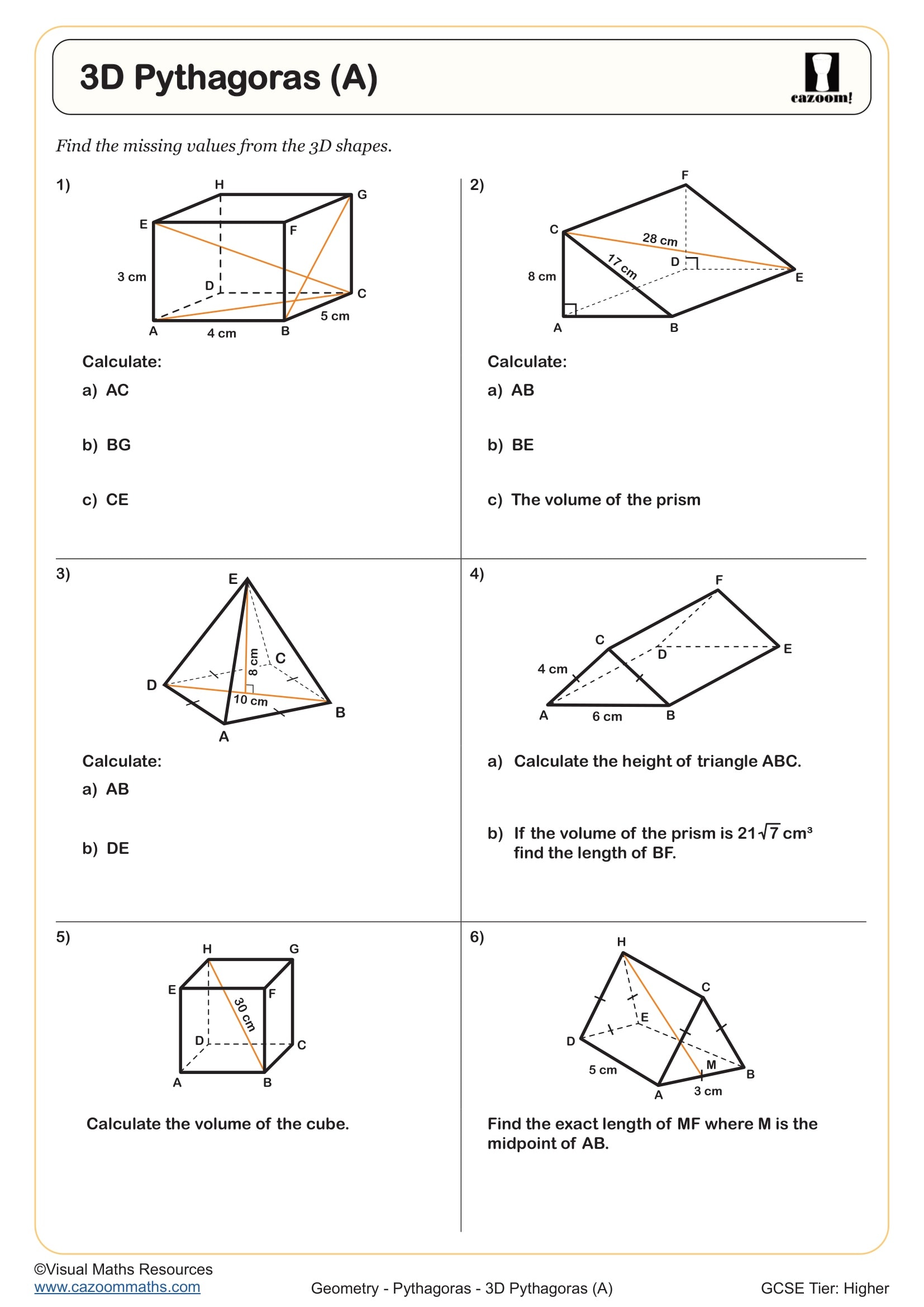
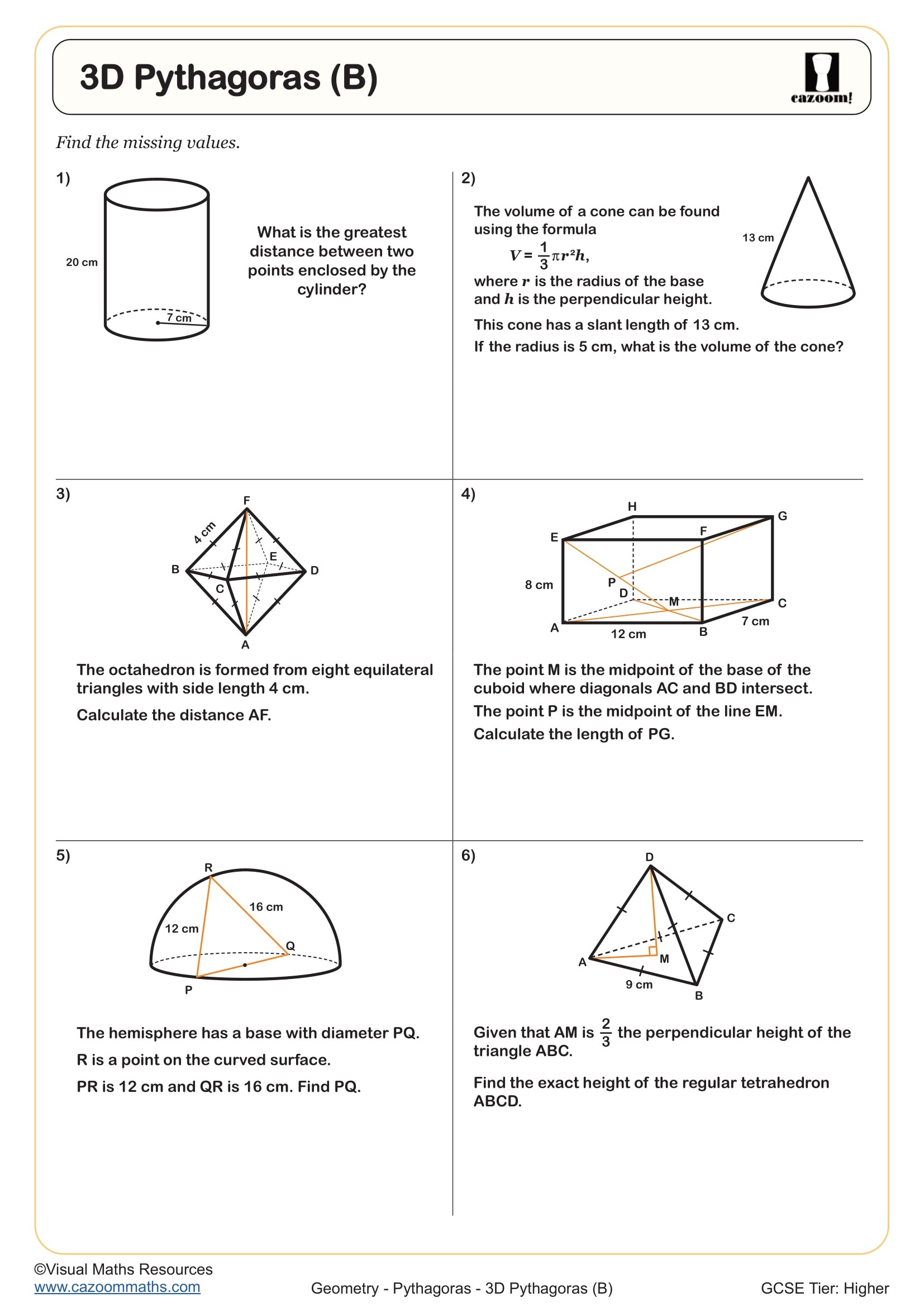
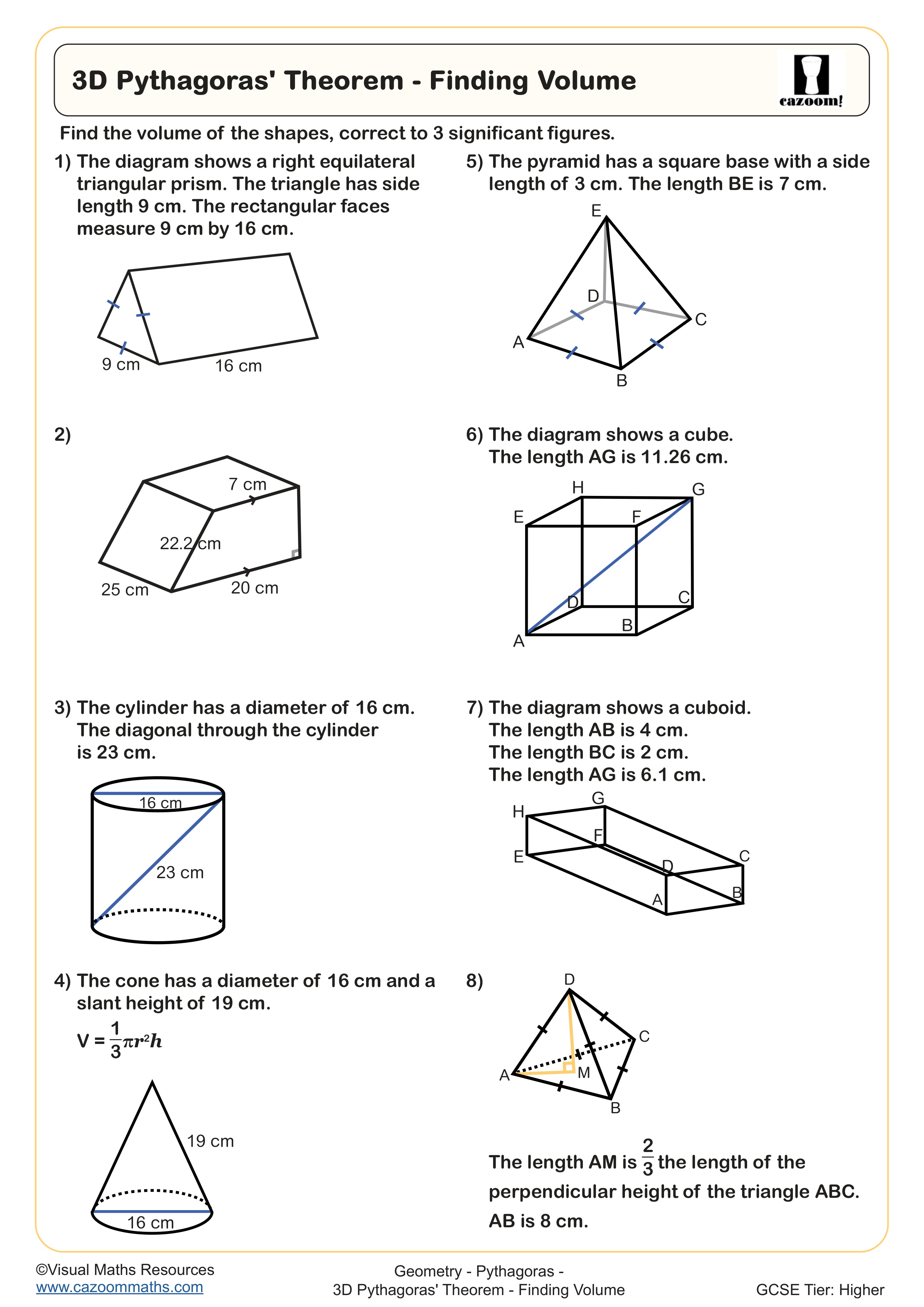
All worksheets are created by the team of experienced teachers at Cazoom Maths.
How do you use Pythagoras' theorem in 3D shapes?
Pythagoras' theorem applies to 3D shapes by identifying right-angled triangles within the solid. For cuboids, students typically need to find a face diagonal first (using two edges), then use that diagonal with a third edge to calculate the space diagonal. In pyramids and cones, the vertical height, slant height, and base radius form a right-angled triangle.
The most common error occurs when students try to use three measurements simultaneously in one calculation. Pythagoras only works with two sides at a time, so problems involving cuboid space diagonals require two separate applications. Exam mark schemes specifically allocate marks for showing this two-stage process, and students lose marks when they attempt shortcuts or apply the theorem incorrectly to non-right-angled triangles.
Which year groups study Pythagoras in 3D?
Pythagoras in 3D shapes appears in Year 10 and Year 11 as part of the GCSE Higher tier curriculum. Students typically meet this after mastering Pythagoras in 2D contexts, building on their understanding of the theorem's application to flat shapes. This topic forms part of the Geometry and Measures strand and connects directly to problem-solving skills tested in non-calculator papers.
The progression involves increasing complexity in the shapes encountered and the number of calculations required. Year 10 students often begin with cuboids and straightforward pyramids where dimensions are clearly labelled. By Year 11, problems involve compound shapes, missing information that must be deduced, and multi-step questions combining Pythagoras with other geometric properties such as similar triangles or trigonometry.
What is the space diagonal formula for a cuboid?
The space diagonal of a cuboid is the longest straight line connecting opposite vertices through the interior. While students can derive this using Pythagoras twice, the direct formula is d² = l² + w² + h², where l, w, and h represent length, width, and height. This formula essentially combines two applications of Pythagoras' theorem into one step, though exam questions often require students to show the two-stage method.
This calculation has practical applications in packaging design and construction. Warehouse managers use space diagonal calculations to determine whether long items like pipes or timber can fit diagonally inside shipping containers. Aircraft cargo hold designers apply the same principle when calculating whether items can be loaded at angles. Engineers working on wind turbine transportation regularly calculate vehicle dimensions needed to transport blades that may travel diagonally within the load space.
How can these worksheets improve understanding of 3D Pythagoras?
These worksheets build confidence through carefully sequenced problems that develop visualisation skills alongside calculation techniques. Questions progress from clearly labelled diagrams to shapes where students must identify the relevant triangle themselves. Answer sheets provide worked solutions showing each step of the process, which helps students understand the logic behind identifying which lengths to use first.
Teachers find these resources particularly useful for small group intervention with students who struggle with spatial reasoning. The worksheets work well as paired activities where students explain their thinking to each other, helping to articulate which triangle they're using and why. Many teachers set these for homework after introducing the topic, using the answer sheets for self-assessment before dedicating lesson time to addressing misconceptions revealed by common errors.