Pythagoras in Right Angled Triangles Worksheets
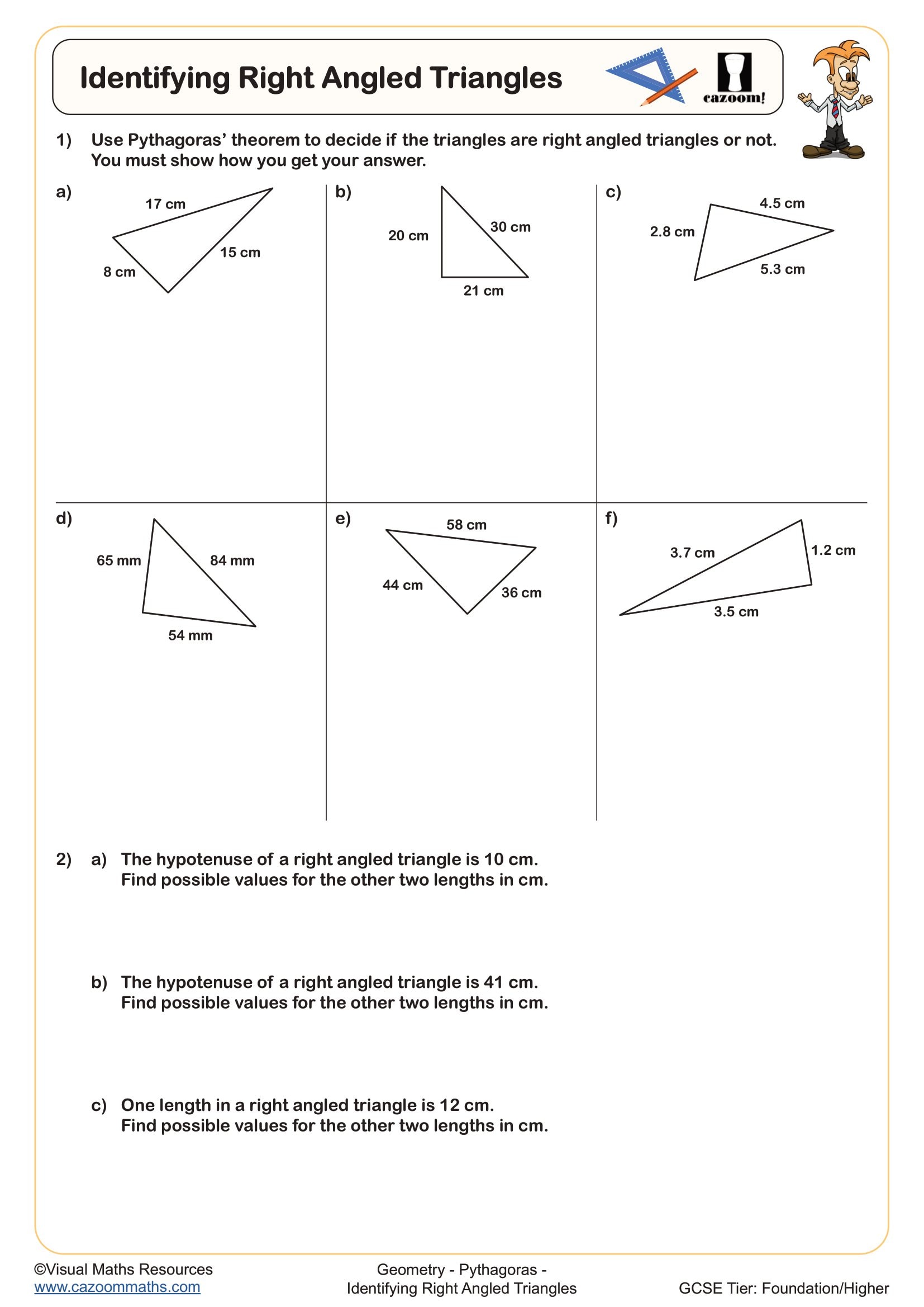
Identifying Right Angled Triangles
Year groups: 9, 10
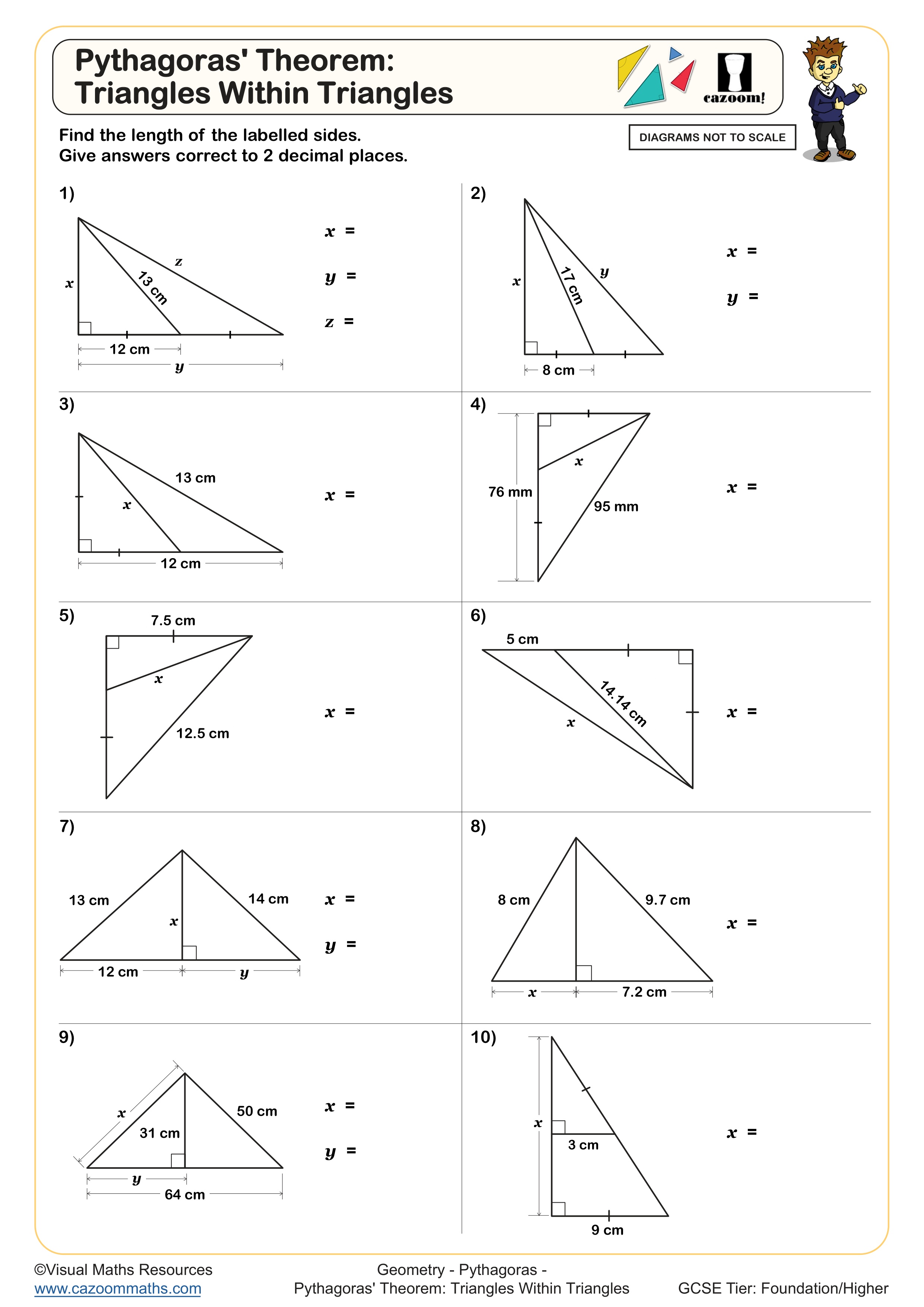
Pythagoras' Theorem: Triangles Within Triangles
Year groups: 9, 10
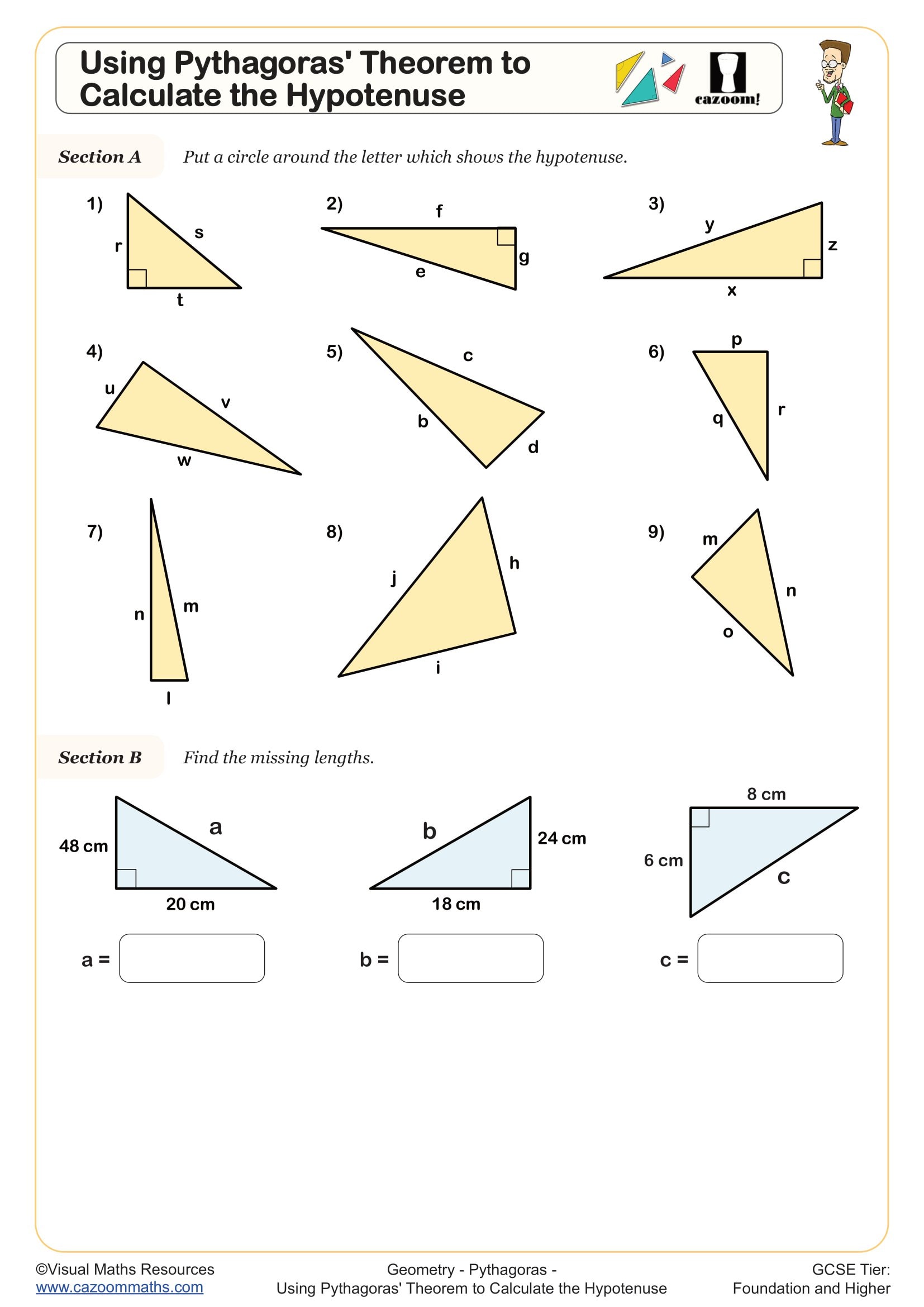
Using Pythagoras Theorem to Calculate the Hypotenuse
Year groups: 9, 10, 11
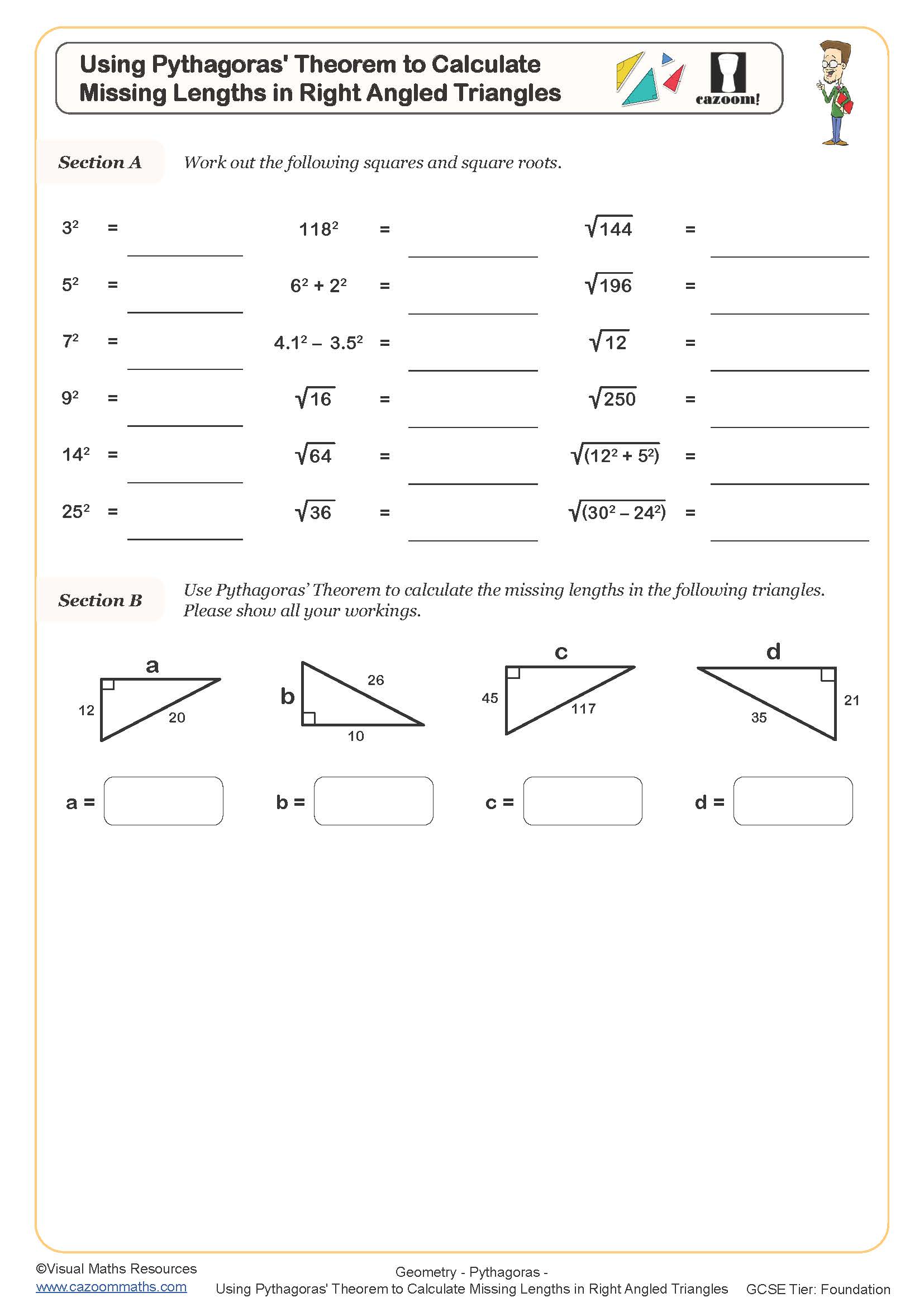
Using Pythagoras' Theorem to Calculate Missing Lengths in Right Angled Triangles
Year groups: 9, 10, 11
Pythagoras with Surds
Year groups: 10, 11
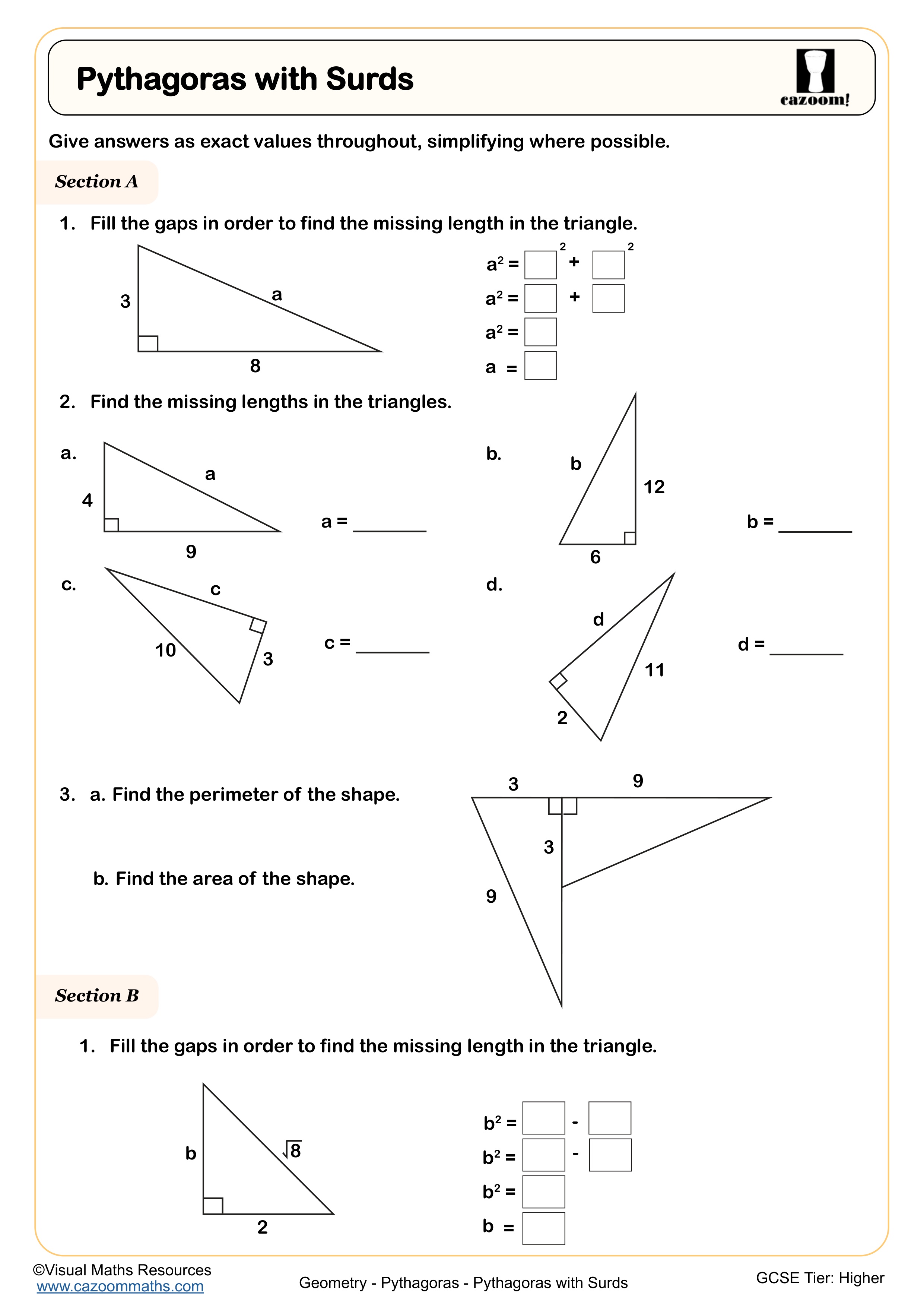
All worksheets are created by the team of experienced teachers at Cazoom Maths.
What is Pythagoras' theorem and how does it work?
Pythagoras' theorem states that in any right-angled triangle, the square of the hypotenuse (the longest side opposite the right angle) equals the sum of the squares of the other two sides. Written as a² + b² = c², where c represents the hypotenuse, this relationship allows students to calculate any missing side length when two sides are known. The theorem only applies to right-angled triangles, and students must identify the right angle before determining which side is the hypotenuse.
Many students lose marks in exams by squaring the numbers correctly but forgetting to square root their final answer when finding a missing side. For example, when finding c with a = 3 and b = 4, students calculate 9 + 16 = 25 but write 25 as their answer instead of √25 = 5. Exam mark schemes penalise this heavily, as it demonstrates incomplete method despite correct working up to that point.
Which year groups study Pythagoras in right angled triangles?
Students encounter Pythagoras' theorem from Year 9 onwards, with initial work at Key Stage 3 focusing on calculating the hypotenuse when both shorter sides are given. Year 10 extends this to finding shorter sides and working with decimal lengths, whilst Year 11 worksheets incorporate Pythagoras into more complex problem-solving contexts including coordinate geometry, isosceles triangles, and three-dimensional shapes. This topic appears on both GCSE foundation and higher tier papers, making it non-negotiable for all students regardless of their target grade.
The progression across year groups reflects increasing demand: Year 9 typically works with integer triples (3-4-5, 5-12-13) before introducing non-integer answers, Year 10 expects fluency with rearranging the formula when a shorter side is missing, and Year 11 combines Pythagoras with other geometry skills. Students working towards higher tier need confidence applying the theorem in unfamiliar contexts, including recognising when Pythagoras is the appropriate method without being explicitly told.
How do you find a shorter side using Pythagoras' theorem?
Finding a shorter side requires rearranging Pythagoras' theorem because the missing side is not the hypotenuse. If the hypotenuse c is known and one shorter side a is given, students rearrange a² + b² = c² to b² = c² - a², then find b by square rooting. The key understanding is recognising that the hypotenuse squared minus one side squared gives the square of the remaining side. Students who attempt to substitute the known shorter side as c make significant errors, reinforcing why identifying the hypotenuse first matters.
Construction and engineering rely heavily on this calculation. When designing roof trusses, architects know the span (base) and the height the roof must reach, then calculate the rafter length using Pythagoras. Similarly, structural engineers checking whether support beams are perpendicular verify measurements using the 3-4-5 ratio and its multiples. This same principle applies when setting out building foundations, where accuracy within millimetres prevents costly structural issues later in construction projects.
How can teachers use these Pythagoras worksheets effectively?
The worksheets scaffold learning by presenting questions with clear diagrams showing the right angle and labelled sides, helping students identify the hypotenuse before attempting calculations. Questions progress from finding the hypotenuse with simple integers to finding shorter sides with decimal values, allowing teachers to target specific skills students find challenging. The included answer sheets show exact answers and rounded decimals where appropriate, helping students check not just their final answers but also whether they've applied correct rounding for context.
These resources work particularly well for intervention groups where students need additional practice outside whole-class teaching, or as homework following initial instruction. Teachers often use selected questions for low-stakes retrieval practice at lesson starts, whilst paired work allows students to compare methods and catch calculation errors before checking answers. The clear structure makes them suitable for cover lessons or independent revision, as students can work through problems systematically without requiring constant teacher input.