Scale Worksheets
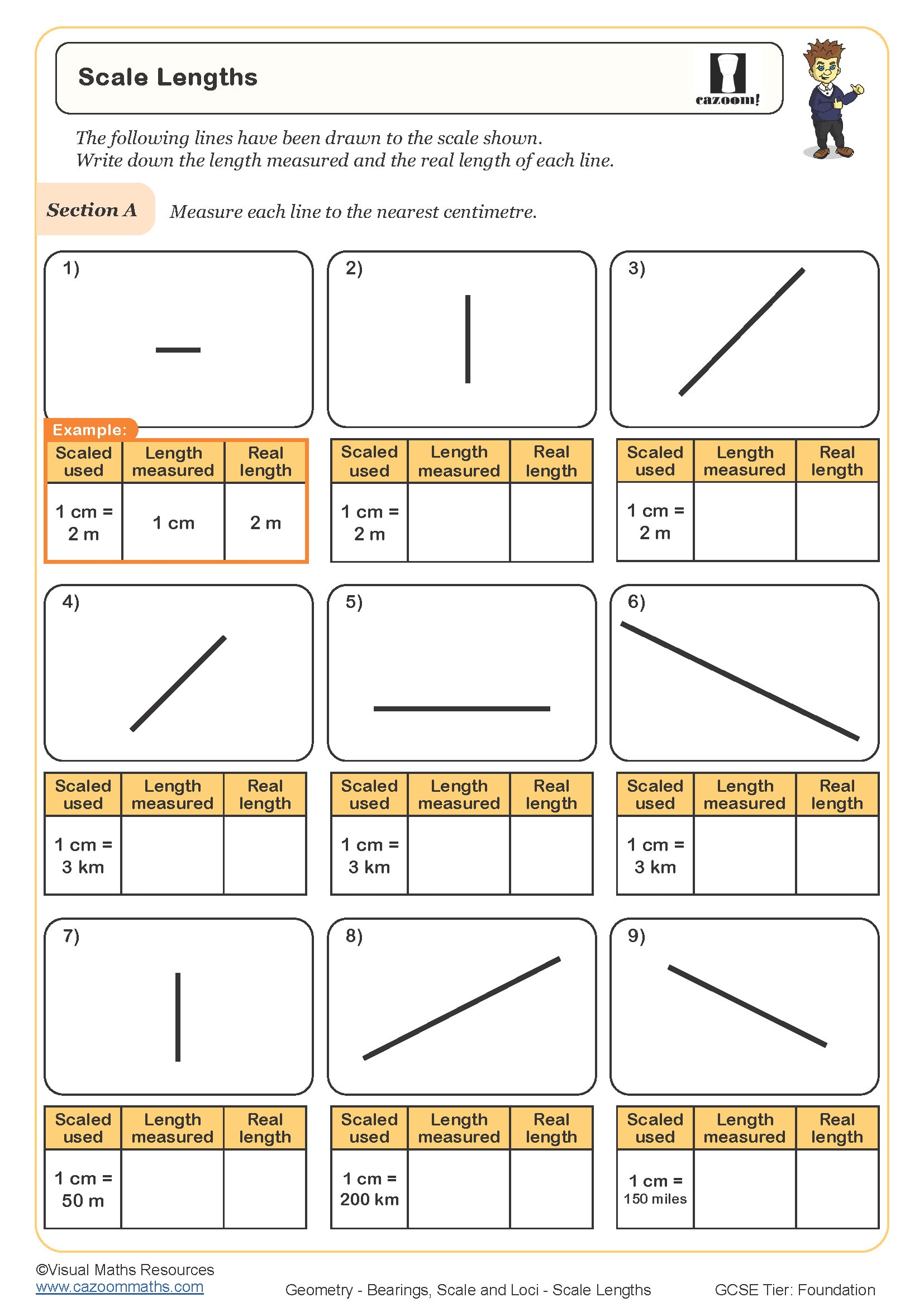
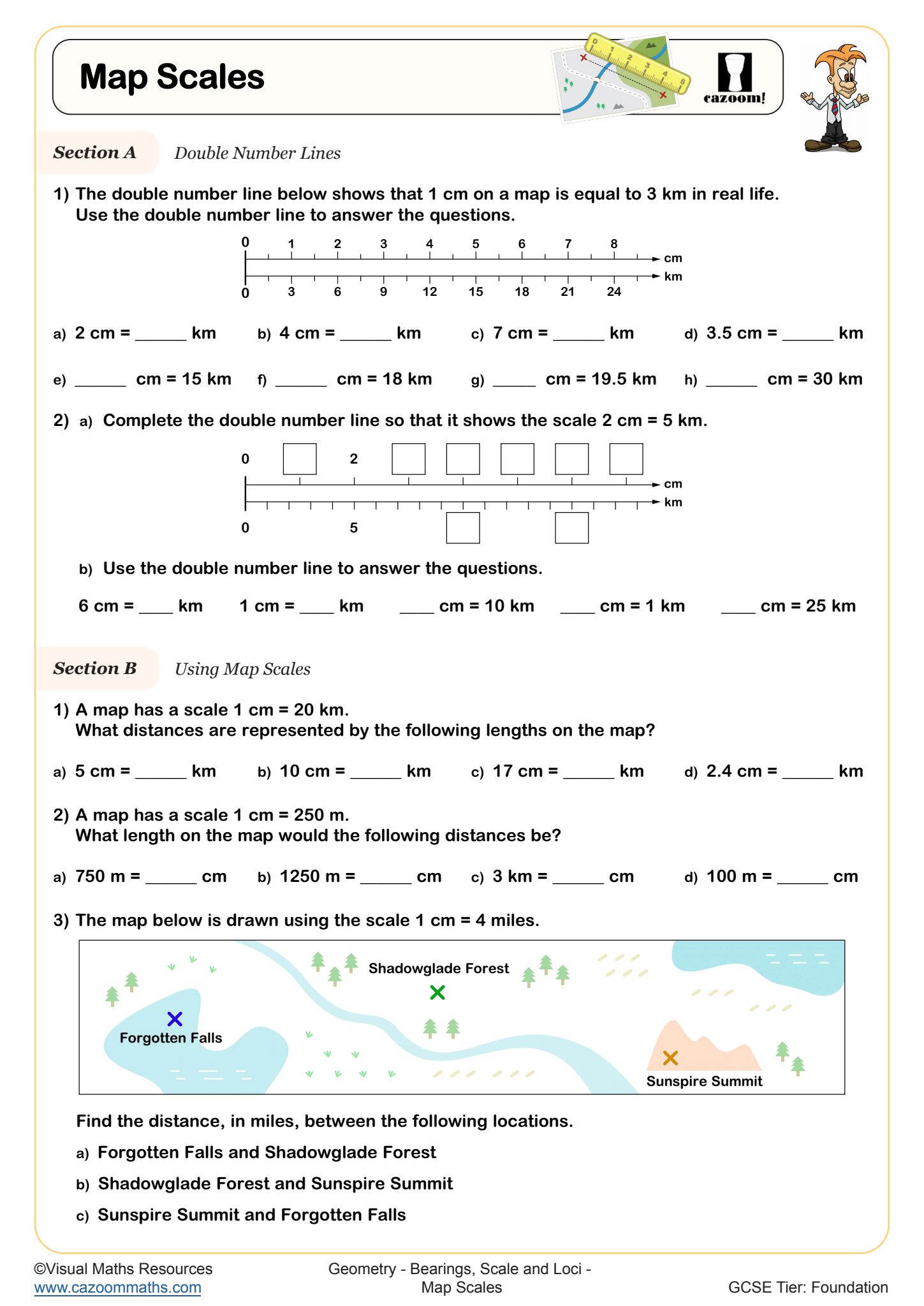
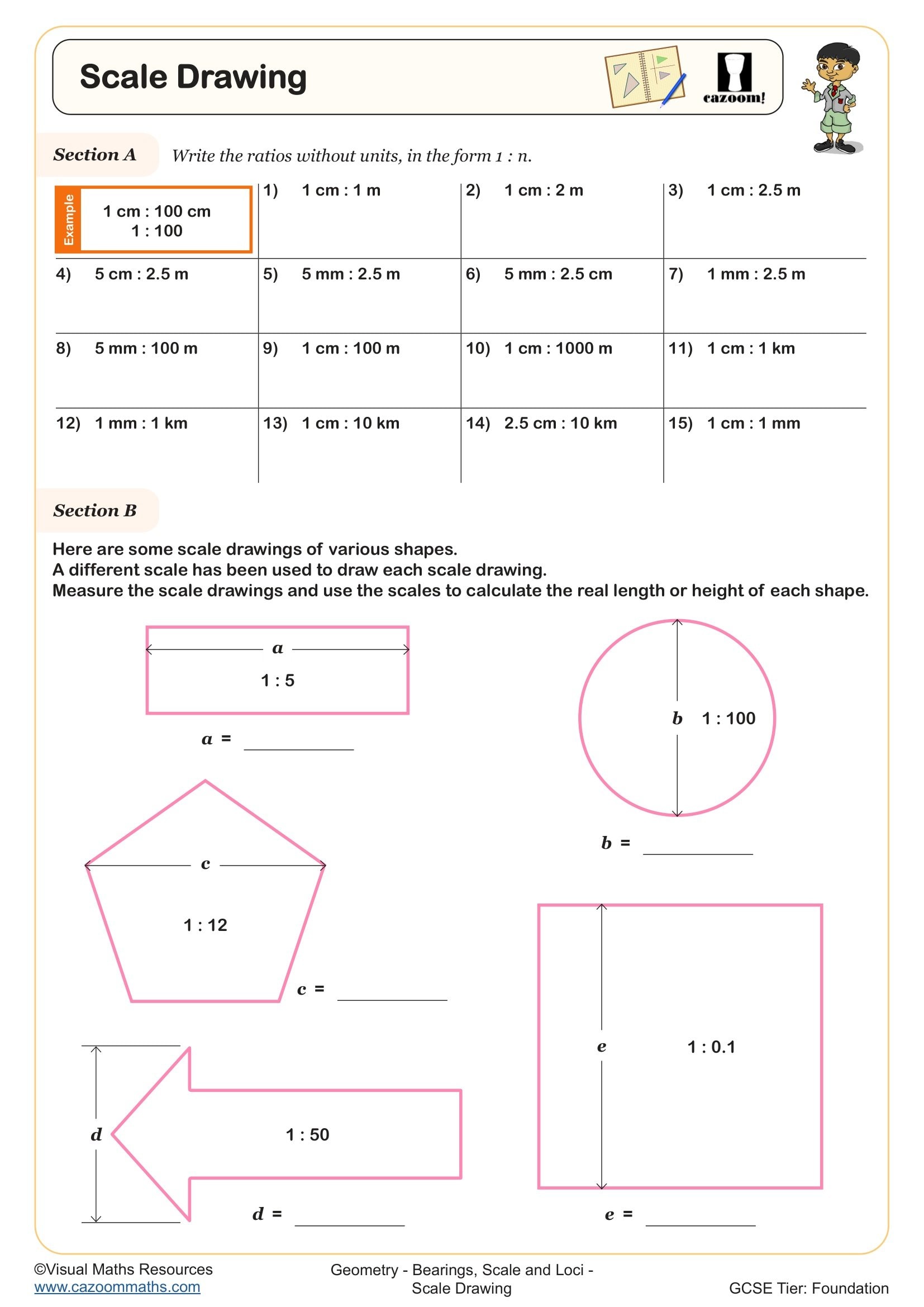
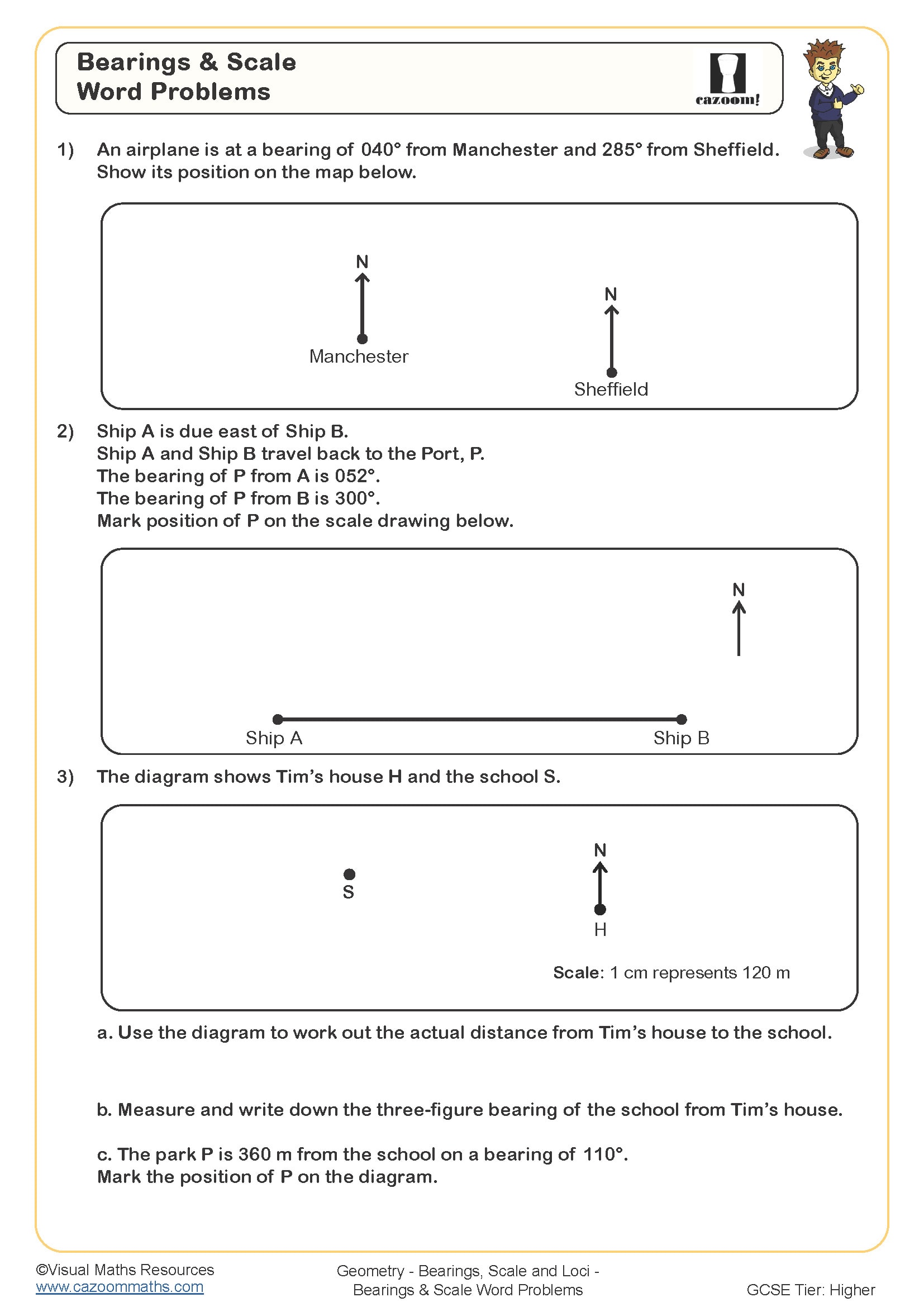
All worksheets are created by the team of experienced teachers at Cazoom Maths.
What are scale worksheets used for in maths?
Scale worksheets develop students' understanding of proportional relationships and how to enlarge or reduce shapes using scale factors. In the National Curriculum, this sits within ratio and proportion at KS3, then extends to transformations at KS4 where scale factors link to similarity and congruence. Students apply these skills when reading maps, technical drawings, and architectural plans, as well as in GCSE questions worth multiple marks.
A common error occurs when students multiply when they should divide, particularly when finding original lengths from scaled diagrams. Students often lose marks by mixing up whether they're enlarging or reducing, especially when the scale is given as a ratio like 1:50 rather than as a single multiplier. Teachers see this confusion most clearly when word problems require students to determine the direction of scaling themselves.
Which year groups study scale in maths?
This collection covers Year 7 through Year 11, spanning both Key Stage 3 and Key Stage 4. Scale is introduced in Year 7 as simple scale drawings with whole number scale factors, then develops through Year 8 and Year 9 where students work with ratio notation and more complex diagrams. By KS4, students tackle fractional scale factors (enlarging and reducing), negative scale factors that involve rotation, and centres of enlargement in coordinate geometry.
The progression moves from concrete measurement tasks towards abstract algebraic reasoning. Year 7 students might measure a scale drawing to find actual lengths, whilst Year 10 and 11 students calculate coordinates after enlargement from a given centre, determine scale factors from pairs of shapes, and work with fractional scales less than 1 that produce reductions. GCSE questions often combine scale with other topics like area scale factors or vector descriptions of transformations.
How do negative scale factors work in enlargements?
Negative scale factors produce an enlargement on the opposite side of the centre of enlargement, creating both a size change and a rotation of 180 degrees. If a shape is enlarged by scale factor -2 from a centre point, each vertex moves twice as far from the centre but in the opposite direction, resulting in an inverted image. This appears at GCSE higher tier and often catches students out because they focus only on the numerical value and forget the directional component.
Architects and engineers use negative scale factors in optical systems and projection mapping, where images need inverting whilst changing size. Camera lenses and microscopes both create enlarged, inverted images through similar mathematical principles. Students who understand negative scale factors find it easier to grasp how telescopes and projectors work, connecting classroom geometry to real optical equipment. This concept also links to vectors and transformations in further maths, where direction matters as much as magnitude.
How can teachers use these scale worksheets effectively?
The worksheets build systematically from straightforward scale diagram questions towards multi-step problems involving centres of enlargement and fractional factors. Each resource includes worked examples that model the method before students attempt similar problems, helping them understand the process rather than just memorising steps. The answer sheets show full working, which supports students who need to self-check their method when practising independently.
Many teachers use these resources for differentiated homework, assigning different worksheets based on prior assessment results. They work well in intervention sessions where small groups need focused practice on a specific aspect like finding scale factors or working with ratio notation. The range of subtopics means teachers can select worksheets that match current lesson content or provide mixed revision before assessments. Paired work sessions allow students to compare their diagram constructions and discuss any discrepancies in their scaled measurements.