Sine and Cosine Rules Worksheets
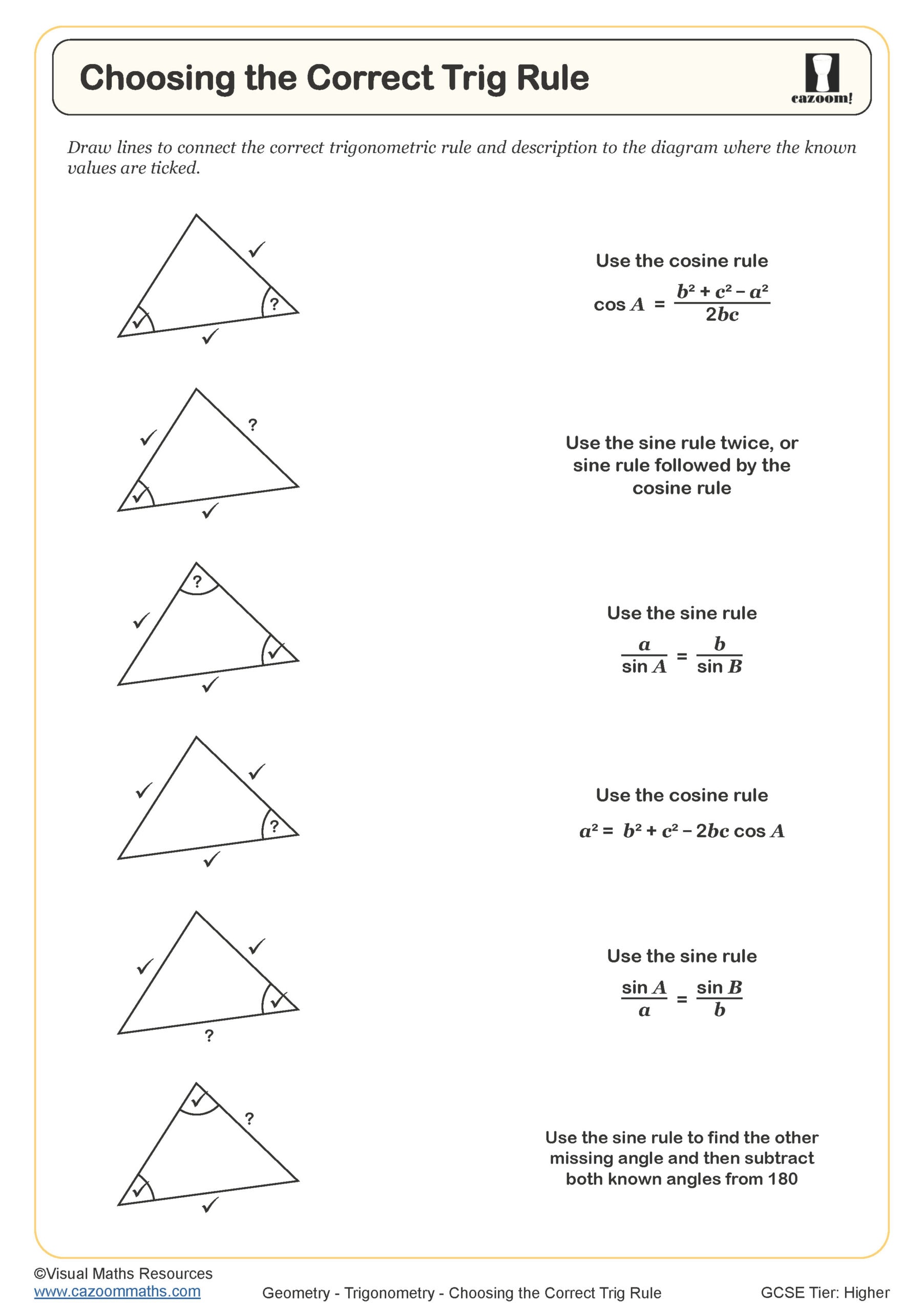
Choosing the Correct Trig Rule
Year groups: 10, 11
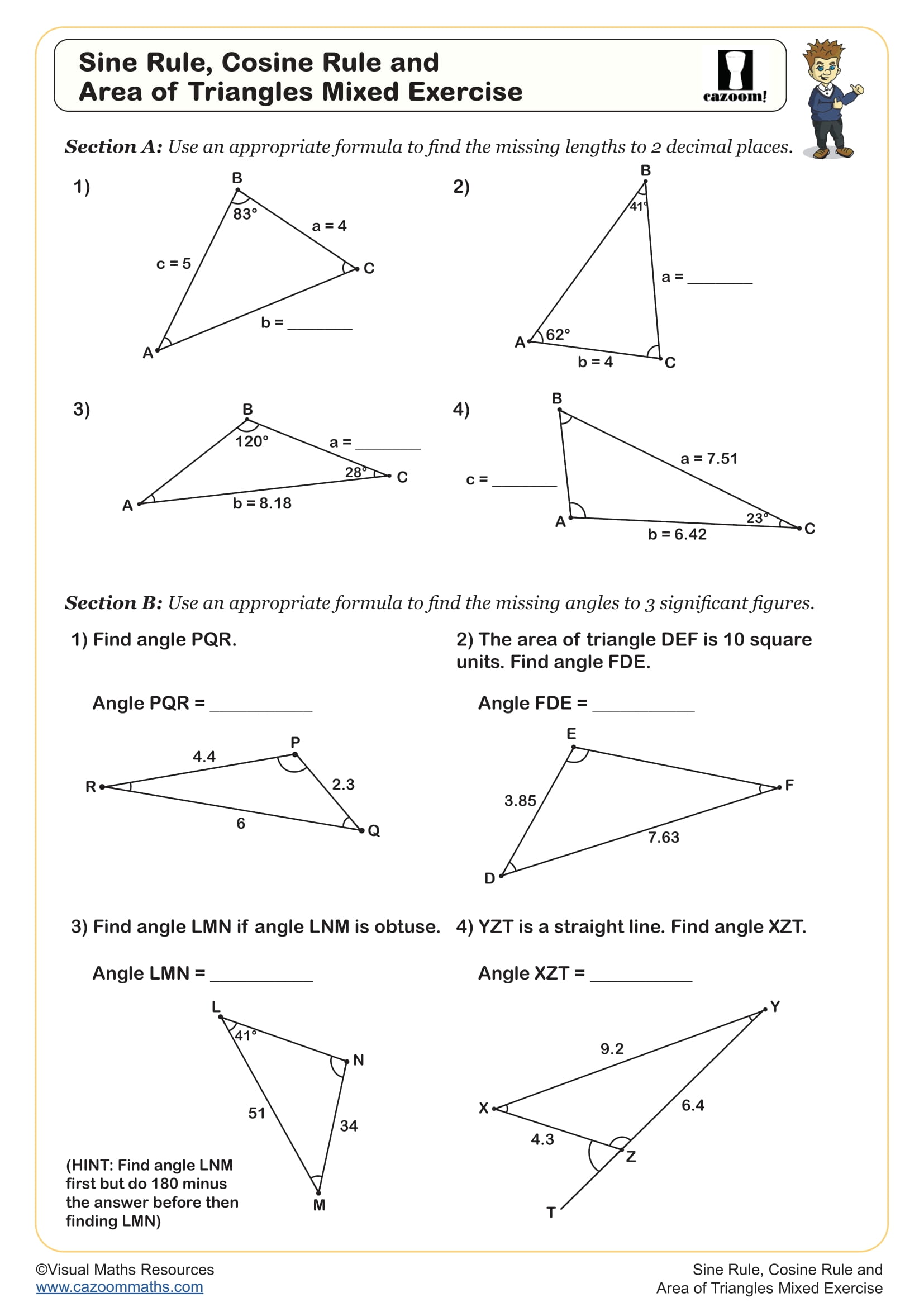
Sine Rule Cosine Rule and Area Mixed Exercise
Year groups: 10, 11
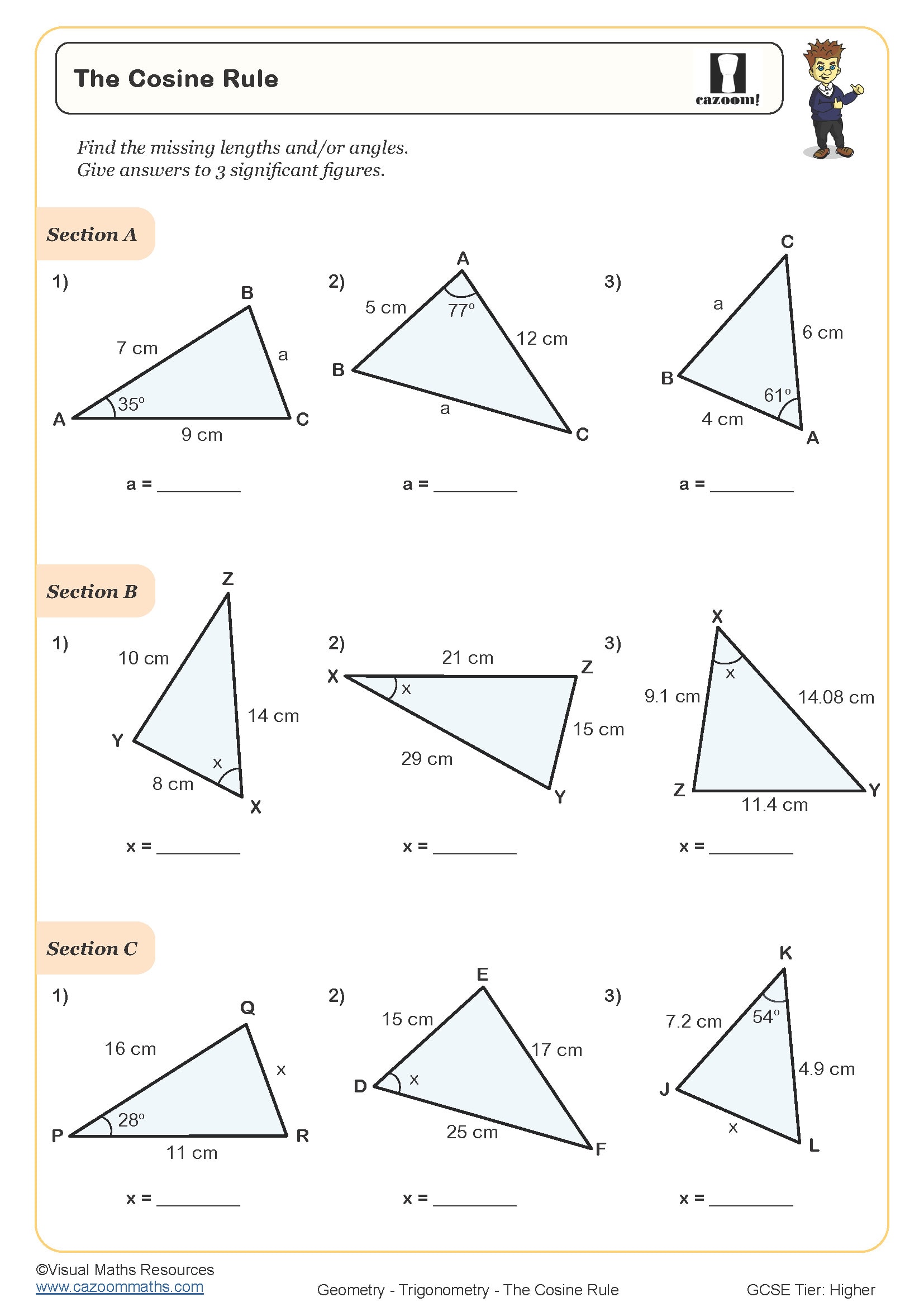
The Cosine Rule
Year groups: 10, 11
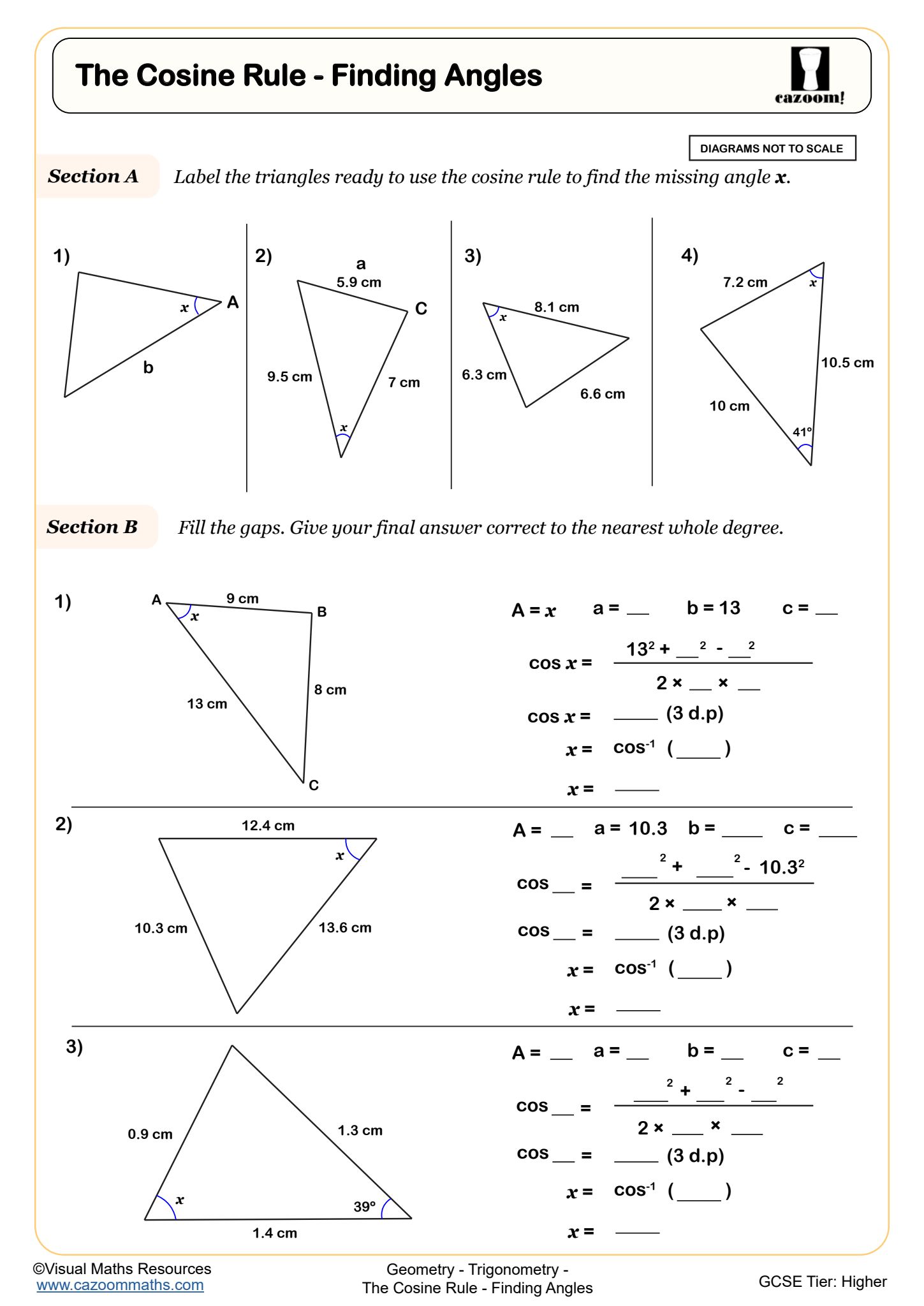
The Cosine Rule - Finding Angles
Year groups: 10, 11
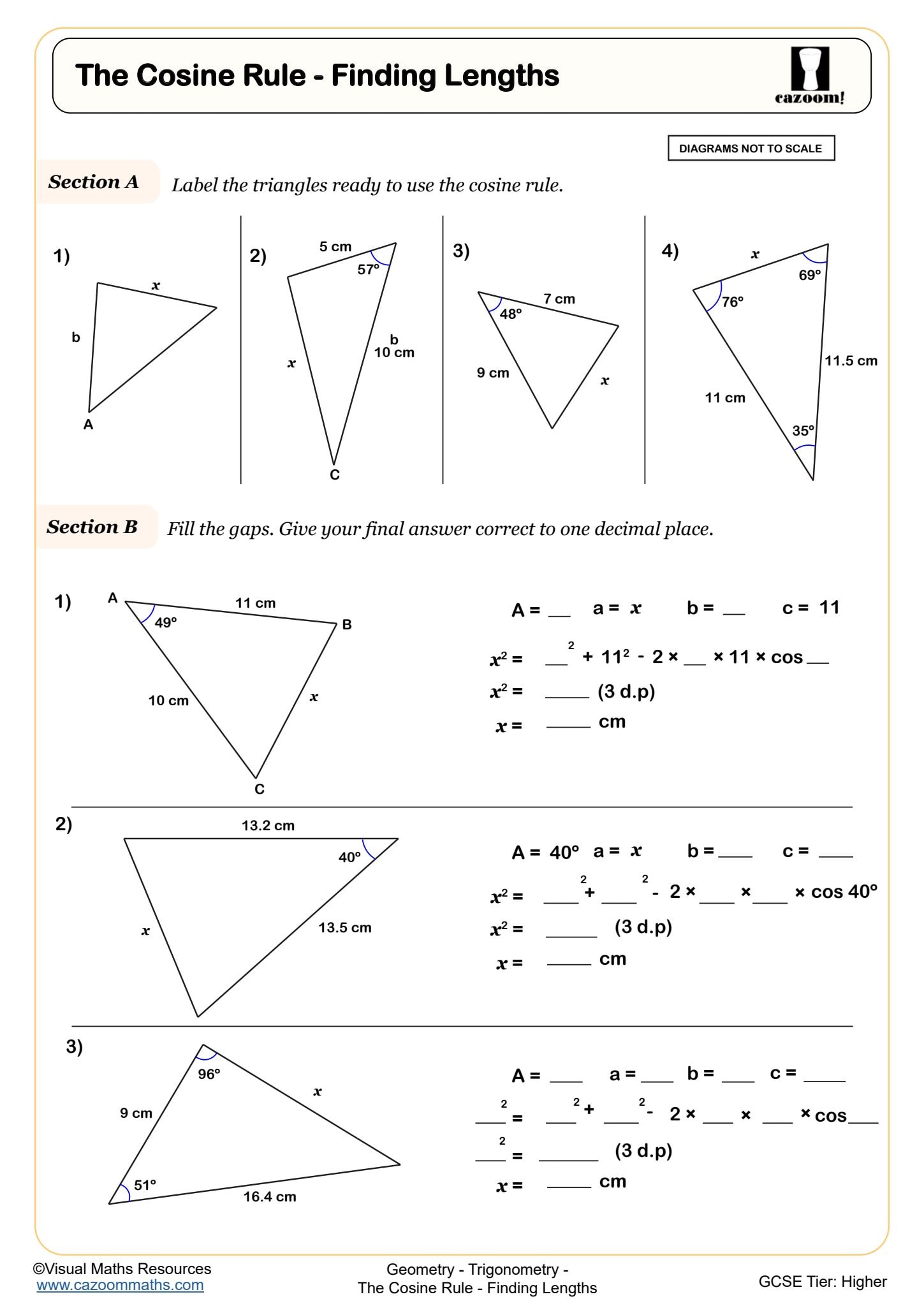
The Cosine Rule - Finding Lengths
Year groups: 10, 11
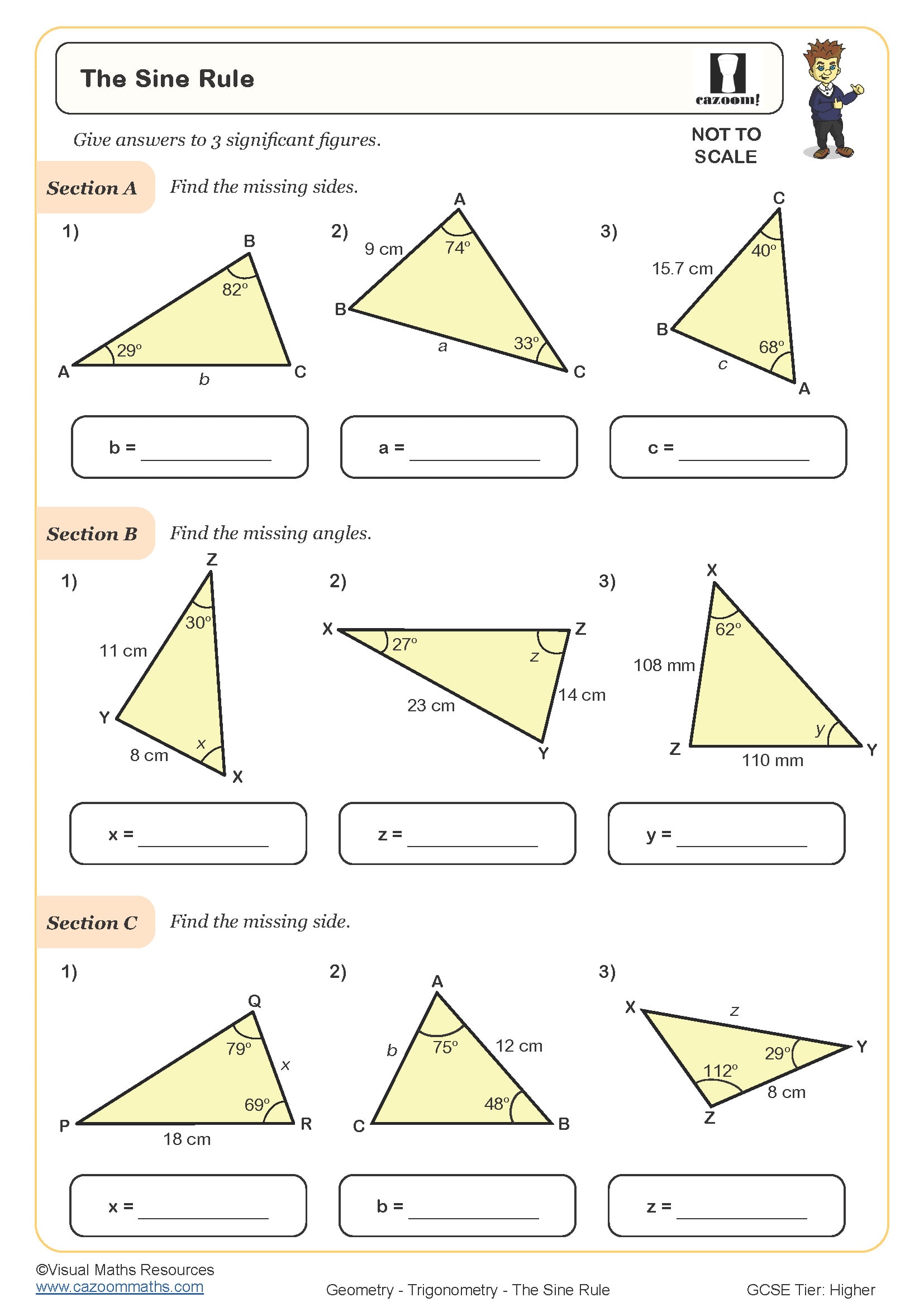
The Sine Rule
Year groups: 10, 11
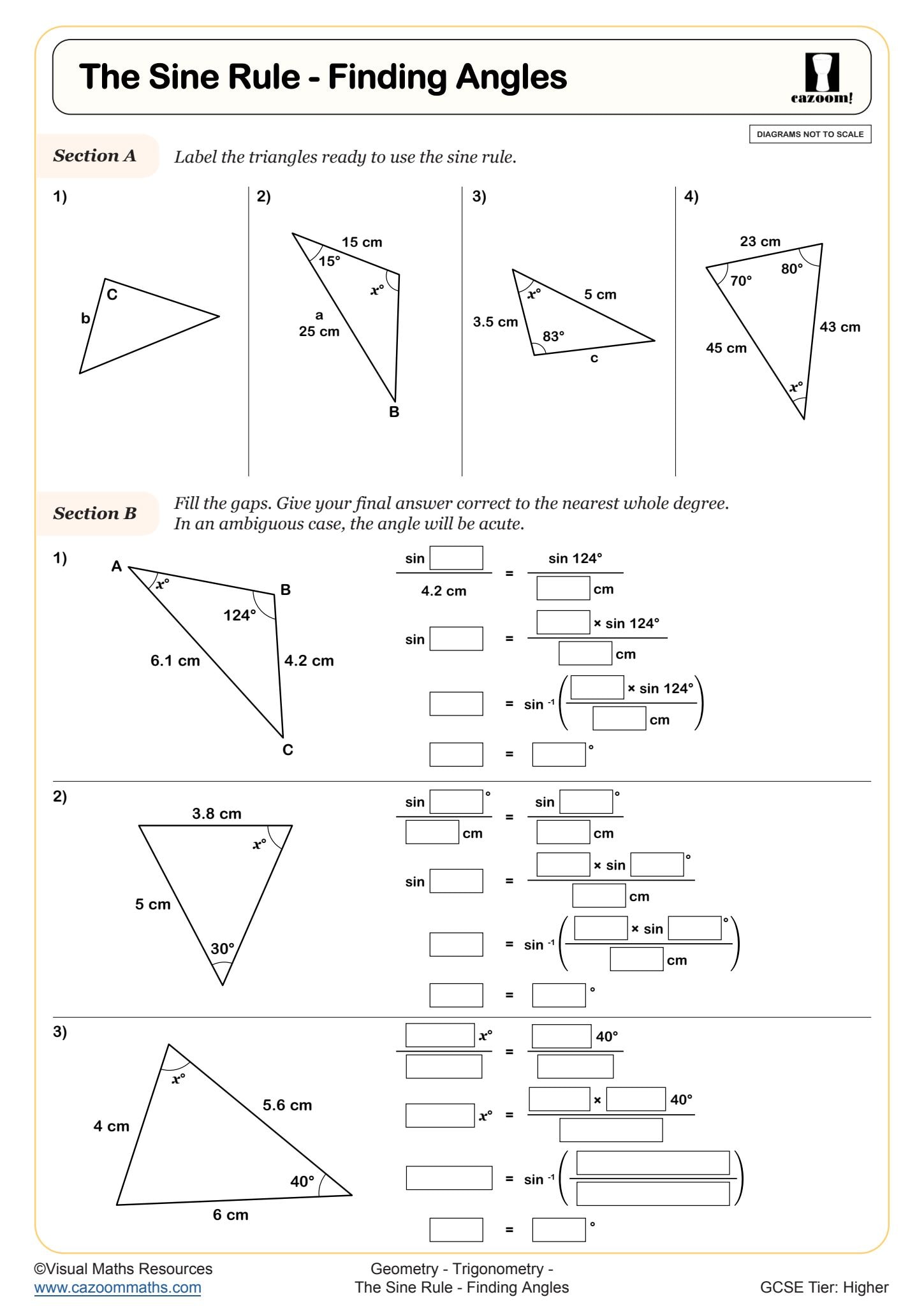
The Sine Rule - Finding Angles
Year groups: 10, 11
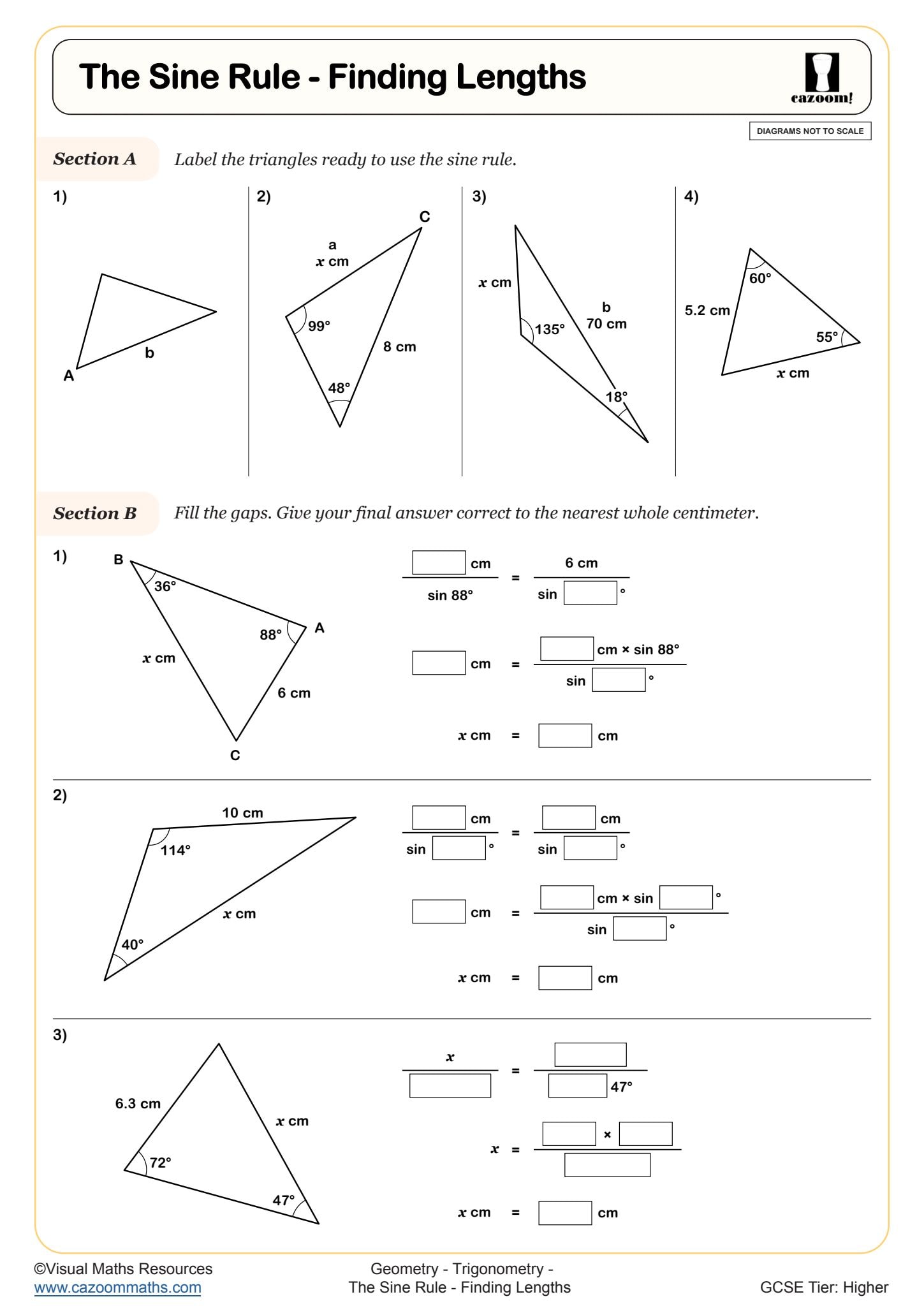
The Sine Rule - Finding Lengths
Year groups: 10, 11
All worksheets are created by the team of experienced teachers at Cazoom Maths.
What are the sine and cosine rules used for?
The sine and cosine rules extend trigonometry beyond right-angled triangles, allowing students to find missing sides and angles in any triangle. The sine rule connects opposite sides and angles through the relationship a/sin A = b/sin B = c/sin C, whilst the cosine rule provides a² = b² + c² - 2bc cos A. GCSE Higher tier students must know when each rule applies and how to rearrange formulas for different unknowns.
Exam questions typically provide diagrams where students must first identify which rule to apply. A common error occurs when students attempt to use the sine rule with two sides and the included angle, where the cosine rule is required. Mark schemes specifically penalise incorrect rule selection even if subsequent working is accurate, making this identification skill worth practising systematically before moving to calculation fluency.
Which year groups learn sine and cosine rules?
Sine and cosine rules appear in Year 10 and Year 11 as part of GCSE Higher tier content within the geometry and measures strand. Most schools introduce these rules after students have secured right-angled triangle trigonometry (SOH CAH TOA), typically in Year 10, as the concepts build directly on understanding how ratios relate angles to sides. This topic isn't covered at Foundation tier, making it a clear marker of Higher tier work.
Progression across these year groups focuses on increasing complexity rather than introducing entirely new rules. Year 10 work typically involves straightforward calculations with clearly labelled triangles, whilst Year 11 sees more disguised contexts, multi-step problems requiring both rules sequentially, and applications within bearings or 3D geometry. Students also progress from being given formula sheets to committing these rules to memory for the non-calculator paper.
How do you decide between using sine rule or cosine rule?
The decision hinges on what information the triangle provides. Use the sine rule when you have two angles and one side, or two sides and a non-included angle. Use the cosine rule when you have three sides, or two sides and the included angle between them. This decision-making process becomes automatic with practice, but teachers regularly notice students attempting sine rule first regardless of the given information, particularly when working under exam pressure.
Engineering and surveying rely heavily on these rules when measuring distances or angles that can't be accessed directly. Land surveyors use the sine and cosine rules to calculate property boundaries from accessible measurement points, whilst architects apply them when designing roof structures where angles and beam lengths must satisfy precise relationships. Navigation systems combine these rules with bearings to calculate shortest routes or determine positions from multiple fixed reference points.
How do these worksheets help students master sine and cosine rules?
The worksheets systematically develop skills from identifying which rule applies through to complex problem-solving. Early questions provide clearly labelled triangles where students practise selecting and applying the correct rule, whilst later questions embed triangles within worded contexts or require students to draw and label their own diagrams from descriptions. This scaffolding helps students build the pattern recognition that exam success requires, particularly for multi-step questions worth 4 or 5 marks.
Many teachers use these resources for targeted intervention with students who've grasped basic trigonometry but struggle with rule selection under exam conditions. The answer sheets support peer marking activities where students explain which rule they chose and why, developing mathematical reasoning alongside calculation skills. They're equally effective as homework to consolidate lesson content or as timed practice sessions where students develop the speed needed to complete GCSE papers within the allocated time.