Symmetry Worksheets
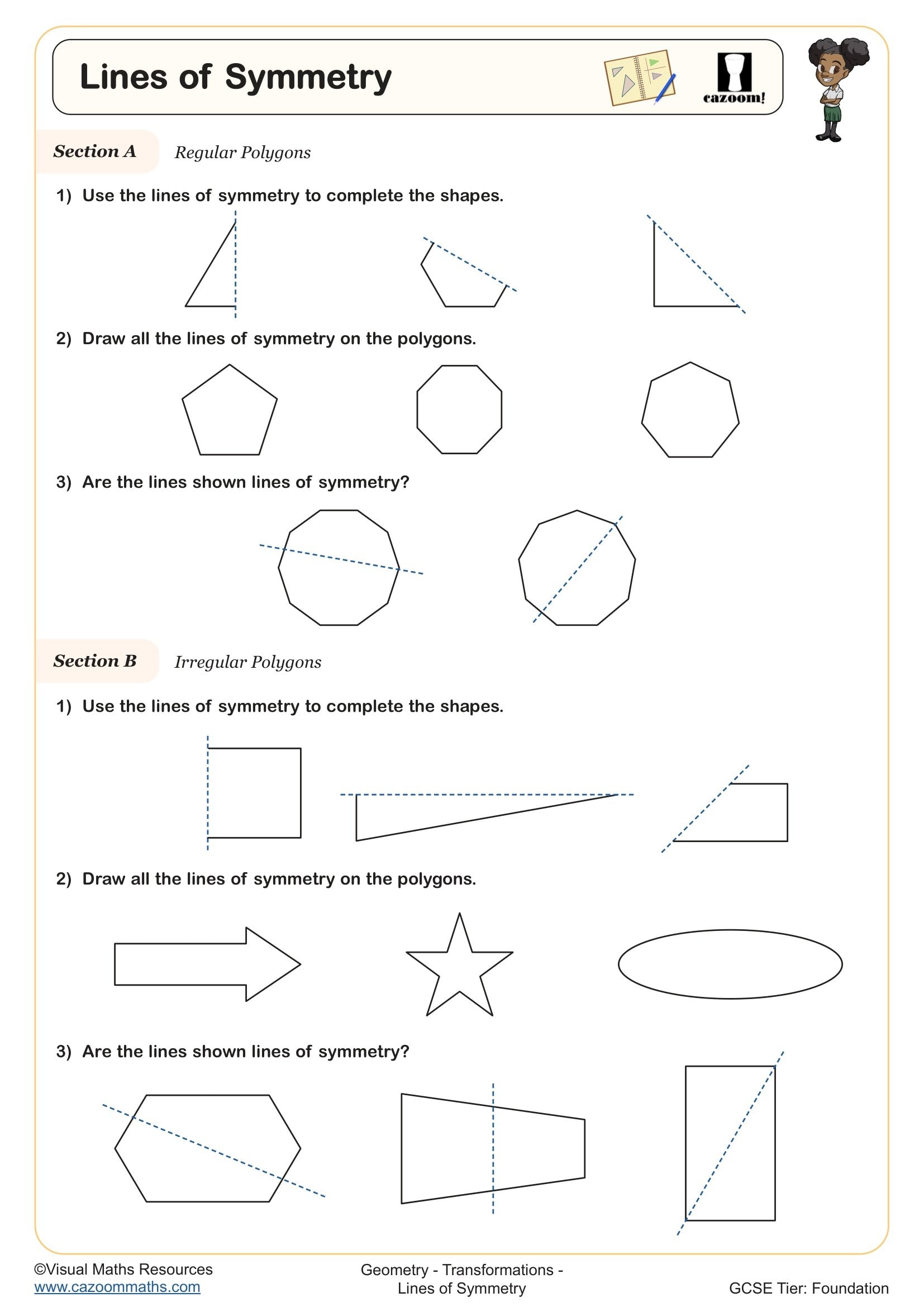
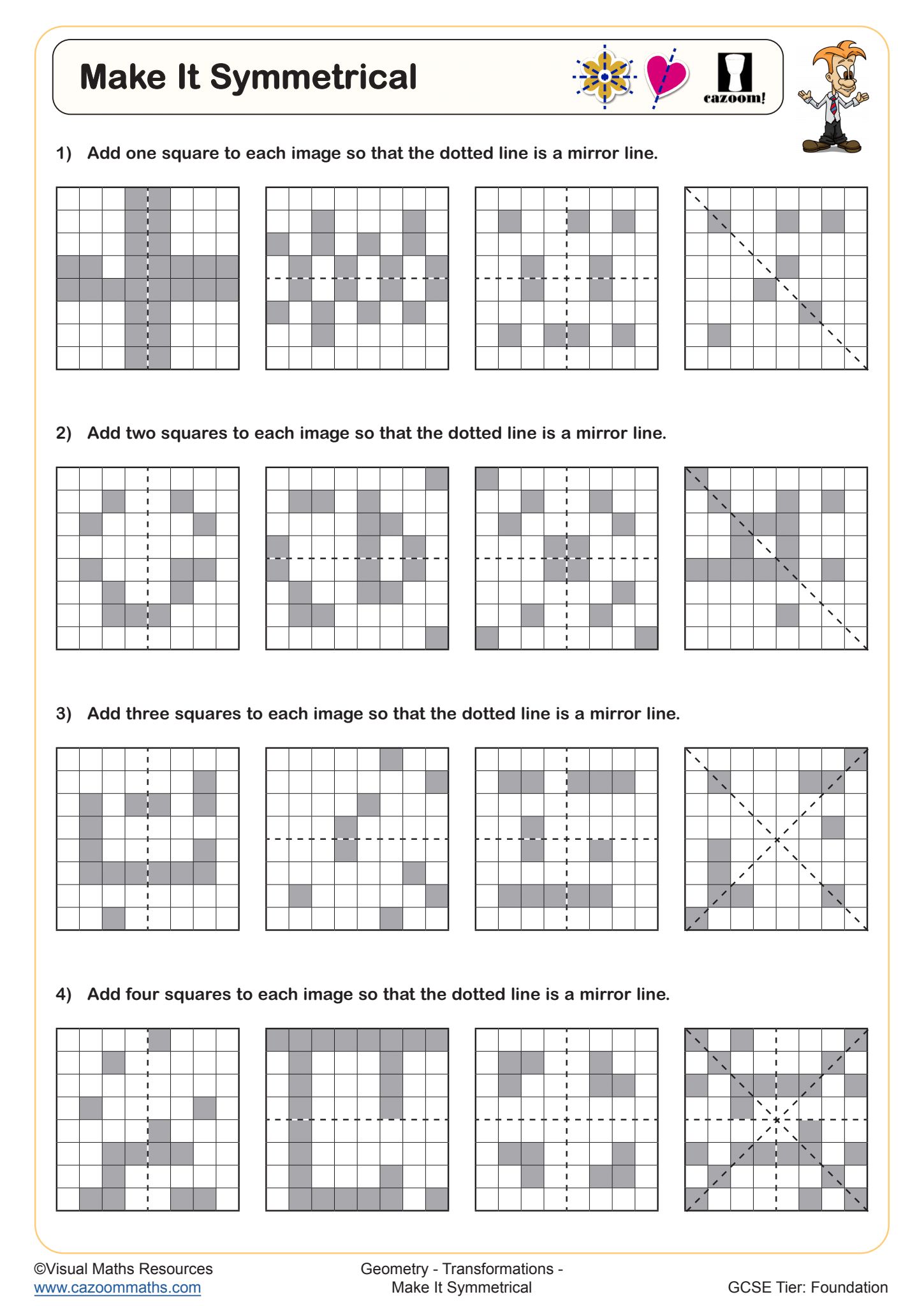
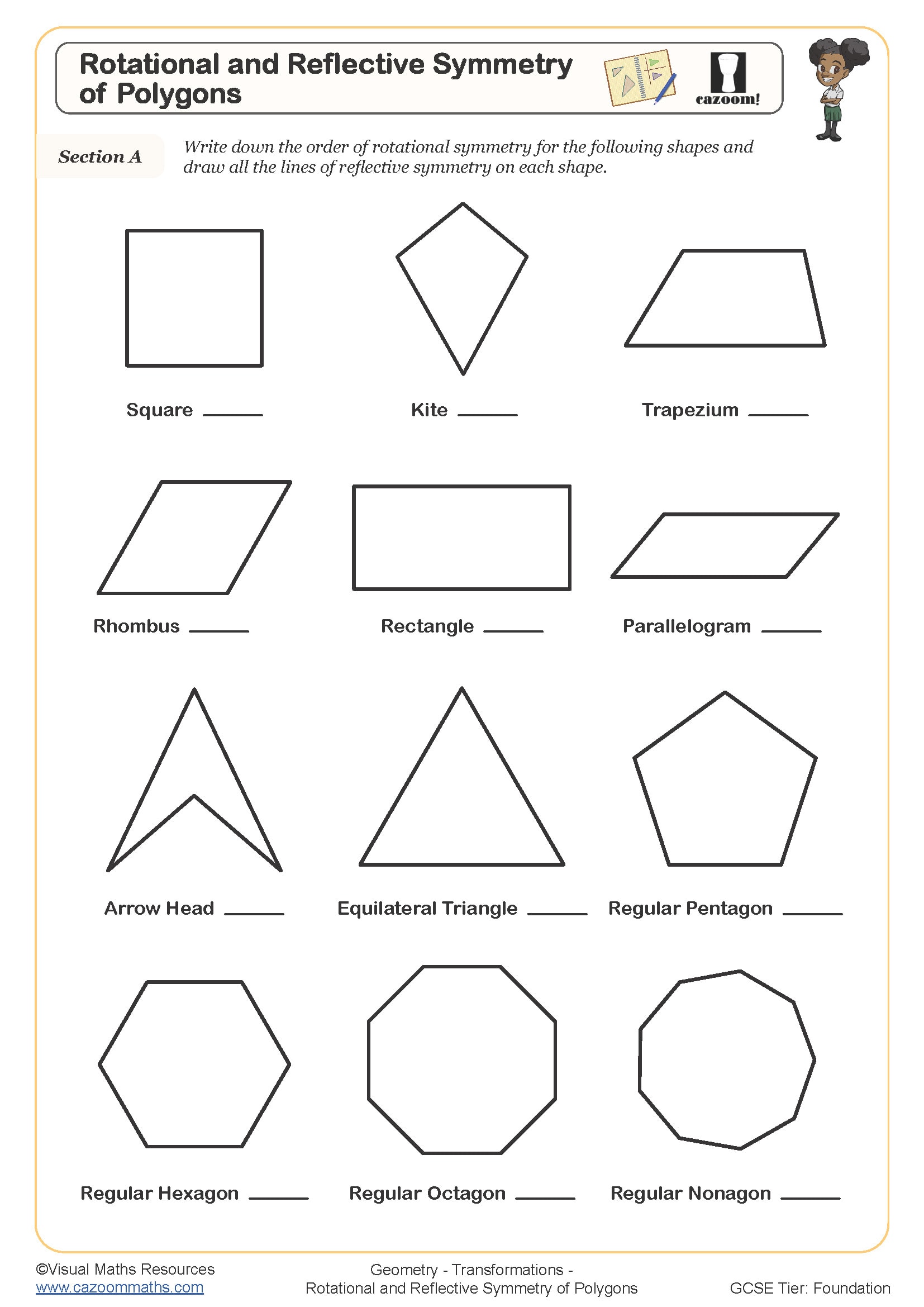
All worksheets are created by the team of experienced teachers at Cazoom Maths.
What types of practice do KS3 symmetry worksheets typically include?
Quality symmetry worksheets for KS3 cover identifying lines of symmetry in regular and irregular polygons, quadrilaterals, triangles, and compound shapes, alongside describing reflection transformations using mathematical language. Students practise counting lines of symmetry accurately and explaining their reasoning, which directly supports the National Curriculum requirements for understanding geometric properties and transformations.
Teachers frequently observe that students initially count rotational symmetry order instead of reflection lines, particularly with shapes like rectangles where they might incorrectly identify four lines rather than two. The most effective worksheet on symmetry includes clear diagrams with grid backgrounds, helping students visualise diagonal lines of symmetry that often prove most challenging to identify without guidance.
Which year groups benefit most from these symmetry resources?
These symmetry worksheets primarily target Year 7 and Year 8 students, building on the foundational symmetry concepts introduced in KS2 whilst preparing students for more advanced transformation geometry in Year 9. The progression typically moves from identifying single lines of symmetry to complex shapes with multiple lines, then connecting to coordinate geometry applications.
Year 7 teachers often use these resources early in the geometry unit when students transition from primary-level symmetry work to more formal mathematical descriptions of transformations. By Year 8, students should confidently identify all lines of symmetry in regular polygons and explain why certain shapes have specific numbers of symmetrical properties, supporting their preparation for GCSE transformation topics.
How do reflection symmetry worksheets support transformation understanding?
Reflection symmetry worksheet exercises help students understand that lines of symmetry act as mirrors, with each point on one side having a corresponding point equidistant on the opposite side. This concept directly connects to transformation geometry where students must describe reflections using precise mathematical language, including identifying the line of reflection and understanding invariant properties.
Teachers notice that students who master line symmetry identification develop stronger spatial awareness for coordinate transformations later in KS3. When students can visualise how shapes fold along symmetry lines, they more easily grasp concepts like perpendicular distance from points to reflection lines, which becomes crucial for GCSE-level transformation questions involving coordinates and equations of lines.
How can teachers use these worksheets most effectively in lessons?
Teachers achieve best results when using these symmetry worksheets as guided practice following practical activities with paper folding, mirrors, or tracing paper demonstrations. The structured progression from simple to complex shapes allows teachers to identify exactly where individual students begin struggling, particularly with diagonal lines of symmetry that don't align with obvious visual cues.
Many teachers find success using the answer sheets for peer marking activities, where students check each other's work and discuss any disagreements about symmetry lines. This approach encourages mathematical discussion and helps students articulate their reasoning. The worksheets work particularly well when teachers project answers onto whiteboards, allowing whole-class discussion of common misconceptions whilst students mark their own attempts.