Translation Worksheets
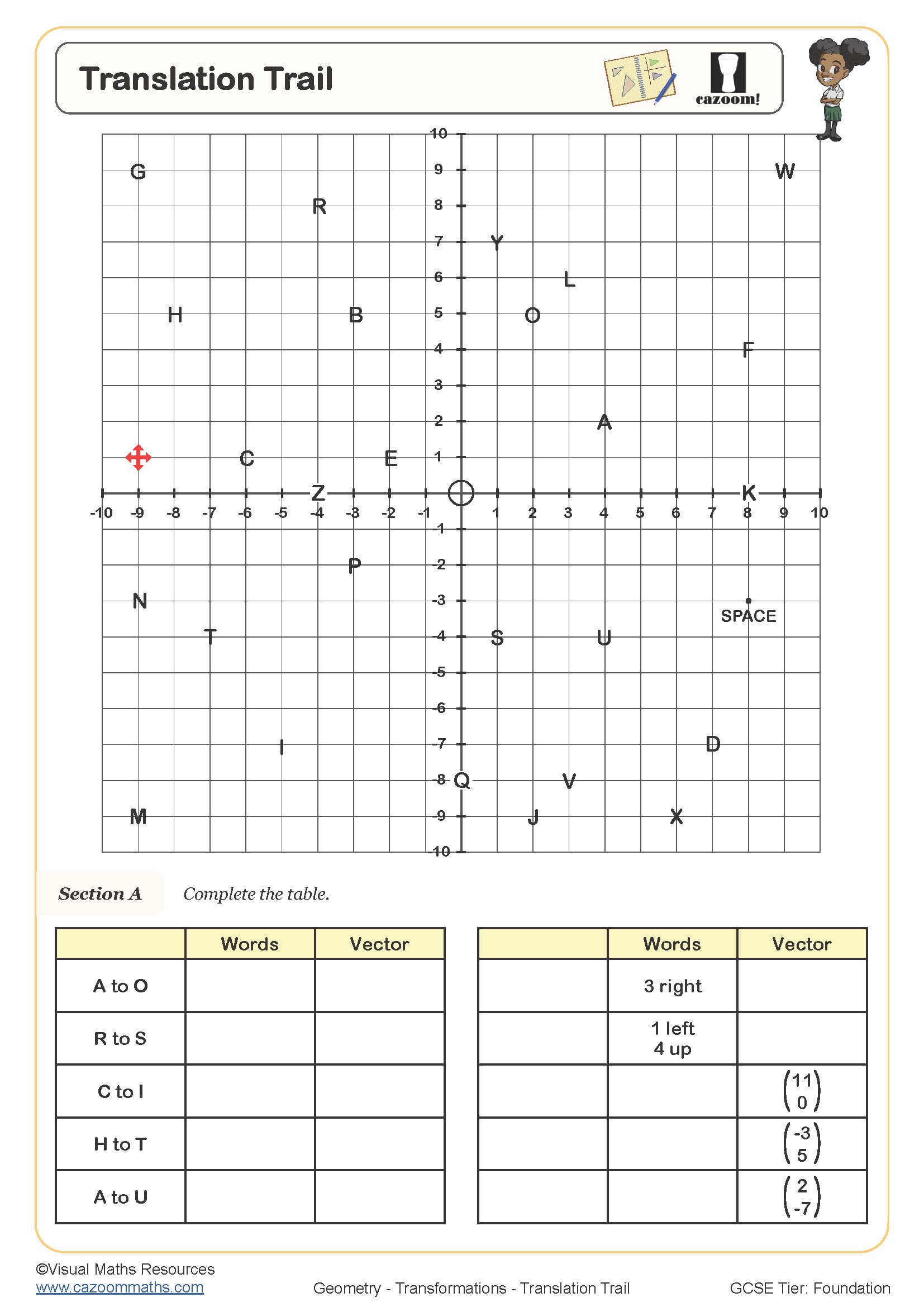
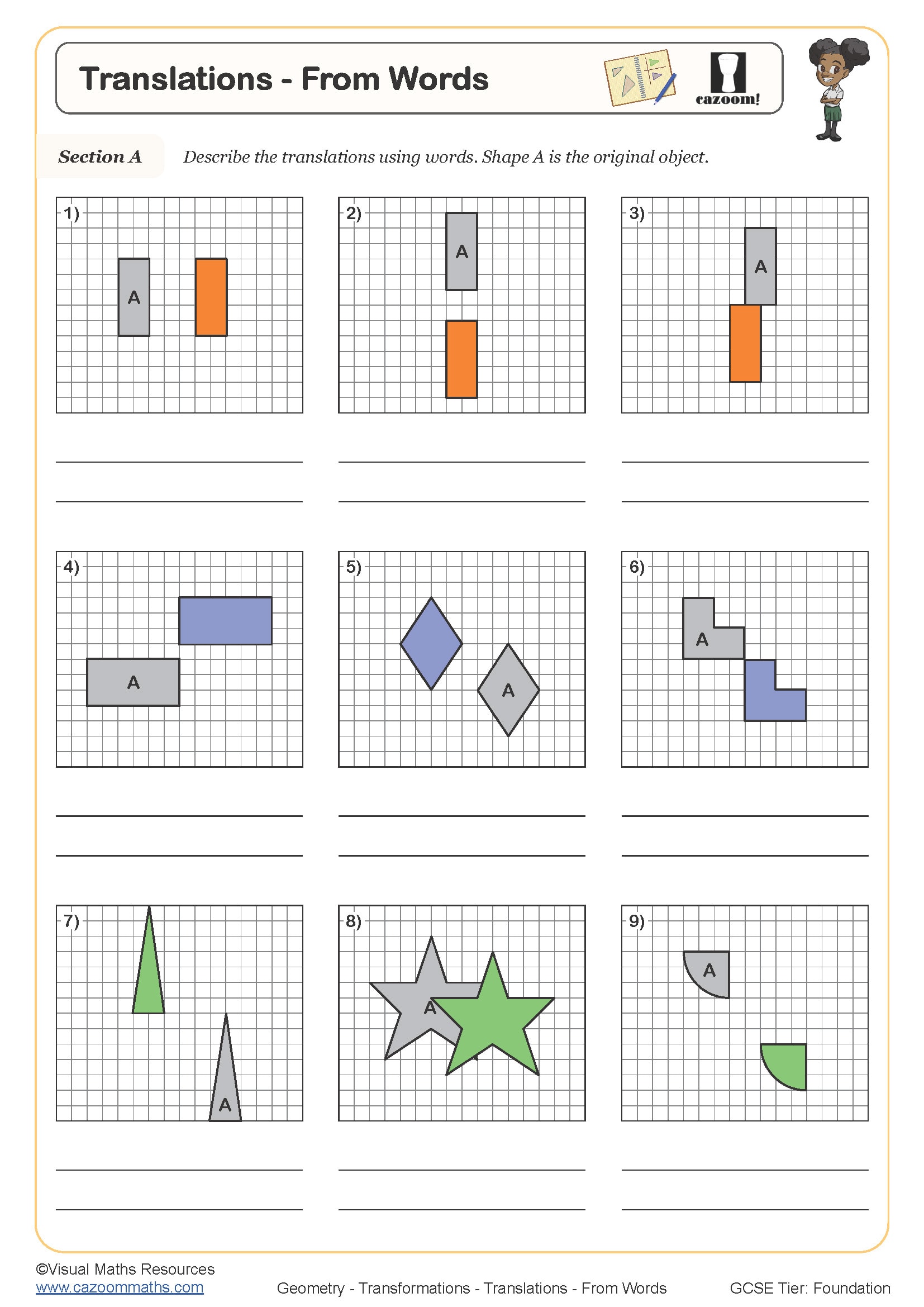
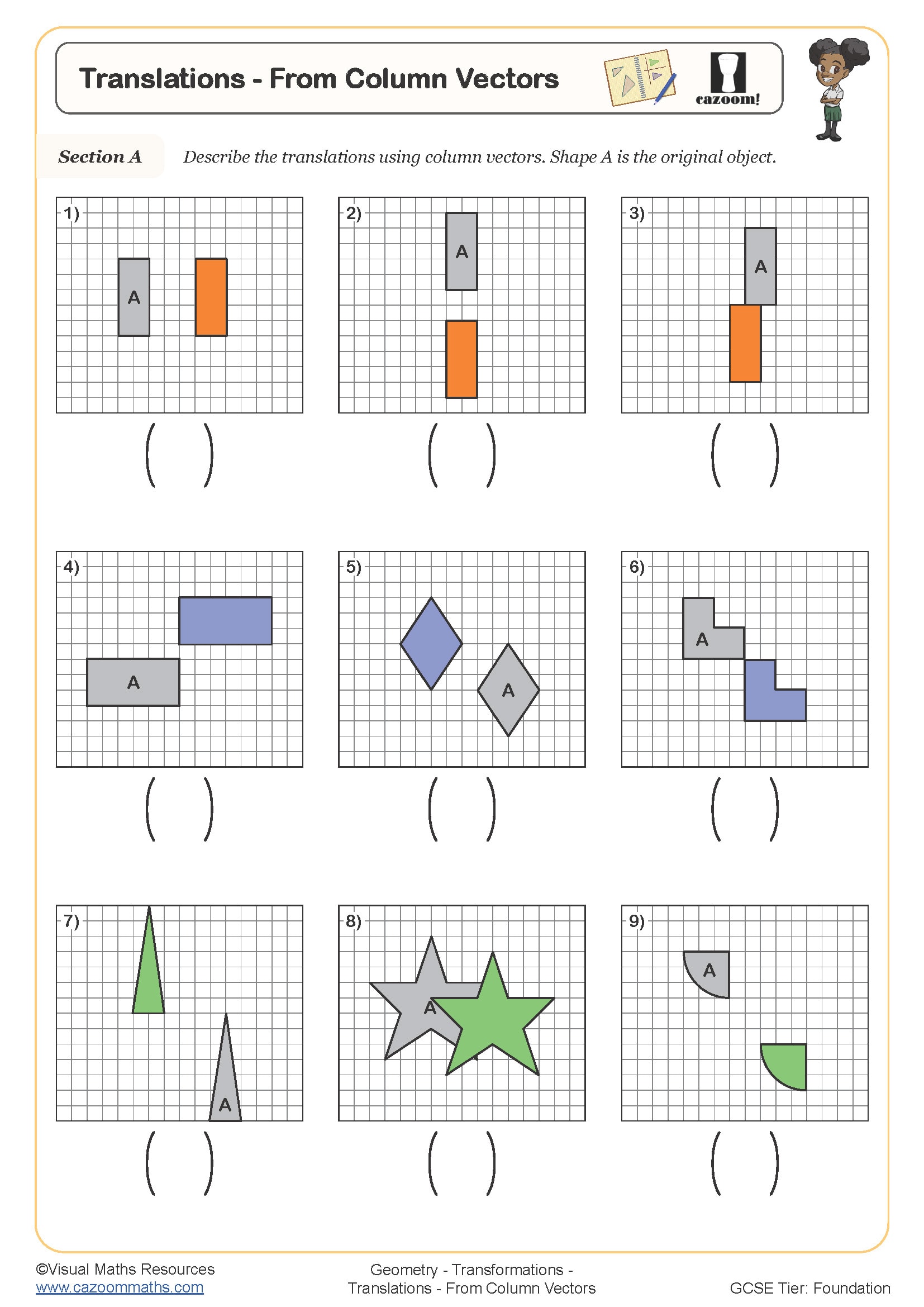
All worksheets are created by the team of experienced teachers at Cazoom Maths.
What is translation in maths?
Translation is a transformation that slides every point of a shape the same distance in the same direction without rotating or flipping it. In the National Curriculum, students learn to describe translations using vectors written as column vectors, where the top number indicates horizontal movement (positive for right, negative for left) and the bottom number shows vertical movement (positive for up, negative for down).
A common error occurs when students write vectors the wrong way round, placing the vertical movement first and horizontal second. Exam mark schemes regularly deduct marks for this, even when students draw the translated shape correctly. Teachers often emphasise that column vectors work like coordinates in reverse order, which helps students remember the horizontal-then-vertical structure when describing translations on coordinate grids.
Which year groups study translation?
Translation appears in Year 8, Year 9, Year 10 and Year 11 across Key Stage 3 and GCSE maths. Students first encounter basic translations at KS3, moving simple shapes on coordinate grids using vectors, before progressing to more complex applications including combined transformations and describing translations between congruent shapes at GCSE.
The progression builds from translating single shapes by given vectors in Year 8 to working backwards from diagrams to determine the translation vector in Year 9. By Years 10 and 11, students tackle questions involving translations in all four quadrants with fractional vectors, combined transformations where translation follows rotation or reflection, and problem-solving questions that require identifying which transformation has been applied from multiple options.
How do you write translations using column vectors?
Column vectors provide a concise mathematical notation for describing translations, written as two numbers in brackets arranged vertically. The top number indicates horizontal movement (positive values move right, negative move left) and the bottom number shows vertical movement (positive values move up, negative move down). For example, the vector (3, -2) translates a shape 3 units right and 2 units down.
This notation connects directly to computer graphics and animation, where programmers use vector operations to move objects on screen. Game developers rely on translation vectors to animate characters and objects, whilst architects use them in CAD software to position elements within building designs. Understanding vectors as instructions for movement rather than just pairs of numbers helps students grasp their practical application in digital design and engineering contexts.
How do these translation worksheets support learning?
The worksheets present translation questions with increasing complexity, starting with straightforward translations of triangles and quadrilaterals before moving to irregular polygons and reverse problems where students identify the vector from given shapes. Questions mix coordinate grids with and without numbered axes to develop spatial reasoning alongside calculation skills, whilst answer sheets show complete worked solutions with all vertex coordinates clearly marked.
Many teachers use these resources for targeted intervention with students who struggle to distinguish between transformation types, setting translation exercises alongside reflection or rotation questions to highlight the differences. The worksheets work well for homework when revising transformations before assessments, or as starter activities to retrieve prior knowledge before teaching combined transformations. Paired work where one student describes a translation whilst another plots it helps develop mathematical communication skills and reveals misconceptions about vector notation immediately.