Trigonometry in Right Angled Triangles Worksheets
Discovering Trigonometry (Investigation)
Year groups: 8, 9
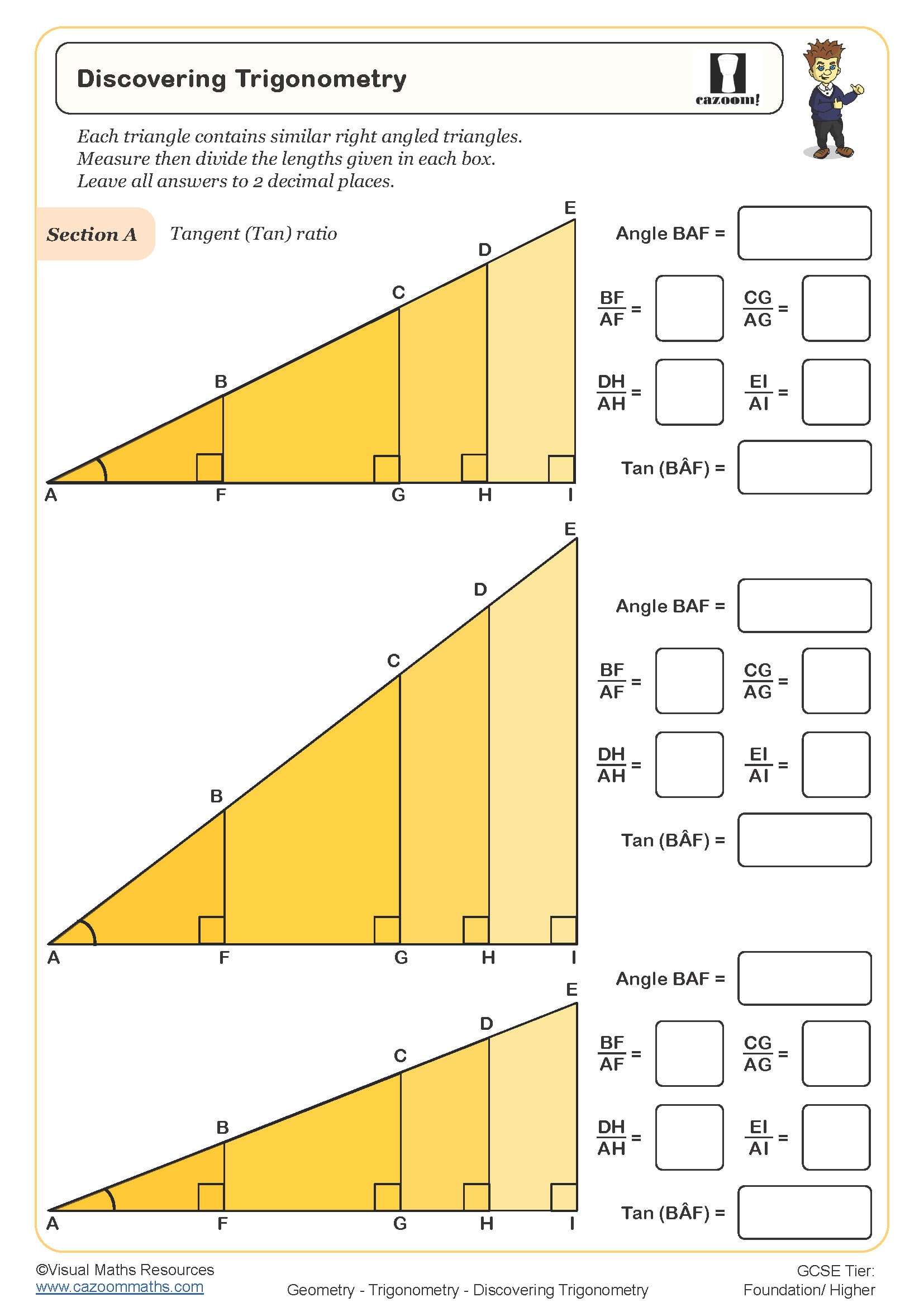
Trigonometry (A) Missing Lengths
Year groups: 8, 9
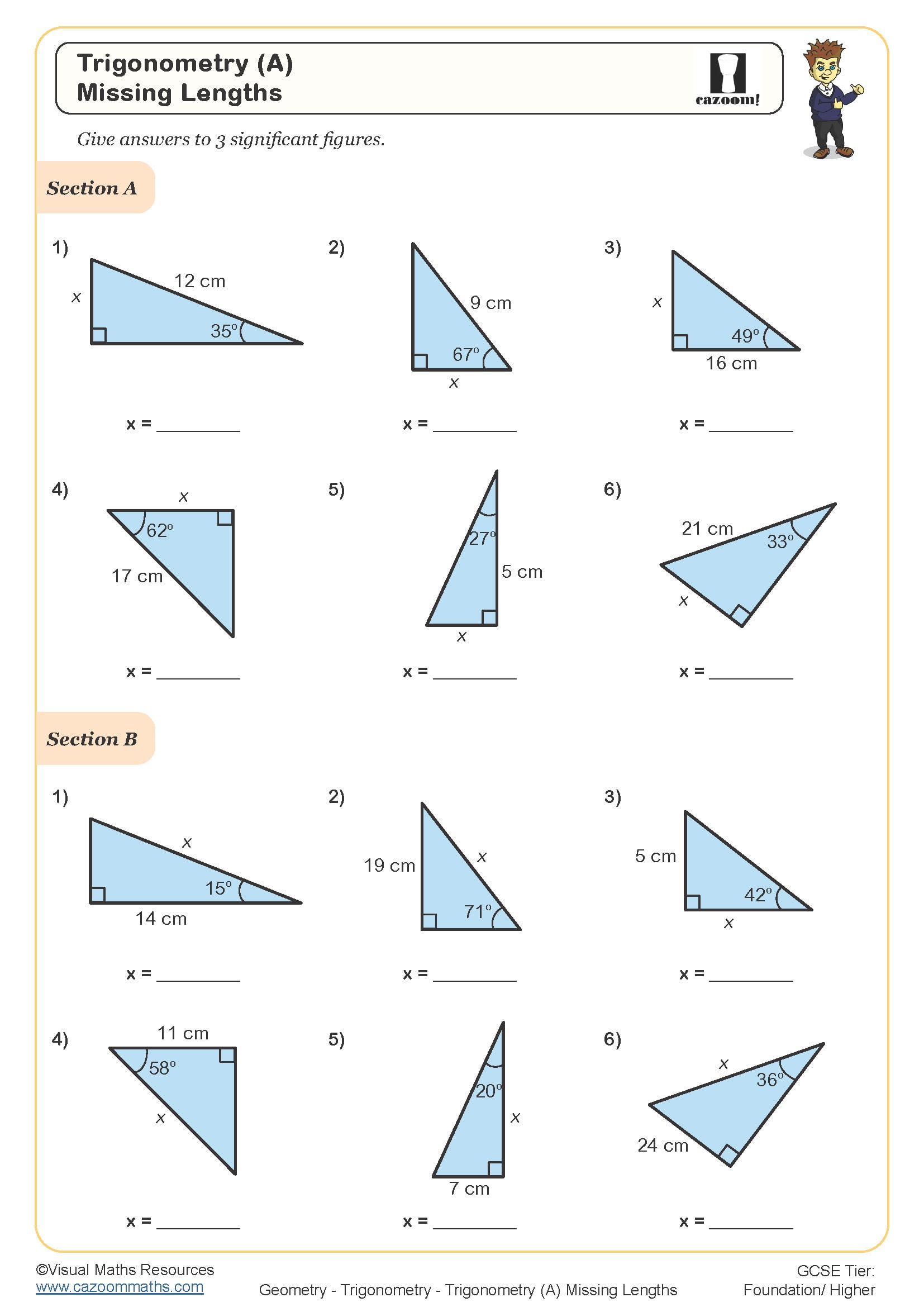
Trigonometry (B) - Missing Angles
Year groups: 8, 9
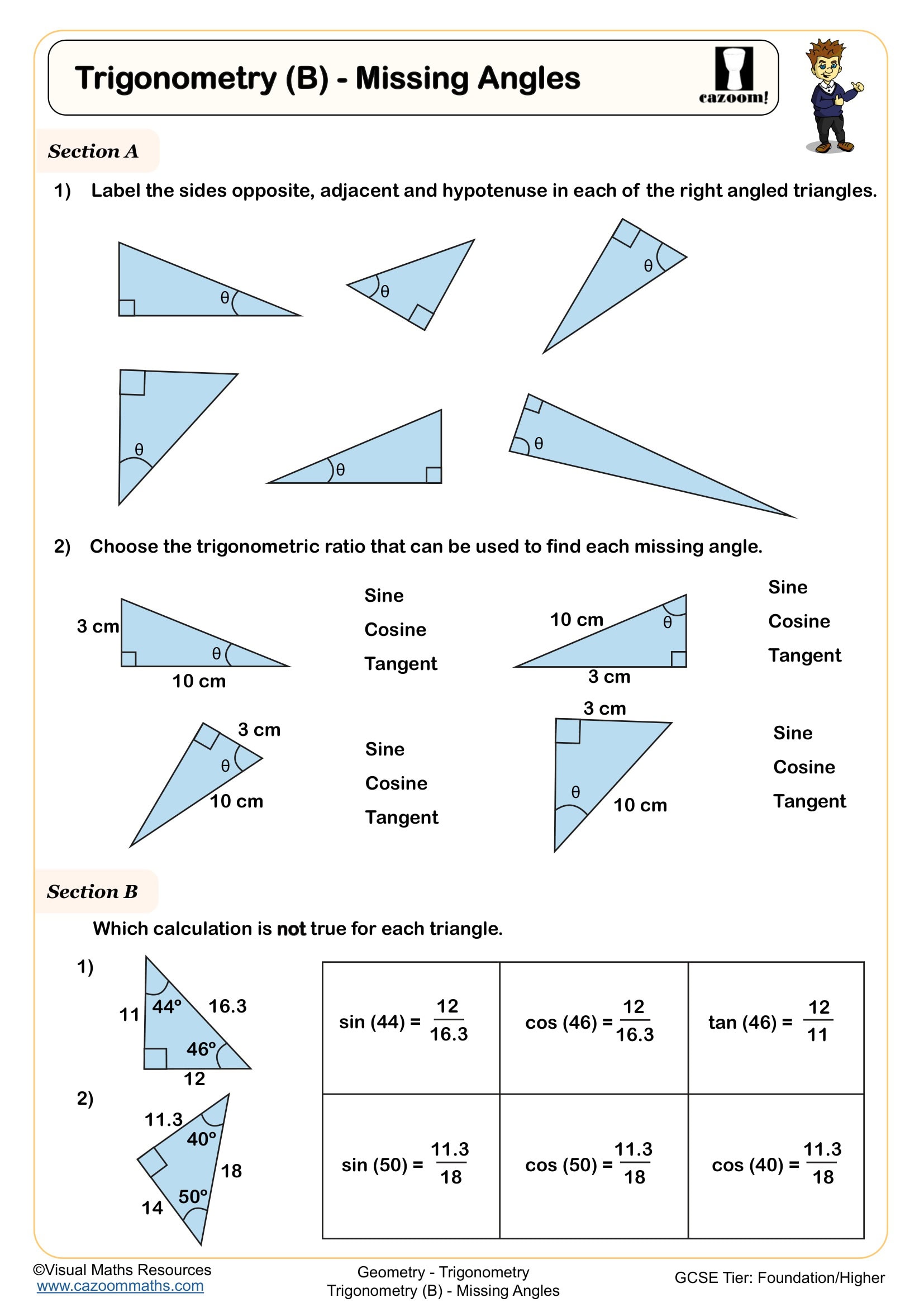
Trigonometry (C) Missing Angles and Lengths
Year groups: 8, 9
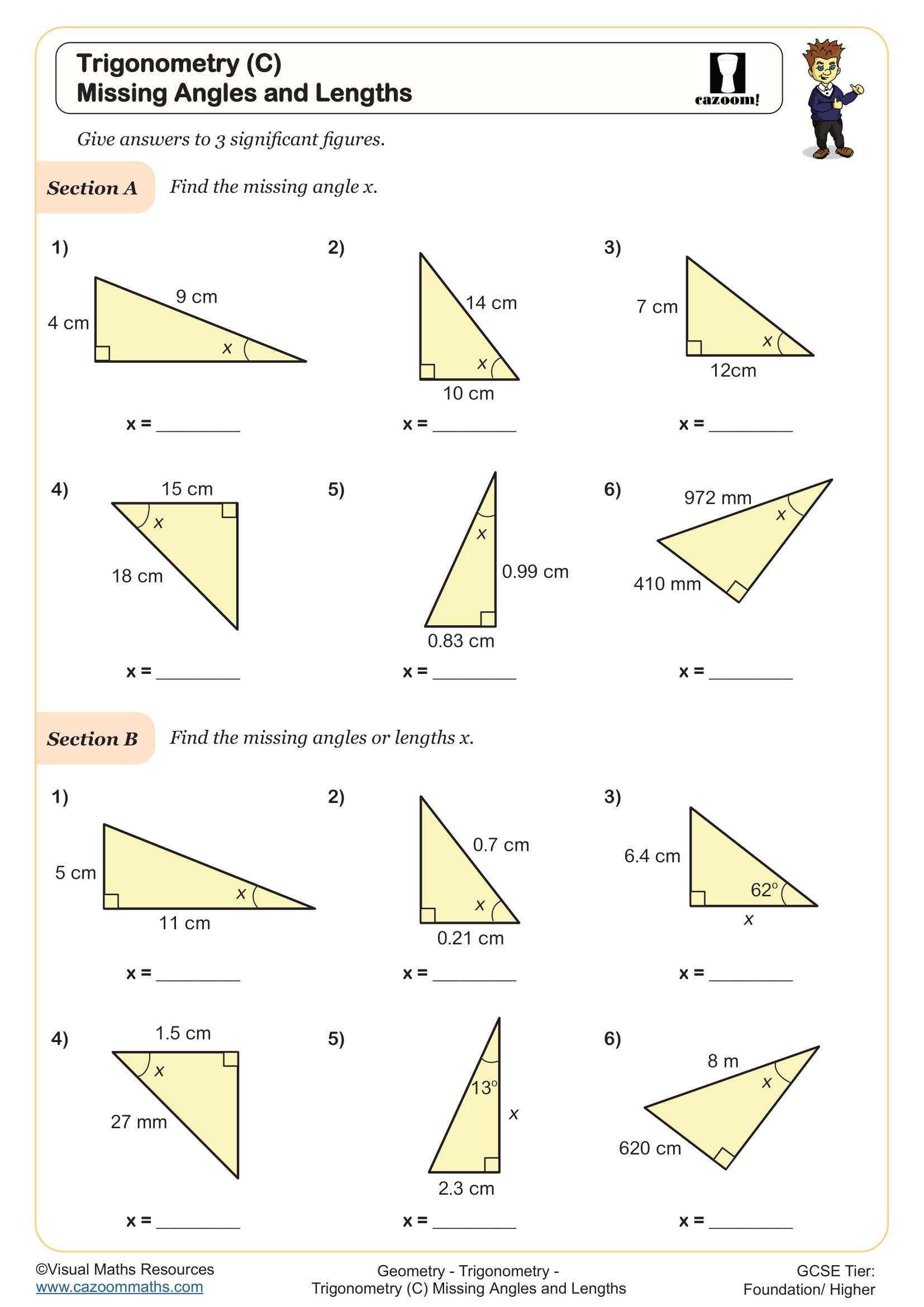
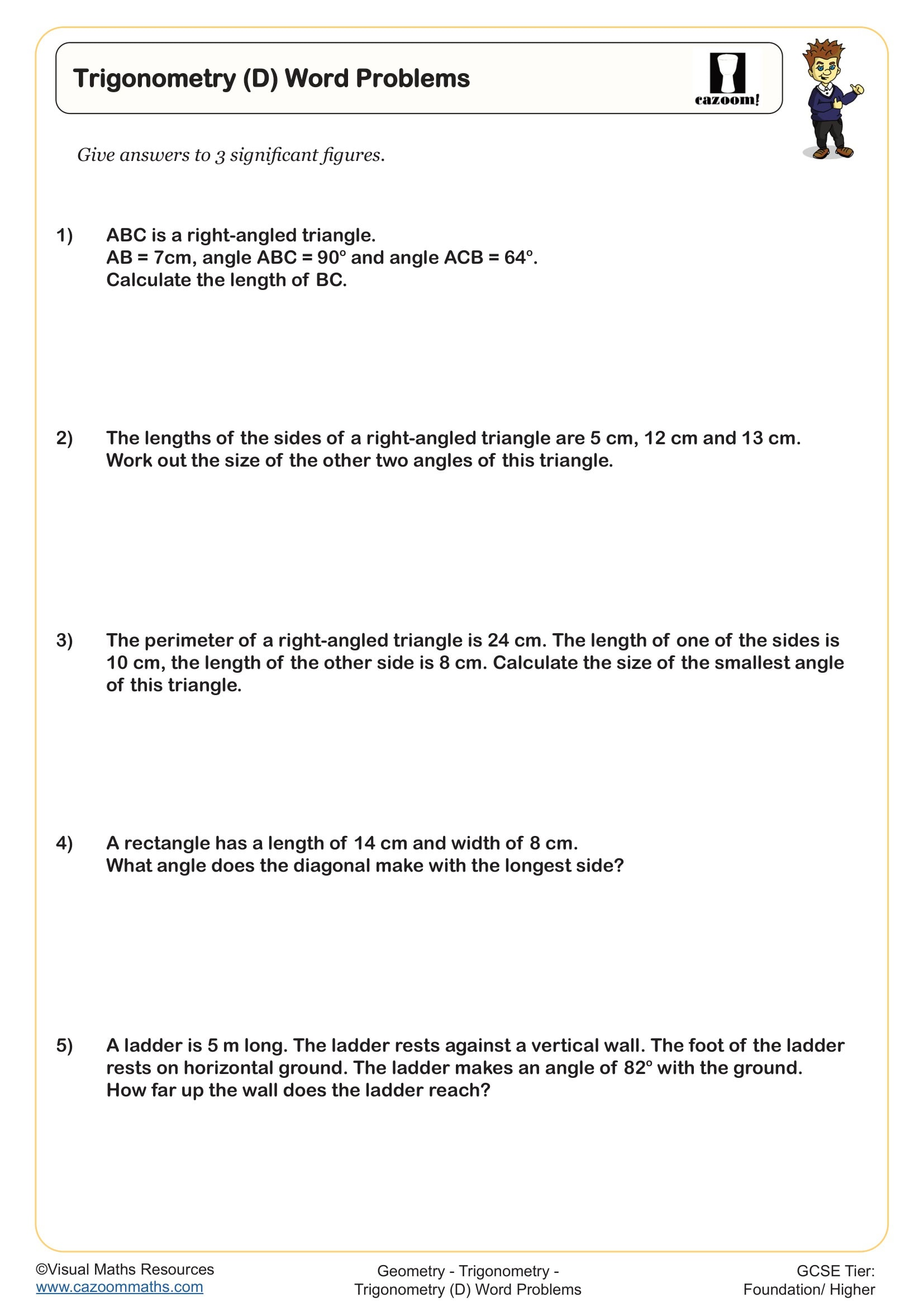
Trigonometry (D) Word Problems
Year groups: 8, 9
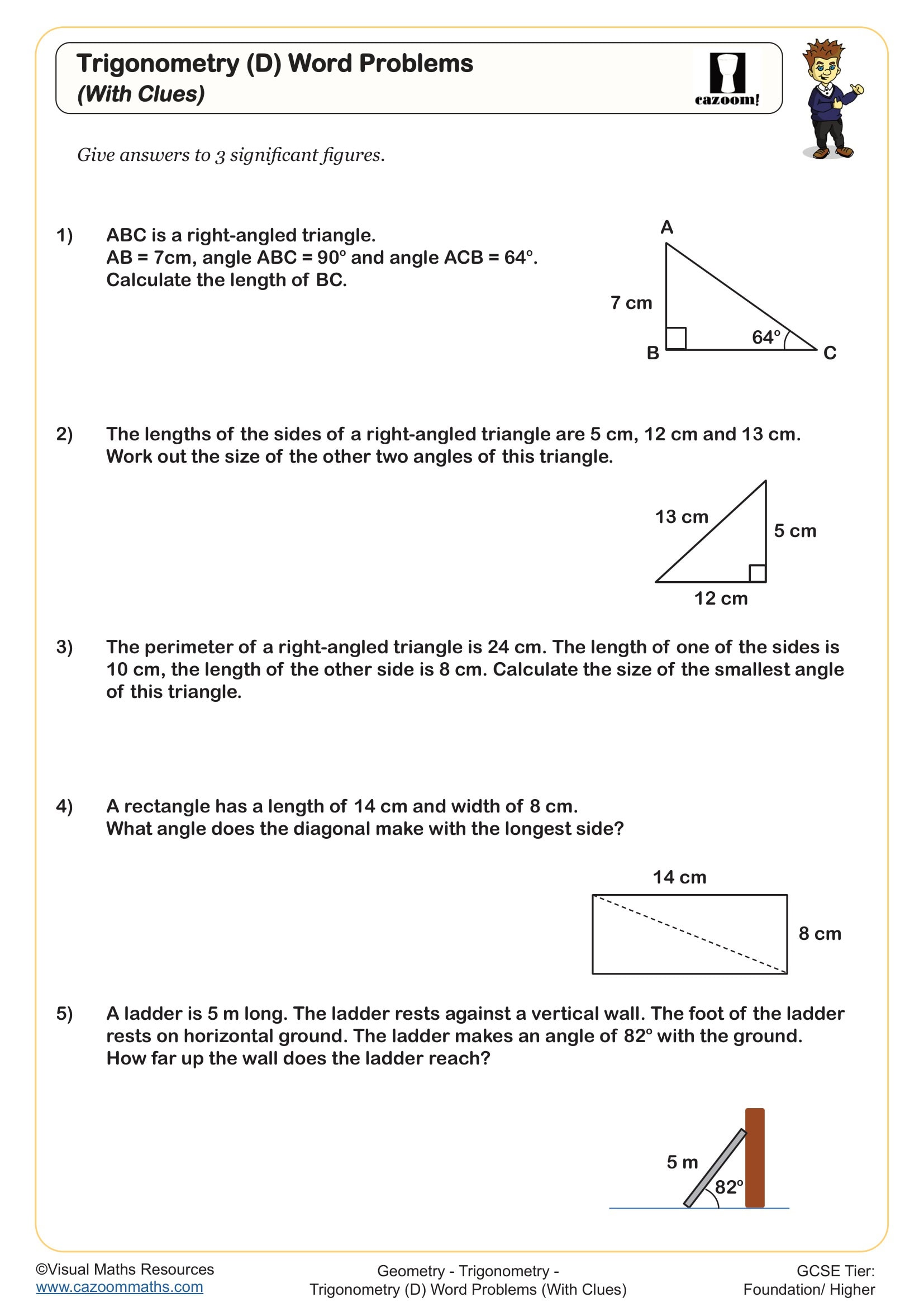
Trigonometry (D) Word Problems (With Clues)
Year groups: 8, 9
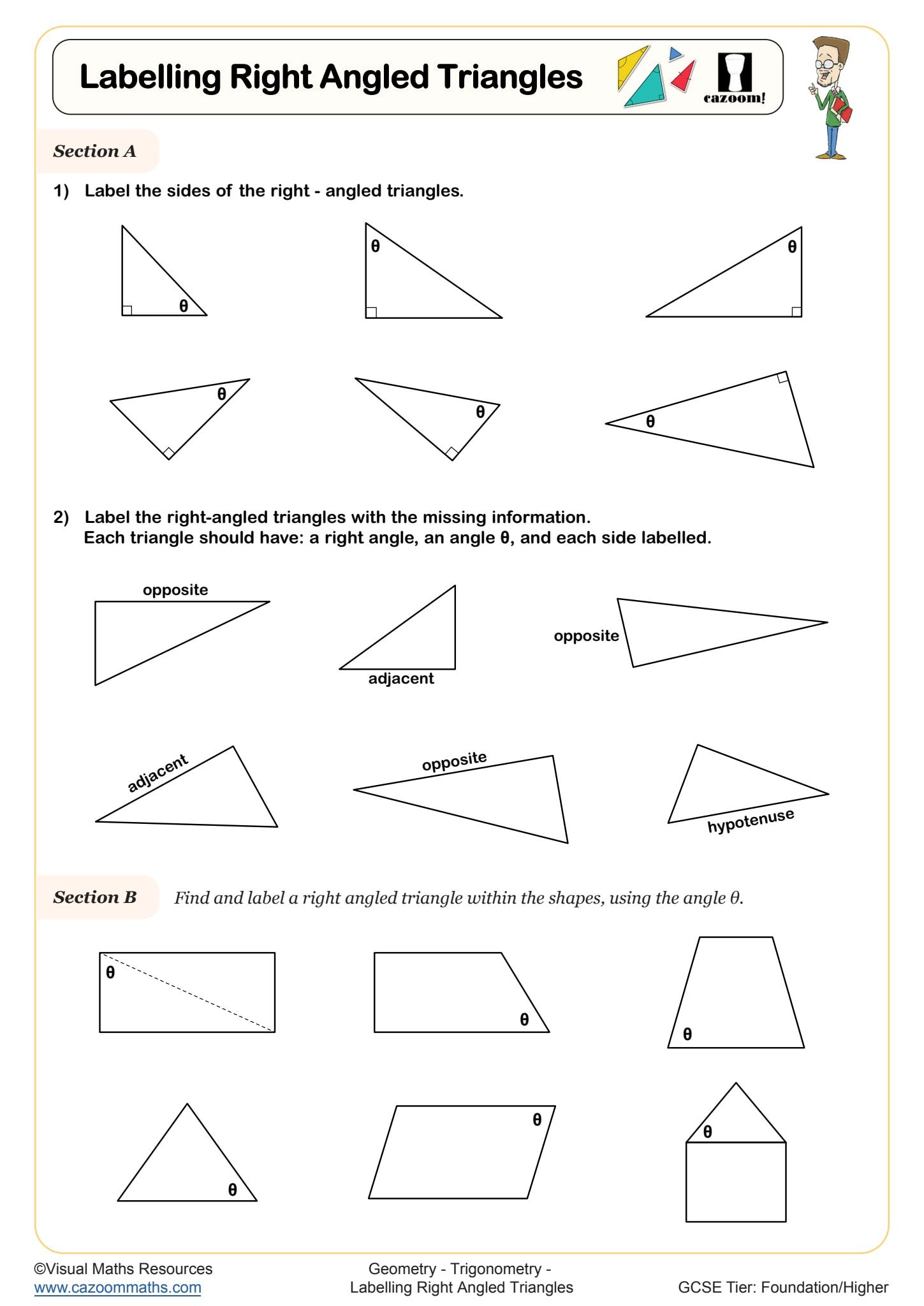
Labelling Right Angled Triangles
Year groups: 9, 10, 11
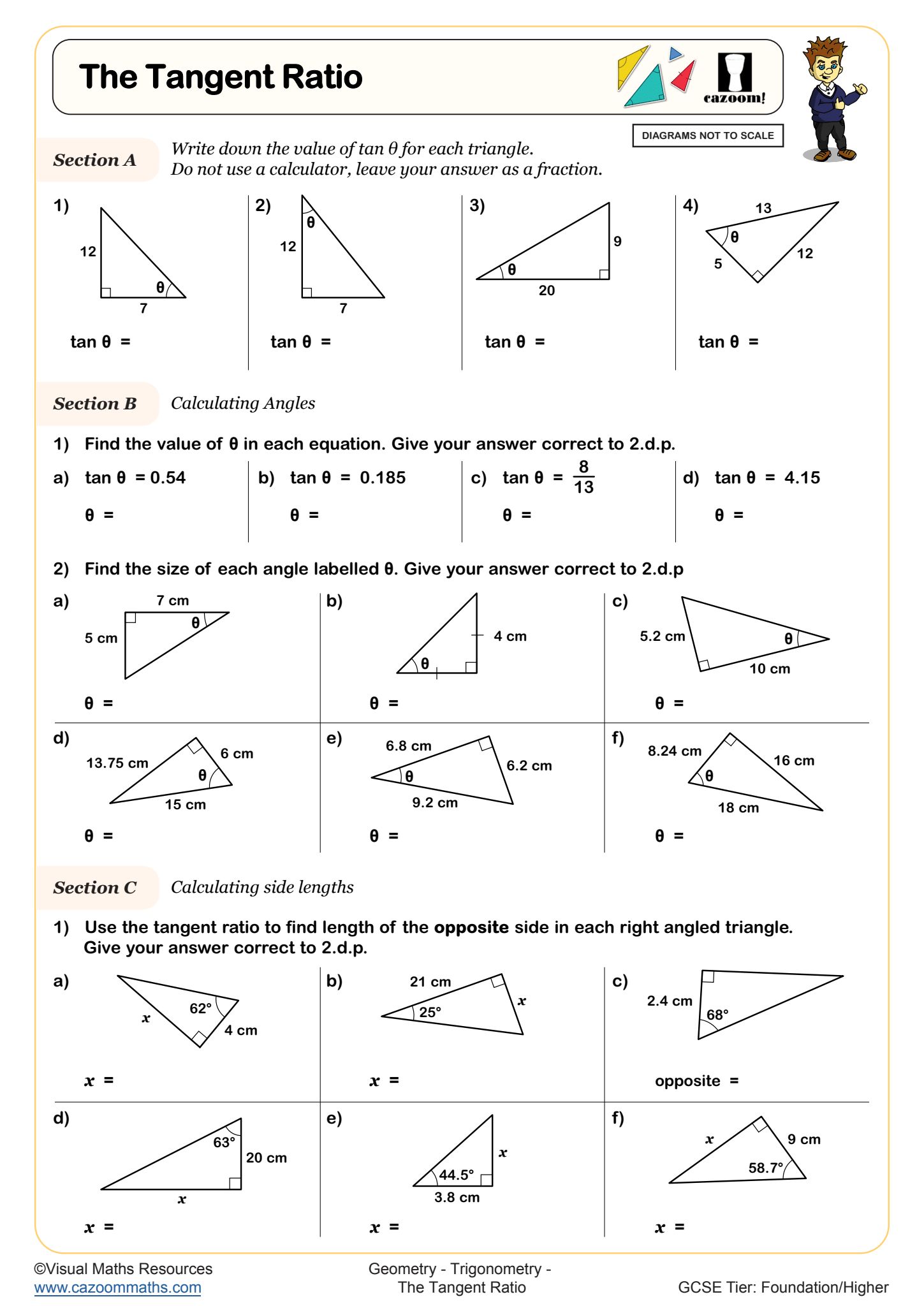
The Tangent Ratio
Year groups: 9, 10, 11
All worksheets are created by the team of experienced teachers at Cazoom Maths.
What is trigonometry in right angled triangles?
Trigonometry in right angled triangles explores the relationship between angles and side lengths using three key ratios: sine (opposite/hypotenuse), cosine (adjacent/hypotenuse), and tangent (opposite/adjacent). Students memorise these through SOHCAHTOA and learn to identify which ratio applies depending on which sides and angles are known or required. This appears in the National Curriculum at Key Stage 3 and develops into a substantial component of GCSE Higher tier geometry.
Many students write sinθ = opposite ÷ hypotenuse correctly but then substitute values into the wrong positions when rearranging, particularly when finding a side length rather than an angle. Teachers notice that students who label every side of the triangle relative to the angle in question make significantly fewer errors than those who try to work mentally. Exam mark schemes penalise unlabelled diagrams because they lead directly to mixing up adjacent and opposite sides.
Which year groups study trigonometry in right angled triangles?
These worksheets cover Year 8, Year 9, Year 10, and Year 11, spanning both Key Stage 3 and Key Stage 4. At Key Stage 3, students encounter trigonometric ratios for the first time, typically starting with finding lengths when an angle and one side are given. By Year 10 and Year 11, the focus shifts to inverse trigonometric functions to calculate unknown angles and applying these skills within multi-step problems.
Progression moves from straightforward single-step calculations with clearly labelled triangles to problems embedded within real-world contexts such as slopes, ramps, and bearings. Year 11 Foundation students need competence with finding lengths and angles in isolated right-angled triangles, whilst Higher tier students must tackle non-right-angled contexts by first introducing a perpendicular line to create a right angle. Questions increasingly require students to interpret diagrams where the triangle orientation varies or where trigonometry combines with Pythagoras' theorem.
How do you know which trigonometric ratio to use?
The choice of sine, cosine, or tangent depends on which two sides of the triangle are involved relative to the angle in question. Students must first identify the hypotenuse (always opposite the right angle), then label the opposite side (across from the angle being used) and the adjacent side (next to the angle being used). Once sides are labelled, SOHCAHTOA determines which ratio connects the known and unknown information. Teachers frequently observe that students who skip the labelling step and try to select a ratio by inspection make systematic errors.
Civil engineers use these exact principles when calculating gradient angles for roads and ramps to meet accessibility standards. A ramp with a 1:12 ratio (vertical rise to horizontal run) can be analysed using tangent to confirm the angle stays below 5 degrees, meeting building regulation requirements. Surveyors similarly use clinometers measuring angles of elevation combined with trigonometric calculations to determine building heights without direct measurement, demonstrating why this skill extends well beyond the classroom.
How do these worksheets help students master trigonometry?
The worksheets build fluency through carefully sequenced questions that begin with triangles in standard orientation before introducing rotated diagrams. Early questions provide labelled sides so students focus purely on selecting and applying the correct ratio, whilst later problems require students to perform the labelling themselves. Worked examples model the complete method including labelling, selecting the ratio, substituting values, and rearranging, which mirrors the step-by-step approach examiners expect. Answer sheets allow students to identify precisely where their method breaks down, whether that's incorrect side identification or calculator errors with inverse functions.
Teachers use these worksheets during initial teaching to provide immediate consolidation after demonstrating SOHCAHTOA, then return to them during GCSE revision when students need targeted practice on specific ratio types. They work effectively as homework because answer sheets enable independent checking, and as intervention resources for students who struggle to distinguish between the three ratios. Paired work proves valuable, with one student labelling the triangle whilst their partner selects the ratio, forcing explicit discussion about the decision-making process that often remains hidden when students work silently alone.