Volume and Surface Area of Compound Shapes Worksheets
All worksheets are created by the team of experienced teachers at Cazoom Maths.
What are compound shapes in volume and surface area?
Compound shapes in three dimensions are solids formed by combining or subtracting standard 3D shapes such as cuboids, prisms, cylinders, cones, and pyramids. Students calculate total volume by breaking the shape into recognisable components, finding each volume separately, then adding or subtracting as appropriate. Surface area requires identifying which faces are external and which are internal (and therefore don't contribute to the total).
A common error occurs when students include internal faces in their surface area calculations. For example, when a small rectangular prism sits on top of a larger cuboid, the area where they connect should not be counted twice. Exam mark schemes typically award method marks for identifying components correctly, but students lose marks when they fail to account for these hidden surfaces or make sign errors in their final calculations.
Which year groups study volume and surface area of compound shapes?
These worksheets cover Year 9 and Year 10, spanning Key Stage 3 into Key Stage 4. At Year 9, students extend their understanding of individual 3D shapes to combinations of two or three simple solids, typically cuboids and triangular prisms. This builds on their earlier work with surface area and volume of single shapes, adding the complexity of decomposition strategies.
By Year 10, questions become more algebraically complex, often including unknown dimensions that require forming and solving equations. Students encounter shapes where cylinders intersect cuboids, or where frustums combine with hemispheres. The progression also introduces more sophisticated problem-solving contexts, such as calculating material costs or capacity of composite containers, which directly prepare students for Foundation and Higher GCSE questions.
How do you find the surface area of an L-shaped prism?
Finding the surface area of an L-shaped prism requires students to identify all external faces systematically. Teachers often recommend drawing a net or sketching each face separately: two identical L-shaped ends, plus five rectangular faces that form the outer surface. Students must calculate the area of each face individually, taking care with the dimensions of inner corners where the L-shape changes direction.
This skill connects directly to manufacturing and construction contexts. Architects calculate surface areas of composite building sections to estimate cladding materials, whilst product designers need surface area calculations when determining paint coverage or packaging requirements for non-standard shapes. Engineers working with ventilation ducts or pipework frequently encounter L-shaped sections where material efficiency depends on accurate surface area calculations, making this an authentic STEM application that extends well beyond the classroom.
How do these worksheets help students master compound shapes?
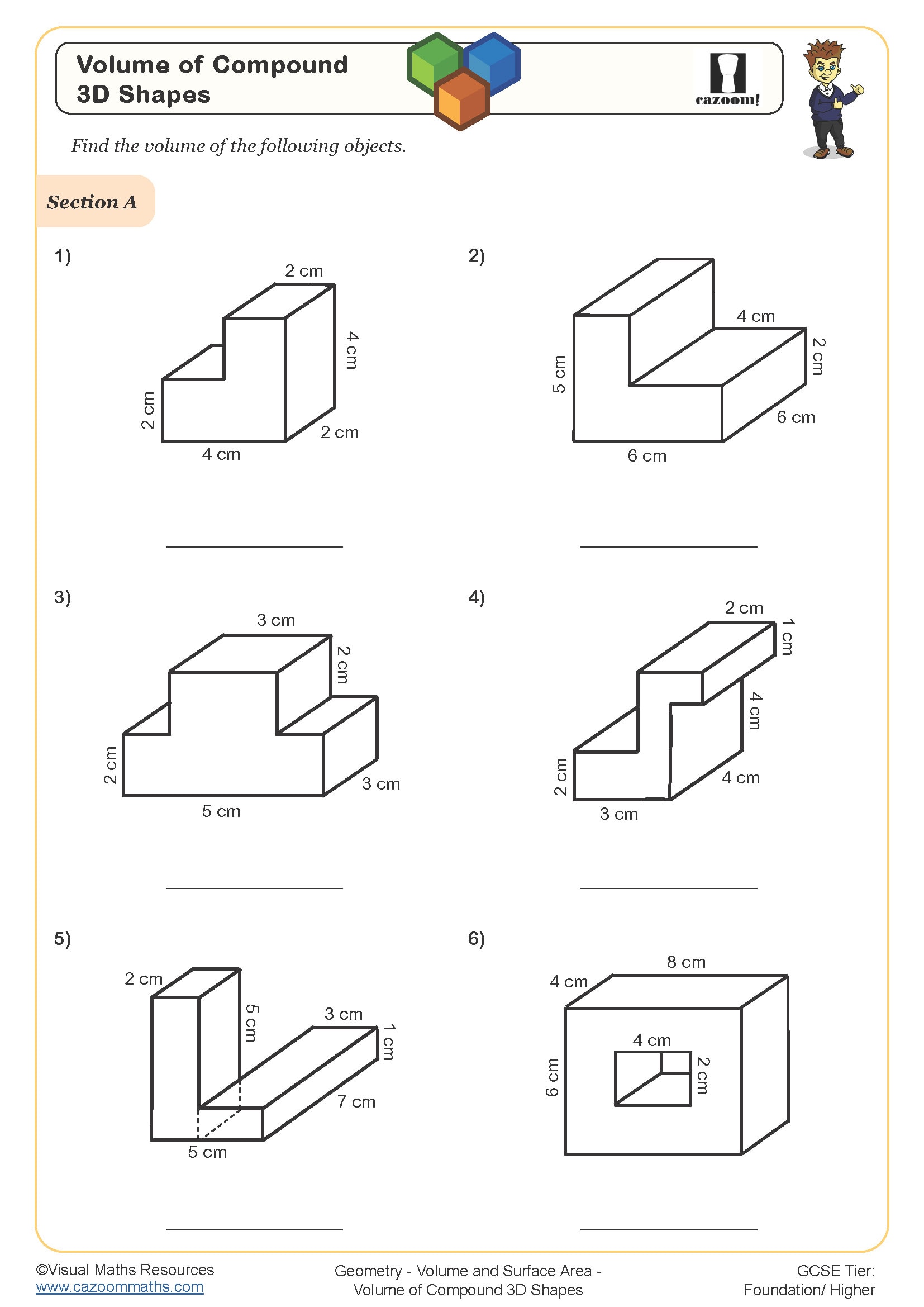
The worksheets guide students through structured problems that begin with clearly decomposable shapes before progressing to those requiring more sophisticated spatial reasoning. Questions typically include diagrams with dimensions marked, encouraging students to annotate and identify component shapes before calculating. The included answer sheets show complete working, which helps students understand where their method diverges from the correct approach, particularly valuable for self-assessment.
Teachers use these resources in various classroom settings: as guided practice during initial teaching, for paired work where students compare their decomposition strategies, or as targeted intervention for students who struggle with 3D visualisation. The worksheets also serve as focused revision before assessments, allowing students to practise the multi-step reasoning that GCSE questions demand. Many teachers set selected questions as homework to consolidate lesson content, using the answer sheets to facilitate peer marking discussions.