Volume and Surface Area of Cones Worksheets
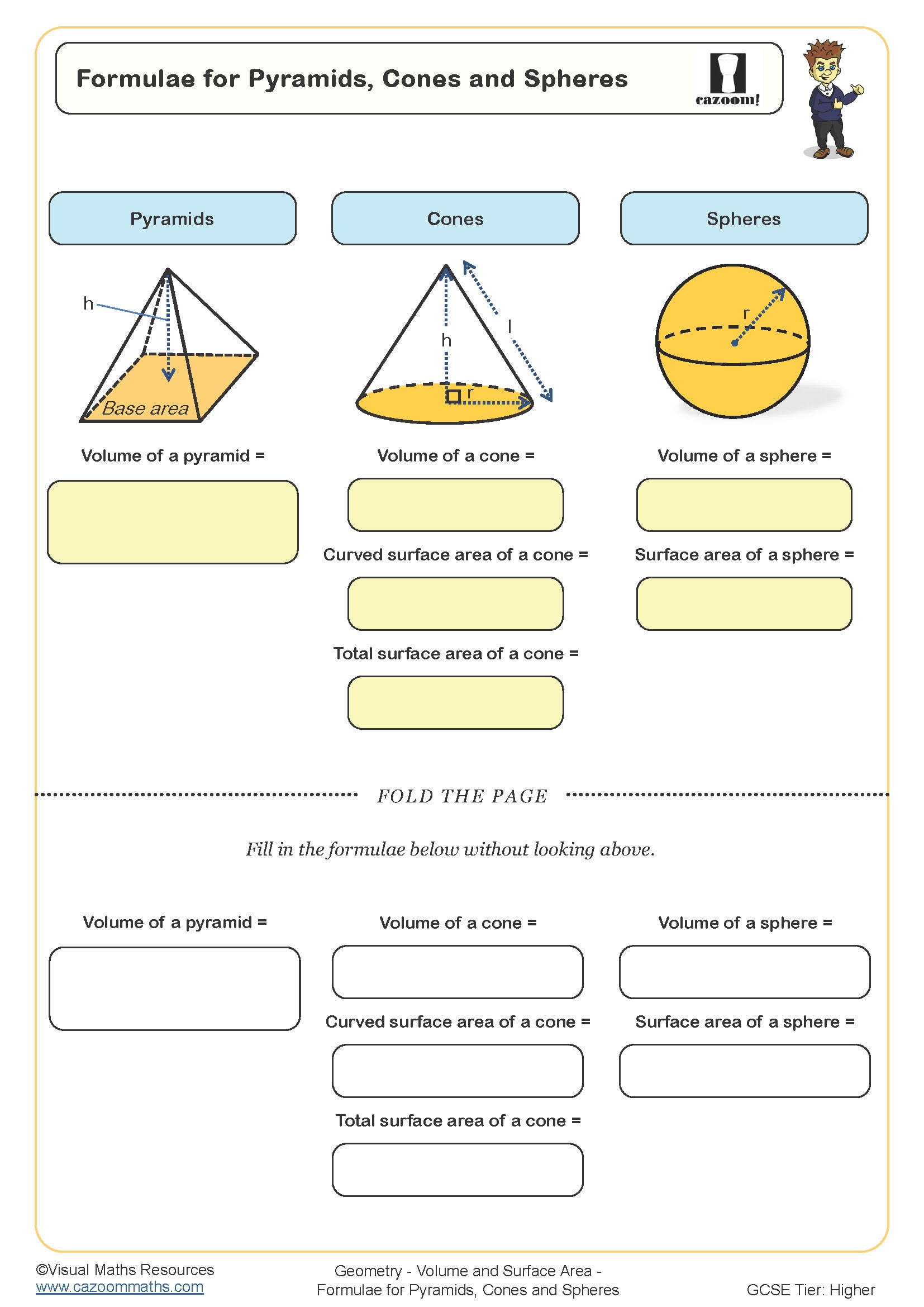
Formulae for Pyramids Cones and Spheres
Year groups: 10, 11
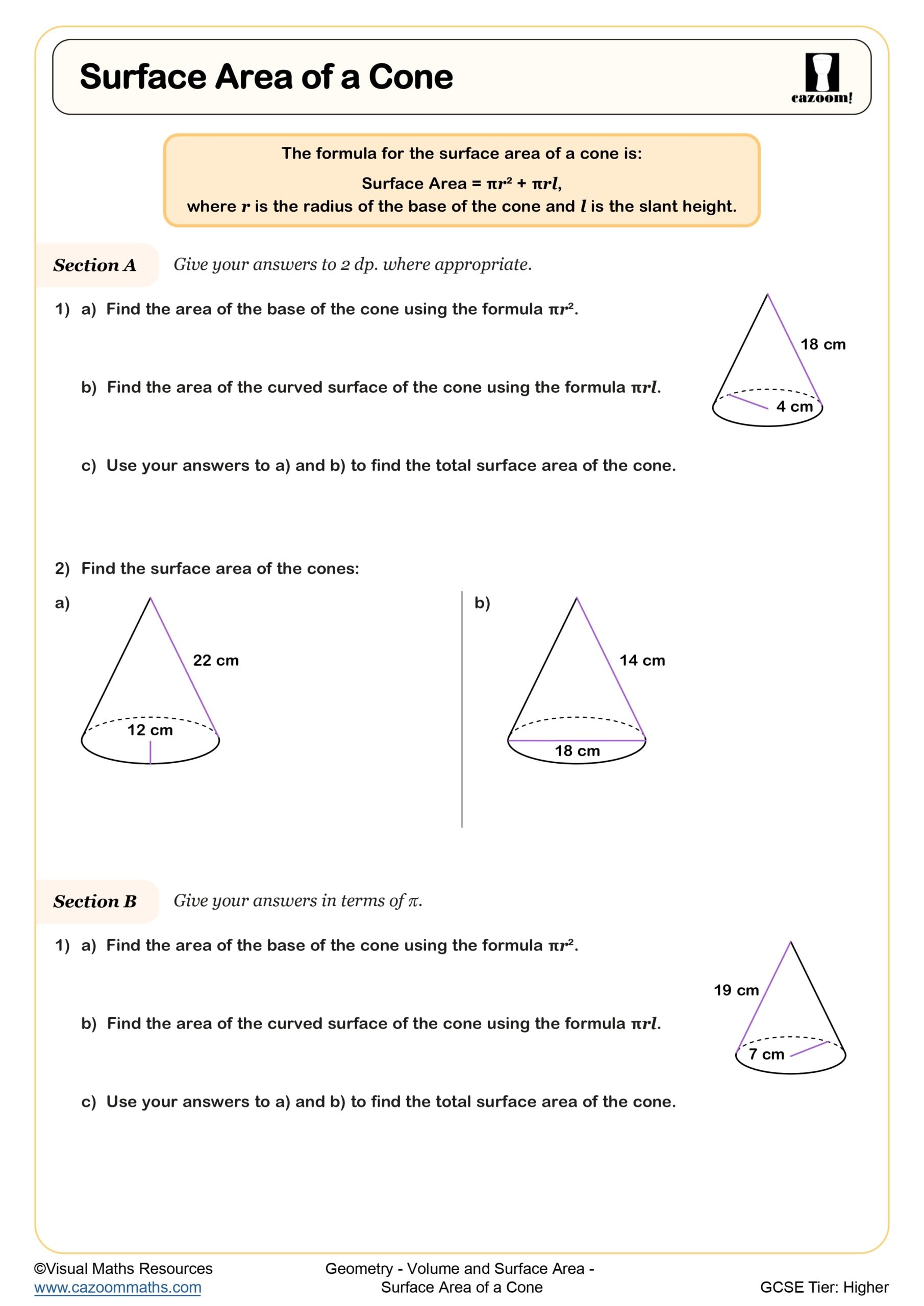
Surface Area of a Cone
Year groups: 10, 11
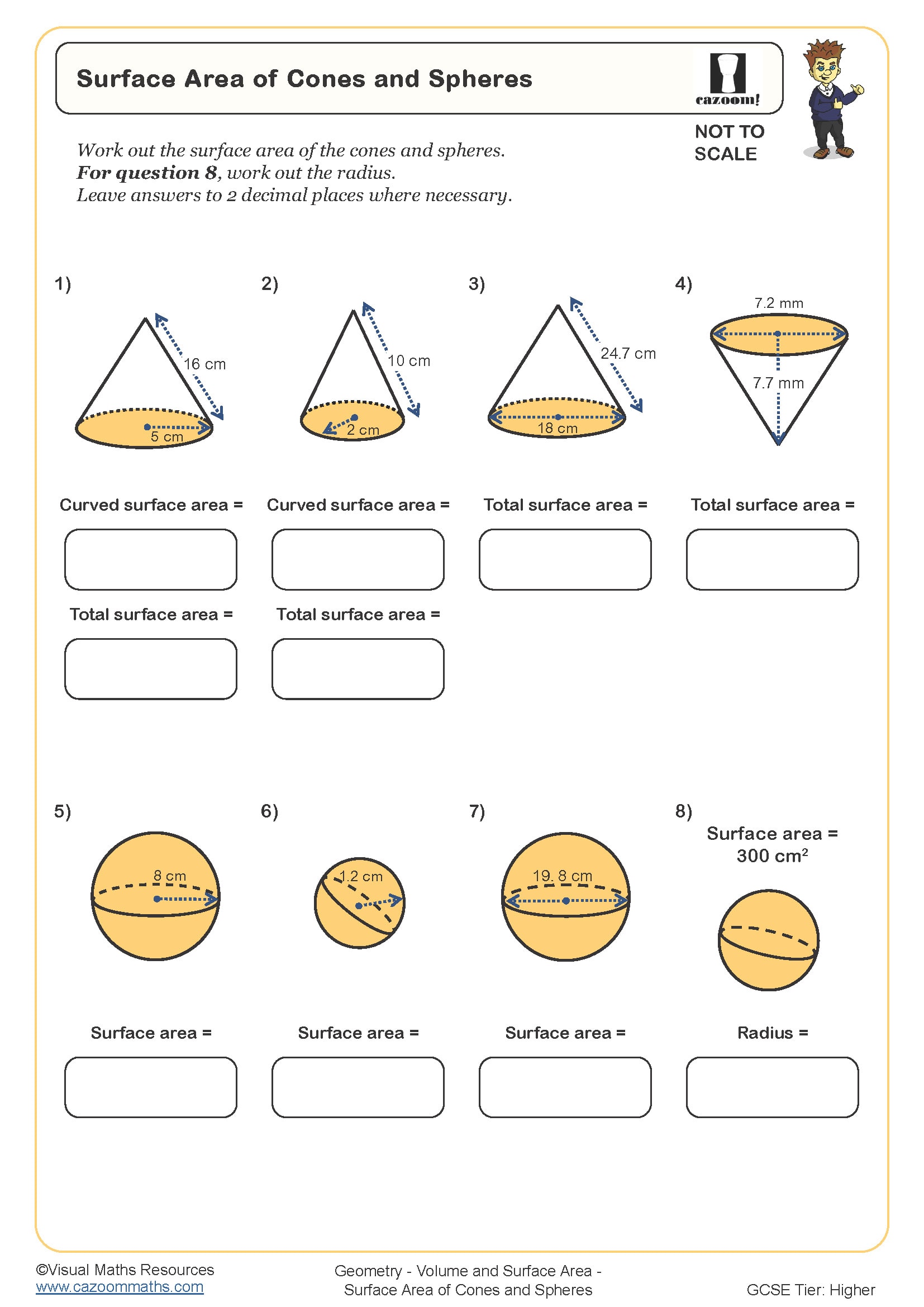
Surface Area of Cones and Spheres
Year groups: 10, 11
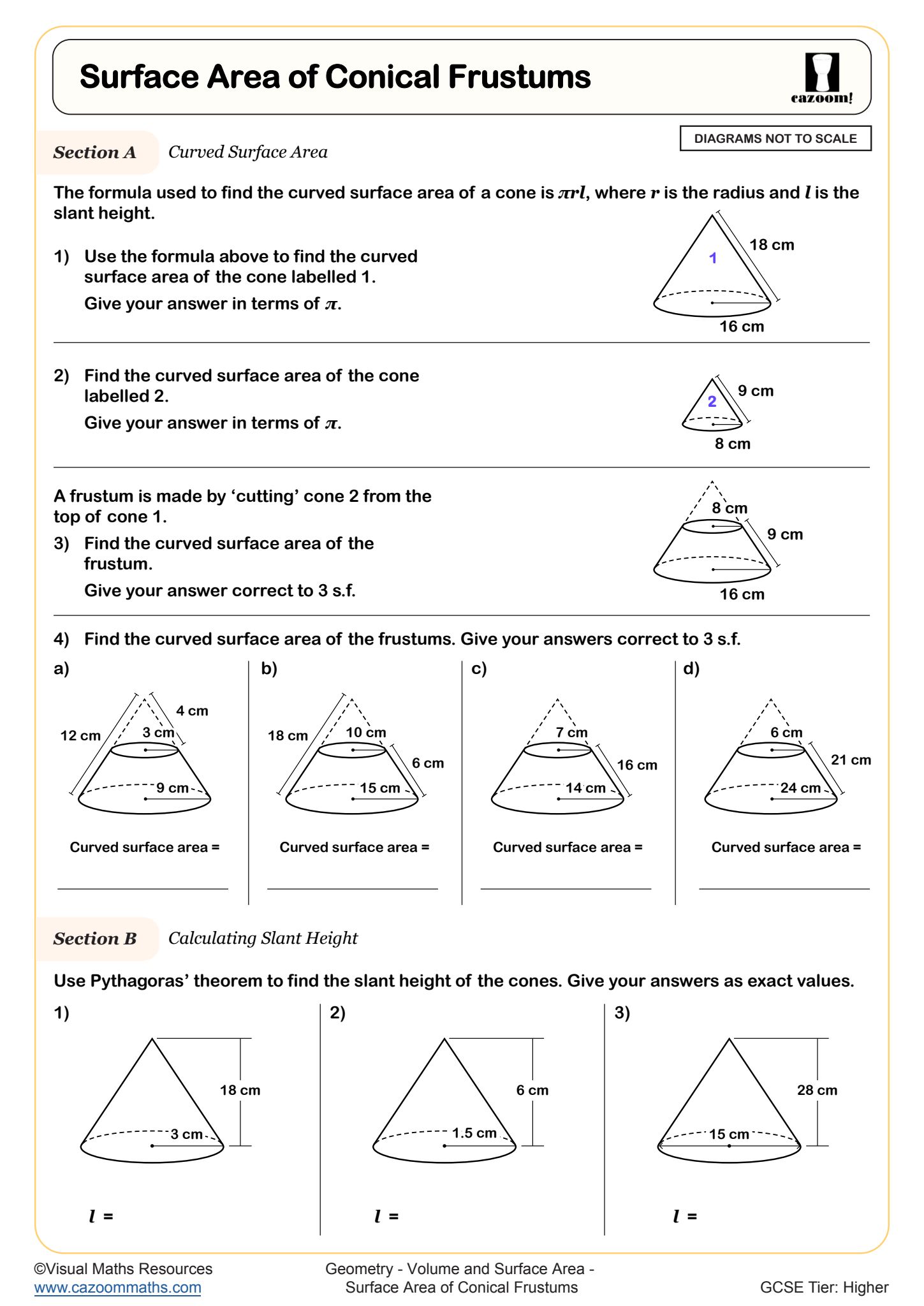
Surface Area of Conical Frustums
Year groups: 10, 11
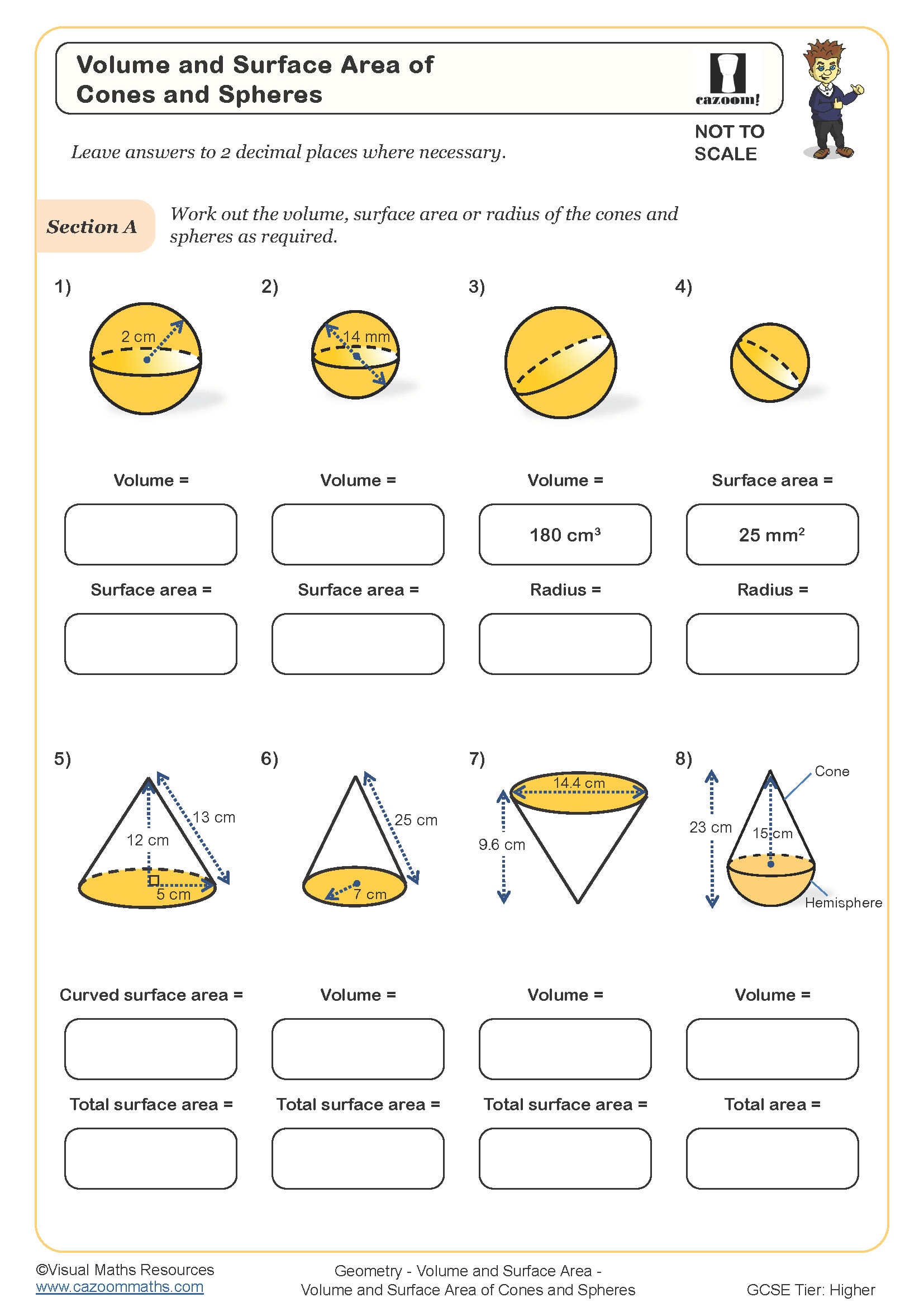
Volume and Surface Area of Cones and Spheres
Year groups: 10, 11
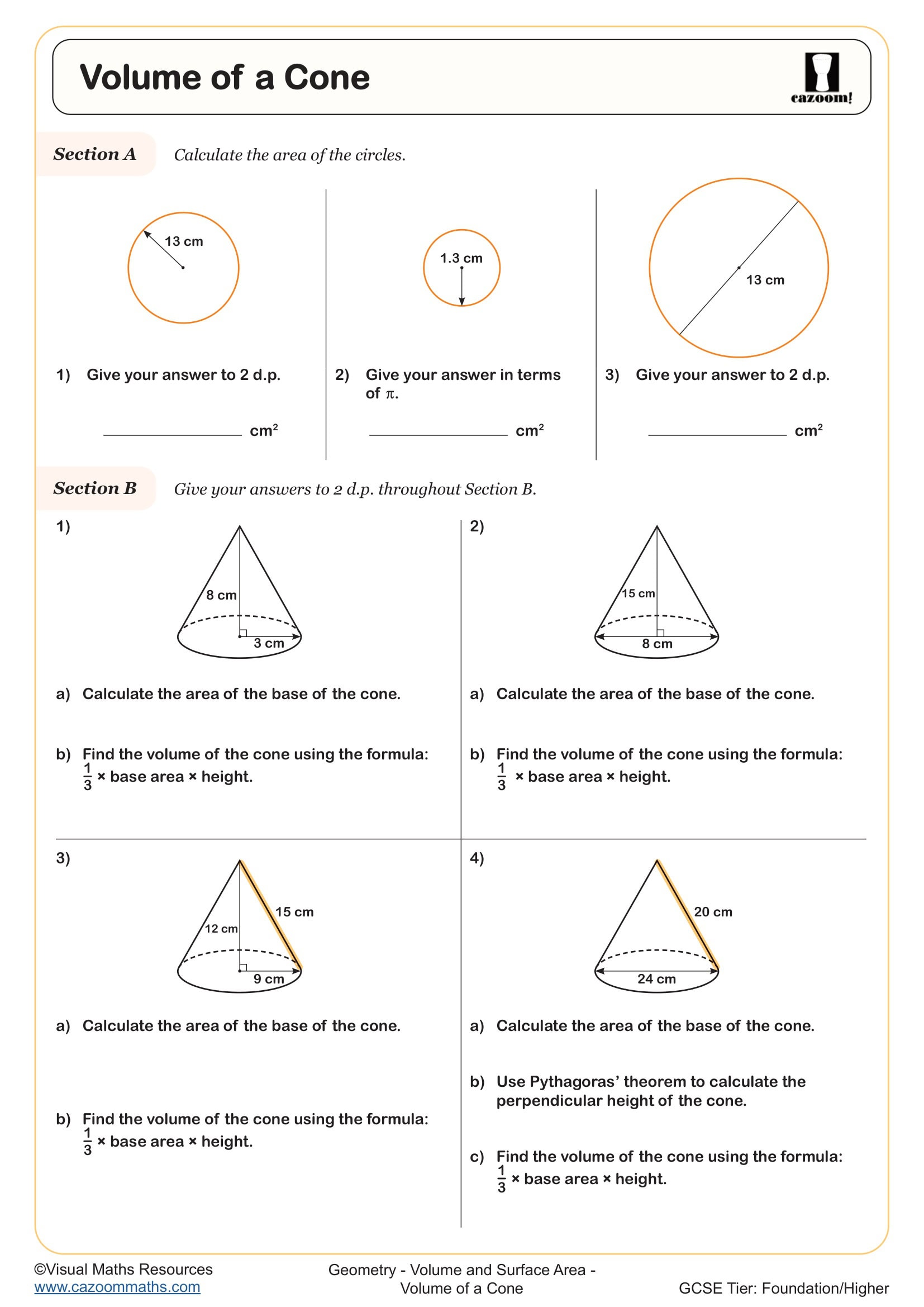
Volume of a Cone
Year groups: 10, 11
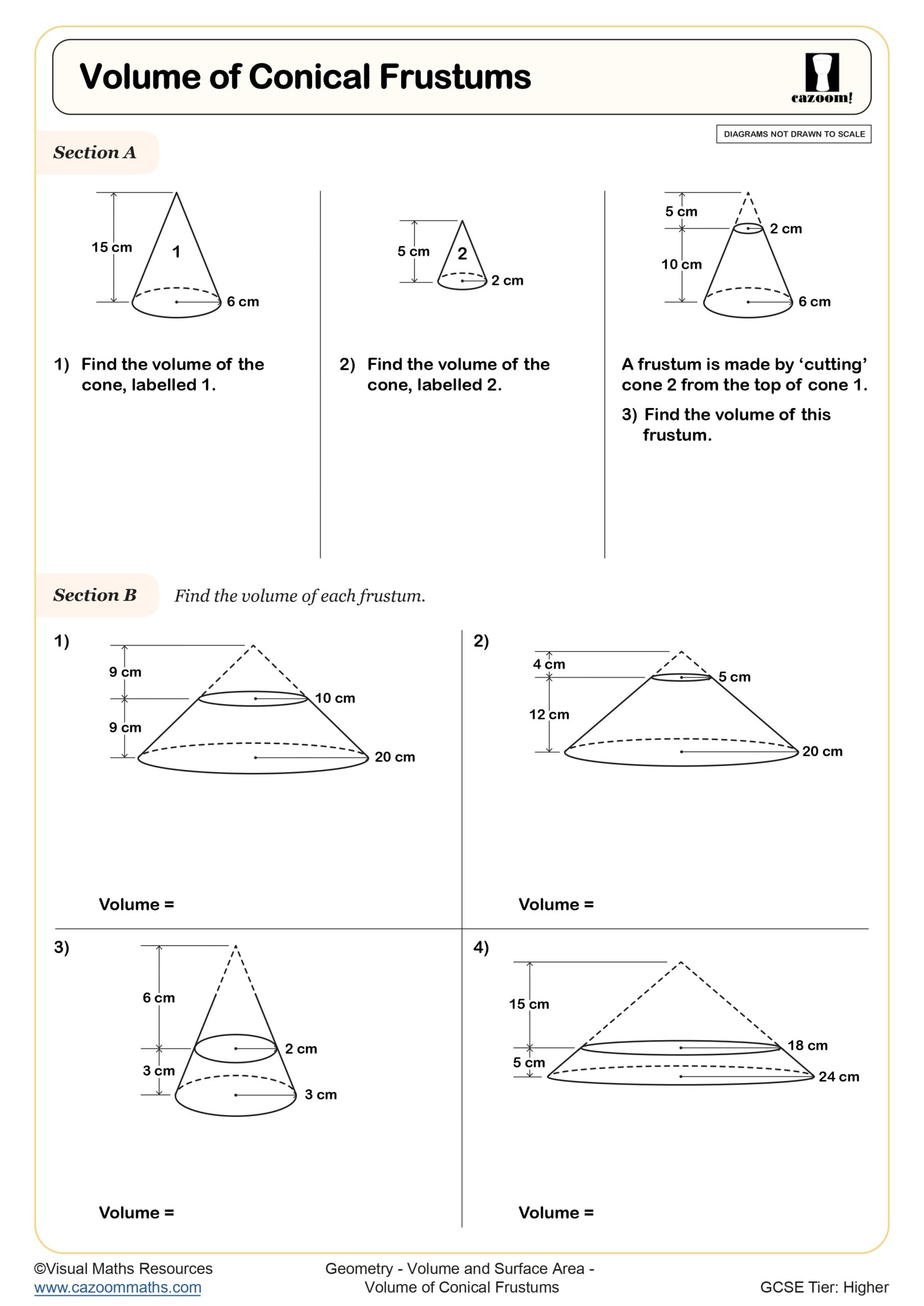
Volume of Conical Frustums
Year groups: 10, 11
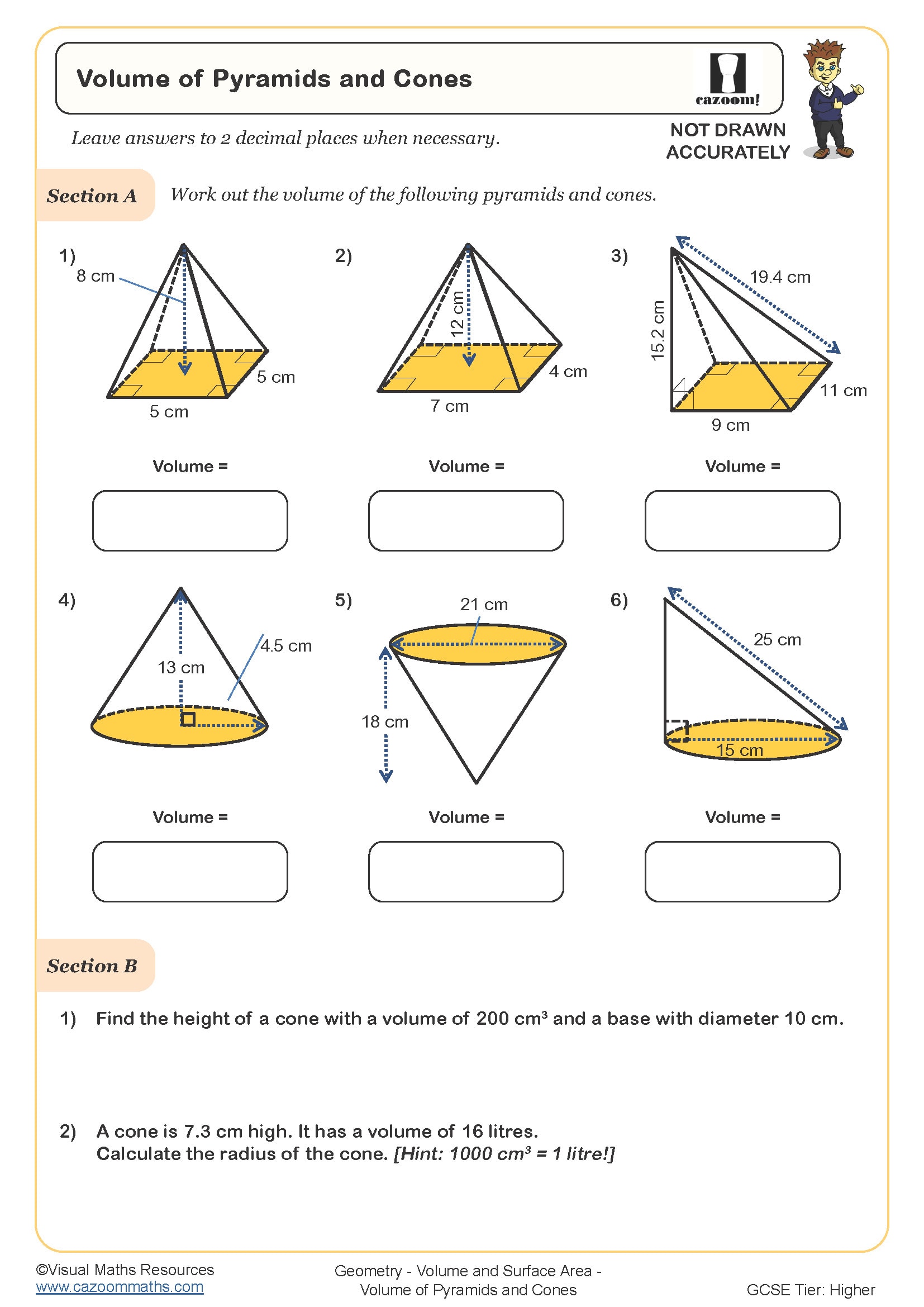
Volume of Pyramids and Cones
Year groups: 10, 11
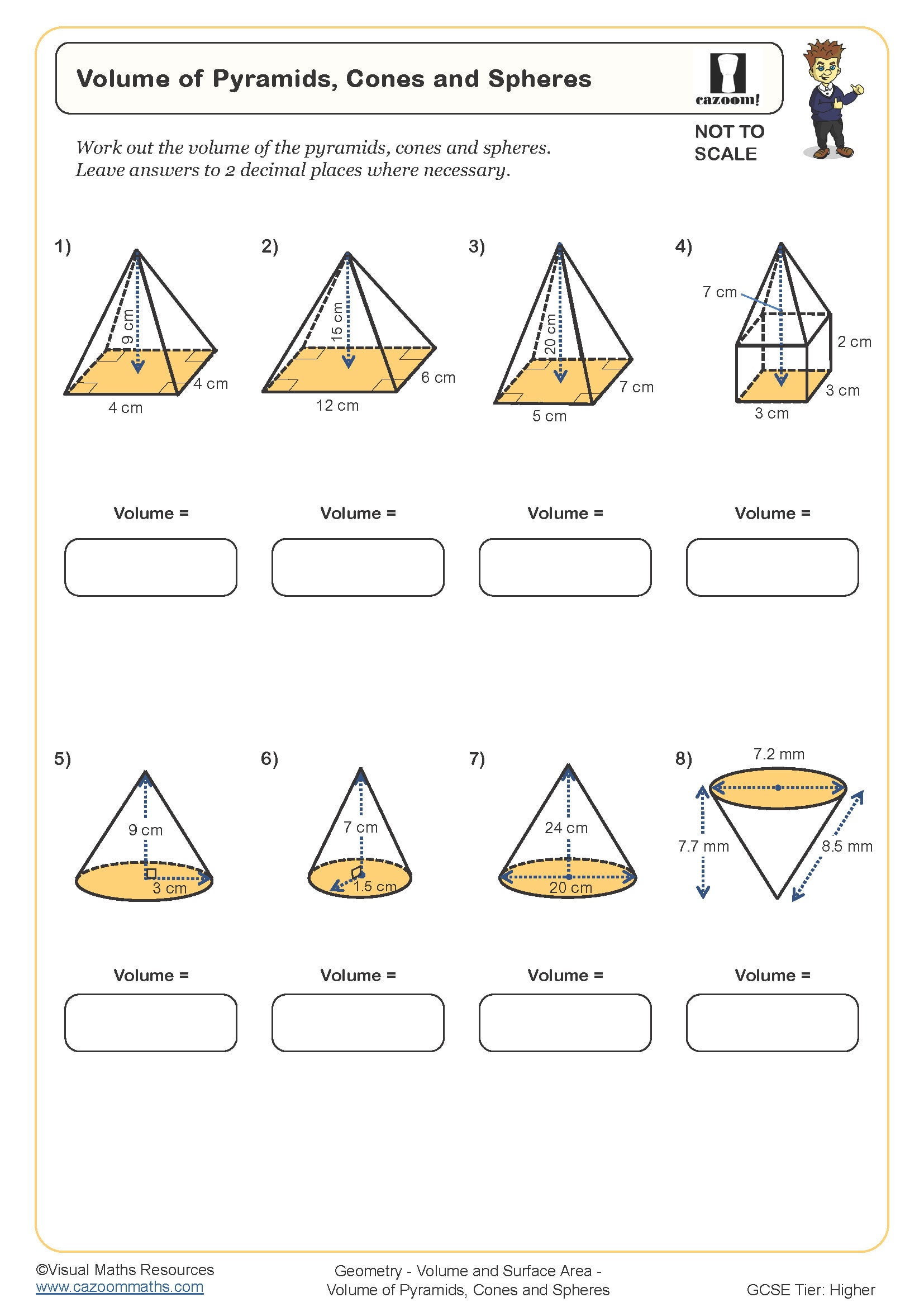
Volume of Pyramids Cones and Spheres
Year groups: 10, 11
All worksheets are created by the team of experienced teachers at Cazoom Maths.
What formulae do students need for volume and surface area of cones?
Students need three key formulae for cones: volume = ⅓πr²h, curved surface area = πrl, and total surface area = πrl + πr² (where r is radius, h is perpendicular height, and l is slant height). At GCSE level, these formulae typically appear on the formula sheet, but students must understand which measurements to substitute and when Pythagoras' theorem is needed to find missing dimensions. The curved surface area formula comes from 'unrolling' the cone into a sector, though most students simply memorise the result.
A persistent error occurs when students use the perpendicular height in the curved surface area formula instead of the slant height, or forget to add the circular base when calculating total surface area. Exam mark schemes frequently penalise students who write down correct formulae but then substitute values incorrectly, particularly in multi-step problems where they must first calculate the slant height using l² = r² + h². Questions often combine these skills with rearranging formulae or working backwards from a given volume to find dimensions.
Which year groups study volume and surface area of cones?
These worksheets target Year 10 and Year 11 students following the KS4 curriculum, where three-dimensional shapes become significantly more complex than earlier work on prisms and cylinders. Volume and surface area of cones appears in both Foundation and Higher tier GCSE specifications, though Higher tier papers typically include more demanding multi-step problems and questions requiring algebraic manipulation. This topic builds directly on earlier work with circles, Pythagoras' theorem, and substitution into formulae.
The progression within these year groups moves from straightforward substitution when all measurements are given, through problems requiring Pythagoras to find slant height or perpendicular height, to complex questions involving composite shapes or real-world contexts. Higher-attaining students also tackle problems where they must rearrange formulae to find radius or height from a given volume, or compare volumes and surface areas of different three-dimensional shapes. The inclusion of pyramids and spheres in these worksheets reflects how exam papers often test multiple 3D shapes within single questions.
How do you calculate the curved surface area of a cone?
The curved surface area of a cone uses the formula πrl, where r is the base radius and l is the slant height from apex to base edge. This slant height is not the same as the perpendicular height (h) used in the volume formula, which causes considerable confusion when both measurements appear in problems. When only the radius and perpendicular height are given, students must first calculate the slant height using Pythagoras' theorem: l² = r² + h². This intermediate step is where many marks are lost in exams when students rush or misread which measurements the question provides.
Conical structures appear throughout architecture and engineering, from roof designs to industrial storage silos and cooling towers. Architects calculating material requirements for metal sheeting or fabric canopies need the curved surface area, whilst structural engineers designing grain hoppers or conical tanks must calculate both volume (capacity) and surface area (material costs and heat loss). Understanding these formulae has practical applications in manufacturing, where optimising cone dimensions can reduce material waste whilst maintaining required volume specifications.
How do these cone worksheets support learning?
The worksheets provide carefully sequenced practice that separates the different skills before combining them in mixed problems. Early questions typically give all measurements directly, allowing students to focus on correct formula selection and substitution without additional complications. Questions then progressively introduce the need for Pythagoras' theorem, unit conversions, and problems presented in context rather than with clearly labelled diagrams. This scaffolding helps students build confidence with each component skill before tackling the multi-step problems that characterise GCSE exam questions on three-dimensional shapes.
Teachers use these worksheets effectively for small group intervention when students struggle to distinguish between different 3D shape formulae, or as retrieval practice leading up to mock and final exams. The complete answer sheets make them particularly useful for homework with self-assessment, or for students working independently during revision periods. Paired work where students check each other's Pythagoras calculations before applying cone formulae helps catch errors early. Many teachers find these resources valuable for same-day intervention following assessments where cone problems revealed gaps in understanding.