Volume and Surface Area of Cuboids Worksheets
All worksheets are created by the team of experienced teachers at Cazoom Maths.
What should students know before tackling a surface area of cuboids worksheet?
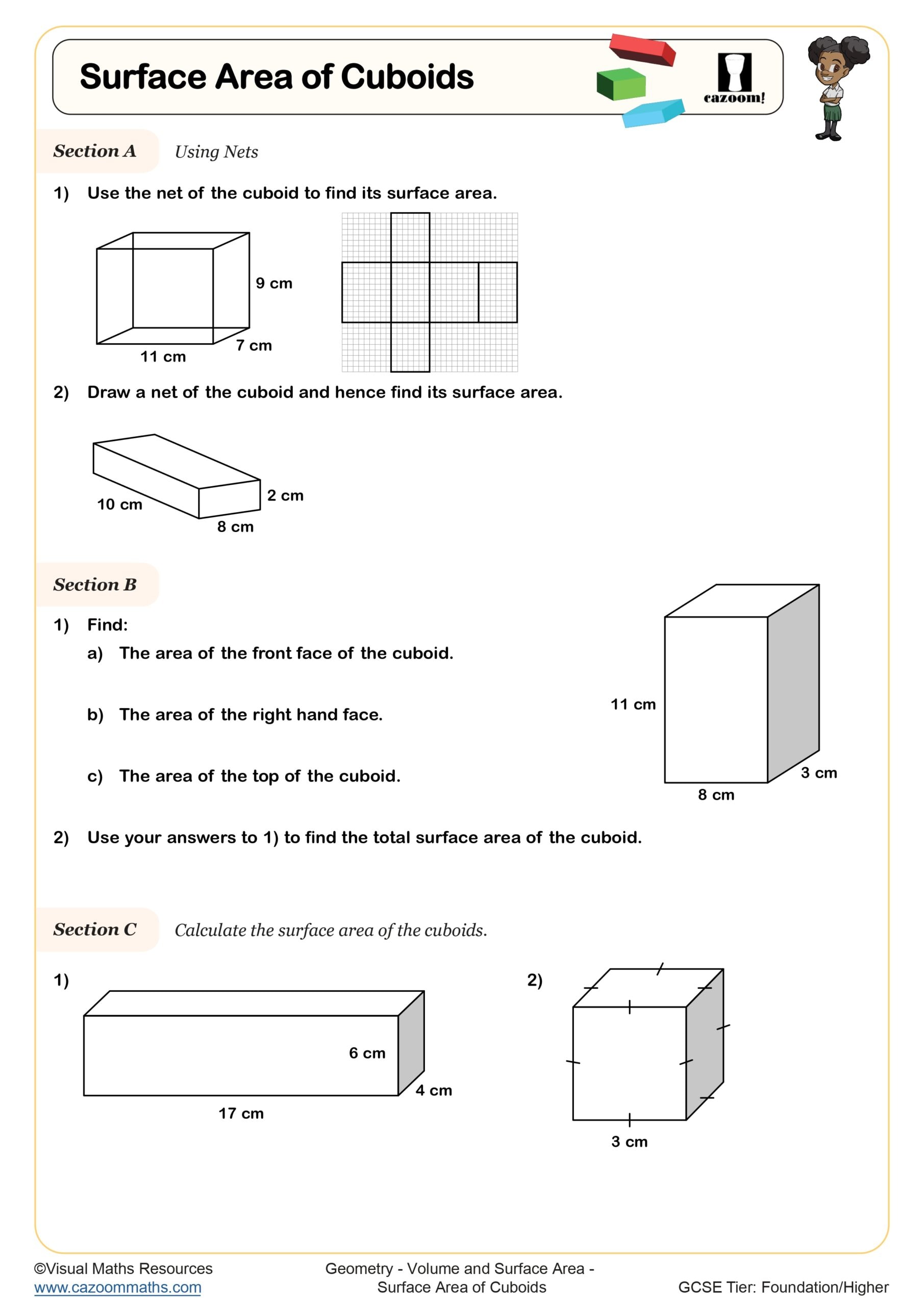
Students need secure knowledge of area calculations for rectangles, including working with different units. They should understand that cuboids have six rectangular faces arranged in three pairs of identical rectangles. Most importantly, they must be able to visualise the net of a cuboid, as this helps them see all six faces rather than just the three visible in a standard 3D diagram. This topic typically appears in Year 7 after students have revisited perimeter and area from primary school.
A common error occurs when students calculate the area of only the visible faces, forgetting the hidden back, bottom and side faces. Teachers frequently find that asking students to sketch or mentally unfold the net helps avoid this mistake. Another typical issue is mixing up length, width and height labels, especially when cuboids are rotated in diagrams. Encouraging students to label dimensions clearly on their working prevents calculation errors even when the correct method is understood.
Which year groups study volume and surface area of cuboids?
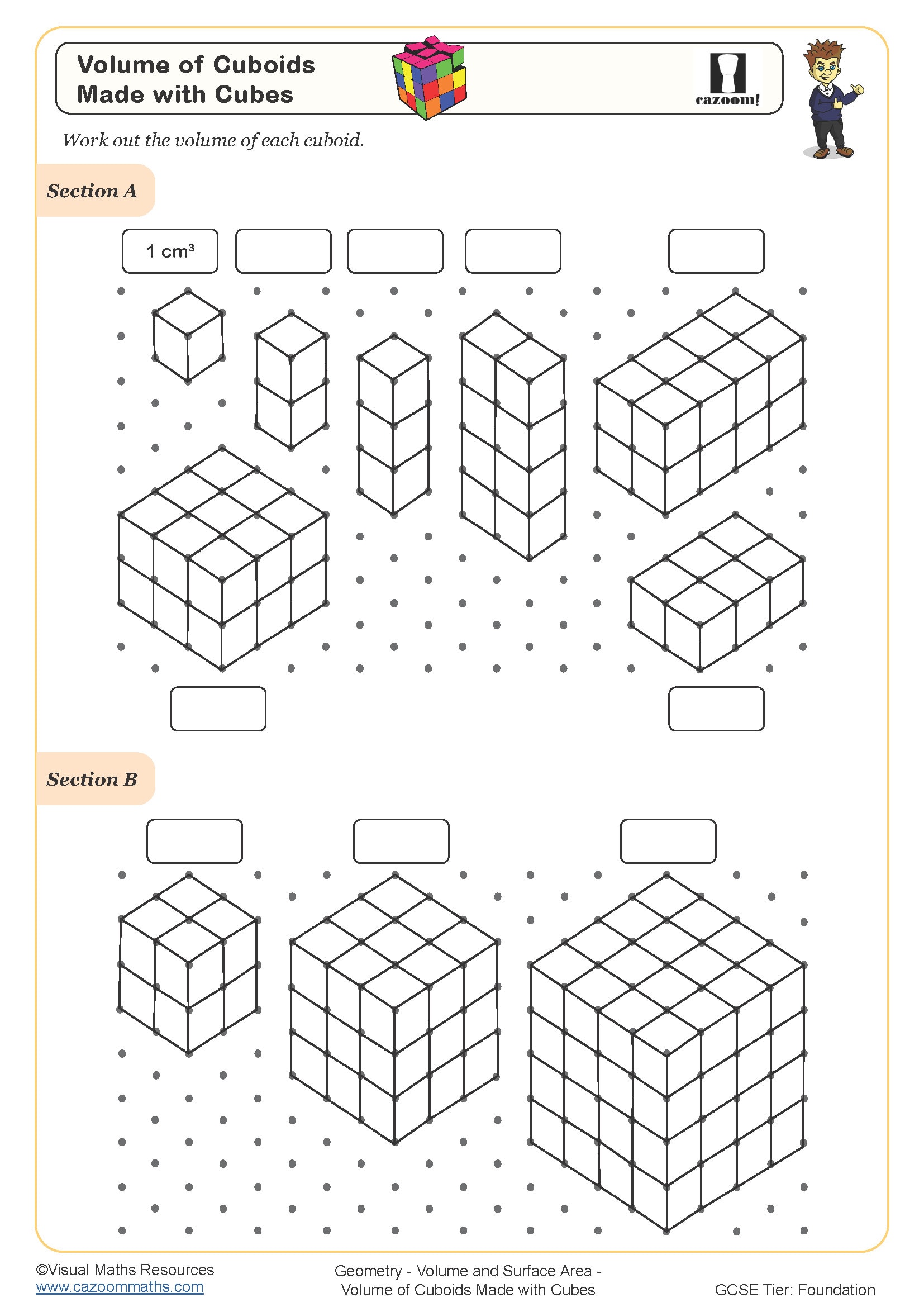
This topic appears across Years 7, 8 and 9 as part of the KS3 National Curriculum for geometry and measures. Year 7 students typically begin with straightforward cuboids where all dimensions are given in the same units, building confidence with the formulae before tackling more complex variations. The focus here is on substituting values correctly and carrying out accurate calculations, often with integer dimensions to keep the arithmetic manageable.
By Year 8, students work with decimal dimensions and mixed units, requiring conversions before calculating. Year 9 work often involves reverse problems where students must find missing dimensions given the surface area or volume, or compare cuboids to determine which has greater surface area. This progression develops algebraic thinking as students rearrange formulae. Some Year 9 schemes also introduce efficiency questions, such as minimising surface area for a fixed volume, which links to real packaging problems.
How do you calculate the surface area of a cuboid?
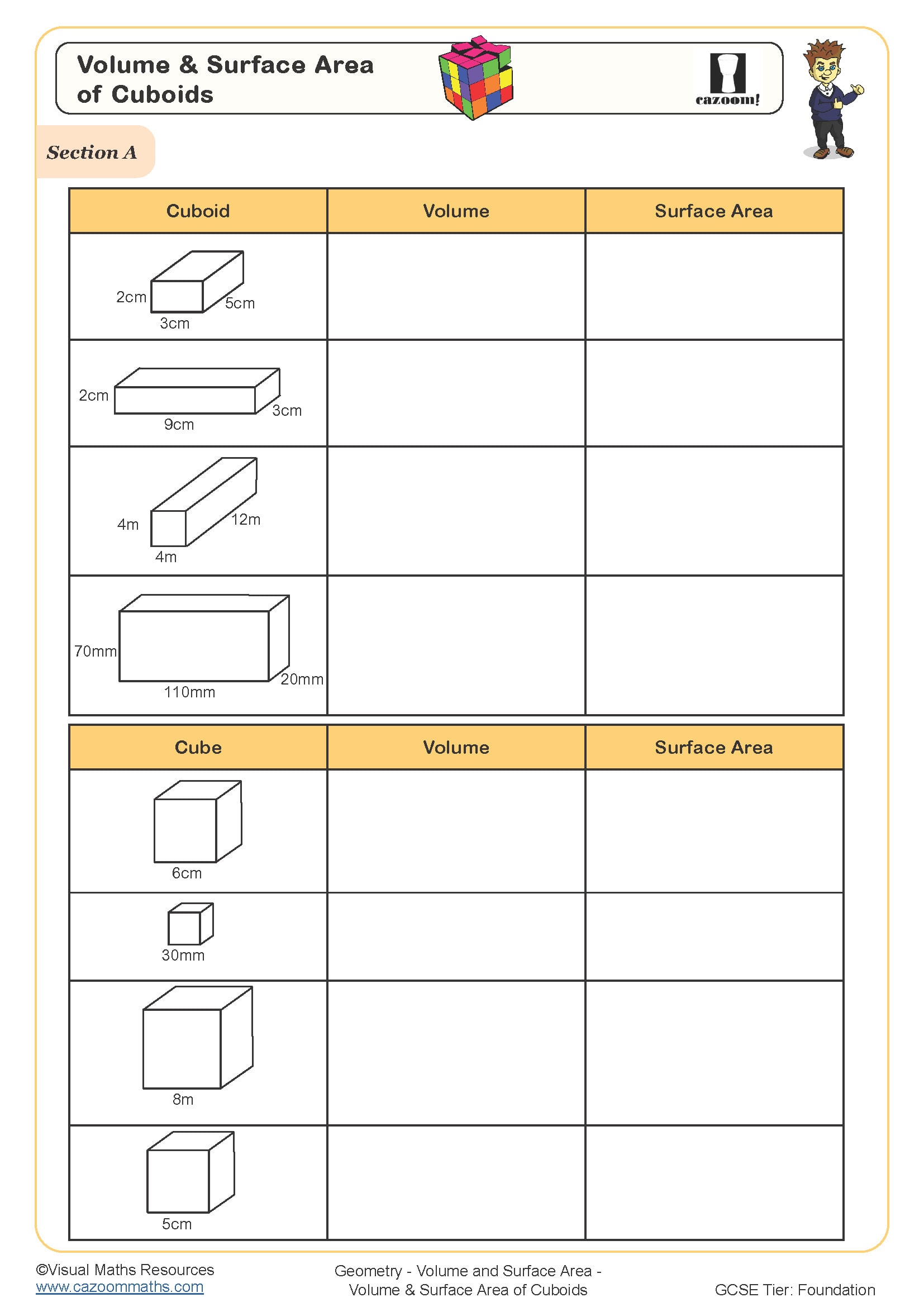
The surface area formula adds the areas of all six rectangular faces. For a cuboid with length l, width w and height h, the formula is 2lw + 2lh + 2wh, though many students find it clearer to calculate the area of each different face and double it: 2(lw + lh + wh). Teachers notice that students who write out each face separately initially make fewer errors than those who jump straight to the condensed formula. The key is recognising that opposite faces are identical, so each area calculation appears twice.
This skill has direct applications in manufacturing and packaging design, where minimising surface area reduces material costs. Cardboard box manufacturers must calculate surface area to determine how much card is needed, factoring in overlap for gluing. In architecture, surface area calculations help estimate paint quantities or cladding materials for rectangular buildings. Even in biology, understanding surface area to volume ratios for rectangular containers helps explain why cells must remain small to maintain efficient exchange of materials across their membranes.
How can teachers use these worksheets effectively in lessons?
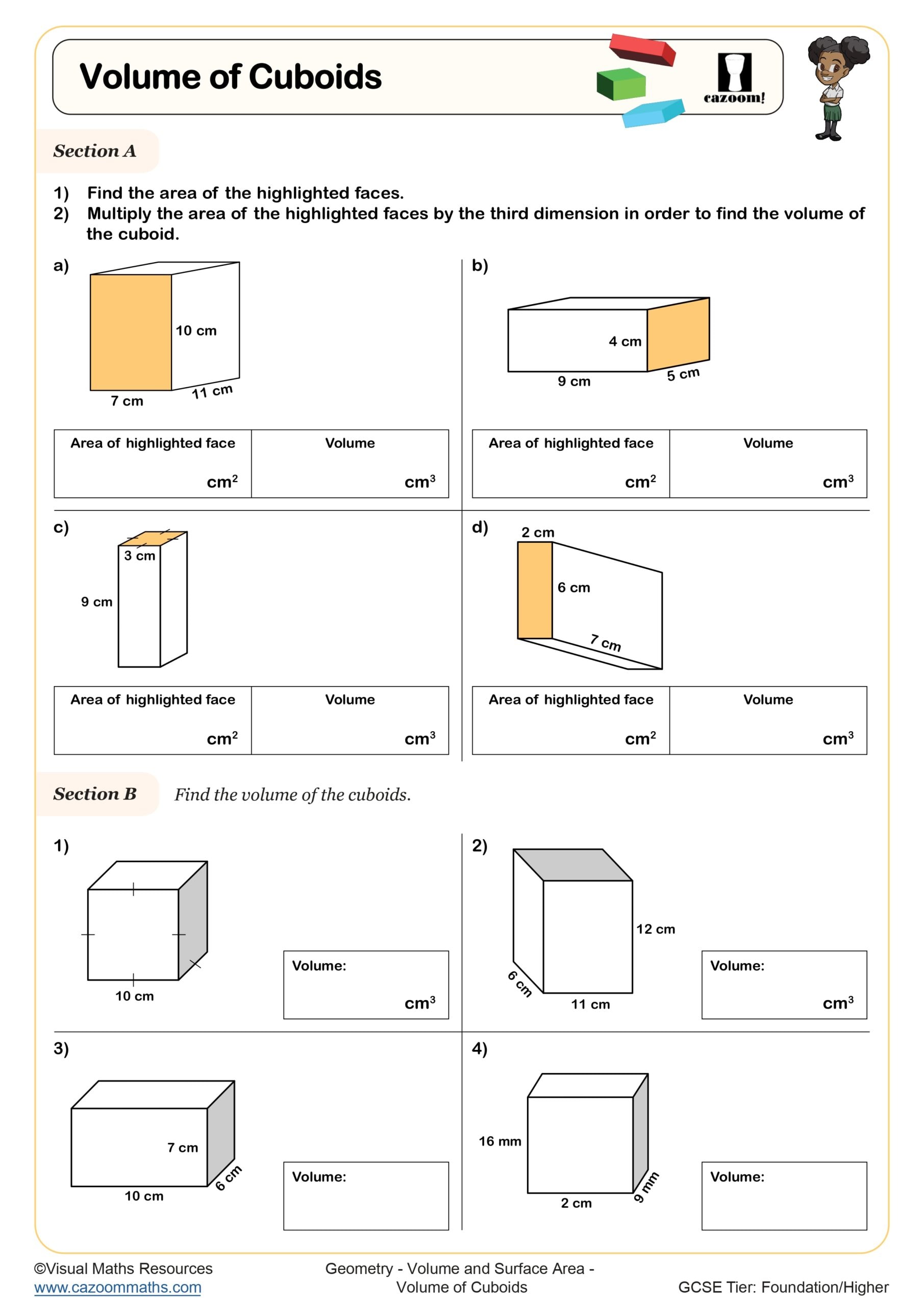
The worksheets provide structured practice that builds from basic substitution into formulae through to multi-step problems requiring unit conversions or working backwards from a given surface area. Scaffolding across the questions allows students to develop confidence before attempting more challenging variations. The progression matches how teachers typically introduce this topic, starting with labelled diagrams where all dimensions are clear before moving to problems requiring more interpretation or where dimensions must be calculated first.
Many teachers use these resources for differentiated practice during lessons, with some students working independently whilst others receive targeted support with visualisation or formula application. The complete answer sheets make them suitable for homework or revision, as students can identify errors in their method without waiting for teacher feedback. They work well in paired activities where students compare their approaches to the same problem, particularly when checking they've included all six faces. For intervention groups, working through these systematically helps identify whether difficulties stem from the 3D visualisation, the area calculations, or arithmetic accuracy.