Volume and Surface Area of Cylinders Worksheets
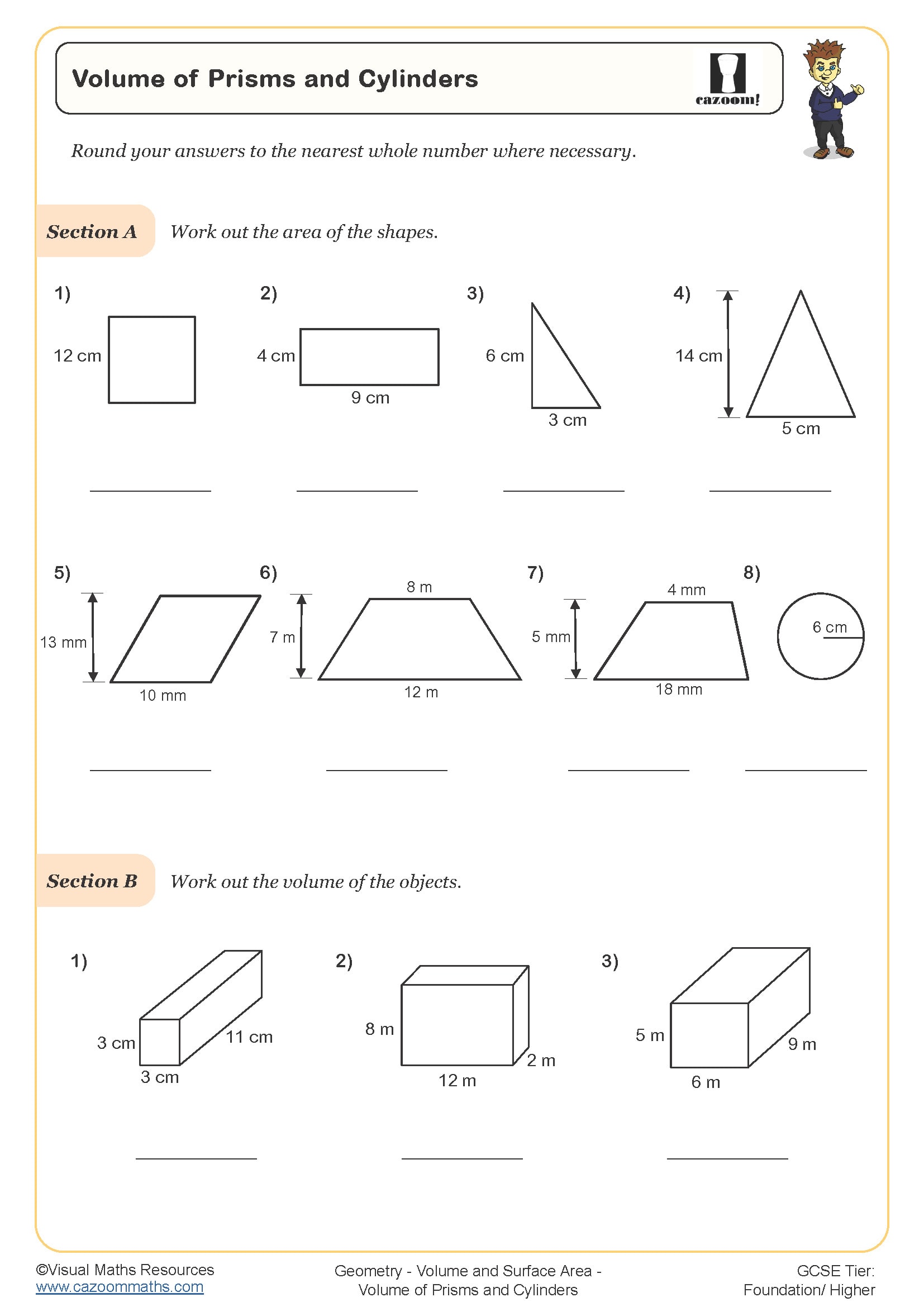
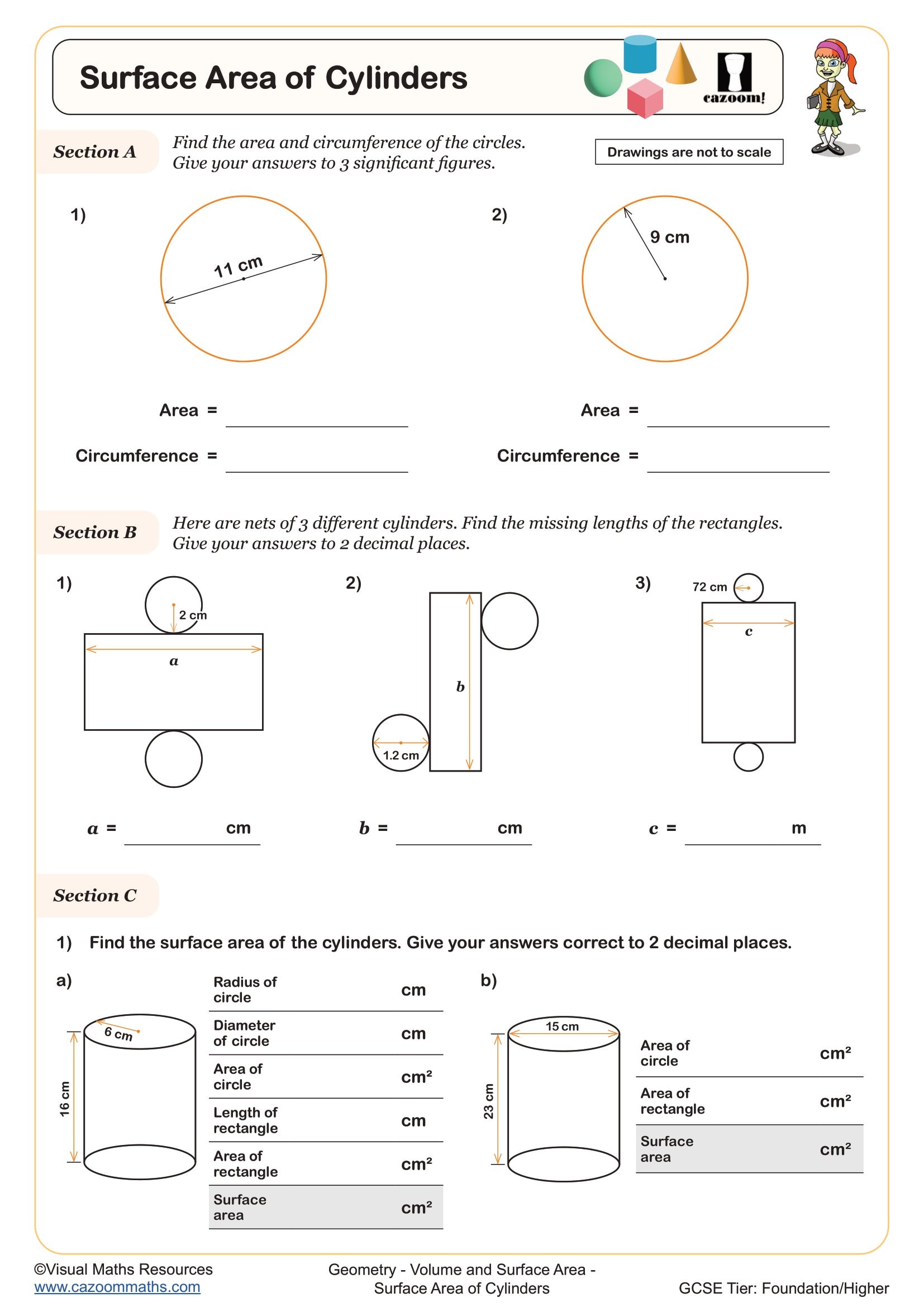
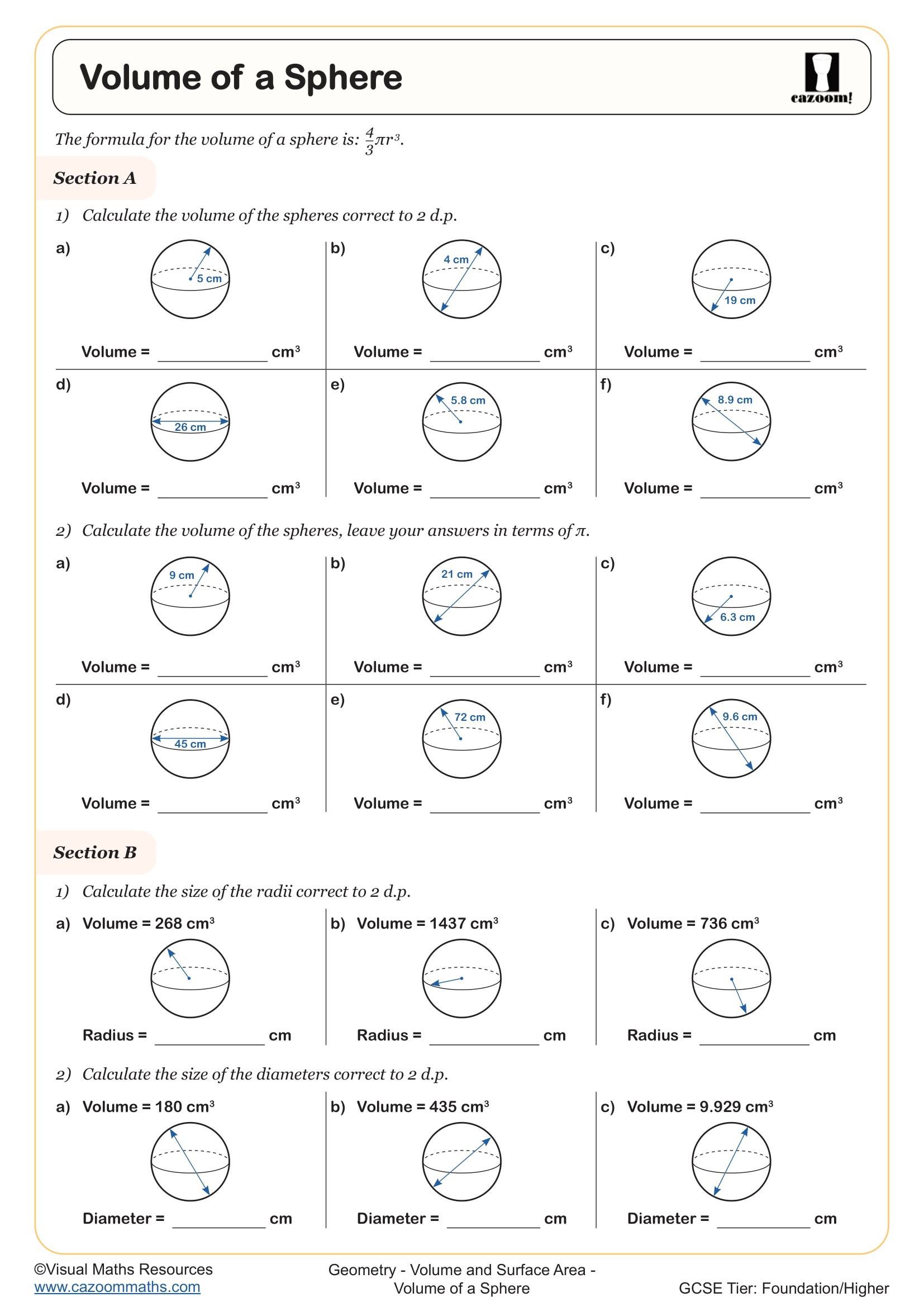
All worksheets are created by the team of experienced teachers at Cazoom Maths.
What formulas do students need for volume and surface area of cylinders?
Students require three key formulas: volume = πr²h, curved surface area = 2πrh, and total surface area = 2πr² + 2πrh (or 2πr(r + h)). At KS3, students typically meet these formulas explicitly and learn when to apply each one, whilst GCSE students must recall them confidently and manipulate them to find missing dimensions when given volume or surface area.
Teachers frequently notice students attempting to calculate volume using diameter rather than radius, a mistake that compounds through the squaring operation. Another common error occurs when students calculate only the curved surface and forget the two circular ends, particularly in multi-step problems where they lose track of what they've already included. Exam mark schemes consistently penalise these oversights, so systematic checking becomes vital.
Which year groups study volume and surface area of cylinders?
These worksheets cover Year 8, Year 9, Year 10, and Year 11, spanning both KS3 and KS4. The topic first appears in Year 8 as part of the National Curriculum requirements for calculating volumes of cuboids and other prisms, with cylinders introduced as circular prisms. Students consolidate this understanding through Year 9 before revisiting cylinders in more complex contexts during GCSE preparation.
Progression across year groups typically moves from straightforward substitution into given formulas towards problems requiring rearrangement to find radius or height from known volumes. Year 11 Higher tier students encounter cylinders within compound shapes, real-world contexts with multiple steps, and problems requiring conversion between units. Foundation tier maintains focus on direct application with clearly identified dimensions.
Why does surface area include curved and flat surfaces?
A cylinder comprises three surfaces: two identical circular ends (the bases) and one curved rectangular surface that wraps around the cylinder. When calculating total surface area, students must account for all three components. The curved surface, if unwrapped, forms a rectangle with length equal to the circle's circumference (2πr) and width equal to the cylinder's height (h), giving area 2πrh. The two circular ends each contribute πr².
This concept connects directly to packaging and manufacturing contexts where material efficiency matters. Drinks cans, for instance, are designed to minimise surface area for a given volume to reduce aluminium costs, which is why taller, narrower cans actually use less metal than shorter, wider alternatives holding the same amount. Engineers and product designers routinely optimise cylinder dimensions for material economy, making these calculations genuinely relevant in manufacturing and sustainability roles.
How do these worksheets support cylinder calculations?
The worksheets build proficiency through carefully structured questions that separate curved surface area, total surface area, and volume calculations before combining them in mixed exercises. This scaffolded approach prevents students from attempting complex problems before mastering individual formula applications. Answer sheets allow students to self-check their working and identify specific calculation errors rather than simply marking answers correct or incorrect.
Many teachers use these resources for intervention groups where students need additional consolidation outside main lessons, particularly before mock examinations when cylinder questions predictably appear. The worksheets function equally well for homework to reinforce classwork or as starter activities to retrieve prior knowledge. Paired work proves particularly effective, with students comparing methods for finding radius when given volume, as this reverse-calculation approach reveals whether they genuinely understand the relationship between the variables rather than just memorising formulas.