Volume and Surface Area of Frustums Worksheets
All worksheets are created by the team of experienced teachers at Cazoom Maths.
What is a frustum and how do you calculate its volume?
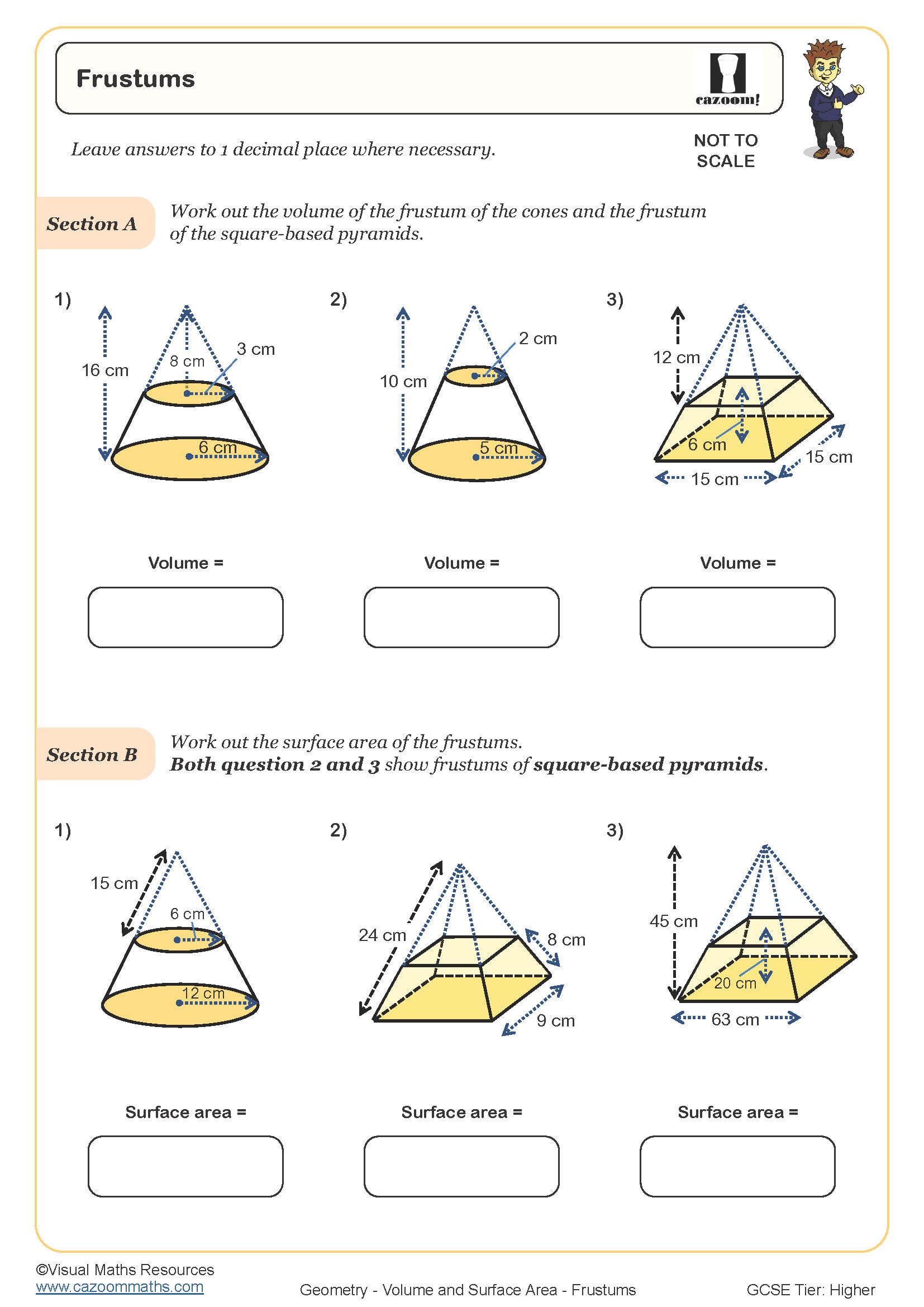
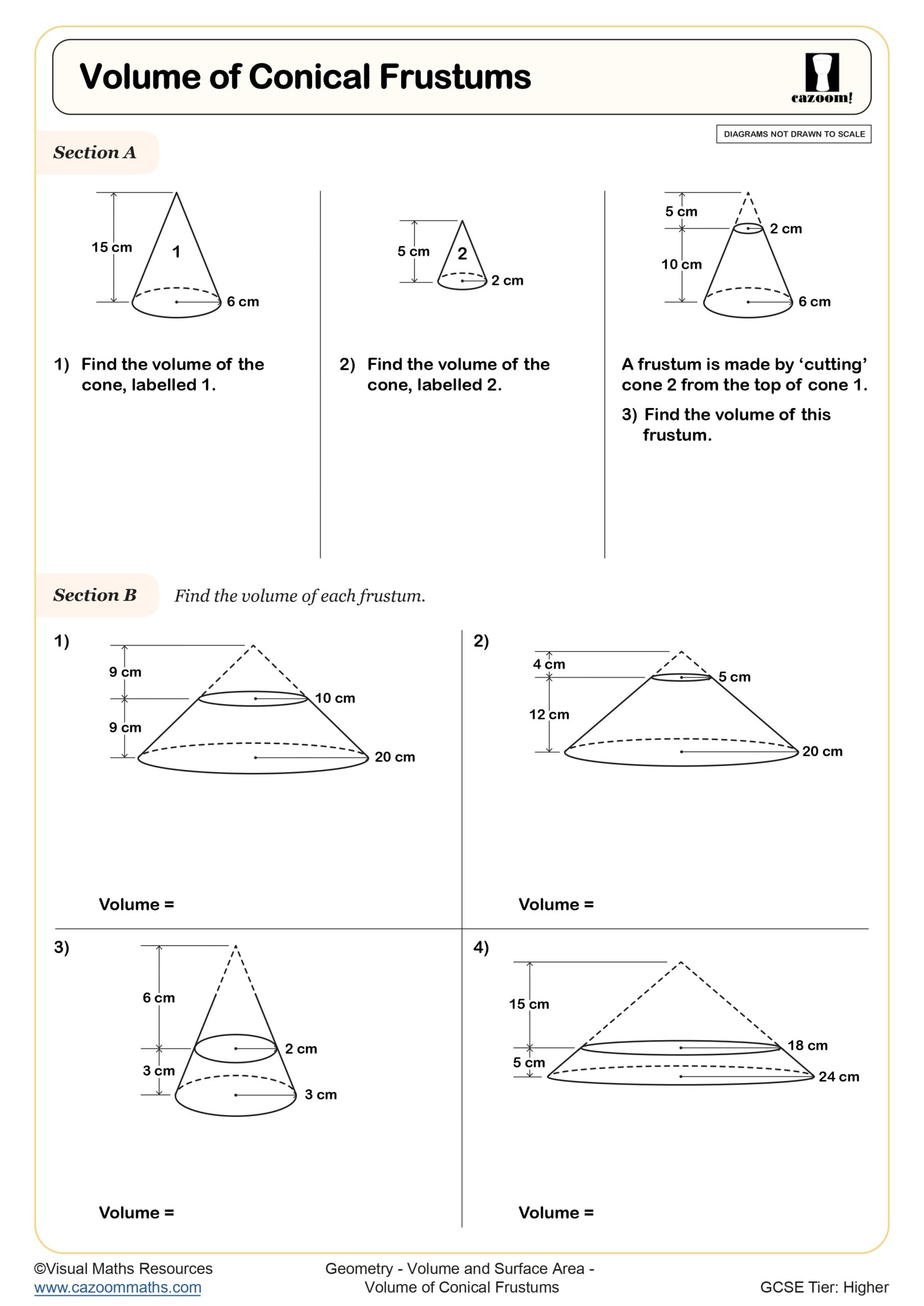
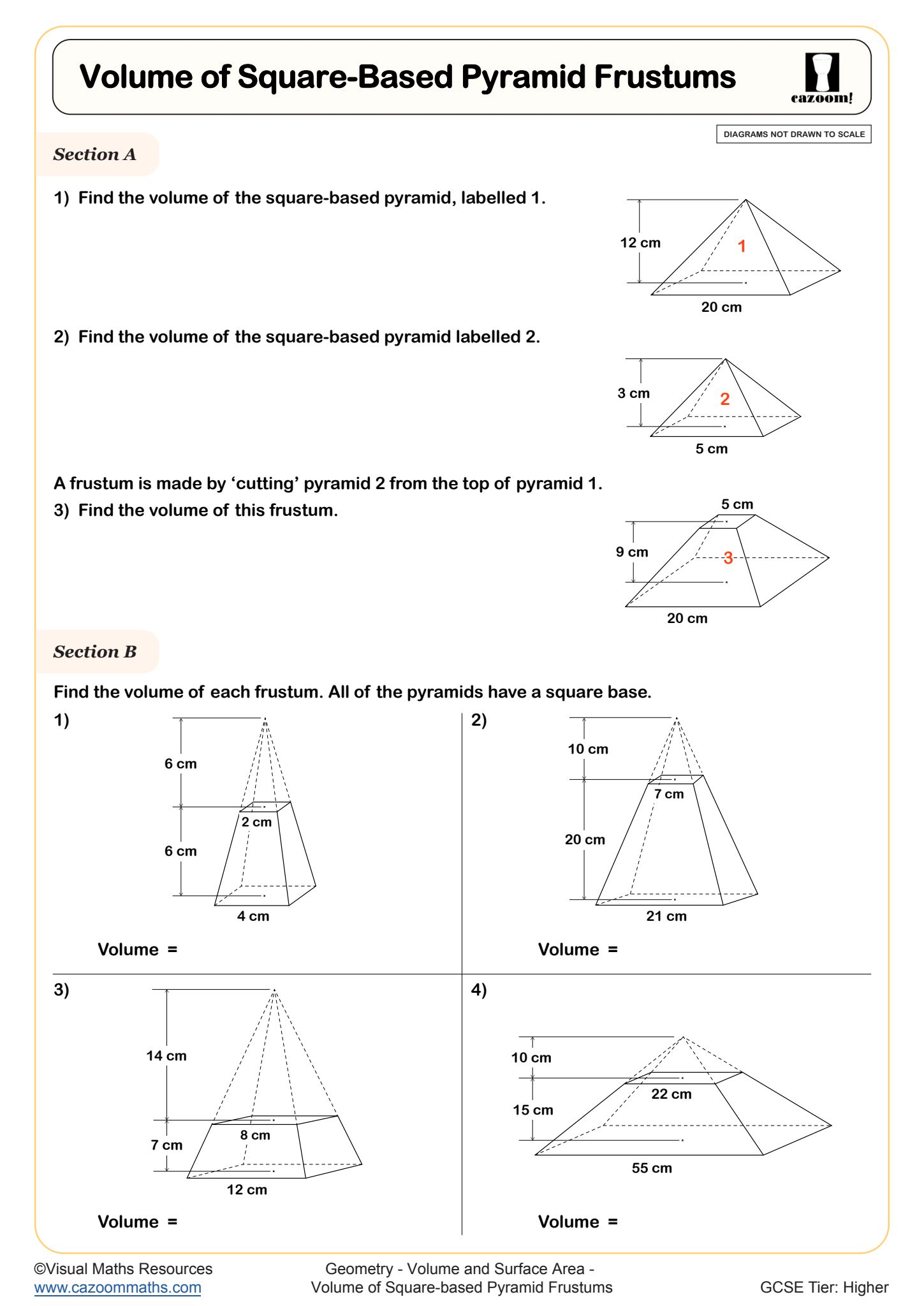
A frustum is the portion of a pyramid or cone that remains after the top section has been removed by a cut parallel to the base. To find the volume of a frustum, students subtract the volume of the smaller removed solid from the volume of the complete original solid. This requires identifying corresponding dimensions and often working with ratios when only certain measurements are provided.
Many students mistakenly try to find a direct formula rather than using the subtraction method, or they fail to recognise that the slant heights and radii are related through similar triangles. Mark schemes consistently expect clear working showing both volume calculations separately before subtraction. Teachers often use physical models or cross-sections to help students visualise the relationship between the complete cone or pyramid and the frustum that remains.
Which year groups study volume and surface area of frustums?
Volume and surface area of frustums appear in the curriculum for Year 9, Year 10 and Year 11 students, spanning both Key Stage 3 and Key Stage 4. This topic typically follows secure understanding of volume and surface area for standard 3D shapes including prisms, pyramids and cones. At GCSE, frustum problems often appear as Higher tier questions requiring multiple steps and algebraic manipulation.
The progression across year groups involves increasing complexity in the information provided and the calculations required. Year 9 students might work with clearly labelled diagrams and straightforward dimensions, whilst Year 11 students encounter problems where they must first use similar shapes to find missing measurements, or reverse problems where they work backwards from a given volume. Some exam questions combine frustums with other topics such as density or converting between units.
How do you find the curved surface area of a frustum of a cone?
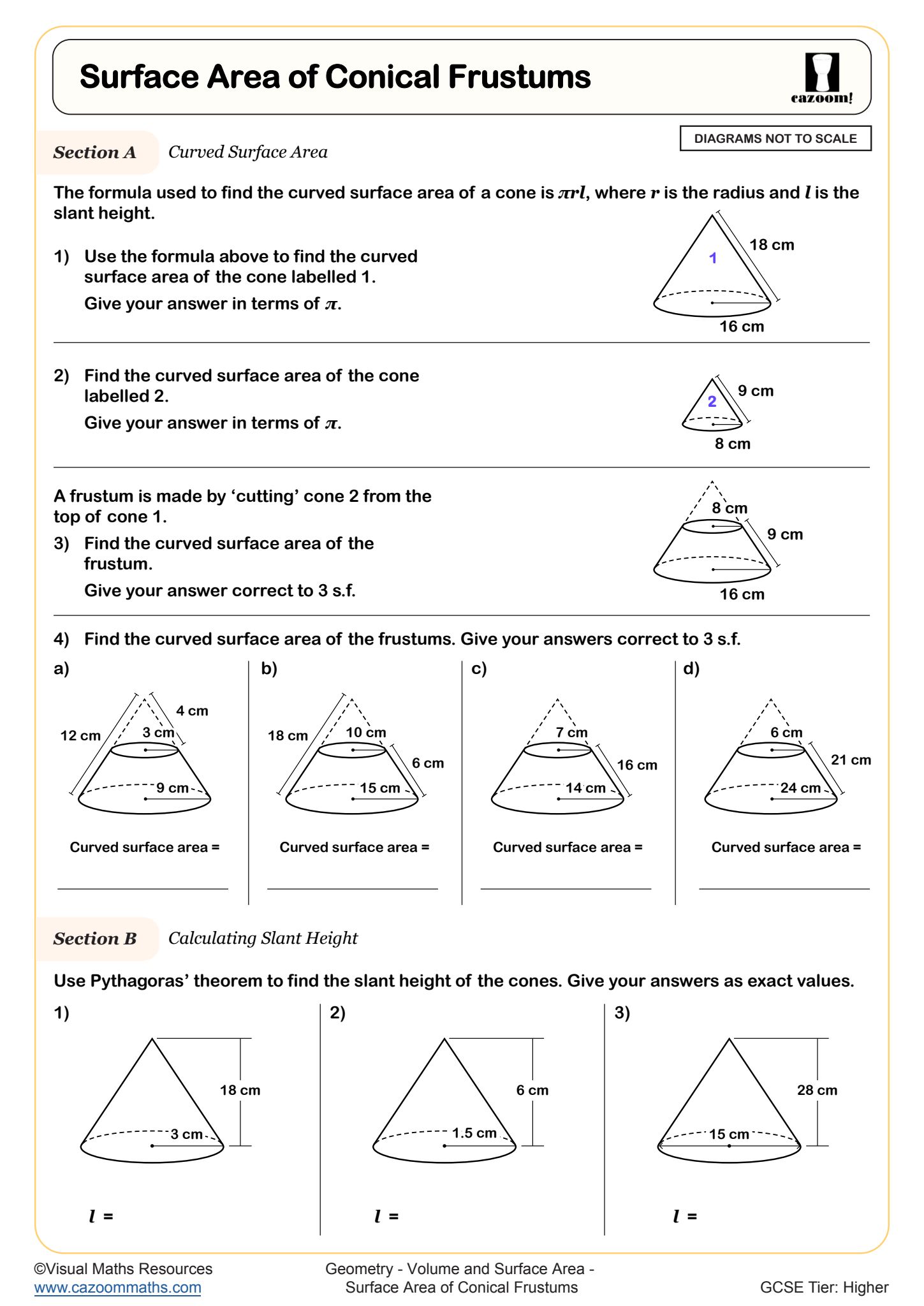
The curved surface area of a frustum of a cone requires finding the difference between the curved surface area of the complete cone and the smaller cone that was removed. Students use πrl for each cone (where r is the radius and l is the slant height), then subtract the smaller from the larger. A common error occurs when students confuse the slant height with the vertical height, or fail to find the slant height of the removed portion correctly using similar triangles and ratios.
This skill has direct applications in manufacturing and packaging design. Water towers, lampshades, buckets and industrial hoppers frequently use frustum shapes because they combine structural stability with efficient material use. Engineers must calculate surface areas accurately to determine material quantities and costs when fabricating these components, making this topic highly relevant in construction, aerospace and product design contexts where optimising material usage directly impacts budgets and sustainability.
How can these worksheets support learning about frustums?
The worksheets build understanding systematically, starting with identifying frustums and their properties before progressing to calculations involving volume and surface area. Questions include carefully chosen dimensions that help students recognise patterns in similar shapes and develop confidence with the subtraction method. Worked examples and structured questions scaffold the problem-solving process, particularly for students who find visualising 3D shapes challenging.
These resources work effectively for targeted intervention with small groups who need additional practice before attempting GCSE Higher tier questions. Teachers use them for homework following initial teaching, or as revision material before assessments where frustums typically appear as multi-mark questions. The answer sheets allow students to self-check their methods during independent work, whilst paired activities can involve students explaining their approaches to each other, strengthening both their procedural fluency and mathematical reasoning about 3D shapes.