Volume and Surface Area of Prisms Worksheets
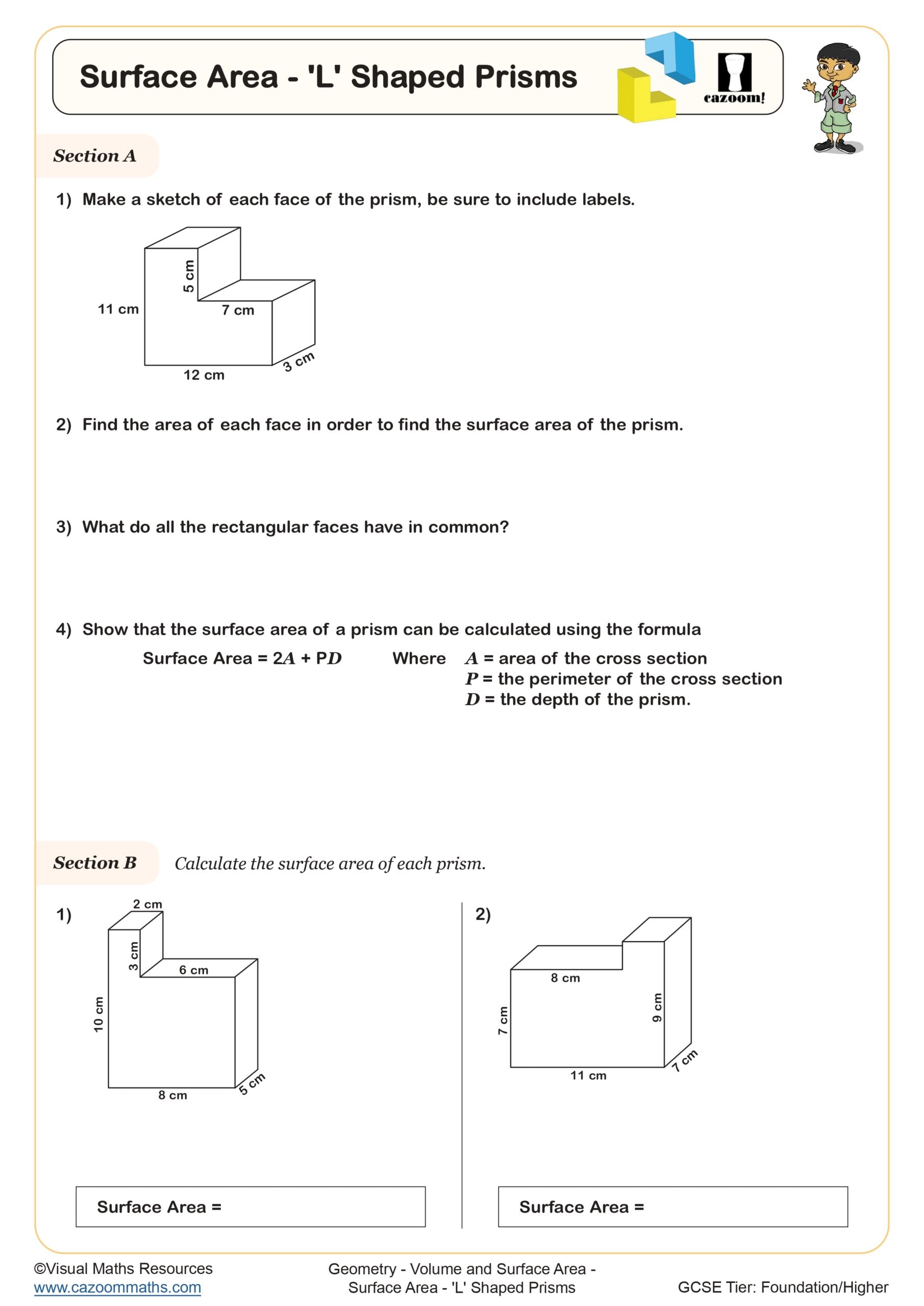
All worksheets are created by the team of experienced teachers at Cazoom Maths.
What's the difference between volume and surface area of prisms?
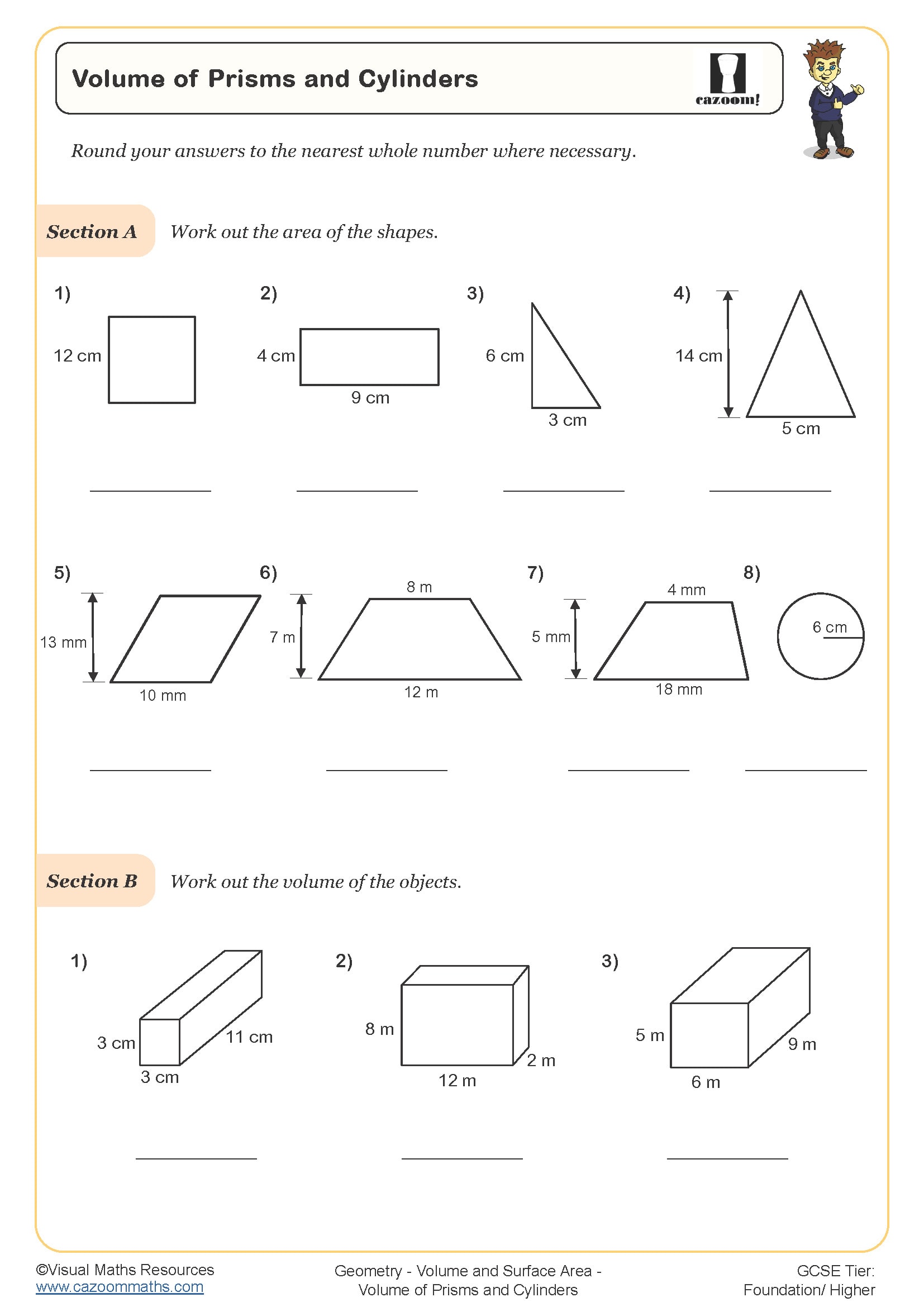
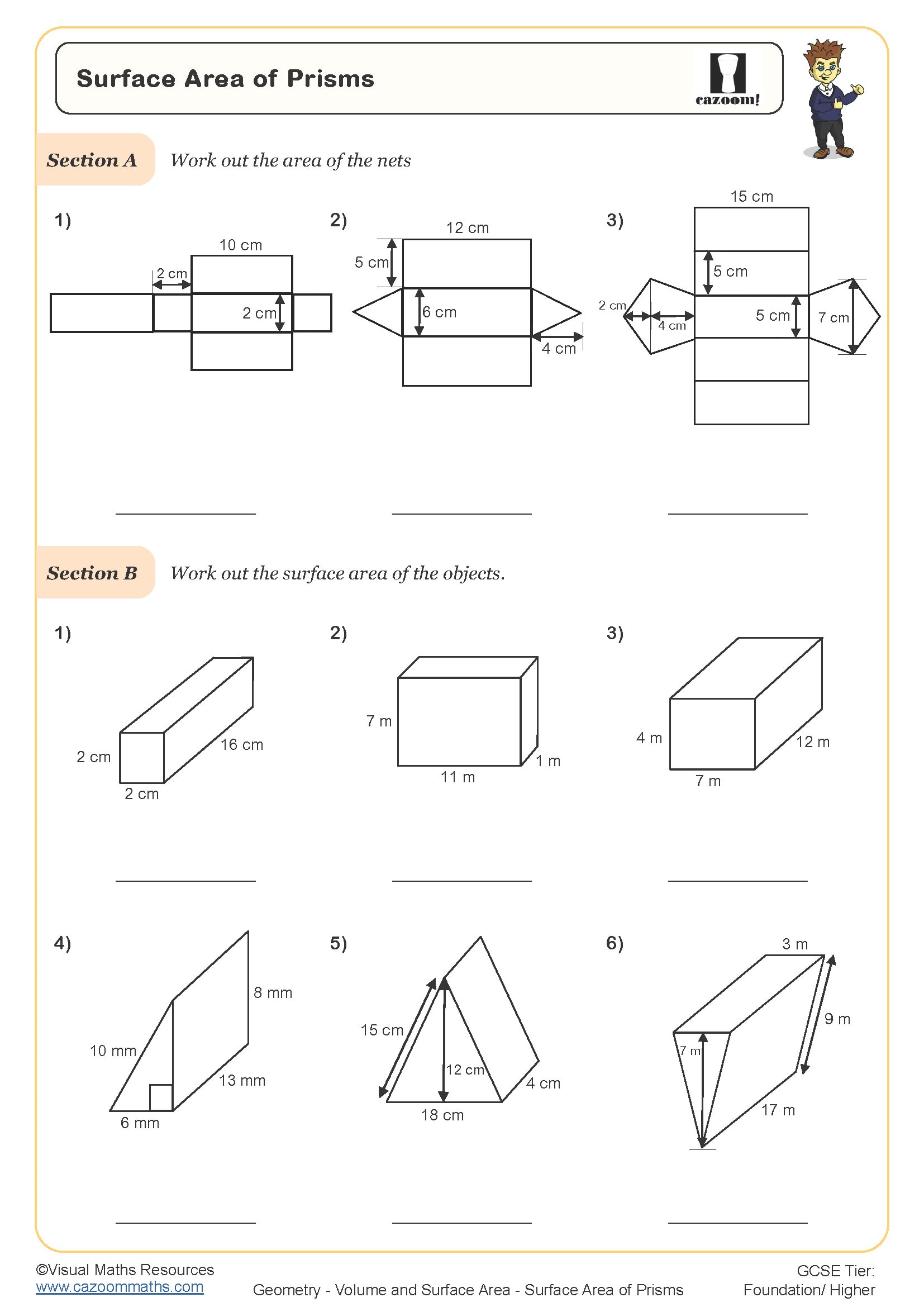
Volume measures the three-dimensional space inside a prism (calculated in cubic units like cm³ or m³), whilst surface area measures the total area of all external faces (calculated in square units like cm² or m²). For prisms, volume equals the area of the cross-section multiplied by the length, whereas surface area requires calculating the area of each face separately, then adding them together. The National Curriculum introduces these concepts at Key Stage 3, with expectations that students can distinguish between the two measurements and select the appropriate formula.
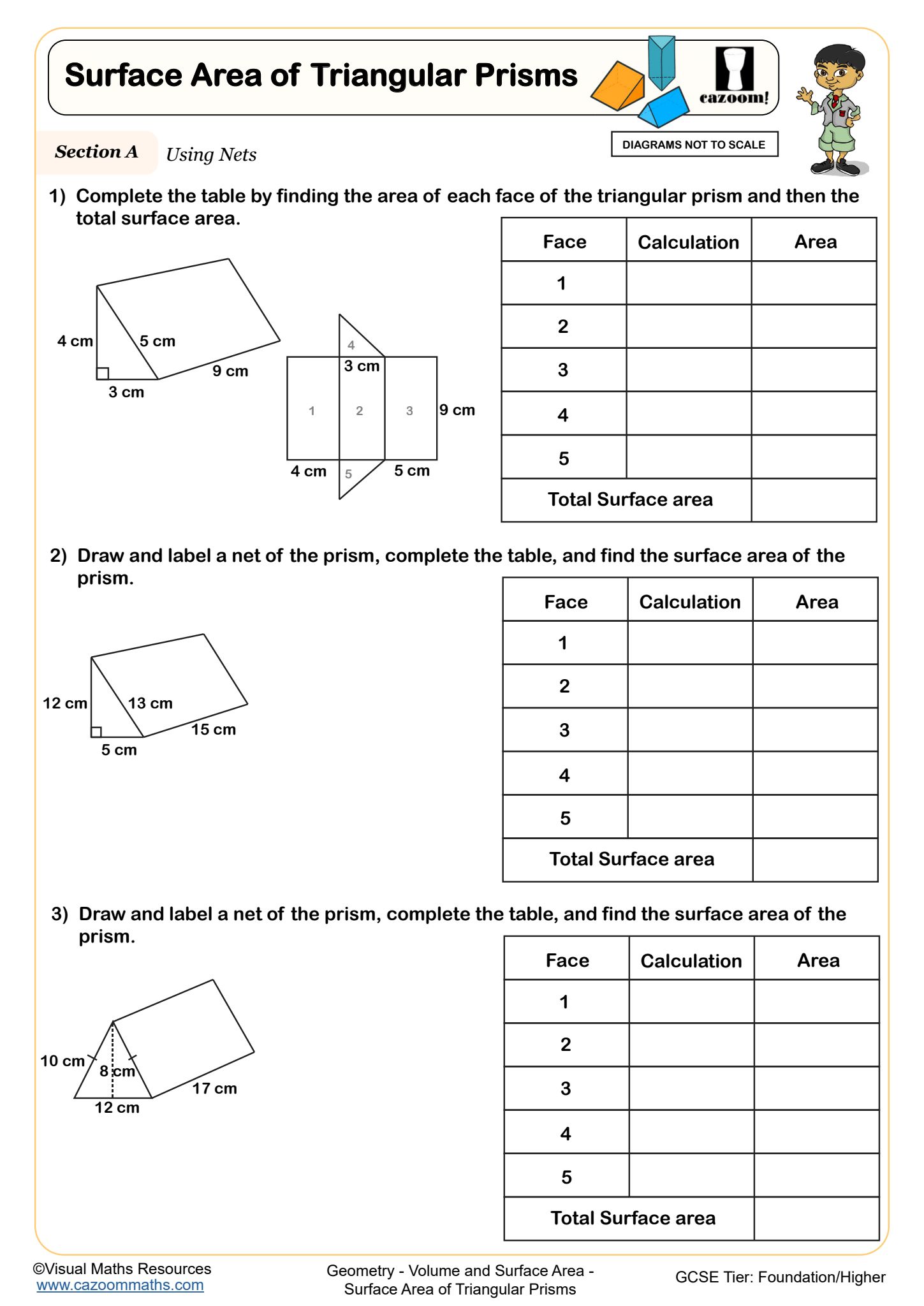
A common error occurs when students calculate volume but express their answer in square units, or vice versa. Exam mark schemes consistently penalise incorrect units, even when the numerical calculation is correct. Students also lose marks when finding the surface area of a triangular prism by forgetting to include the two triangular ends or miscounting rectangular faces, particularly with composite shapes where hidden faces shouldn't be included.
Which year groups study volume and surface area of prisms?
These worksheets cover Year 8, Year 9, and Year 10, spanning both Key Stage 3 and Key Stage 4. Students typically meet cuboids and simple prisms in Year 7, then progress to triangular prisms and more complex shapes in Year 8. By Year 9, they're expected to handle composite prisms and problems involving unit conversions. At GCSE level in Year 10, questions often combine volume and surface area calculations with other topics like ratio, percentage increase, or forming and solving equations.
The progression moves from prisms with integer dimensions and straightforward cross-sections to those requiring multi-step calculations or algebraic expressions. Year 8 questions might focus on calculating volume when given clear dimensions, whilst Year 10 problems often present composite shapes requiring students to identify and subtract sections, or reverse problems where they're given the volume and must calculate a missing dimension. Foundation GCSE papers typically include straightforward prism questions worth 2-3 marks, whilst Higher tier papers may embed them within problem-solving contexts worth 4-5 marks.
How do you calculate the volume of a triangular prism?
To find the volume of a triangular prism, students multiply the area of the triangular cross-section by the prism's length. This requires first calculating the triangle's area using ½ × base × height, then multiplying this result by the prism's depth or length. Teachers notice students frequently forget the '½' when finding the triangle's area, effectively doubling their final answer. Another misconception occurs when students confuse the perpendicular height of the triangle with a slant edge, particularly in questions where diagrams show multiple measurements.
This skill connects directly to real-world applications in packaging design, construction, and engineering. Toblerone packaging uses triangular prisms, and calculating chocolate volume for manufacturing requires precisely this method. In architecture, roof spaces and structural supports often form triangular prisms, making volume calculations essential for material estimation and cost planning. Civil engineers apply the same principles when designing drainage channels, whose cross-sections are often trapezoidal or triangular prisms requiring accurate volume calculations for water capacity and flow rate predictions.
How can teachers use these volume and surface area worksheets effectively?
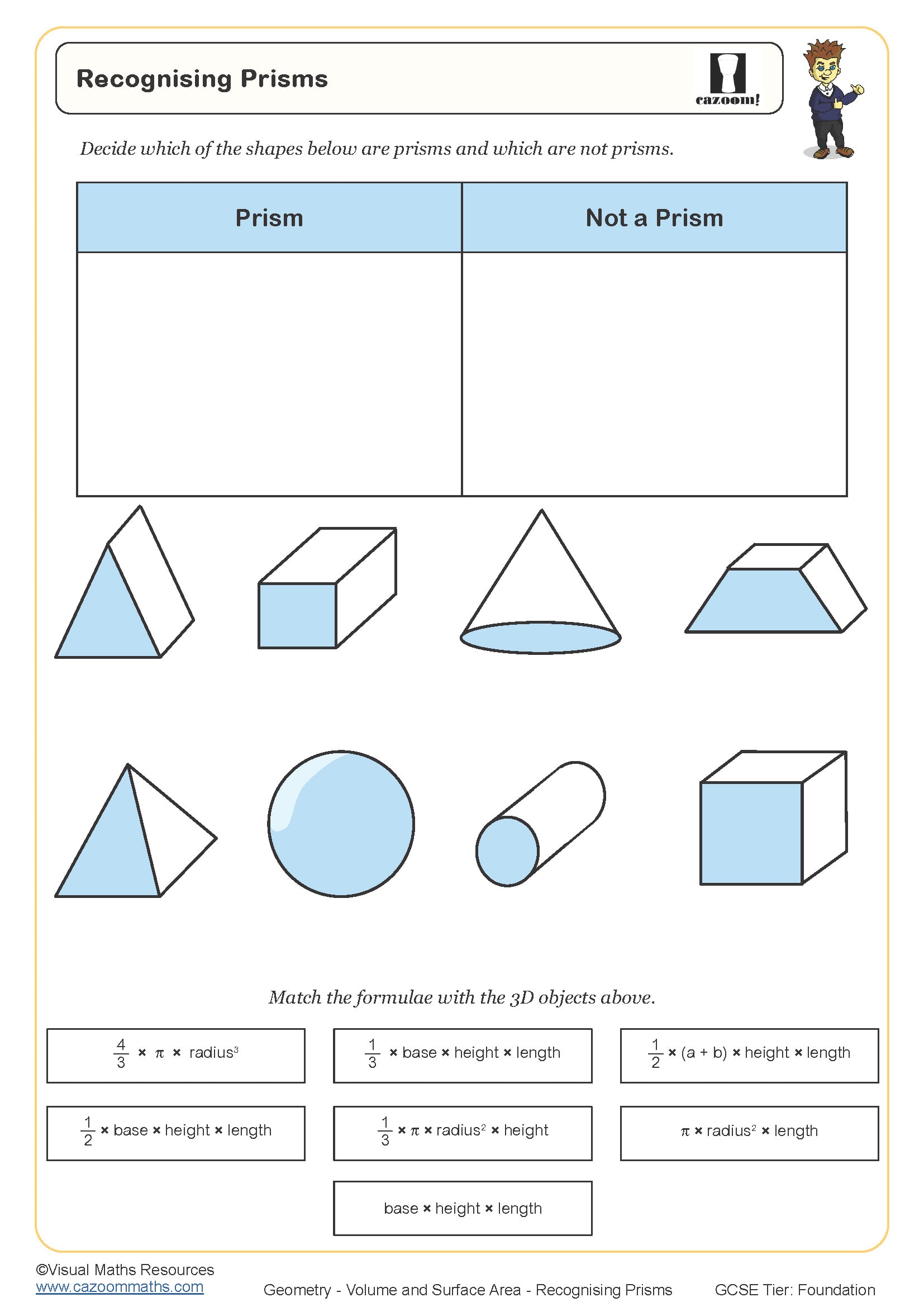
The worksheets provide structured practice that builds from identifying prisms and their properties through to multi-step problem-solving. Each question set includes varied representations: some prisms shown with clear labels, others requiring students to extract information from diagrams with measurements in different positions. The inclusion of both volume and surface area questions on the same sheet helps students practise distinguishing between the two calculations, addressing the common confusion between these concepts. Complete answer sheets support self-assessment and allow students to identify where calculation errors occur.
Many teachers use these resources for differentiated homework tasks, assigning different year group worksheets according to student confidence rather than chronological age. They work particularly well in intervention sessions where small groups can discuss which faces to include in surface area calculations, or during revision periods when students need focused practice on specific geometric skills. The worksheets also suit paired work, with one student calculating volume whilst their partner tackles surface area, then comparing methods and checking each other's working against the answer sheets.