Volume and Surface Area of Pyramids Worksheets
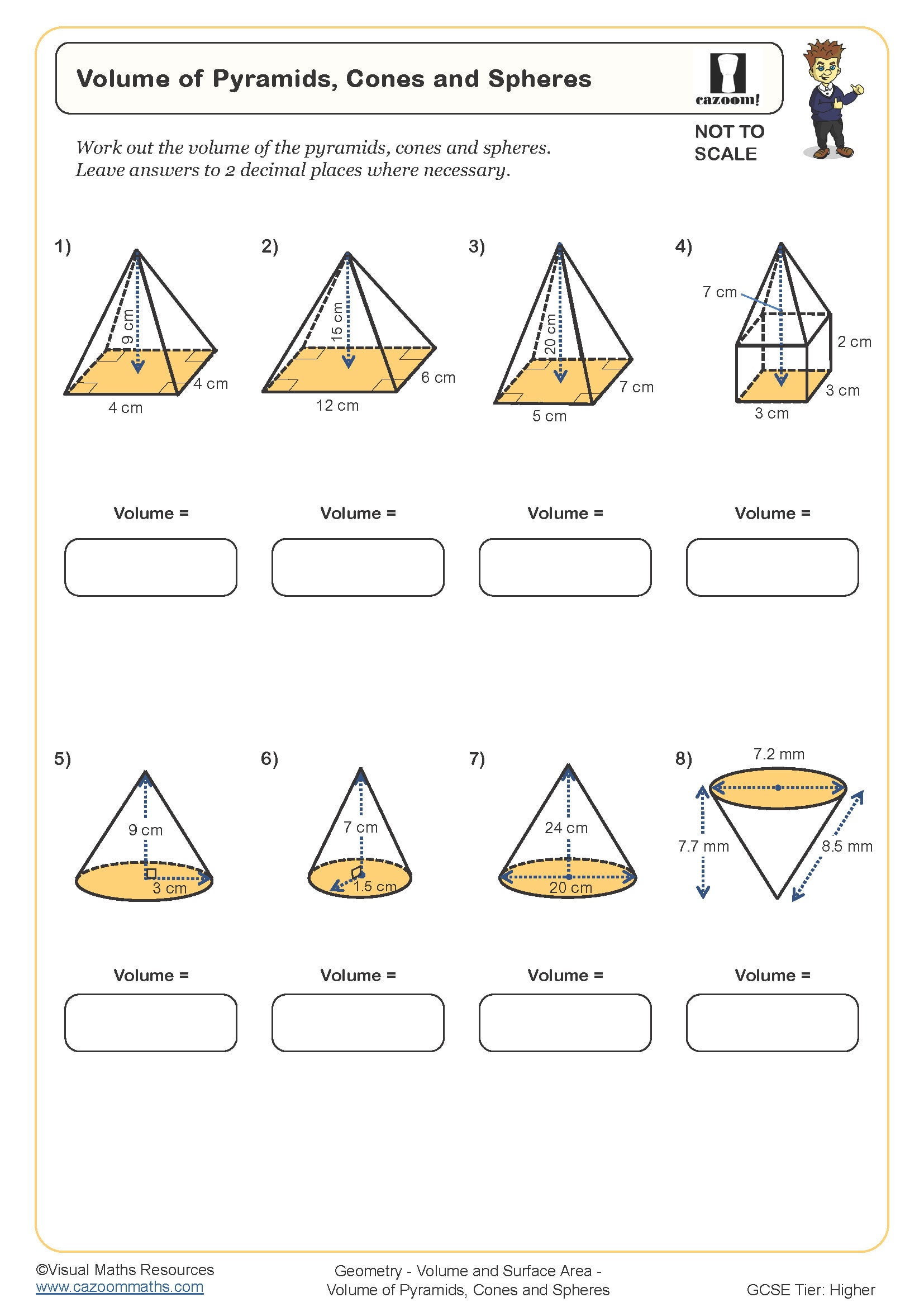
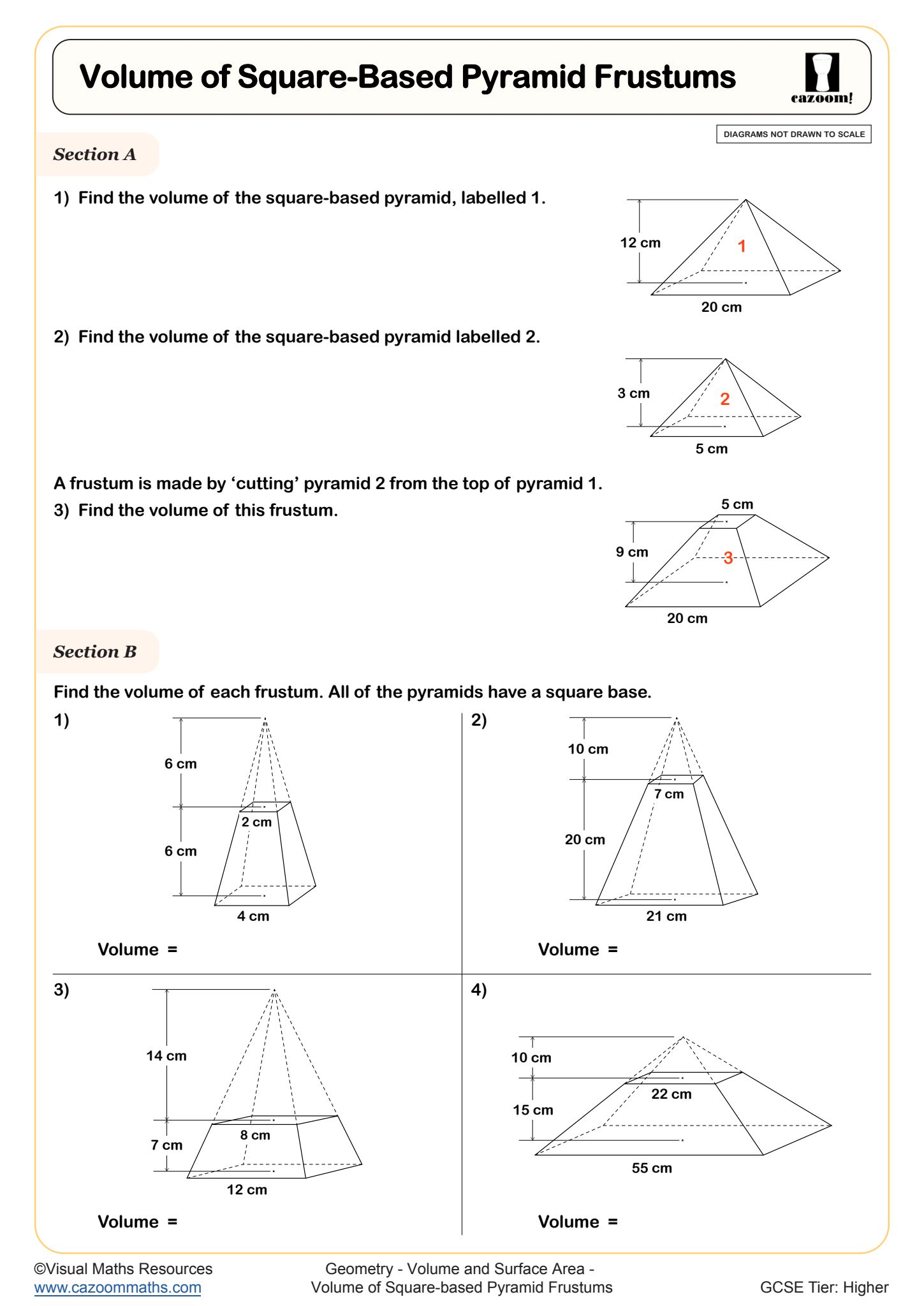
All worksheets are created by the team of experienced teachers at Cazoom Maths.
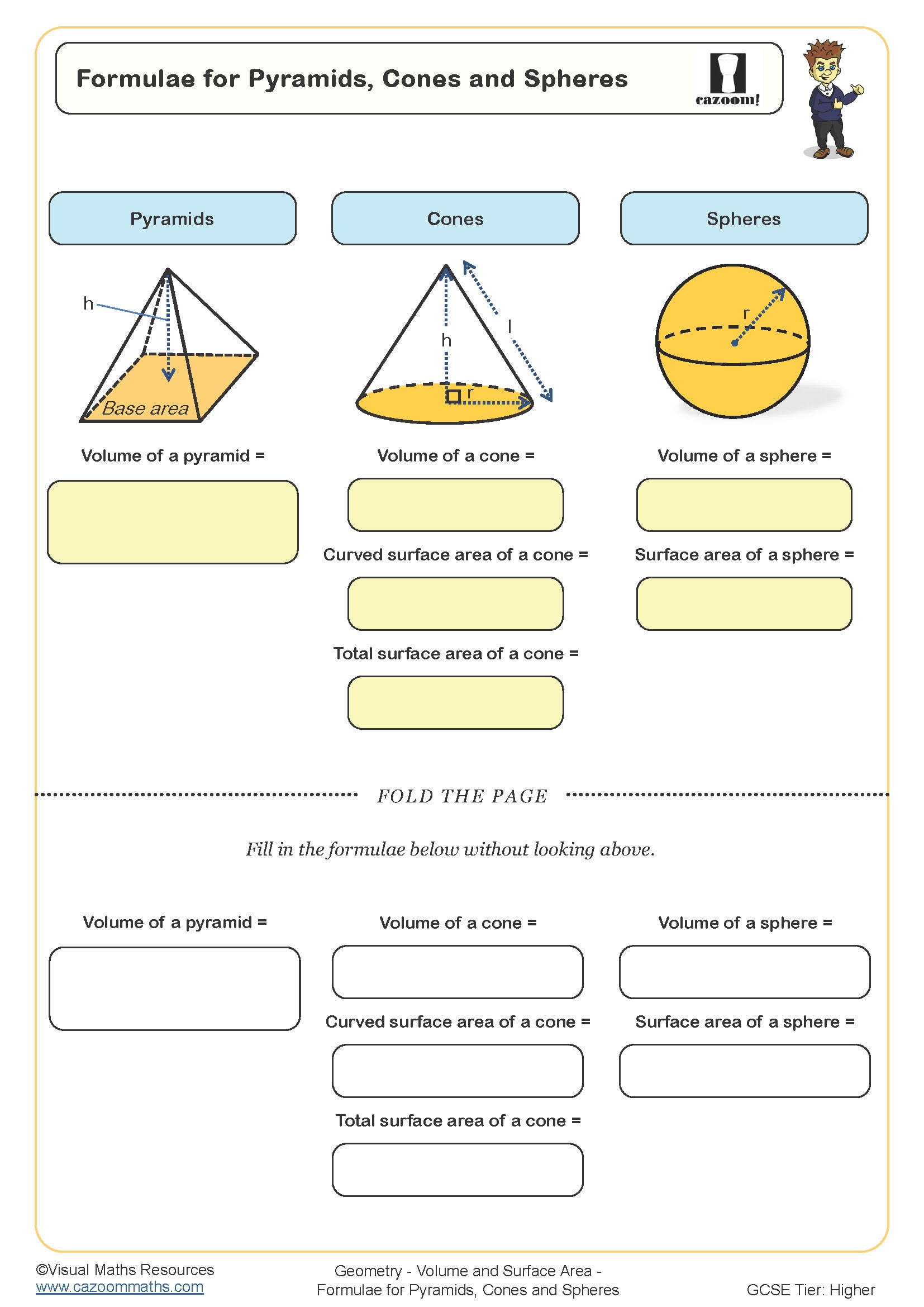
What is the formula for volume of a pyramid?
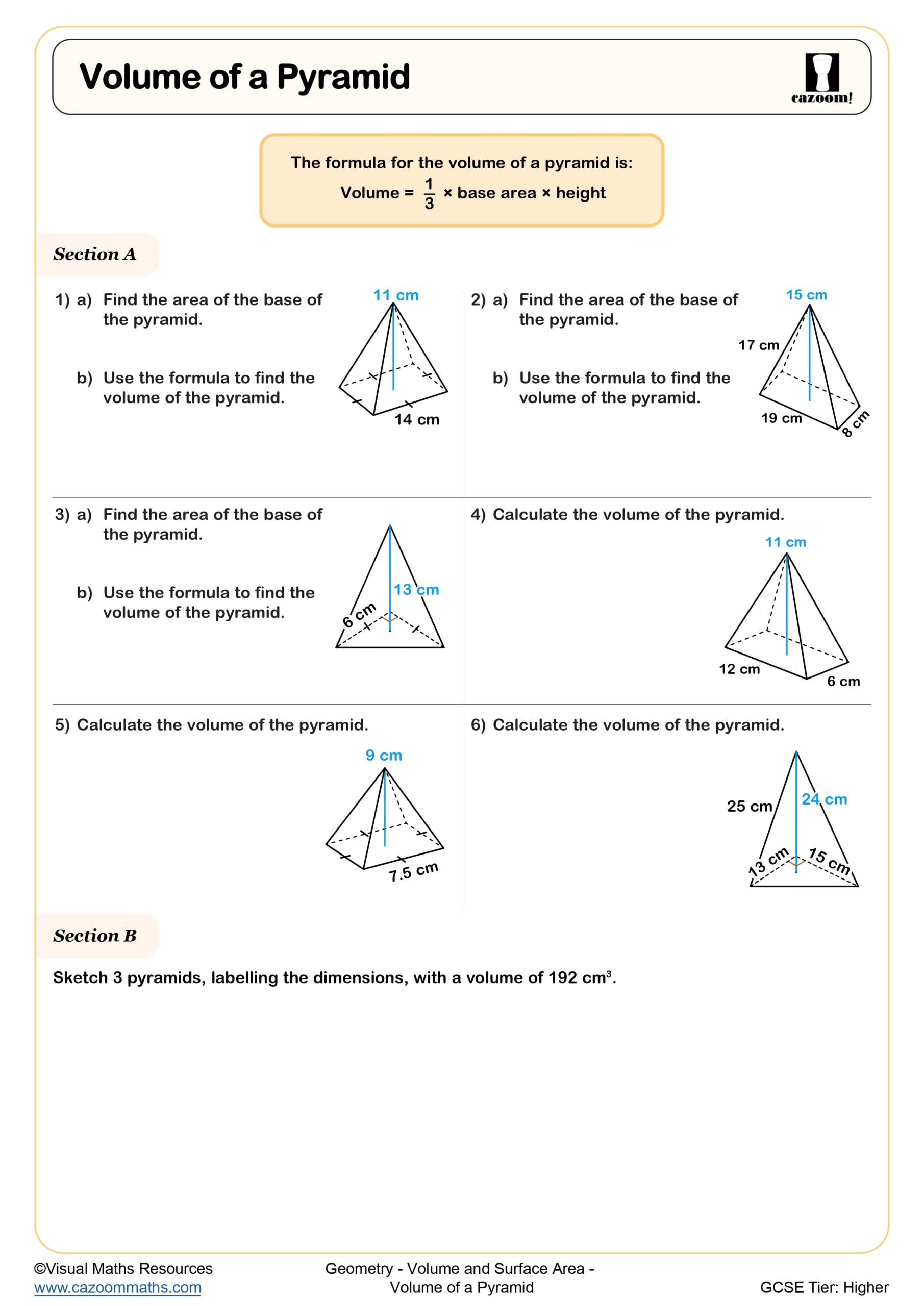
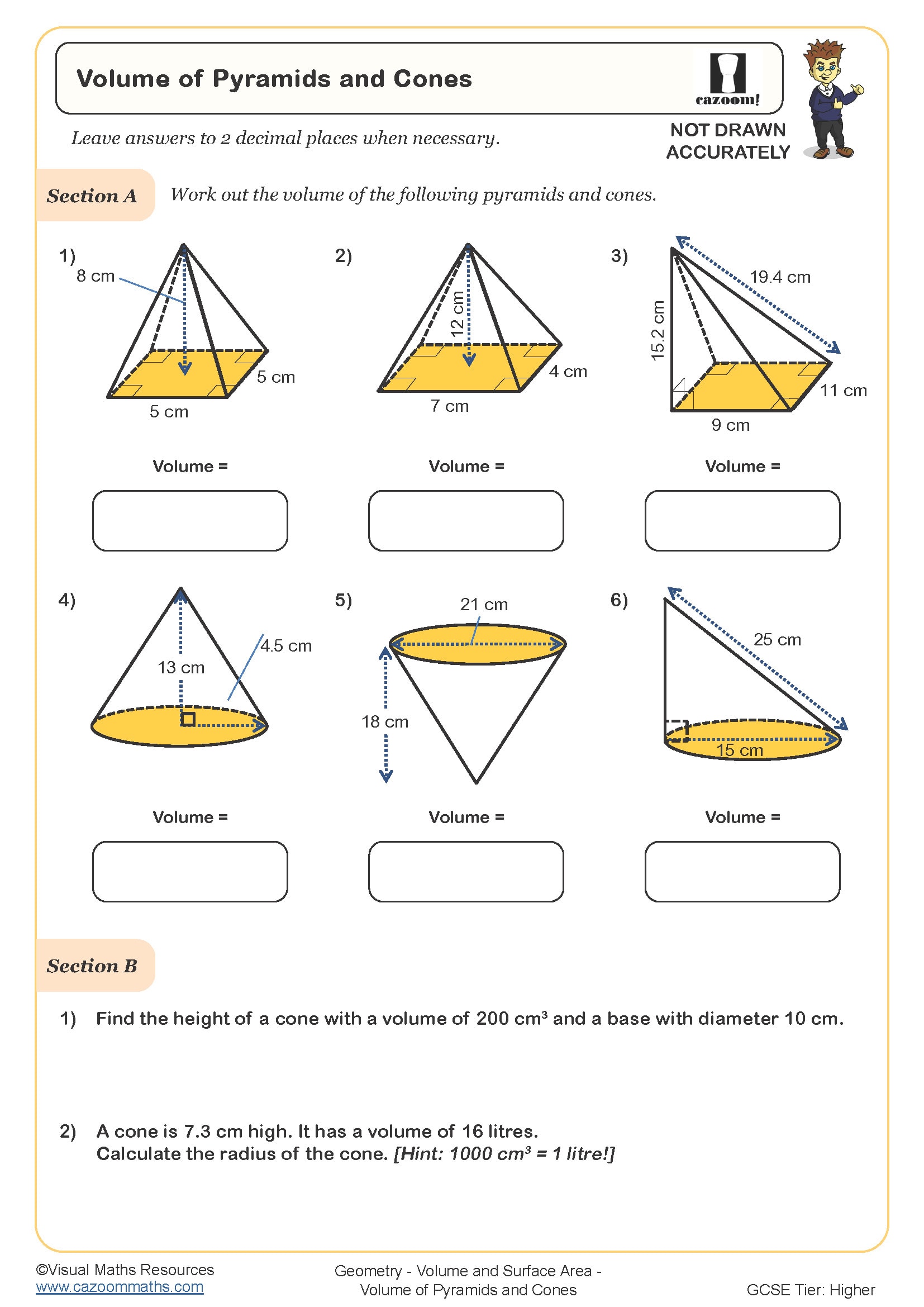
The volume formula for any pyramid is V = ⅓ × base area × height, where the height is the perpendicular distance from the base to the apex. This formula applies regardless of the base shape, whether square, rectangular, triangular, or any other polygon. At GCSE, students most commonly encounter square-based and triangular-based pyramids, and they must identify which measurement represents the perpendicular height rather than a slant height.
Students often lose marks by using the slant height instead of the perpendicular height, particularly when diagrams show both measurements. Exam mark schemes consistently penalise this error, even if the method is otherwise correct. Teachers typically emphasise sketching a right-angled triangle within the pyramid to distinguish between these two heights, which helps students visualise the perpendicular relationship required for the volume calculation.
Which year groups study volume and surface area of pyramids?
Volume and surface area of pyramids appears in the KS4 curriculum, typically taught in Year 10 and Year 11 as part of the GCSE foundation and higher tier content on 3D shapes. This topic builds on students' prior knowledge of calculating areas of 2D shapes and volumes of prisms from KS3, extending their understanding to shapes where cross-sections change size. At GCSE, pyramids are examined alongside cones, spheres, and frustums as part of the broader mensuration requirements.
The complexity increases across the year groups through the inclusion of reverse problems where students must work backwards from a given volume to find a missing dimension. Year 11 students encounter exam questions that combine pyramid calculations with ratio, Pythagoras' theorem to find slant heights, or problems involving composite solids where pyramids form part of a larger structure. Higher tier papers often include algebraic expressions for dimensions, requiring students to form and solve equations.
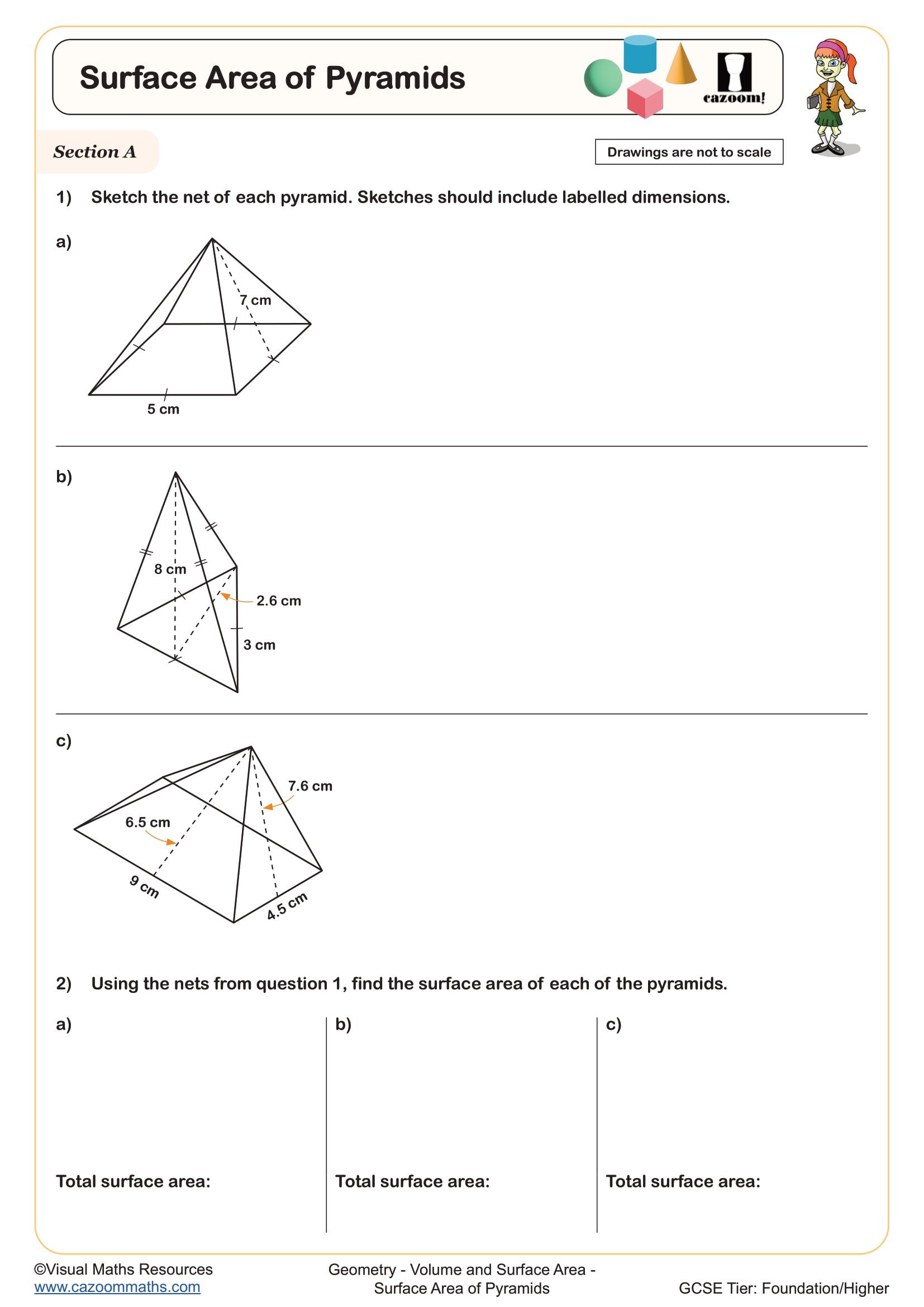
How do you find the surface area of a square-based pyramid?
Finding the surface area of a square-based pyramid requires calculating the area of the square base and adding the areas of the four congruent triangular faces. Students must identify the slant height of these triangular faces, which differs from the perpendicular height used for volume. Each triangular face has an area of ½ × base edge × slant height, so the total surface area is (base edge)² + 4 × (½ × base edge × slant height). When the slant height isn't given, students often need to use Pythagoras' theorem with the perpendicular height and half the base edge.
This calculation appears in real-world contexts including architecture and packaging design. Pyramid-shaped roofs, particularly on towers and decorative structures, require surface area calculations to determine material quantities for cladding or roofing. In manufacturing, pyramid-shaped packaging for luxury goods or confectionery needs surface area calculations for printing and material costing, connecting this mathematical skill directly to industrial design and construction planning.
How do these worksheets help students improve?
The worksheets provide structured practice that builds from straightforward volume calculations through to more demanding surface area problems and combined questions. Students encounter pyramids with different base shapes, ensuring they understand how to calculate base areas for triangles, squares, and rectangles before applying the volume formula. Clear diagrams show which measurements are given and which need calculating, helping students develop the problem-solving approach that GCSE mark schemes reward with method marks.
Teachers use these worksheets flexibly across different classroom situations. They work well for initial consolidation after teaching the topic, allowing students to practise independently whilst the teacher circulates to address individual misconceptions. The answer sheets enable students to self-assess during revision periods or when completing homework, identifying specific calculation errors. Many teachers set particular questions for intervention groups who struggle with the ⅓ multiplier or with identifying perpendicular heights, whilst higher-attaining students tackle the multi-step problems that mirror higher tier exam demands.