Volume Problems Worksheets
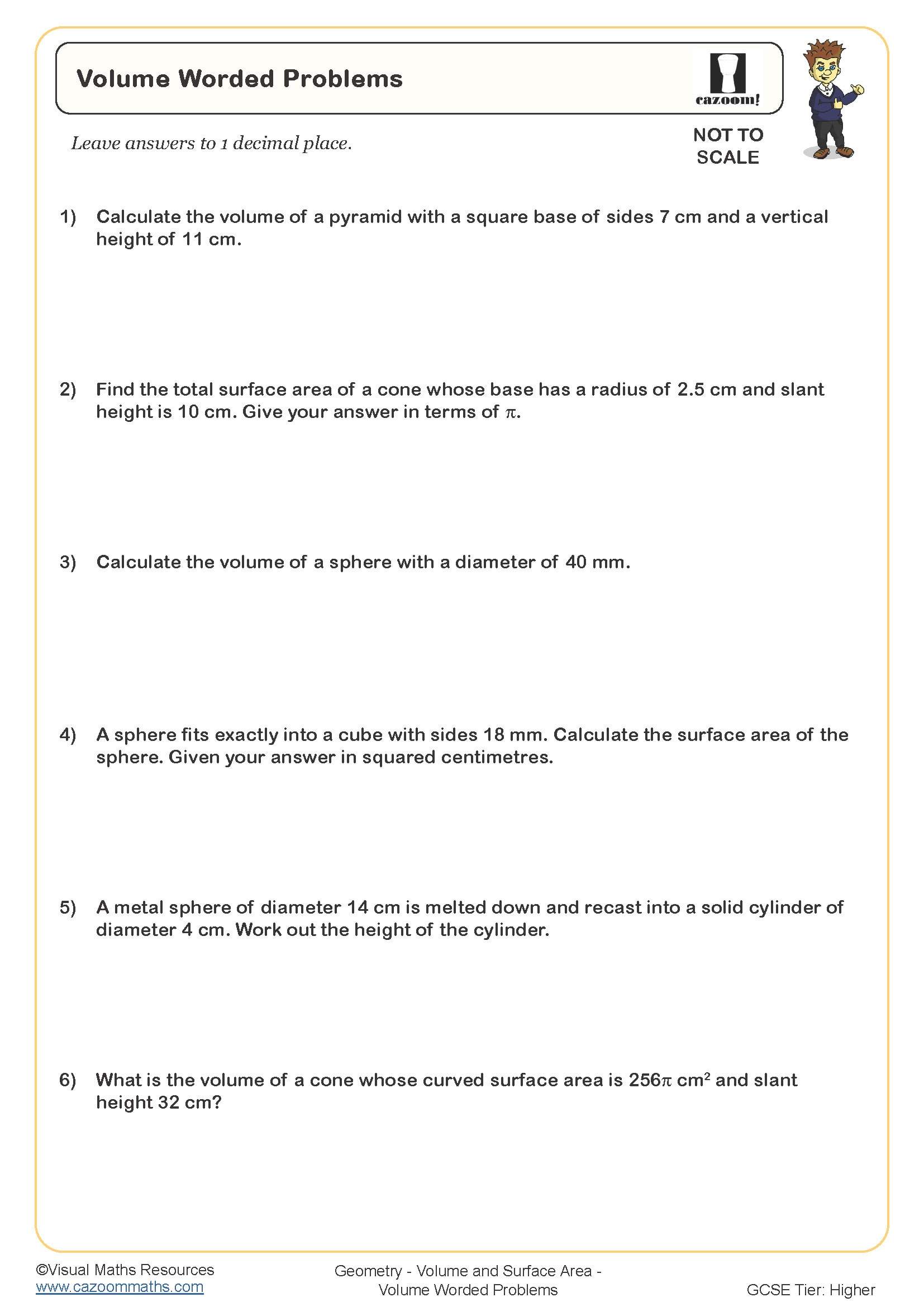
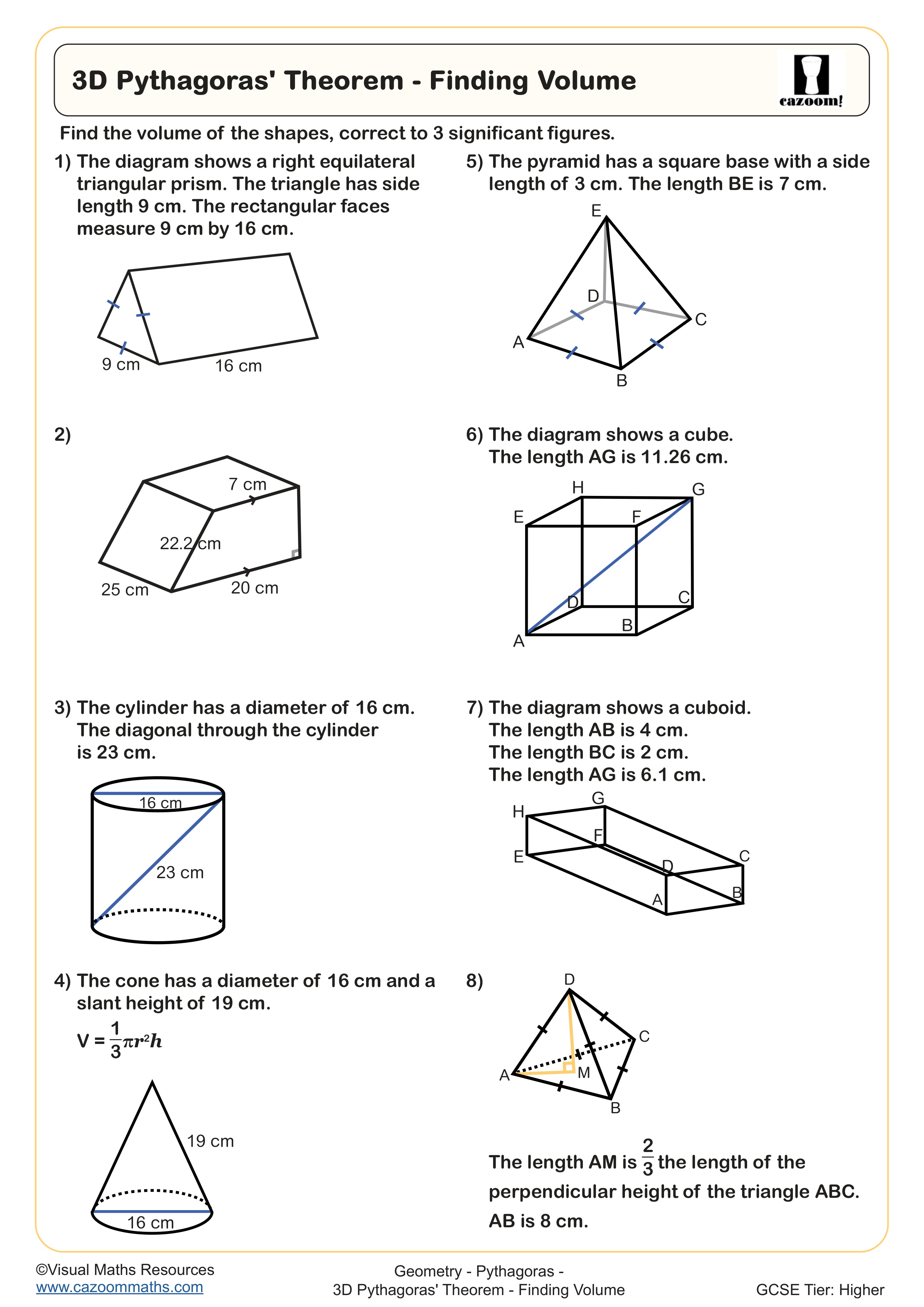
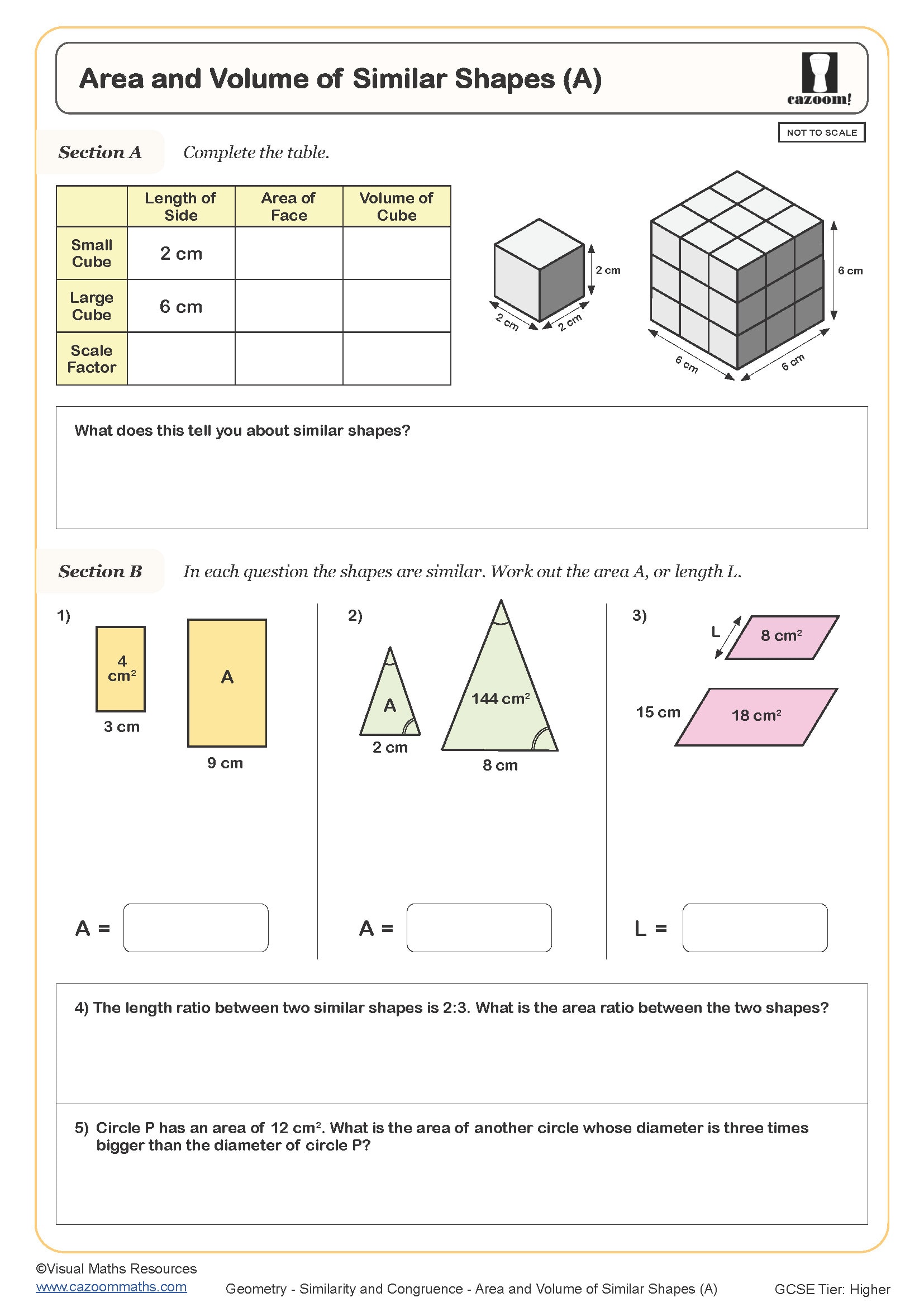
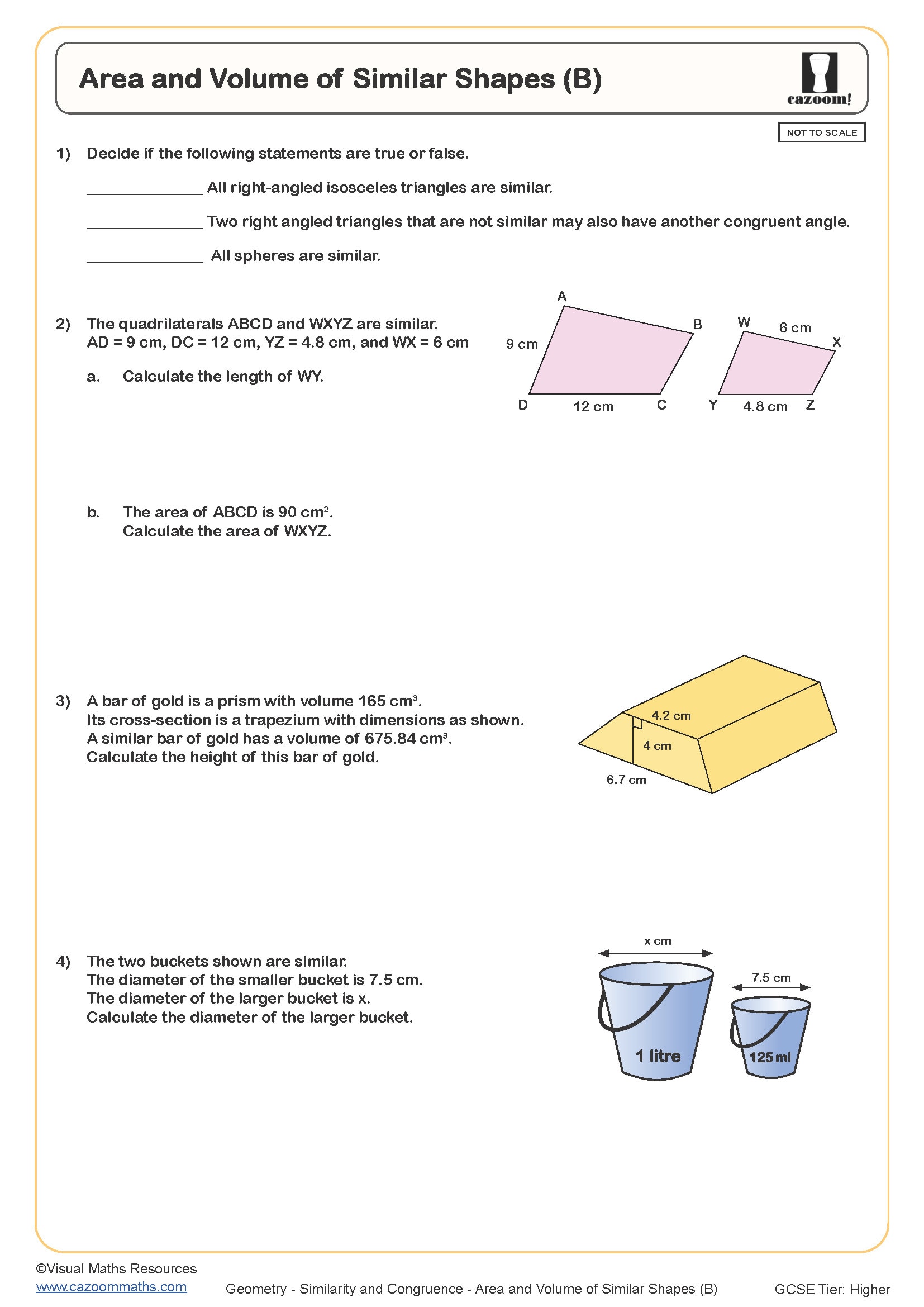
All worksheets are created by the team of experienced teachers at Cazoom Maths.
Where can Teachers find volume word problems worksheets with answers pdf downloads?
These volume word problems worksheets are available as instant PDF downloads, each including thorough answer sheets with fully worked solutions. The collection covers National Curriculum expectations for volume calculations across KS3 and early GCSE, featuring realistic scenarios from packaging design to swimming pool maintenance that demonstrate practical applications of mathematical concepts.
Teachers frequently observe that students benefit significantly from having immediate access to worked solutions, particularly when tackling multi-step problems involving composite shapes or unit conversions. The PDF format ensures worksheets remain properly formatted when printed, maintaining clear diagrams and structured answer spaces that support students' mathematical reasoning and presentation skills.
Which year groups should use these volume problems worksheets?
Volume problems are typically introduced in Year 8 when students have mastered basic area calculations and begin exploring 3D geometry. The progression continues through Year 9 with more complex composite shapes, then advances to GCSE level with problems involving similar shapes, scale factors, and real-world applications requiring multiple calculation steps.
Many teachers find that Year 7 students can access simpler cuboid problems if they've secured their multiplication and basic formula work, whilst Year 10 and 11 students benefit from revisiting volume questions as part of GCSE revision. The key is ensuring students understand the underlying shape properties before attempting word problems, as teachers often notice calculation errors stem from confusion about which formula applies rather than arithmetic mistakes.
How do students tackle volume find the missing dimension worksheet problems?
Missing dimension problems require students to work backwards from a known volume, rearranging formulae to find unknown lengths, widths, or heights. These questions develop algebraic thinking and reinforce the relationship between volume and linear dimensions, particularly important for GCSE problem-solving skills.
Teachers regularly observe students attempting to guess and check rather than using systematic algebraic approaches. The most effective strategy involves clearly identifying the known volume and given dimensions, then substituting into the appropriate formula before solving the resulting equation. Students often struggle when problems involve composite shapes where they must first determine which part of the shape relates to the missing dimension.
What's the most effective way to use these volume questions worksheet resources in lessons?
These volume worksheets work best when students have already practised calculating volumes with clearly labelled diagrams before attempting word problems. Teachers often begin lessons by reviewing relevant formulae, then model how to extract key information from written scenarios, emphasising the importance of drawing diagrams to visualise problems.
Many educators find success using a gradual release approach: demonstrating one problem together, working through a second collaboratively, then allowing independent practice. The included answer sheets enable peer marking and self-assessment, though teachers should circulate to identify students who arrive at correct answers through incorrect methods, particularly when dealing with unit conversions or composite shape breakdowns.