KS3 Indices Worksheets
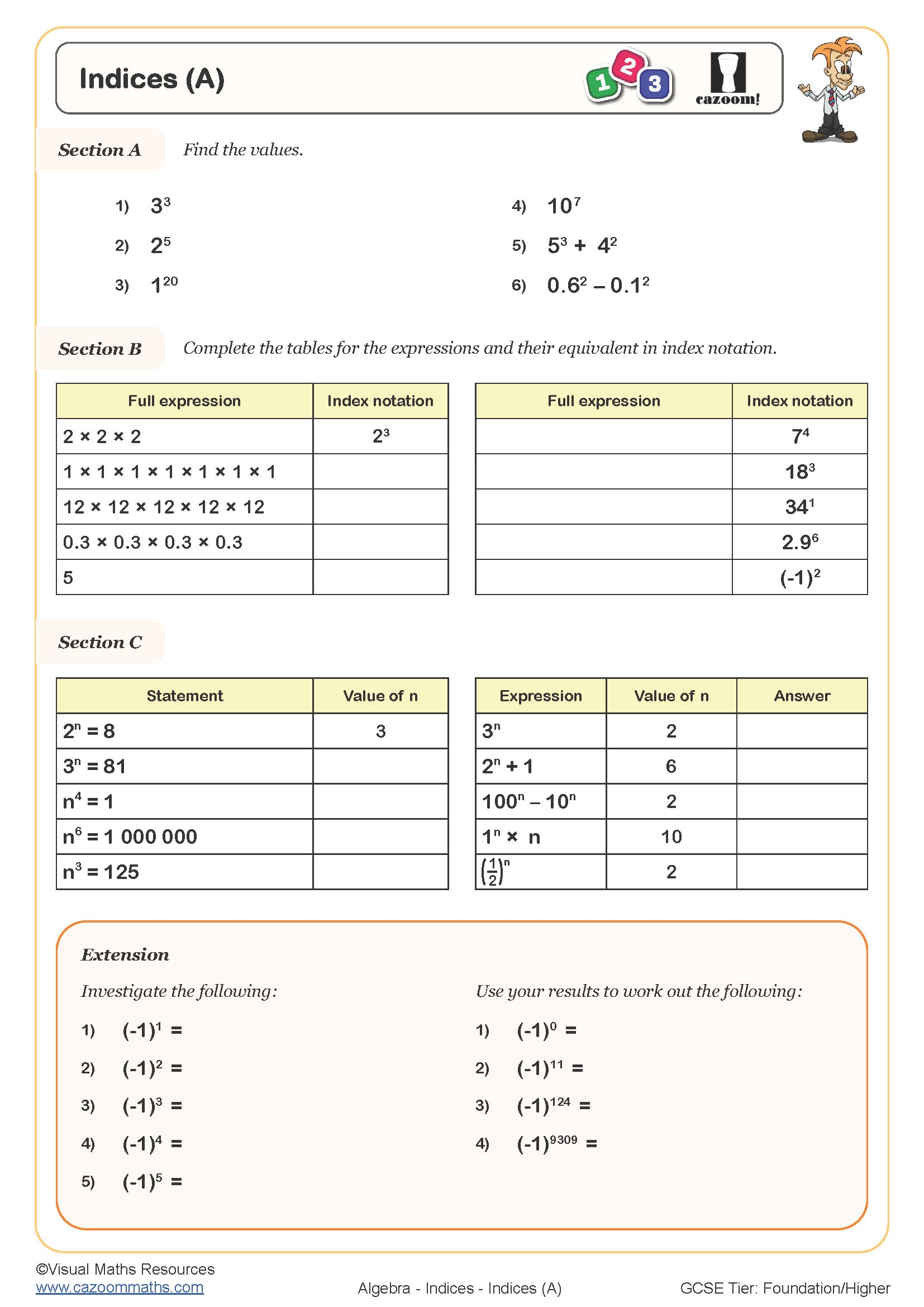
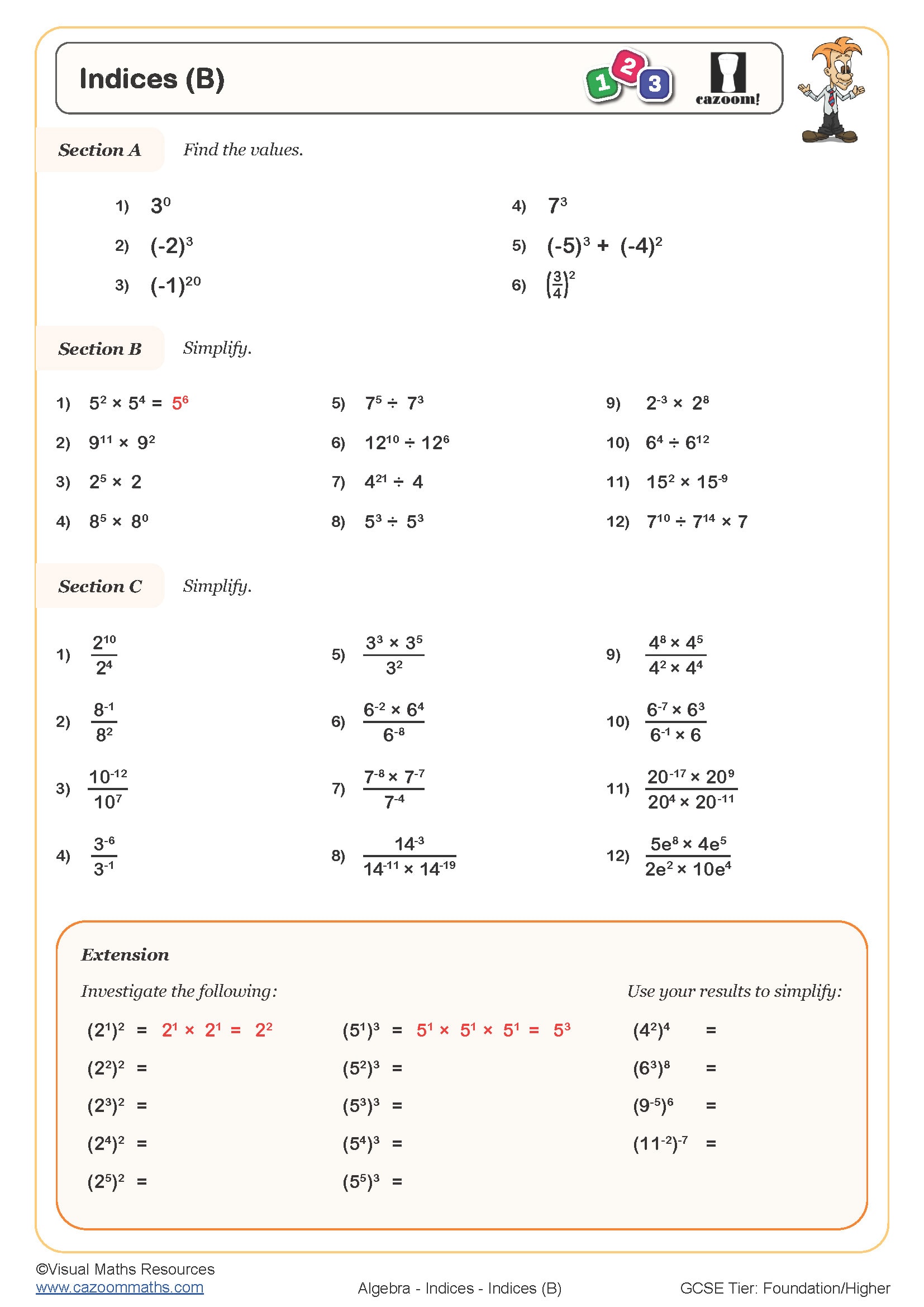
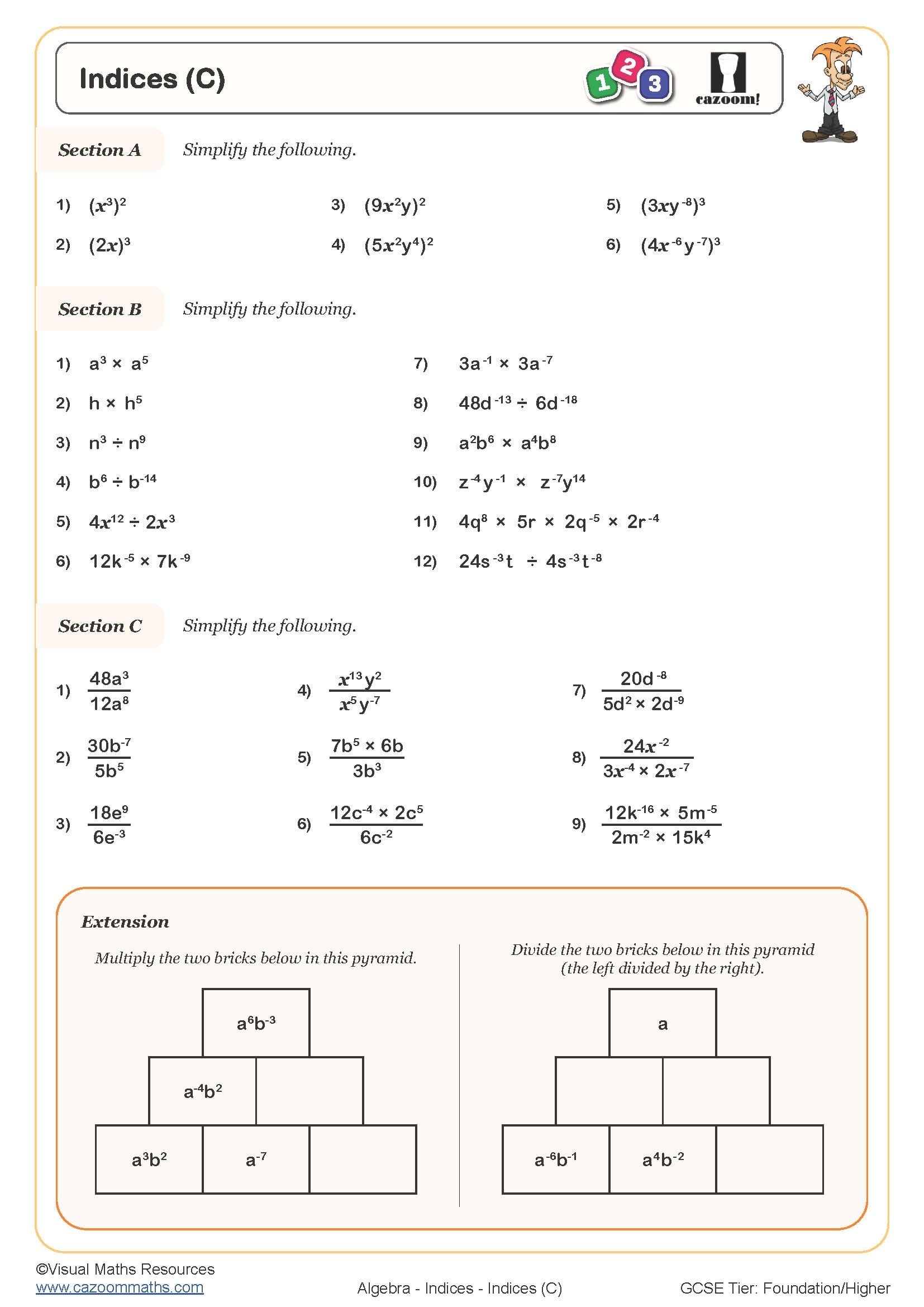
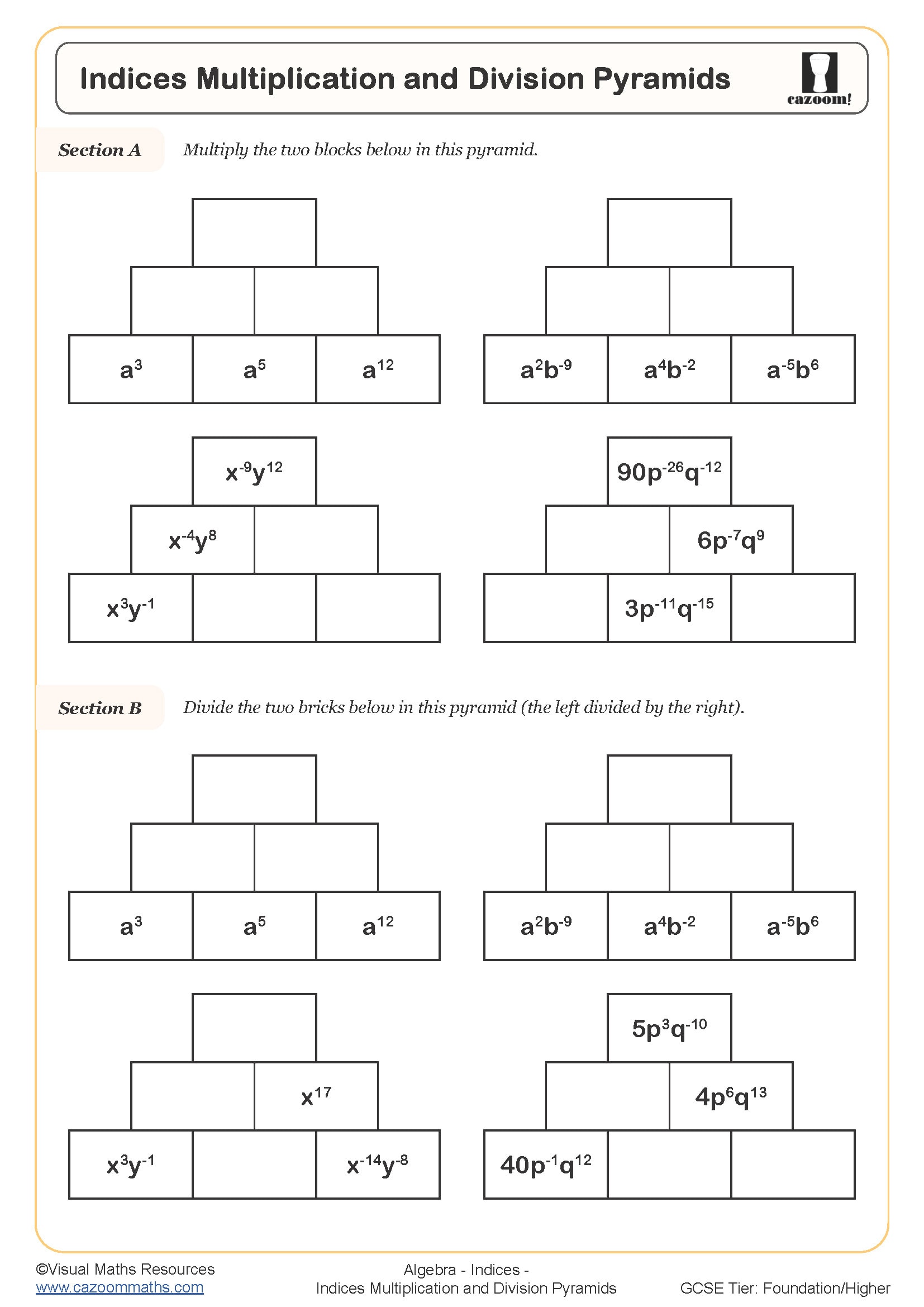
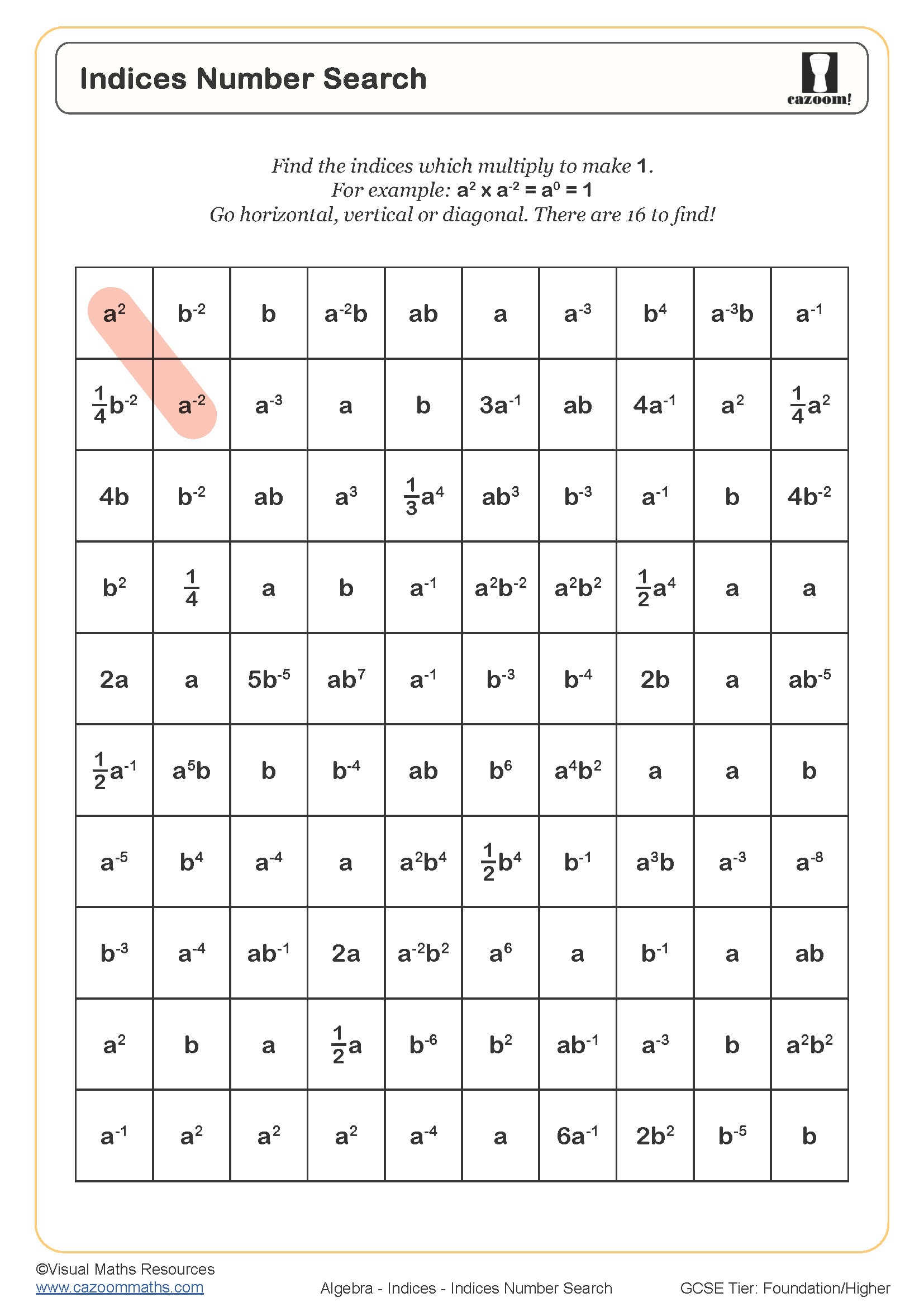
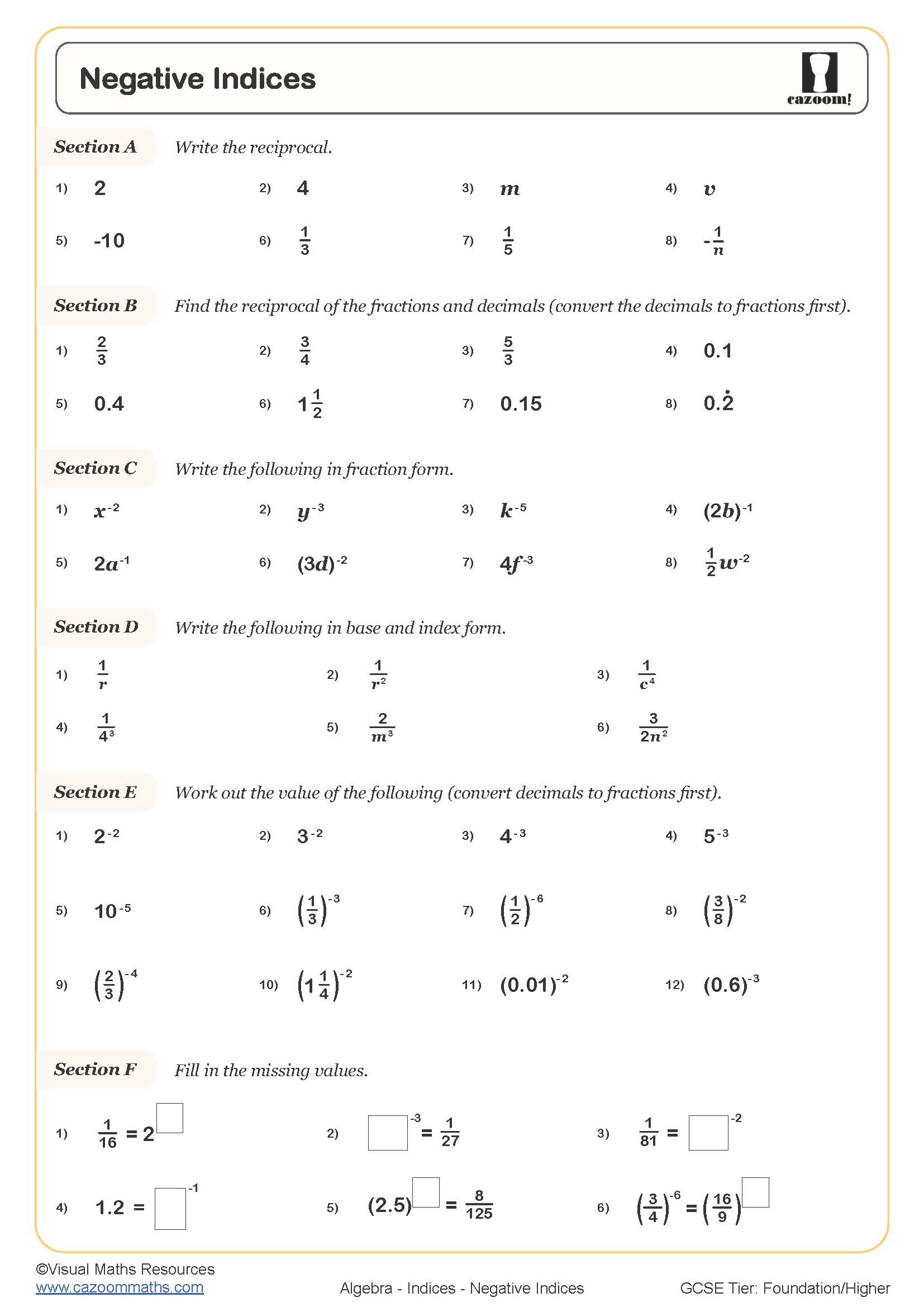
All worksheets are created by the team of experienced teachers at Cazoom Maths.
What do students learn from a KS3 indices worksheet?
A KS3 indices worksheet develops fluency with index laws, teaching students to simplify expressions involving powers, multiply and divide terms with the same base, and work with negative and fractional indices. This builds directly on the index notation introduced in upper Key Stage 2 and prepares students for algebraic fractions and exponential functions at GCSE.
Students often lose marks by attempting to add or subtract the indices when multiplying terms with different bases, such as writing 2³ × 3² = 6⁵ instead of calculating each power separately. The worksheets address this by including division pyramids and varied base numbers, requiring students to distinguish between when index laws apply and when they must calculate values first before combining terms.
Which year groups study indices at KS3?
These worksheets are designed for Year 8 and Year 9 students following the National Curriculum for KS3 mathematics. Index notation typically appears in Year 7 as basic powers, then develops into formal index laws during Year 8, where students learn to multiply and divide indices systematically.
By Year 9, the difficulty increases to include negative and fractional indices, with students expected to understand that a⁻ⁿ = 1/aⁿ and that a^(1/n) represents the nth root. Teachers notice that students who struggle with fractional indices often haven't secured the link between roots and powers, so progression depends on revisiting square and cube roots before introducing fractional index notation formally.
How do fractional indices connect to real-world applications?
Fractional indices provide a bridge between powers and roots, allowing students to write expressions like √x as x^(1/2) or ∛x² as x^(2/3). This unified notation becomes essential in science and engineering, where formulas often require both operations within the same calculation.
Physicists use fractional indices when working with inverse square laws, such as gravitational force decreasing with distance squared, or calculating the period of a pendulum where T ∝ √L. Engineers apply them in stress calculations and scaling laws, where dimensions change by fractional powers. Understanding that these different representations are mathematically equivalent allows students to manipulate complex formulas confidently, a skill that distinguishes higher-achieving GCSE students in problem-solving contexts.
How can teachers use these indices worksheets effectively?
The worksheets support learning through carefully sequenced questions that introduce one law at a time before combining multiple rules in later problems. This scaffolding helps students build procedural fluency without becoming overwhelmed, whilst the inclusion of unknowns in indices and division pyramids extends problem-solving beyond simple substitution exercises.
Many teachers use these resources for targeted intervention with students who struggle during whole-class teaching, as the answer sheets allow for independent checking and self-correction. They work well as homework to consolidate classroom learning, or as revision material before assessments where indices questions regularly appear. In paired work, students can discuss why certain index laws apply, which develops mathematical reasoning alongside procedural skills and addresses common misconceptions through peer explanation.