KS3 Simplification Worksheets
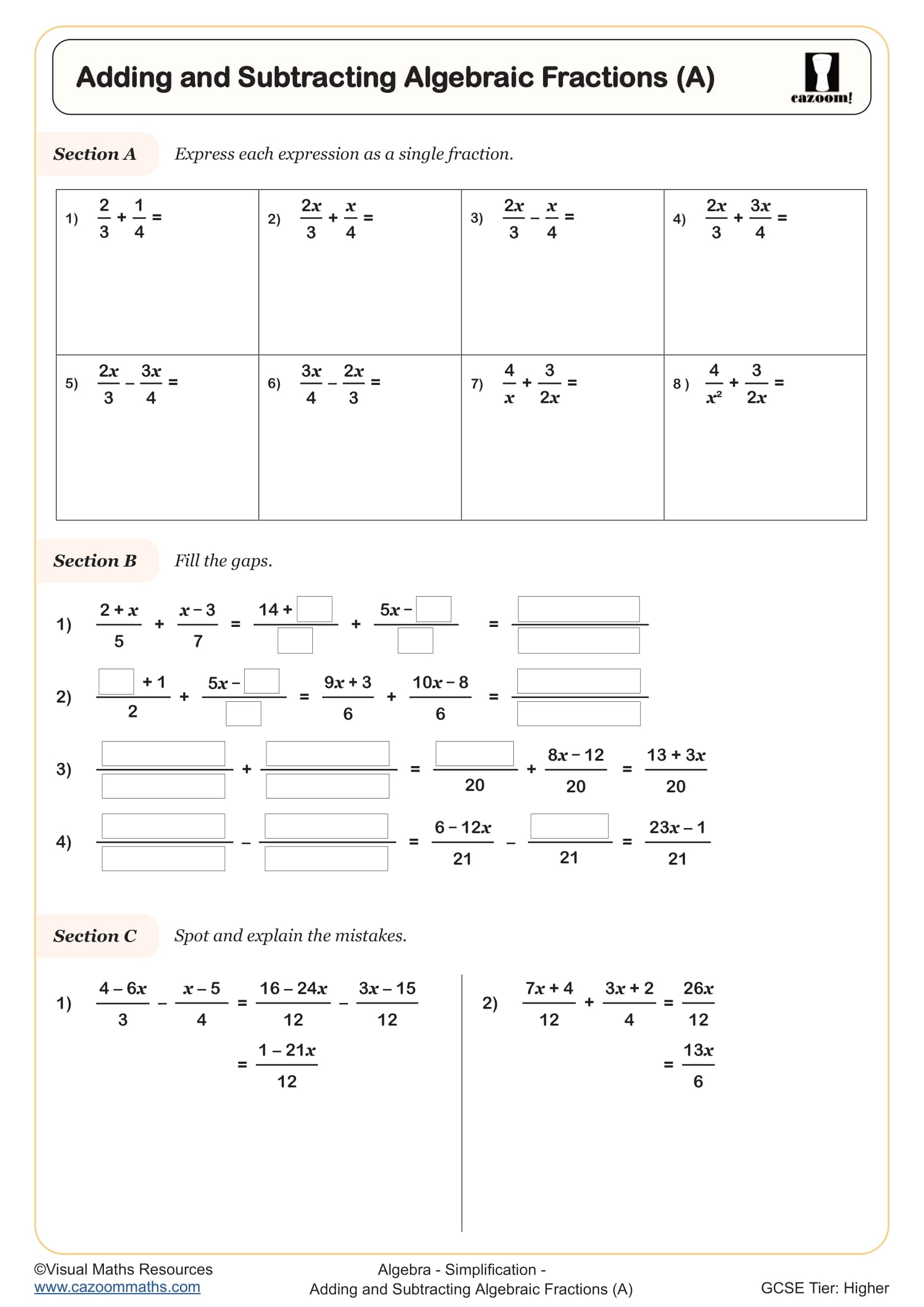
Adding and Subtracting Algebraic Fractions (A)
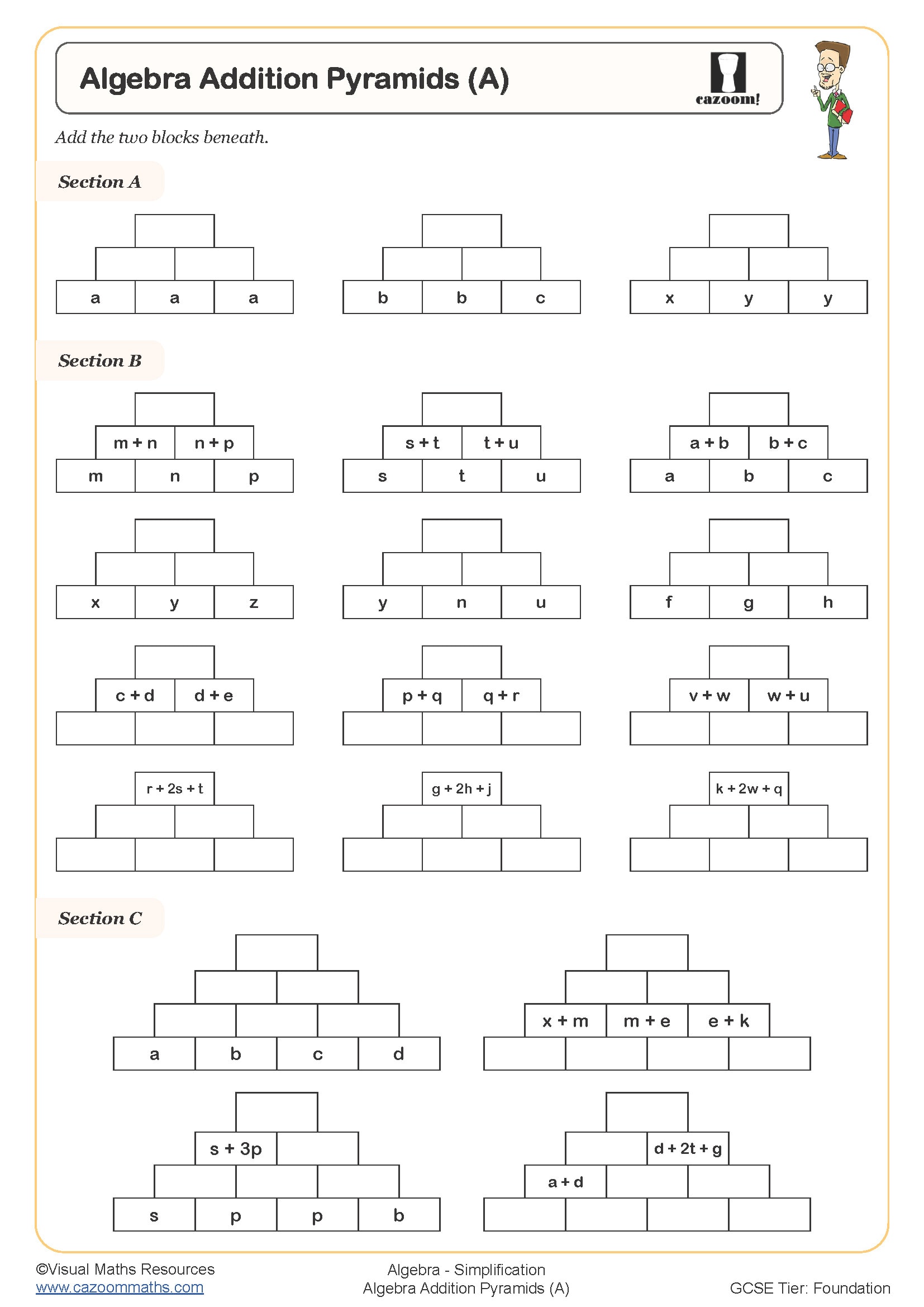
Algebra Addition Pyramids (A)
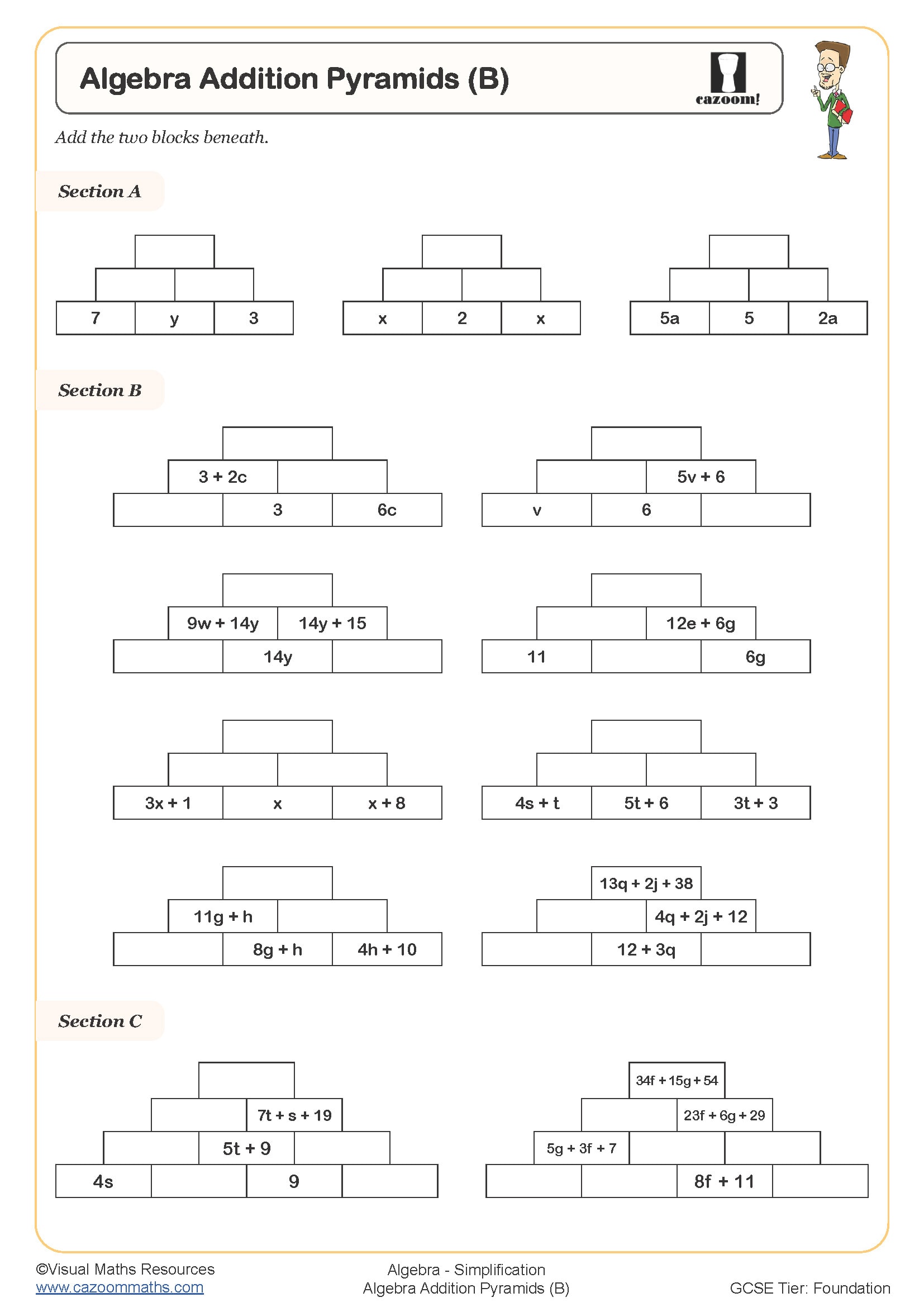
Algebra Addition Pyramids (B)
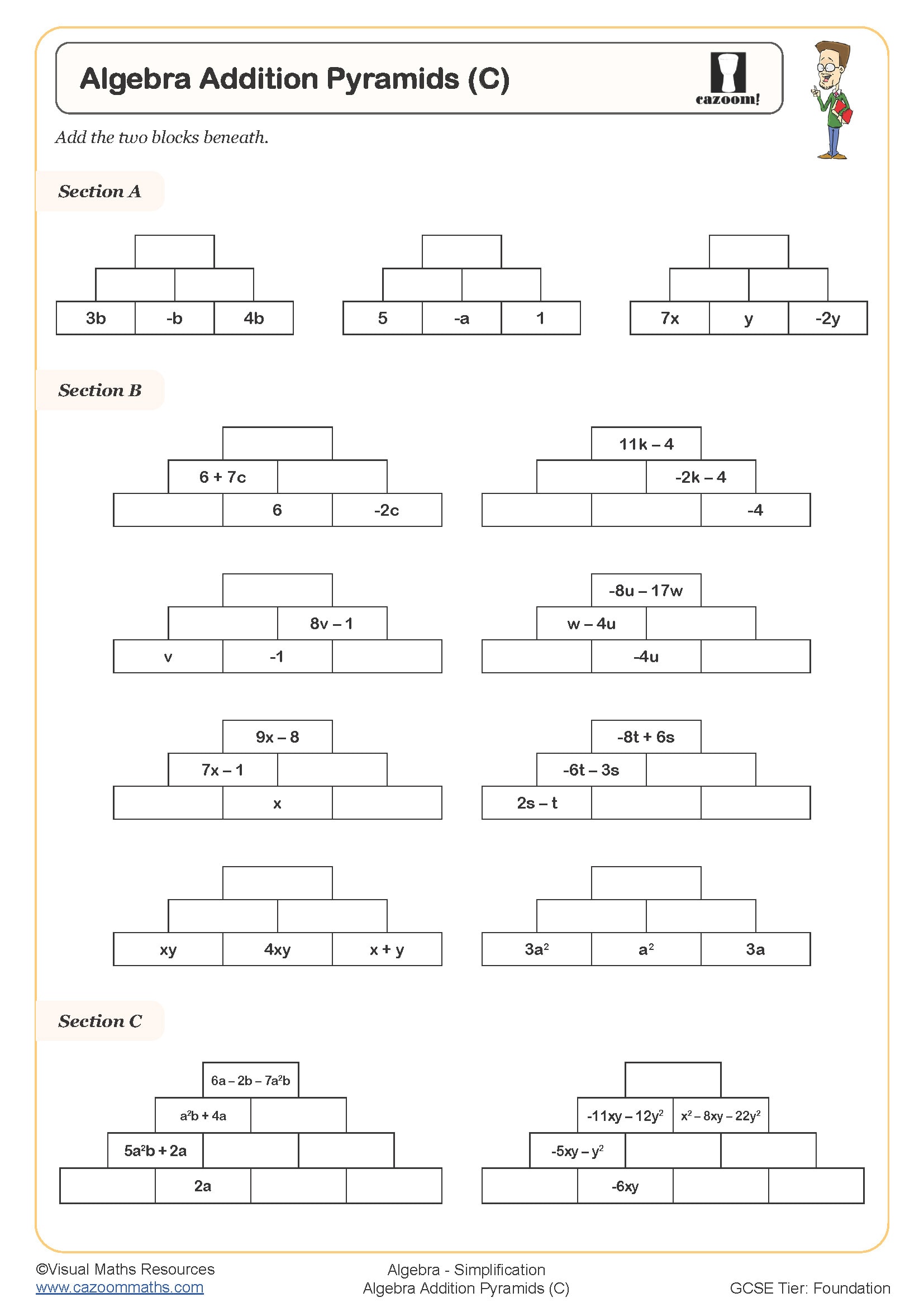
Algebra Addition Pyramids (C)
Algebra Multiplication Pyramids (A)
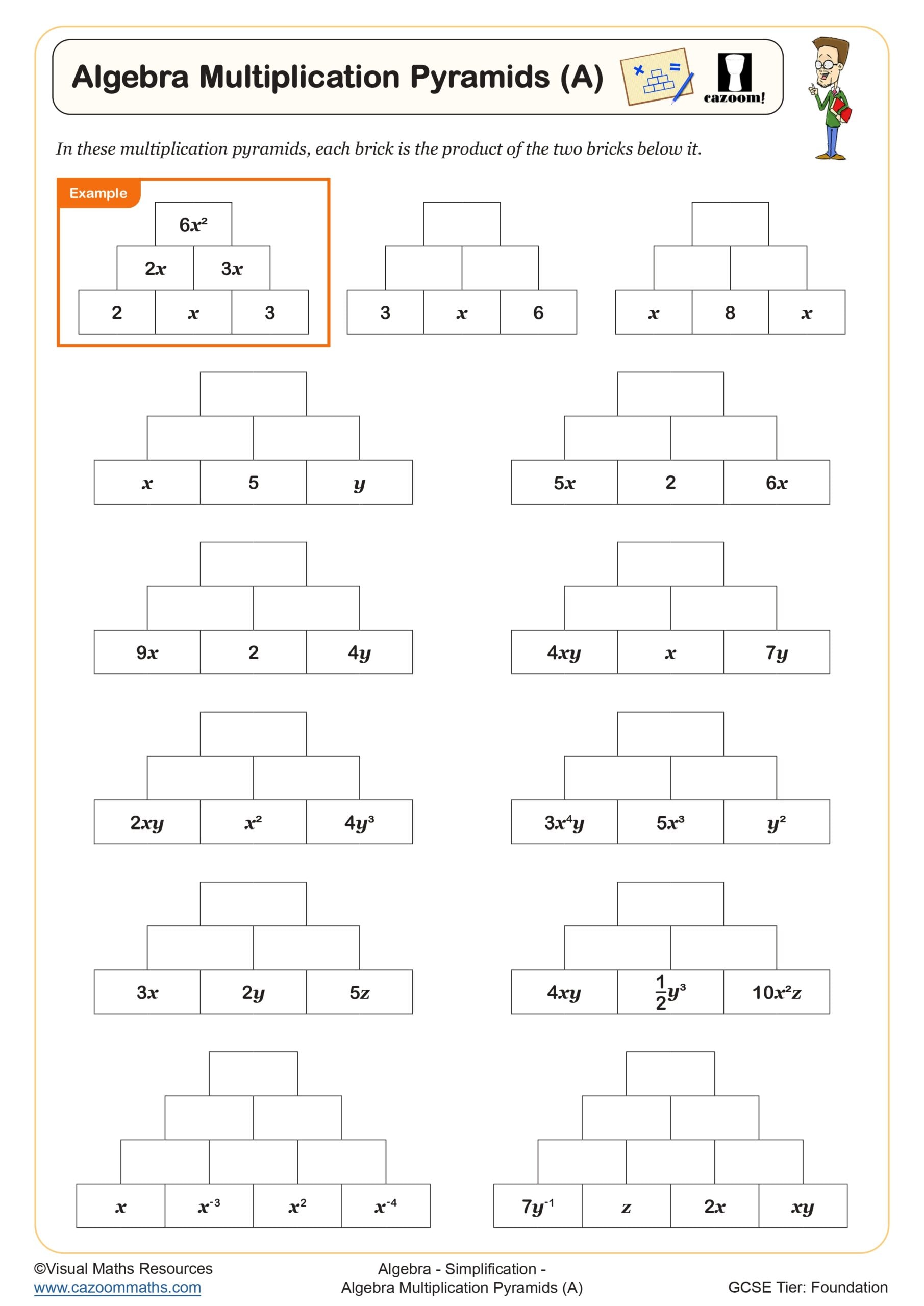
Algebra Multiplication Pyramids (B)
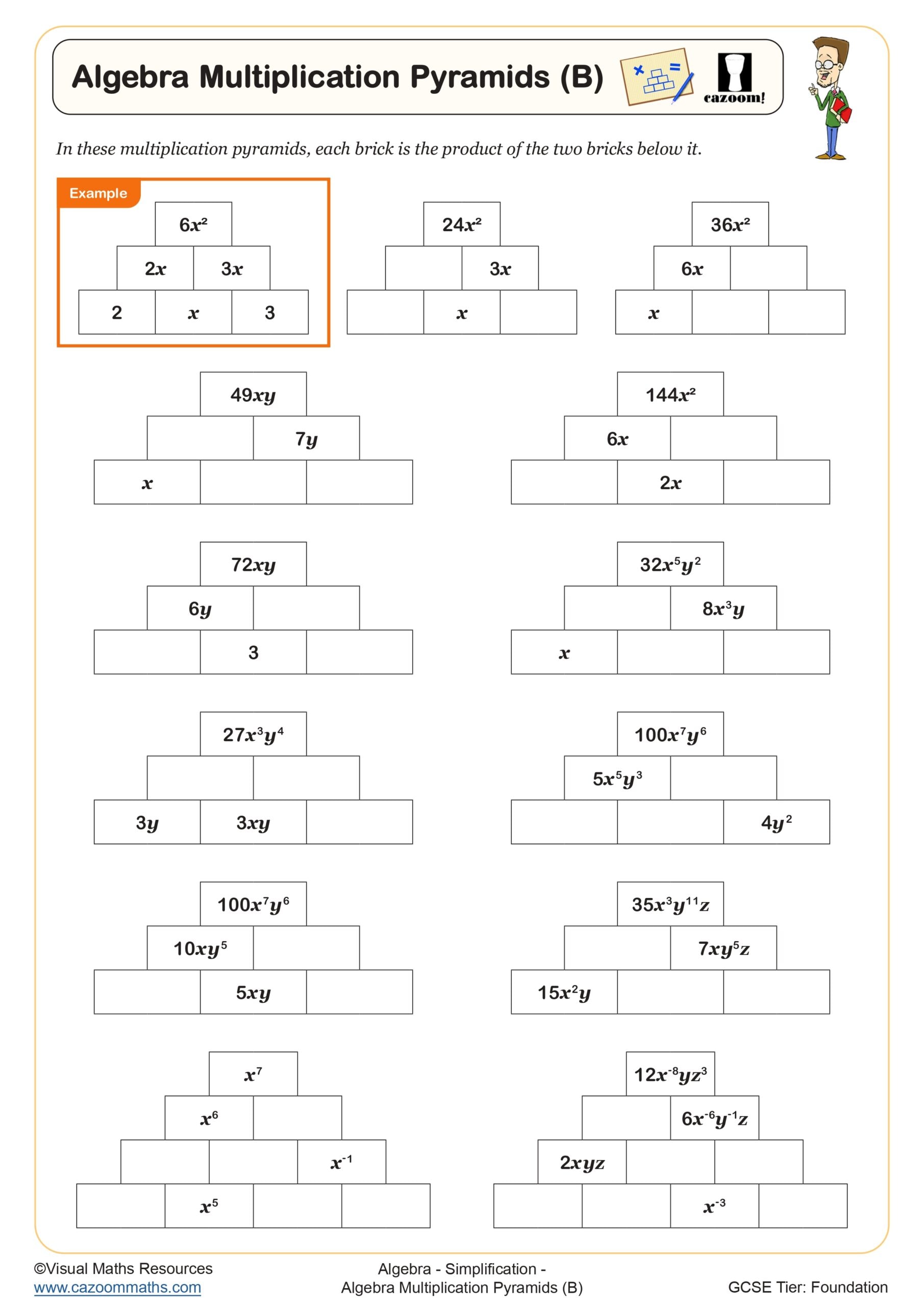
Algebraic Fractions (A)
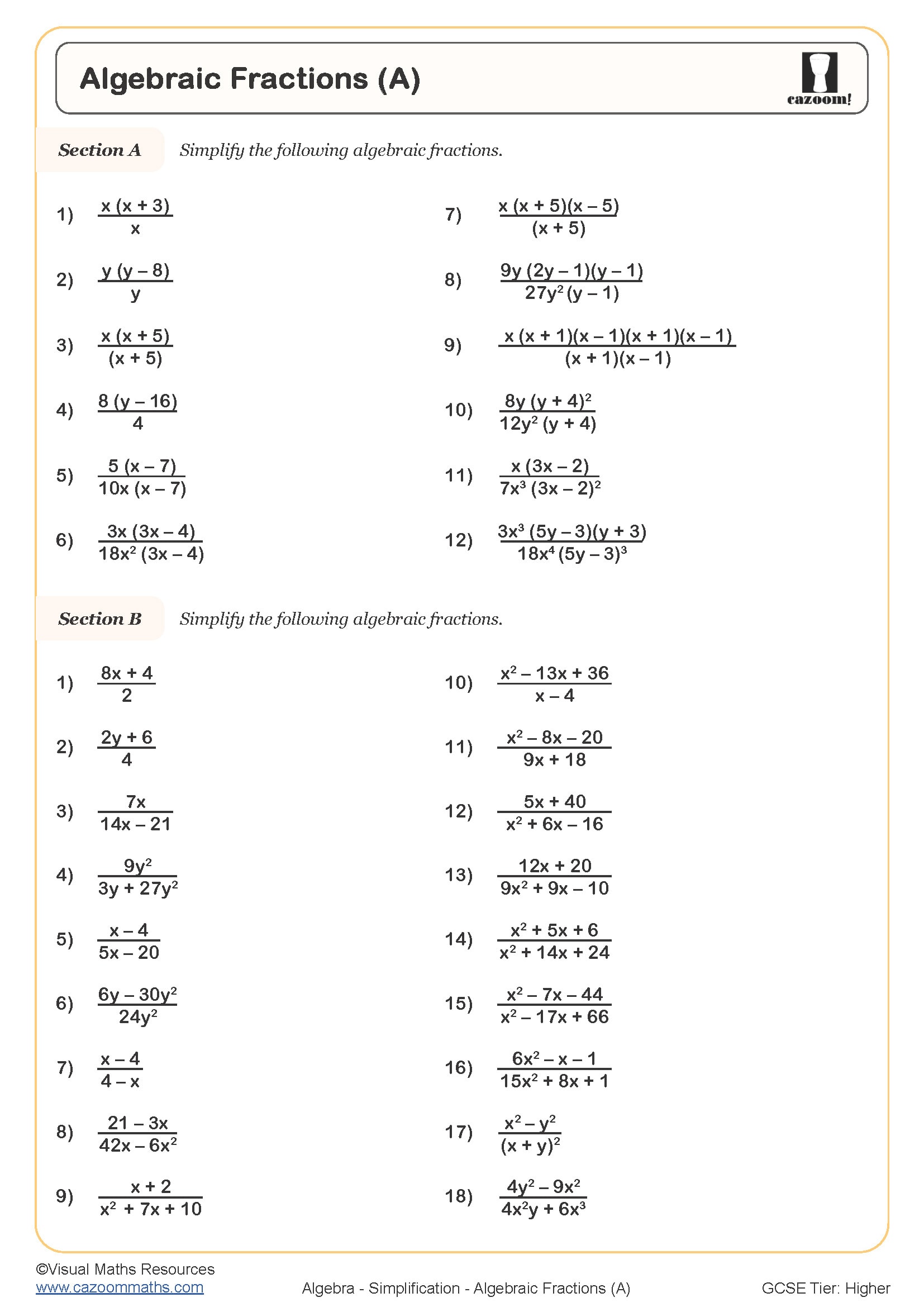
Algebraic Fractions (B)
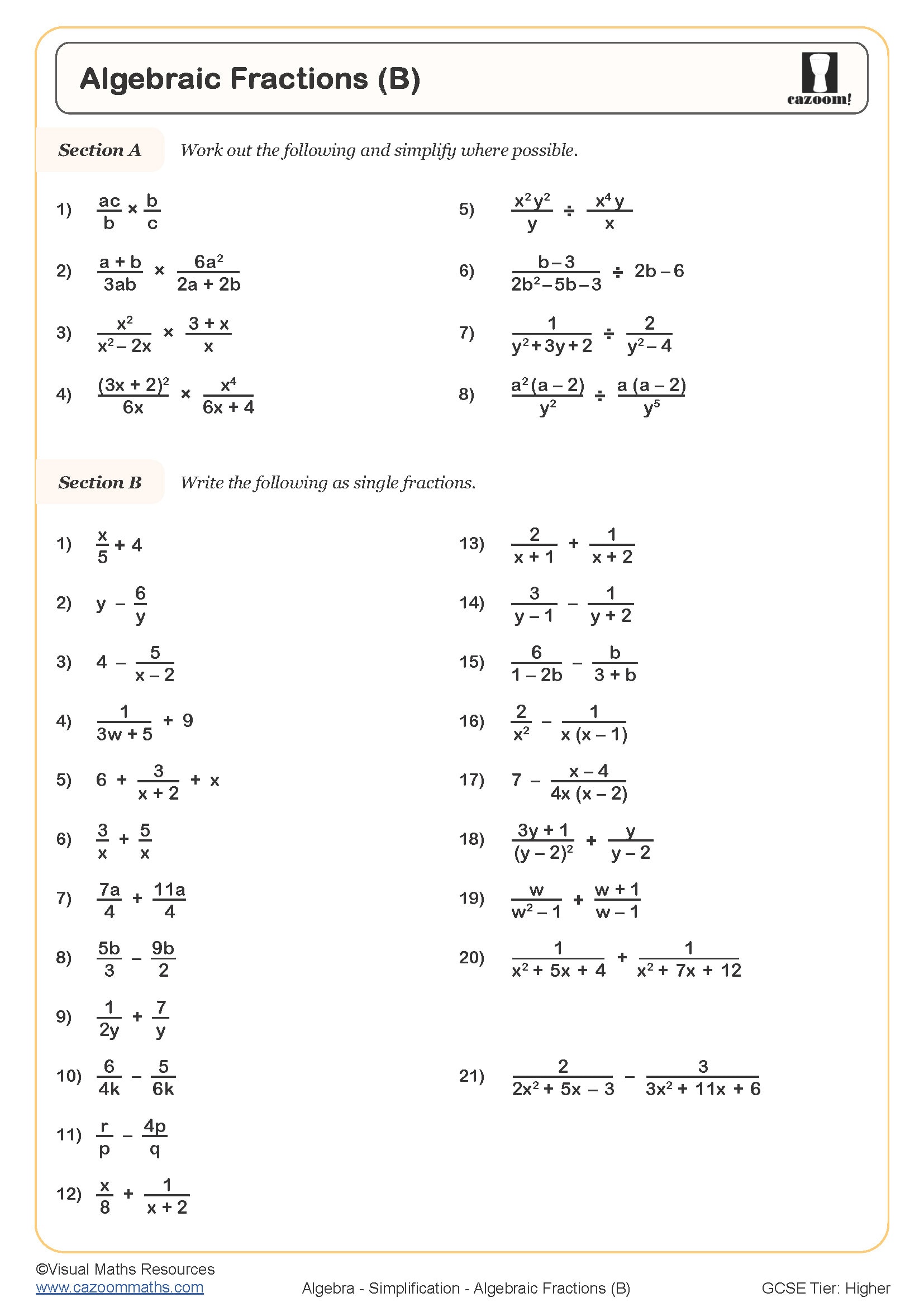
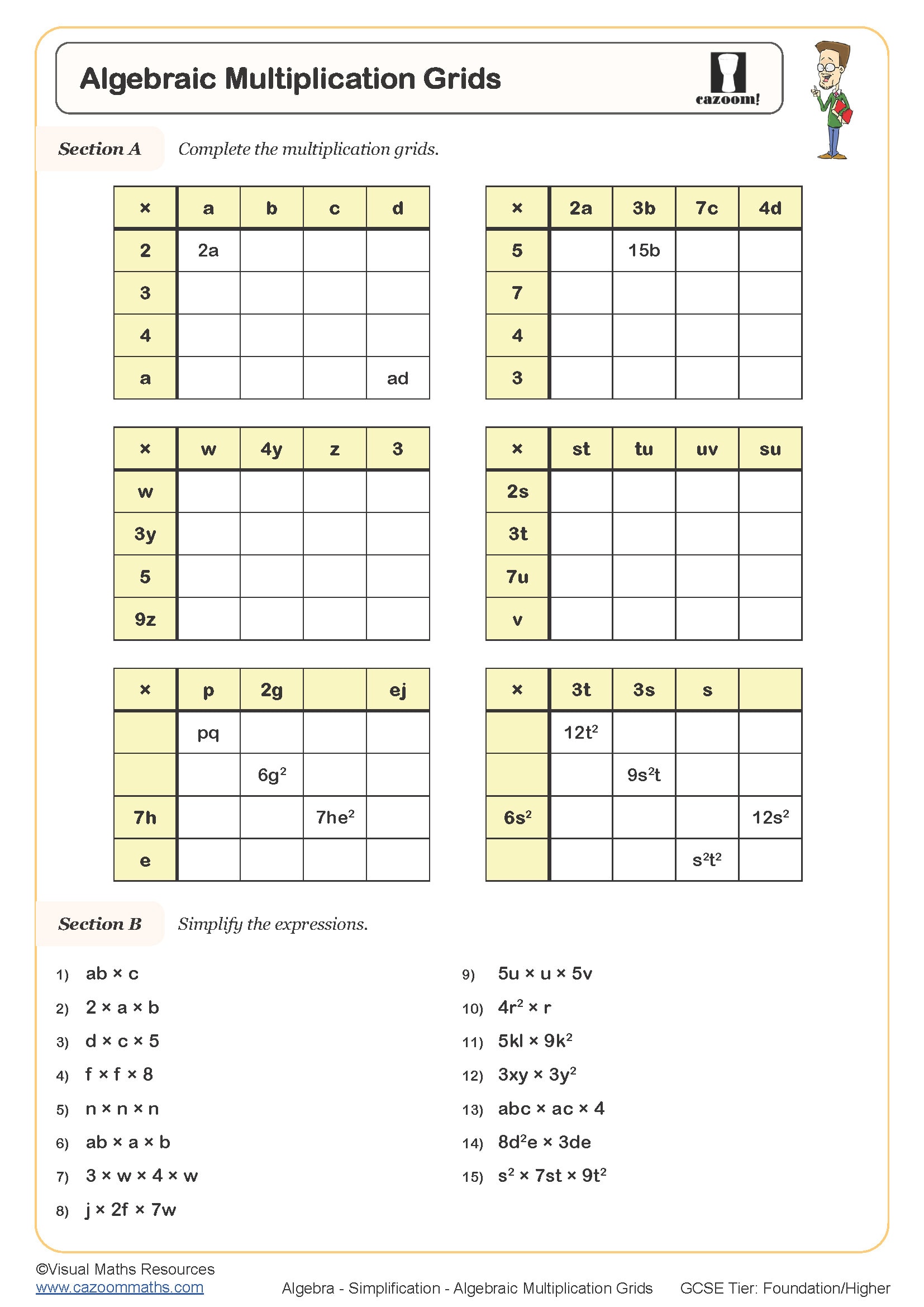
Algebraic Multiplication Grids
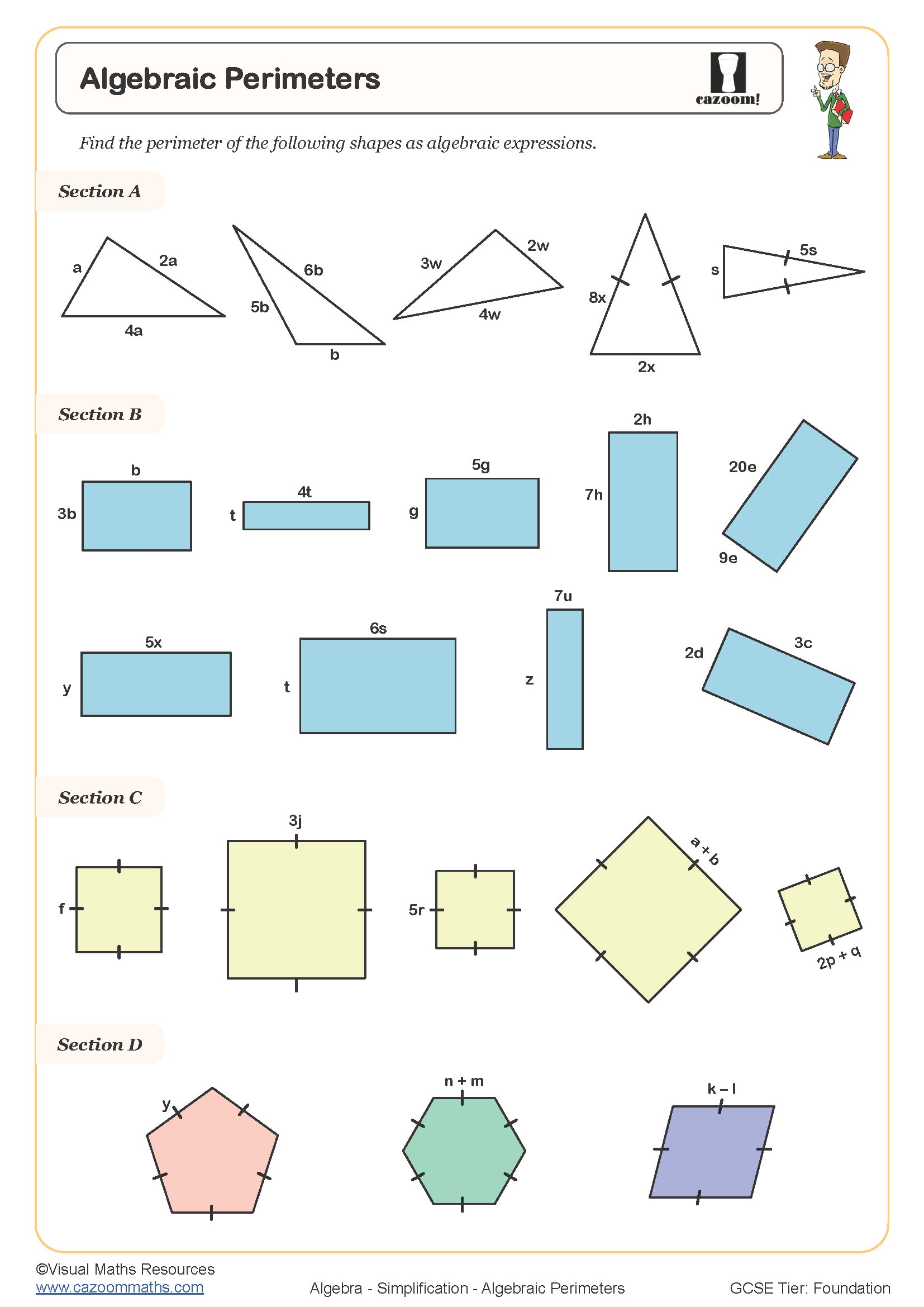
Algebraic Perimeters
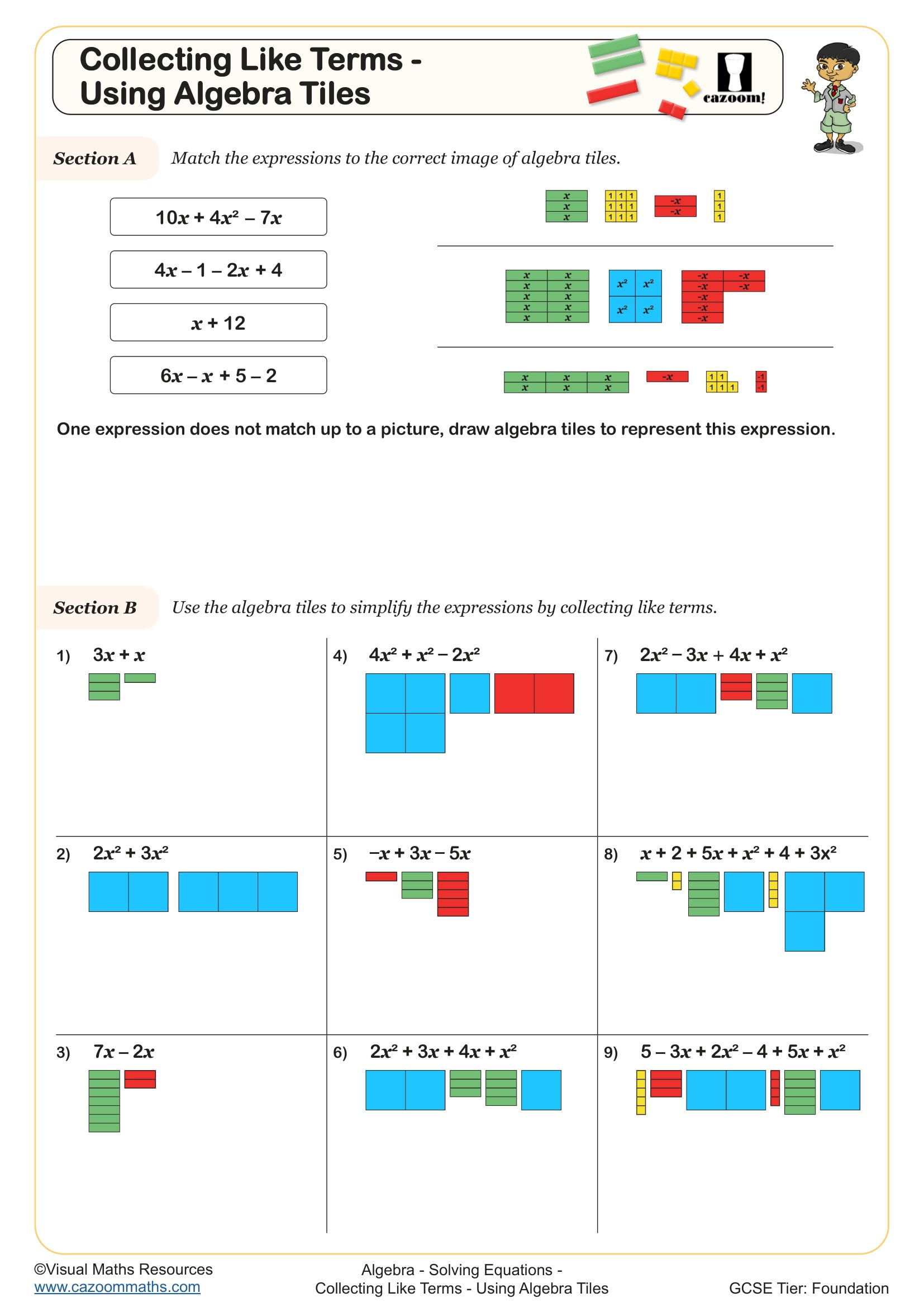
Collecting Like Terms - Using Algebra Tiles
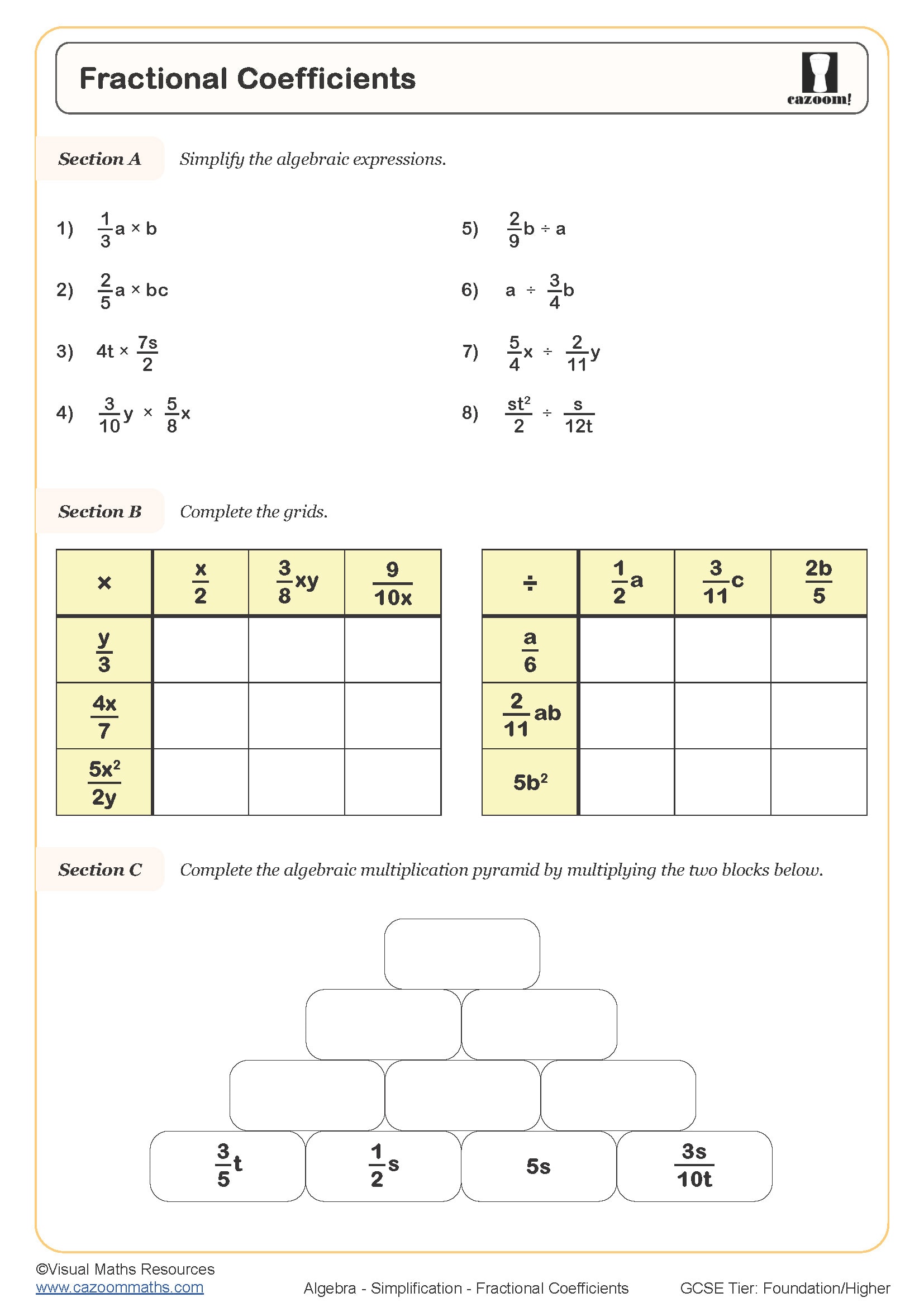
Fractional Coefficients
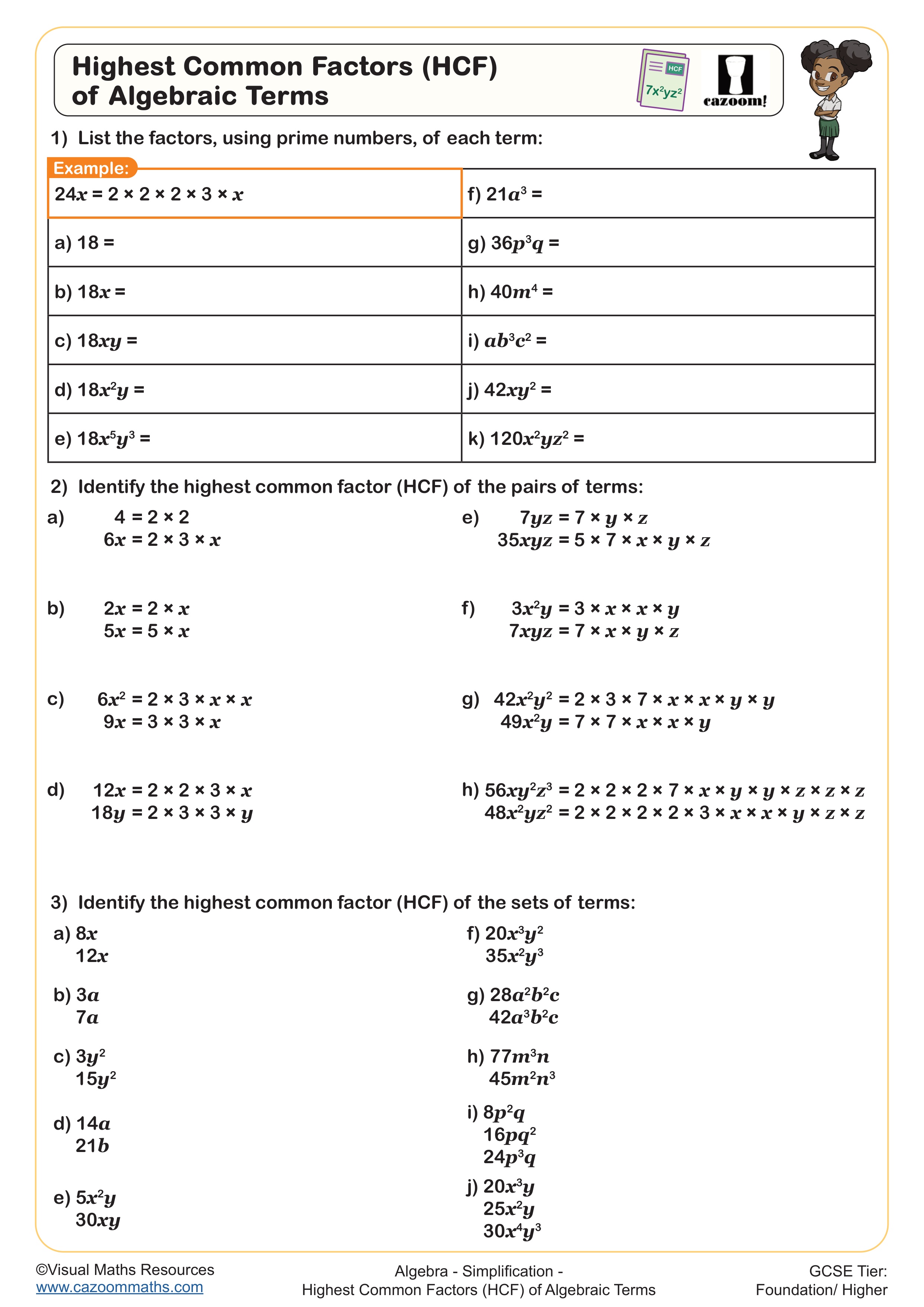
Highest Common Factors (HCF) of Algebraic Terms
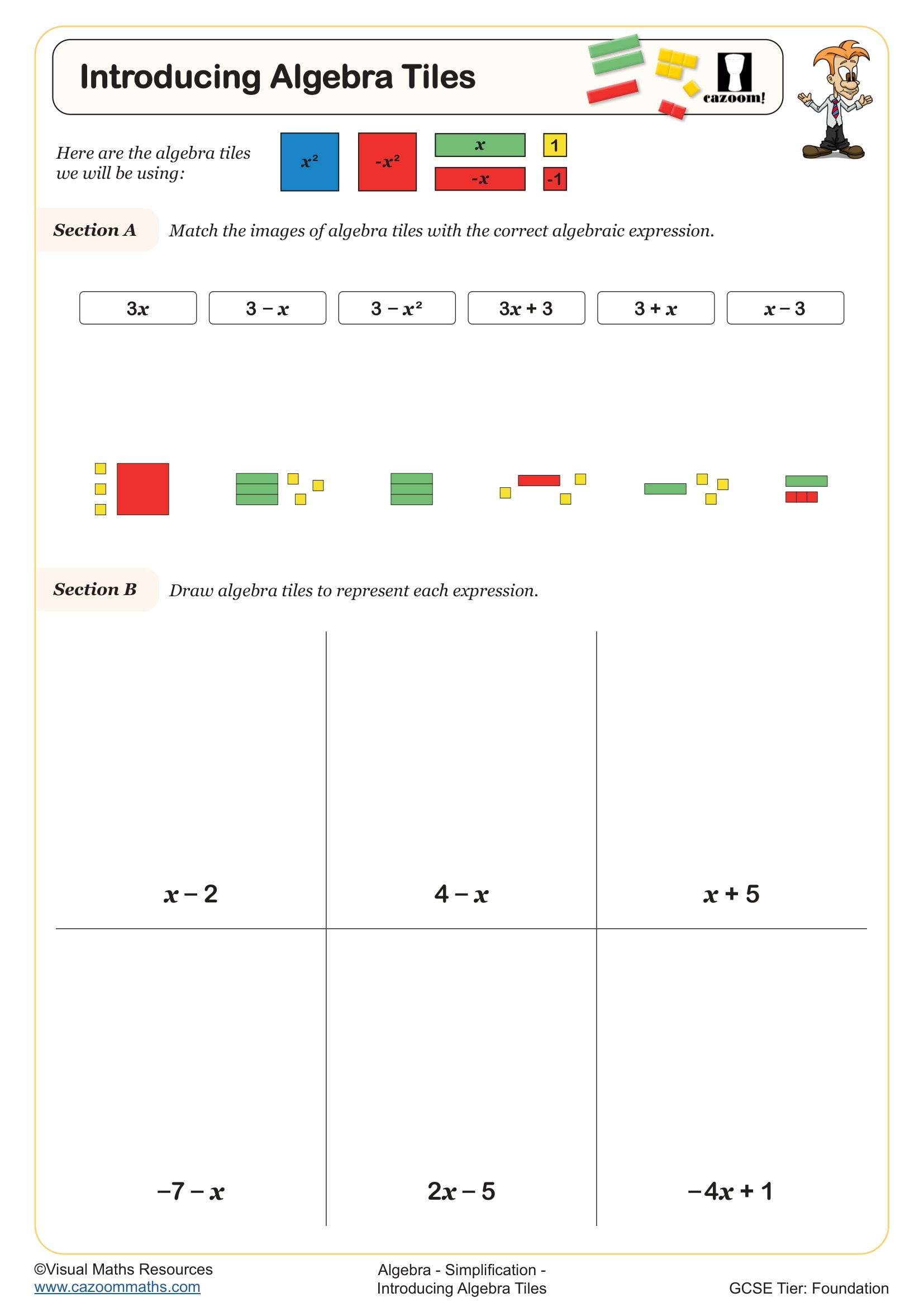
Introducing Algebra Tiles
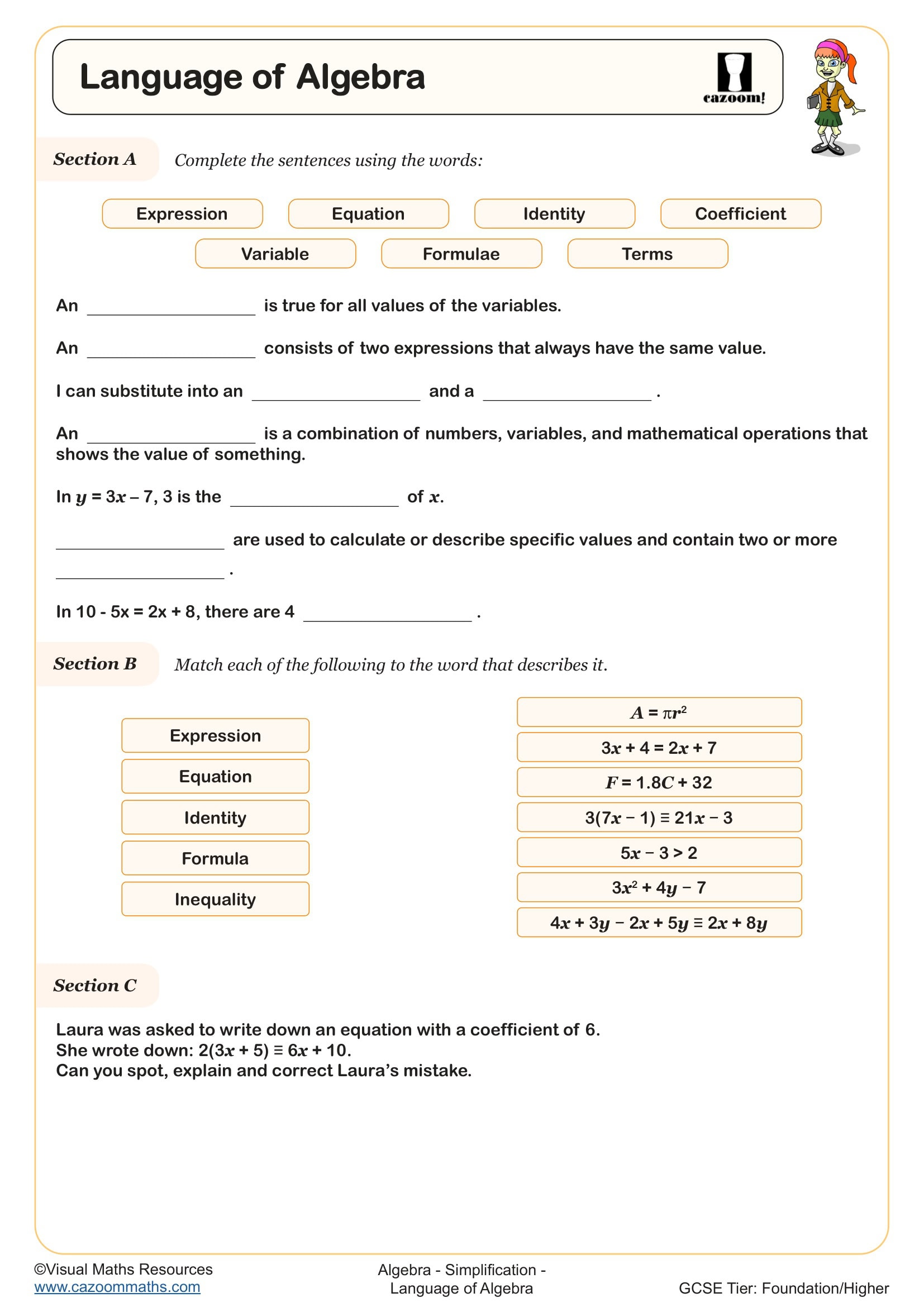
Language of Algebra
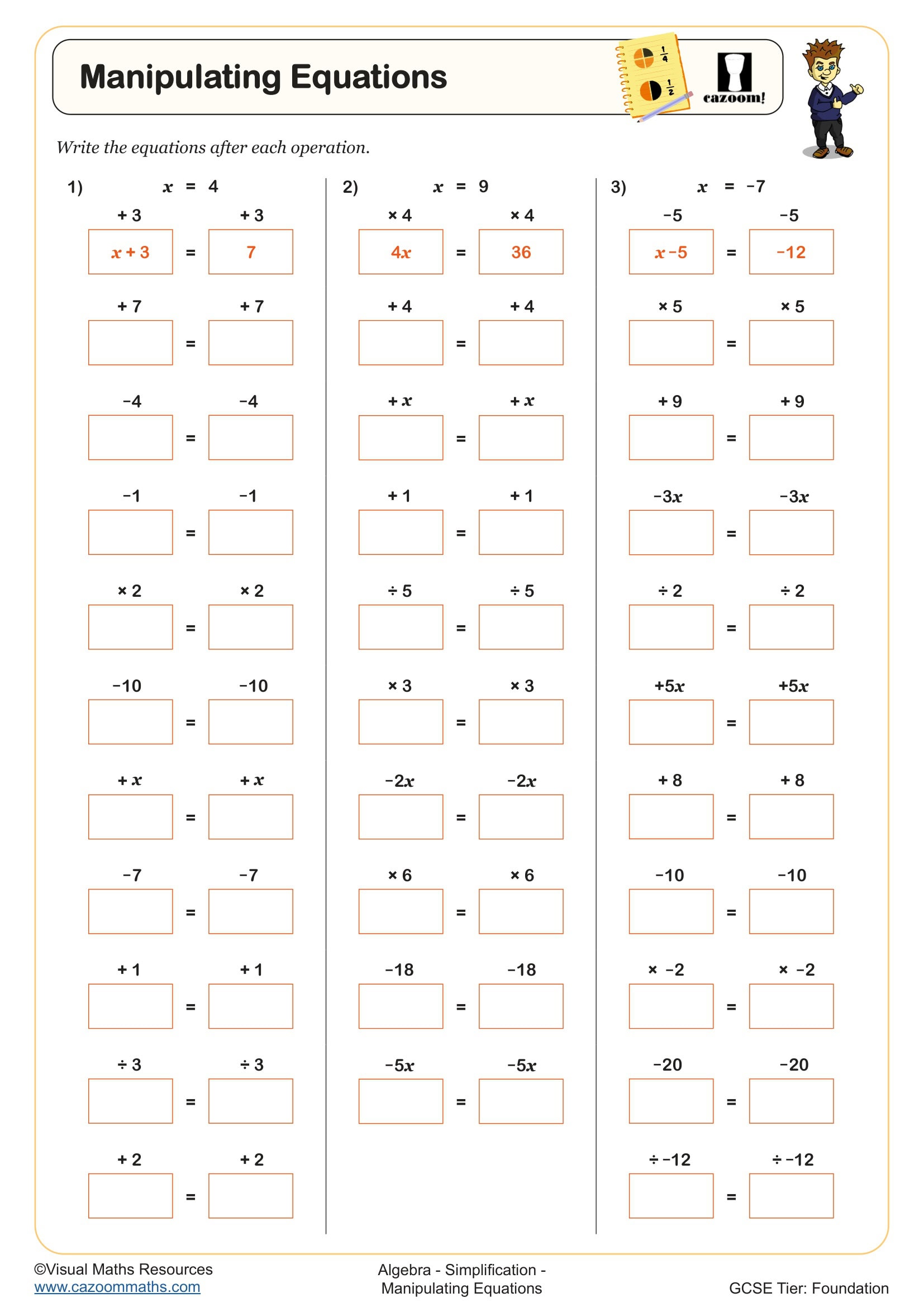
Manipulating Equations
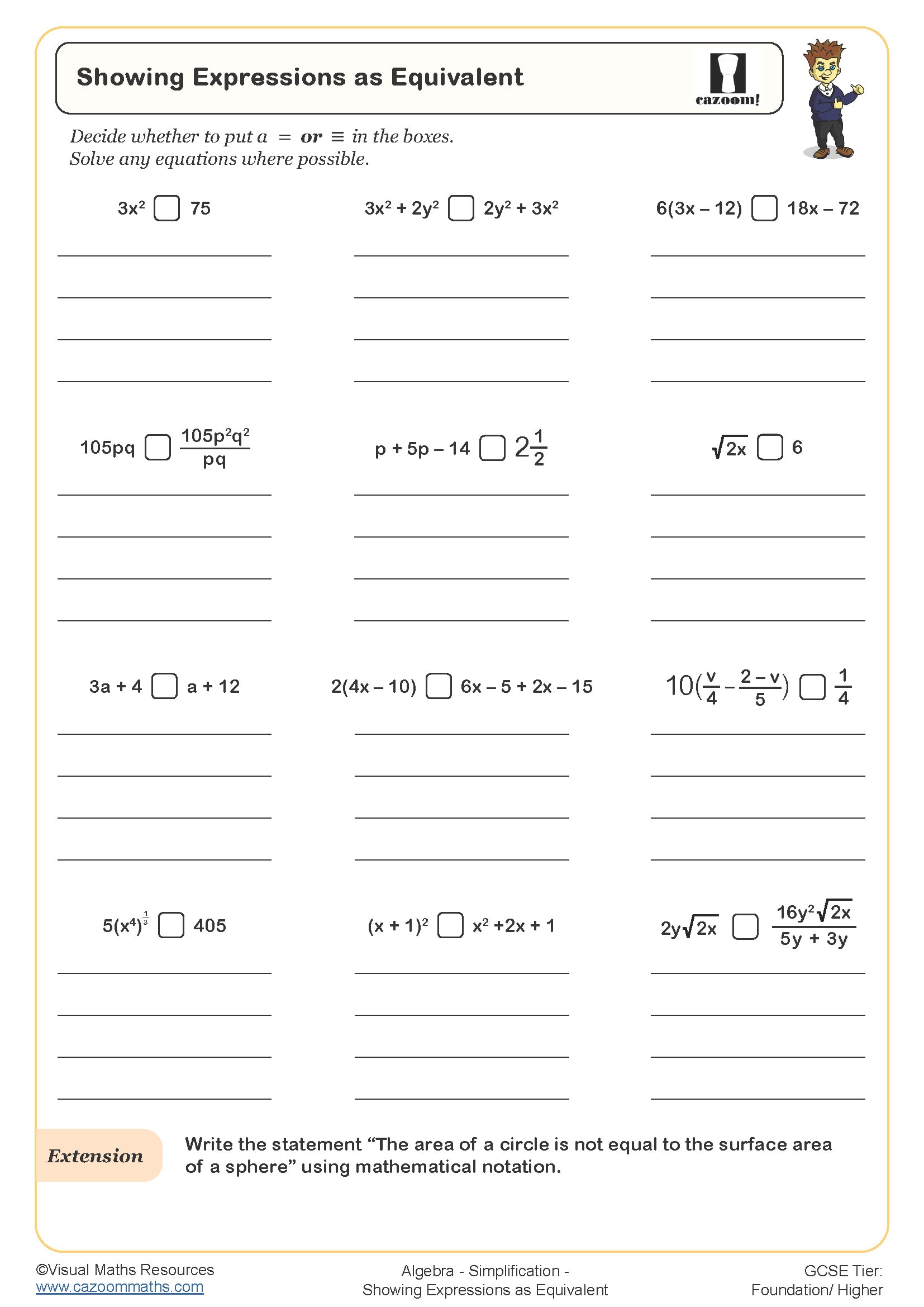
Showing Expressions as Equivalent
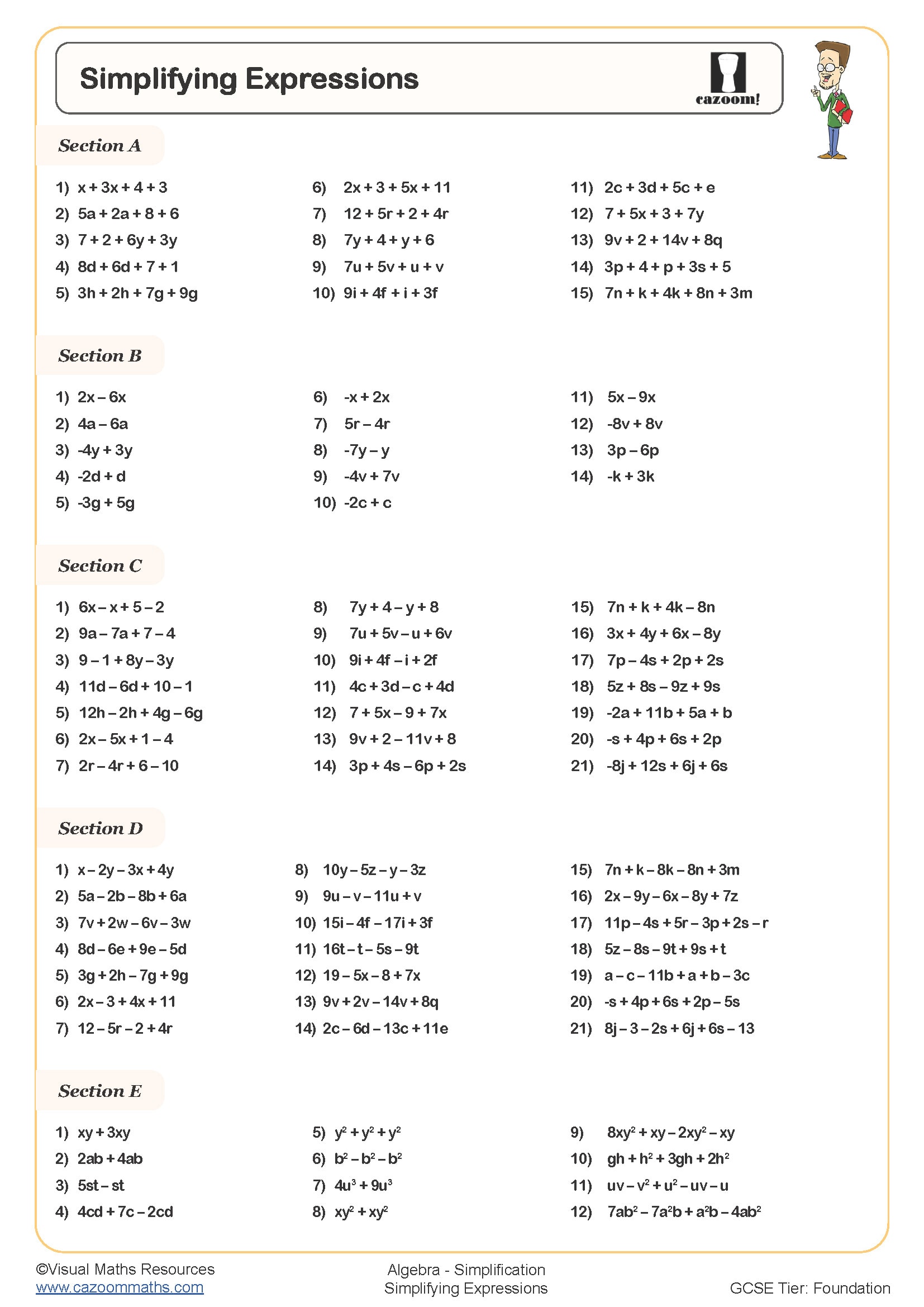
Simplifying Expressions
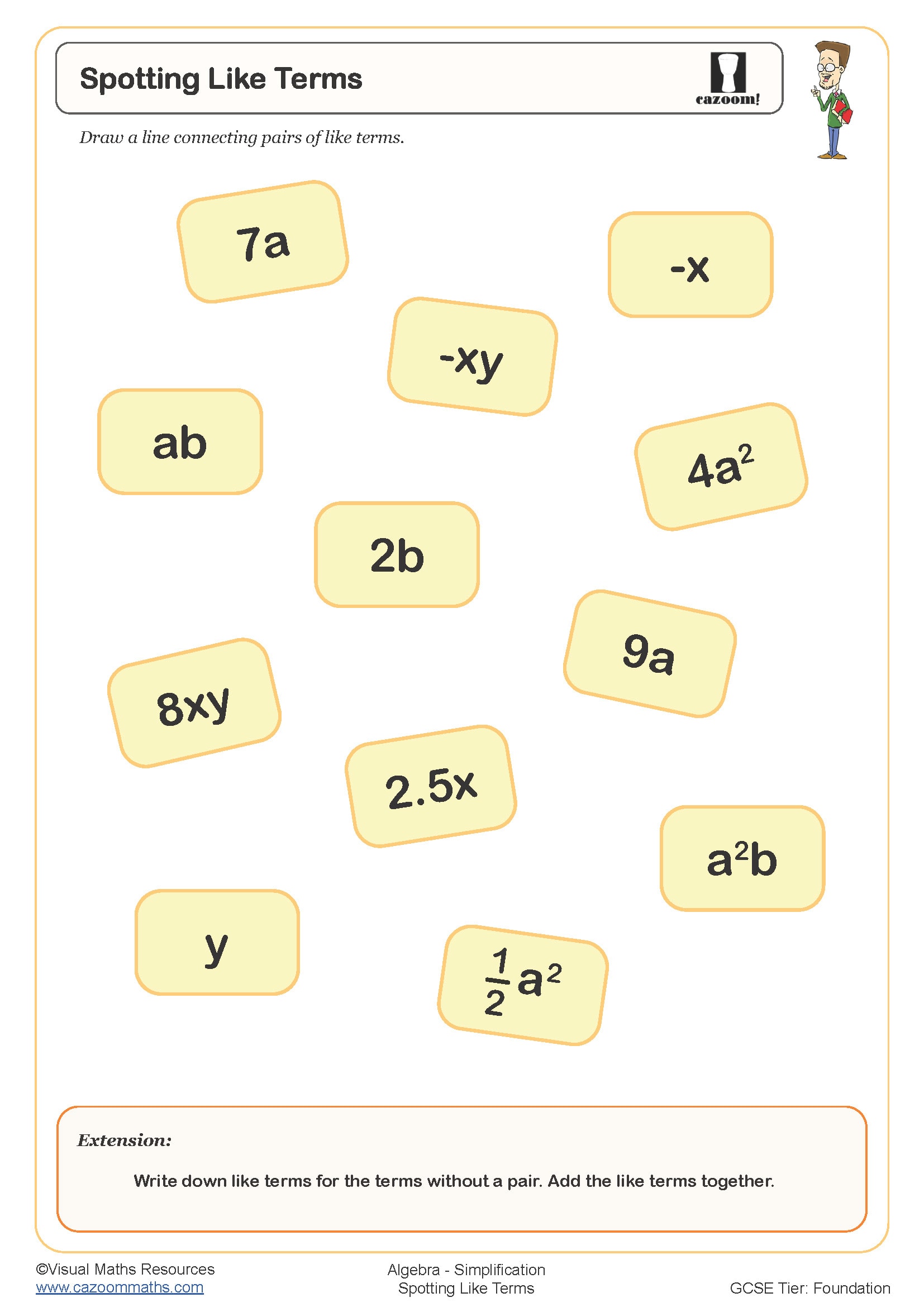
Spotting Like Terms
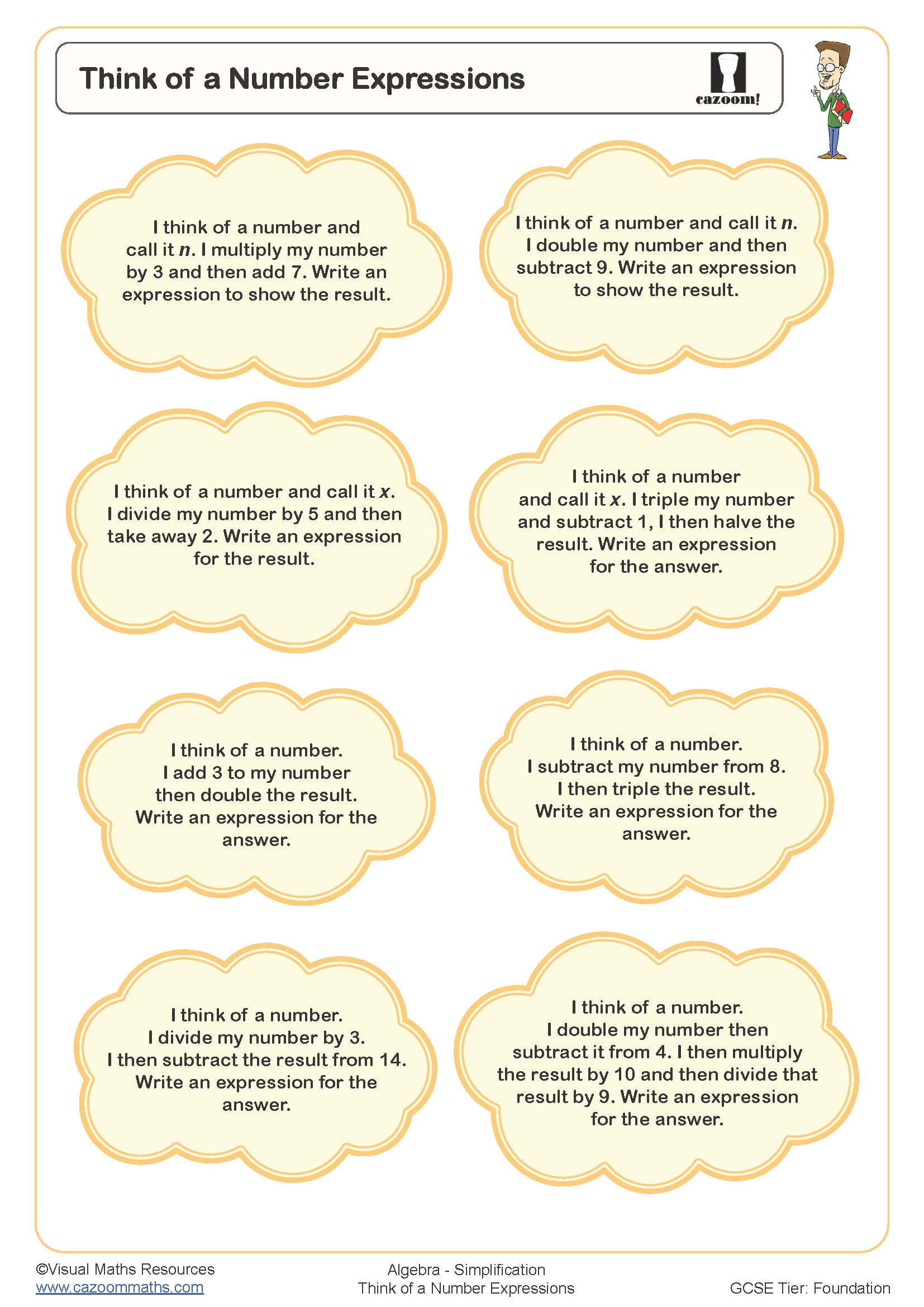
Think of A Number Expressions
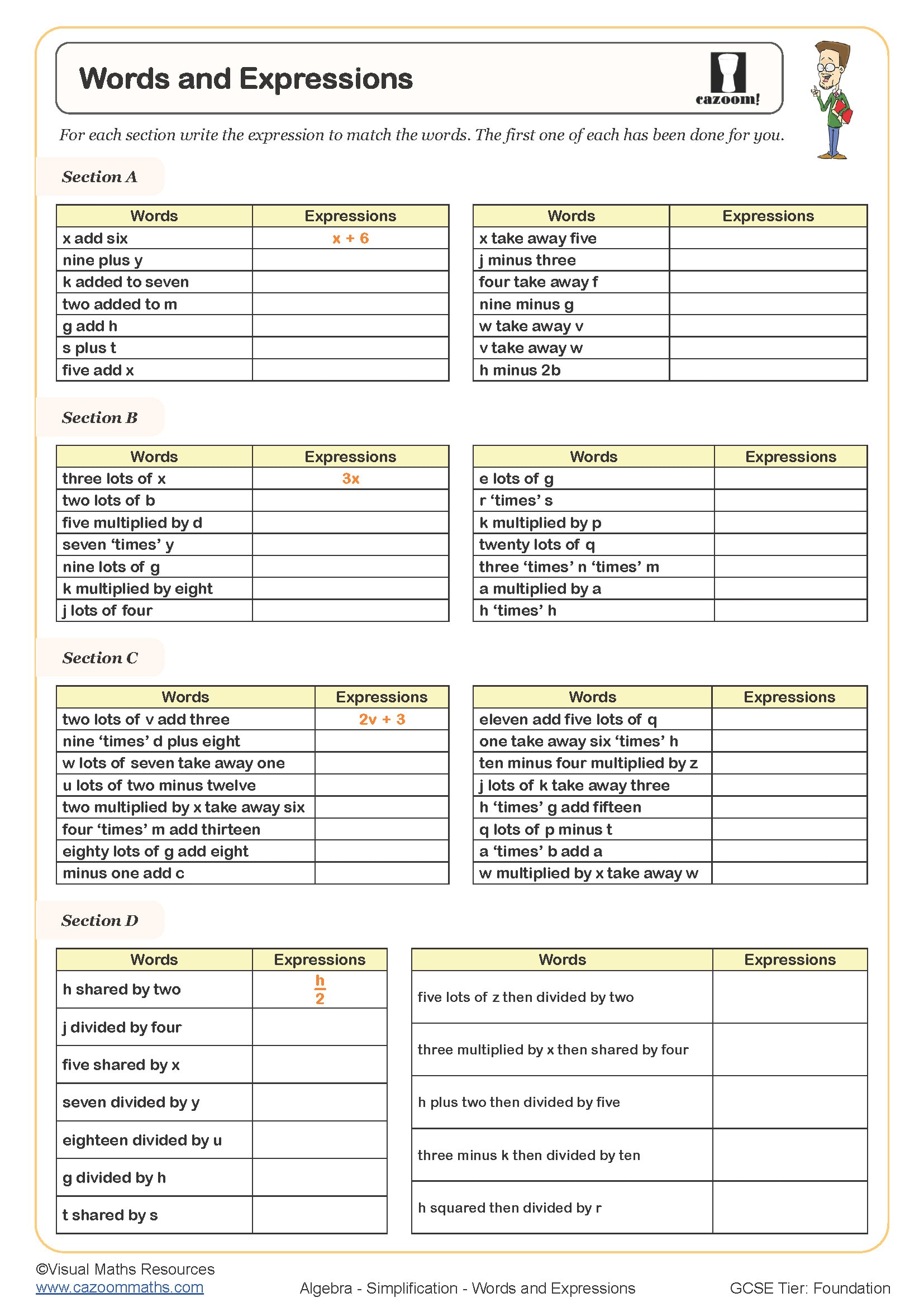
Words and Expressions
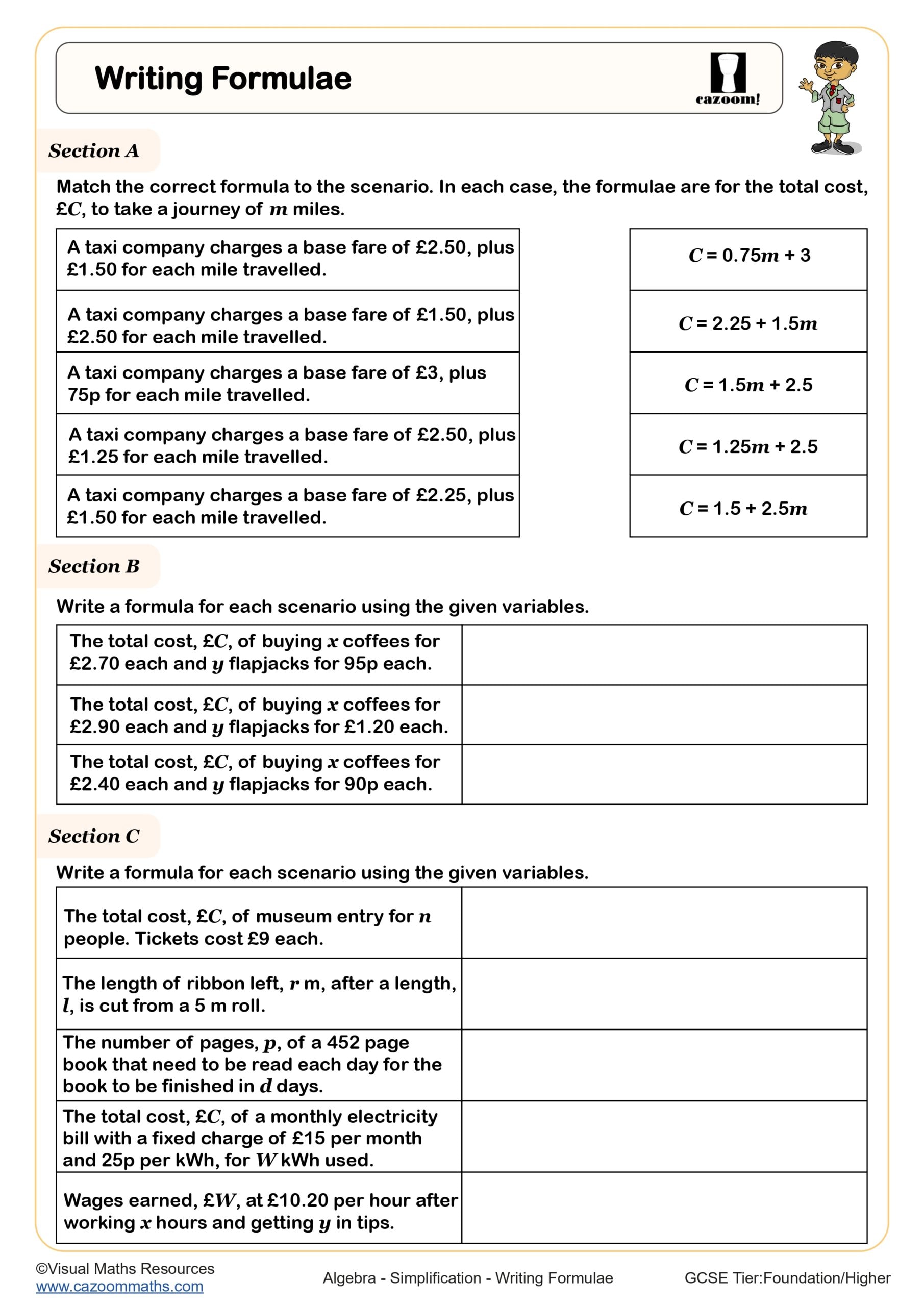
Writing Formulae
All worksheets are created by the team of experienced teachers at Cazoom Maths.
What does simplification mean in KS3 algebra?
Simplification in KS3 algebra involves collecting like terms to write algebraic expressions in their most compact form. Students identify terms with identical variable parts (such as 3x and 5x, or 2y² and -7y²) and combine their coefficients, whilst leaving unlike terms separate. This appears from Year 7 onwards as the first major algebraic manipulation skill in the National Curriculum.
A frequent misconception is treating 4x + 5y as 9xy, or believing that x + x equals x². Teachers regularly see students losing marks on simplification questions when they fail to recognise that the variable part must match exactly before terms can be combined. Exam mark schemes typically award one mark for identifying like terms and a separate mark for correctly calculating the simplified coefficient, so showing clear working remains important even for seemingly straightforward questions.
Which year groups study simplification of algebraic expressions?
These worksheets support Year 7, Year 8, and Year 9 students working through the KS3 algebra curriculum. Simplification first appears in Year 7 when students begin forming and manipulating algebraic expressions, typically starting after they've covered basic substitution. The skill is fundamental because it underpins nearly every subsequent algebra topic, from solving equations to factorising quadratics at GCSE.
The progression across KS3 builds systematically. Year 7 typically begins with single-variable expressions containing positive terms (such as 3x + 5x - 2x). Year 8 introduces multiple variables and negative coefficients (4a - 7b + 2a + 3b), whilst Year 9 work includes indices, brackets, and more complex combinations that prepare students for expanding and factorising. Many teachers revisit simplification regularly throughout KS3 because it's a prerequisite skill that students need to maintain fluency with.
How do you simplify expressions with multiple variables?
When simplifying expressions with multiple variables, students must group terms that contain identical variable components. For example, in the expression 5x + 3y - 2x + 7y, the like terms are 5x with -2x (giving 3x) and 3y with 7y (giving 10y), resulting in 3x + 10y. Terms like 2ab and 3ba are also like terms because multiplication is commutative. The process requires careful attention to both the variable letters and their powers.
This skill appears frequently in STEM contexts, particularly in physics formulae and engineering calculations. When calculating resultant forces, students might need to simplify expressions representing horizontal and vertical components (such as 3F + 5G - F + 2G). Chemistry teachers rely on students' simplification skills when balancing equations or working with molar calculations involving multiple substances. The ability to organise and combine like terms efficiently becomes increasingly important in quantitative subjects at GCSE and beyond.
How can teachers use these simplification worksheets effectively?
The worksheets provide structured practice with graduated difficulty, allowing teachers to match questions to students' current understanding. Answer sheets enable students to self-mark or check their working independently, which is particularly valuable for homework or revision sessions. Teachers can use earlier questions as worked examples on the board, then set later questions for independent practice, building confidence before moving to more challenging multi-variable problems.
Many teachers find these worksheets effective for intervention groups targeting specific gaps in algebraic manipulation. They work well for paired activities where students take turns simplifying expressions and checking each other's answers using the provided solutions. The progression within each worksheet makes them suitable for mixed-ability classes, with all students accessing the opening questions whilst more confident students tackle the demanding final problems. Short starter activities using selected questions help maintain fluency with this essential skill throughout the year.