KS4 Fractions Decimals Percentages Worksheets
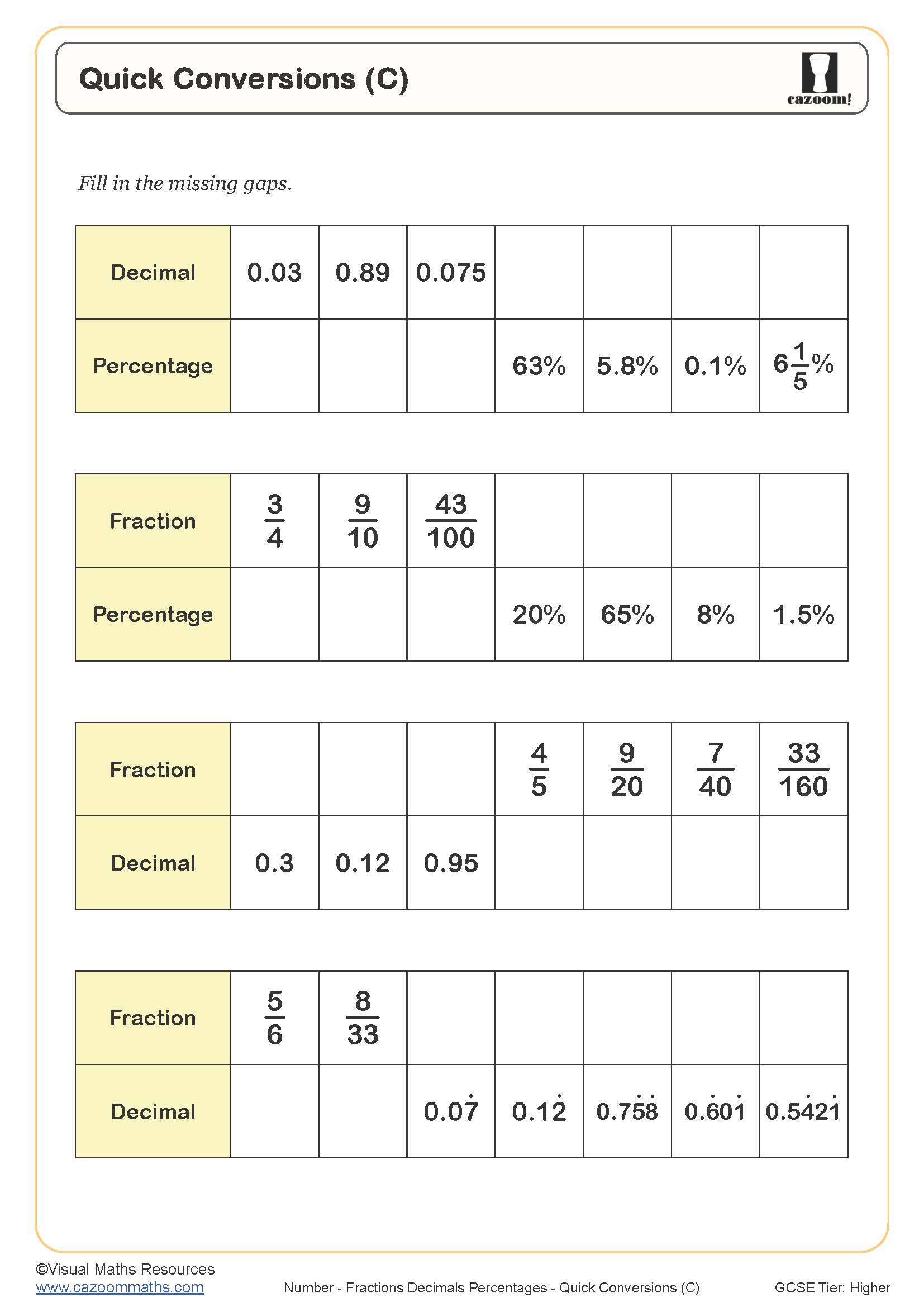
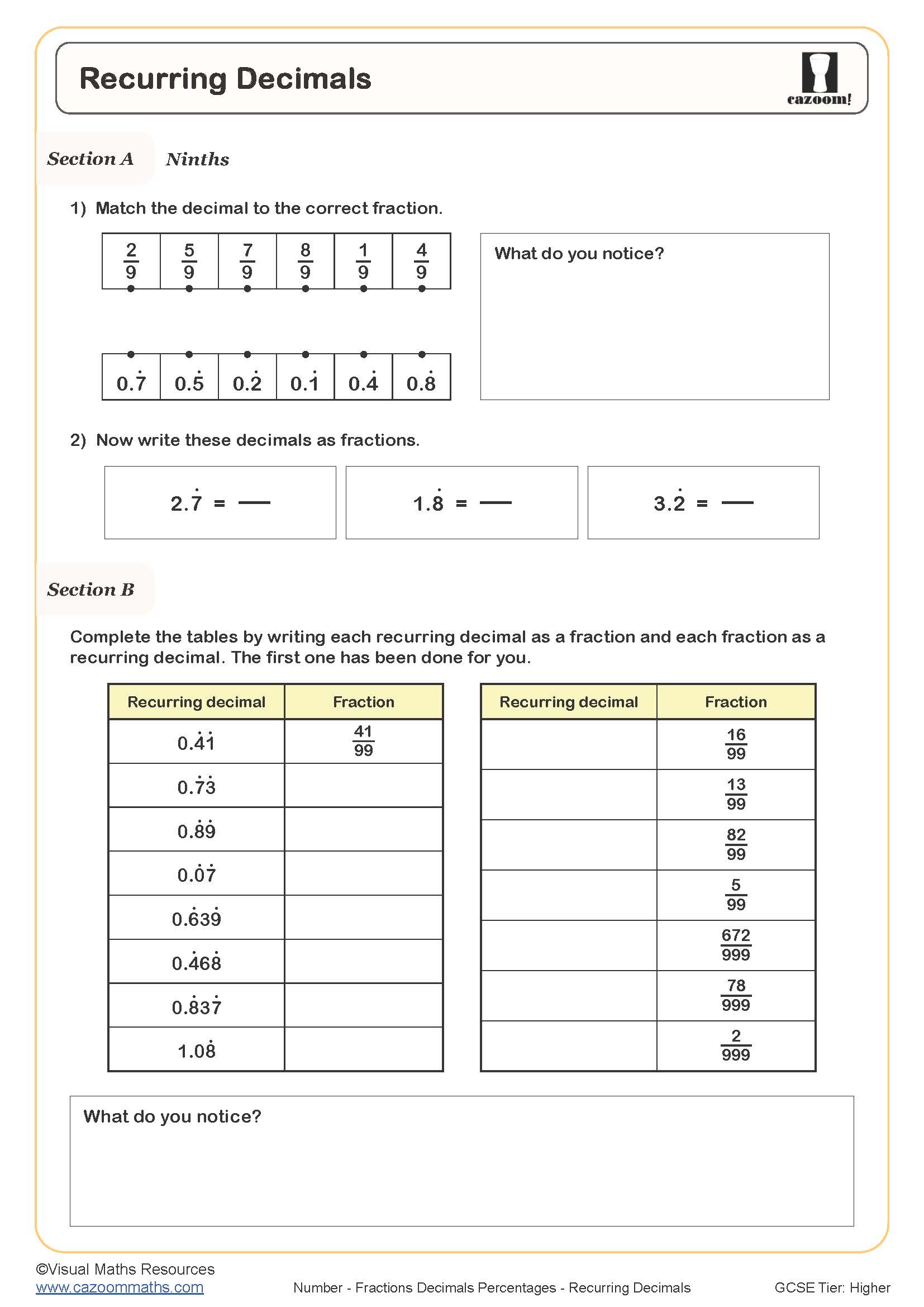
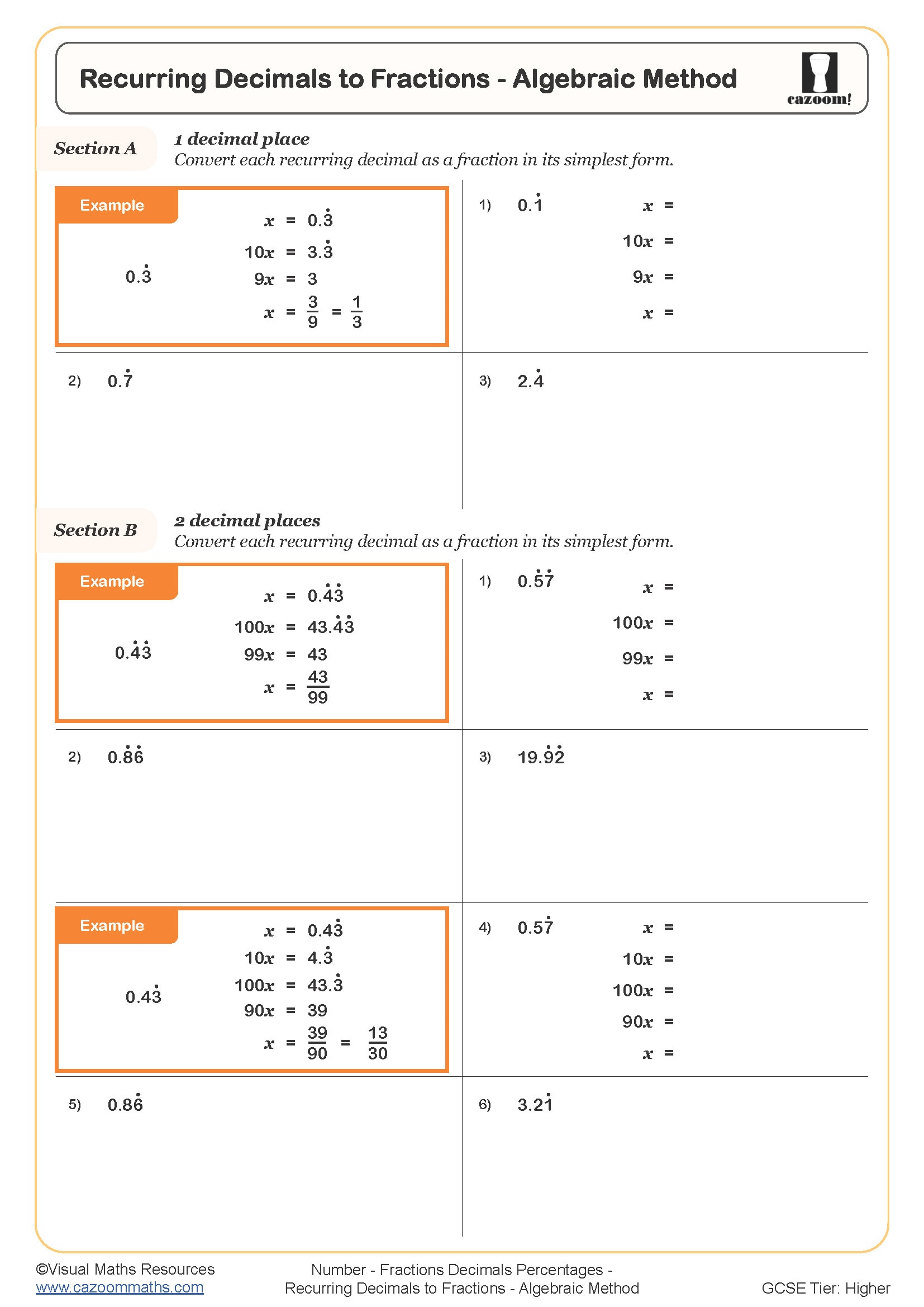
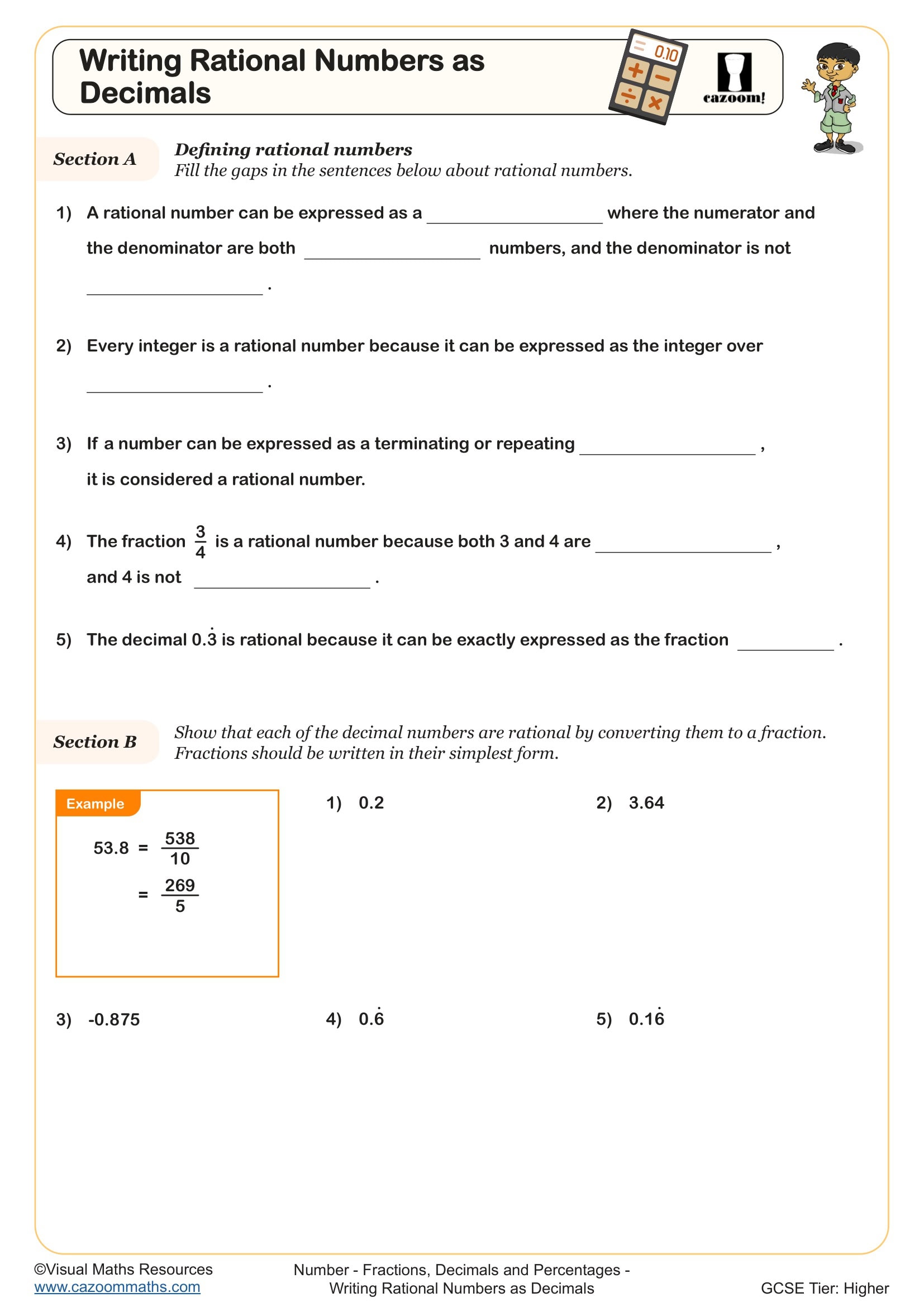
All worksheets are created by the team of experienced teachers at Cazoom Maths.
Why do students struggle to convert between fractions, decimals and percentages?
Many students treat conversions as isolated procedures rather than recognising the mathematical relationships connecting all three forms. They might memorise that "to change a decimal to a percentage, multiply by 100" without understanding why this works, which leads to errors when converting in reverse or when dealing with recurring decimals or improper fractions.
Teachers often notice that students lose marks by converting fractions to decimals using division but then rounding prematurely, so 2/3 becomes 0.67 instead of the exact value 0.666... or 66.6̇%. Exam questions frequently test whether students recognise equivalent forms without calculation, such as knowing 3/8 = 0.375 = 37.5%, which saves time and reduces errors under exam conditions.
Which year groups study fractions, decimals and percentages at KS4?
This collection provides resources for Year 10 and Year 11 students working at GCSE level, where converting between fractions, decimals and percentages becomes essential for tackling proportional reasoning, financial mathematics, and statistical problems. At KS4, the National Curriculum expects students to move beyond basic conversions to apply these skills in multi-step problems involving reverse percentages, compound interest, and ratio calculations.
The progression from Year 10 to Year 11 typically involves increasing complexity in problem contexts rather than new conversion methods. Year 10 students practise fluency with standard conversions and straightforward percentage problems, whilst Year 11 materials incorporate these skills within exam-style questions requiring multiple steps, non-calculator reasoning, and connections to other topics like bounds, standard form, or algebraic manipulation of fractional expressions.
How do recurring decimals connect to fraction conversions?
Recurring decimals represent exact fractional values that cannot be expressed as terminating decimals because their denominators contain prime factors other than 2 or 5. Students need to recognise that 1/3 = 0.333... (written as 0.3̇) is an exact equivalent, not an approximation, and that different notations like dot notation or bar notation represent infinite repetition of digits.
This skill connects directly to scientific applications where precision matters. Engineers and scientists working with measurements need to understand whether 0.33 represents an approximation or the exact value 33/100, as this distinction affects error margins in calculations for construction tolerances, chemical concentrations, or medical dosages. In data science and computer programming, handling recurring decimals correctly prevents rounding errors that compound across large datasets or iterative calculations.
How can these worksheets support revision and exam preparation?
The worksheets build systematic practice through carefully sequenced questions that move from straightforward conversions to problems requiring students to select appropriate methods efficiently. Answer sheets allow students to identify specific error patterns, such as consistently placing decimal points incorrectly or confusing multiplication and division when converting percentages, which teachers can then address through targeted feedback.
Many teachers use these resources for retrieval practice at the start of lessons, as quick homework tasks to maintain fluency between teaching other topics, or as intervention materials for students whose Foundation tier mock results show weaknesses in proportional reasoning. The clear layout works well for paired activities where students complete alternate questions and check each other's working, developing their ability to spot errors and explain conversion methods, both valued skills in GCSE problem-solving questions.