KS4 Indices Worksheets
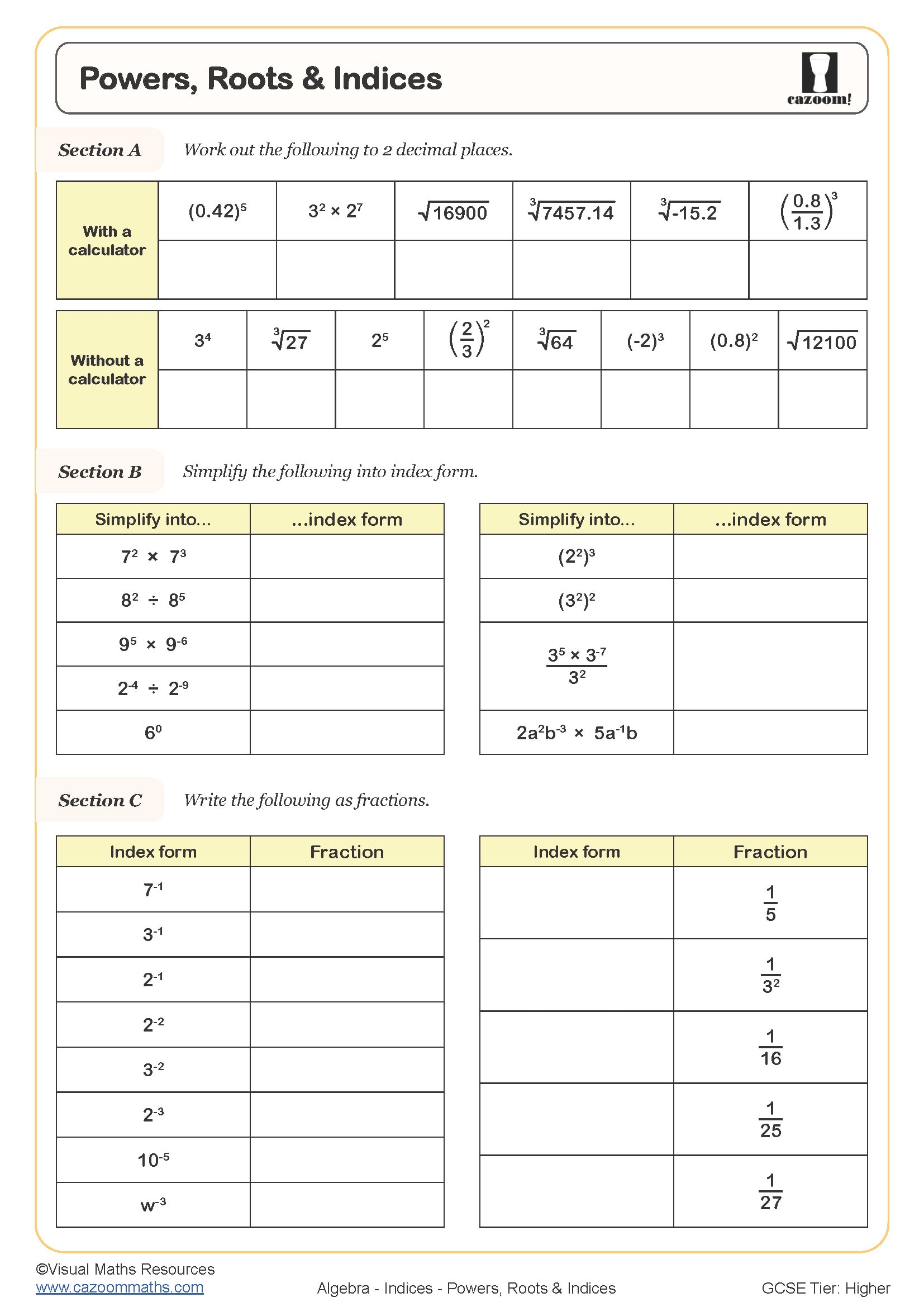
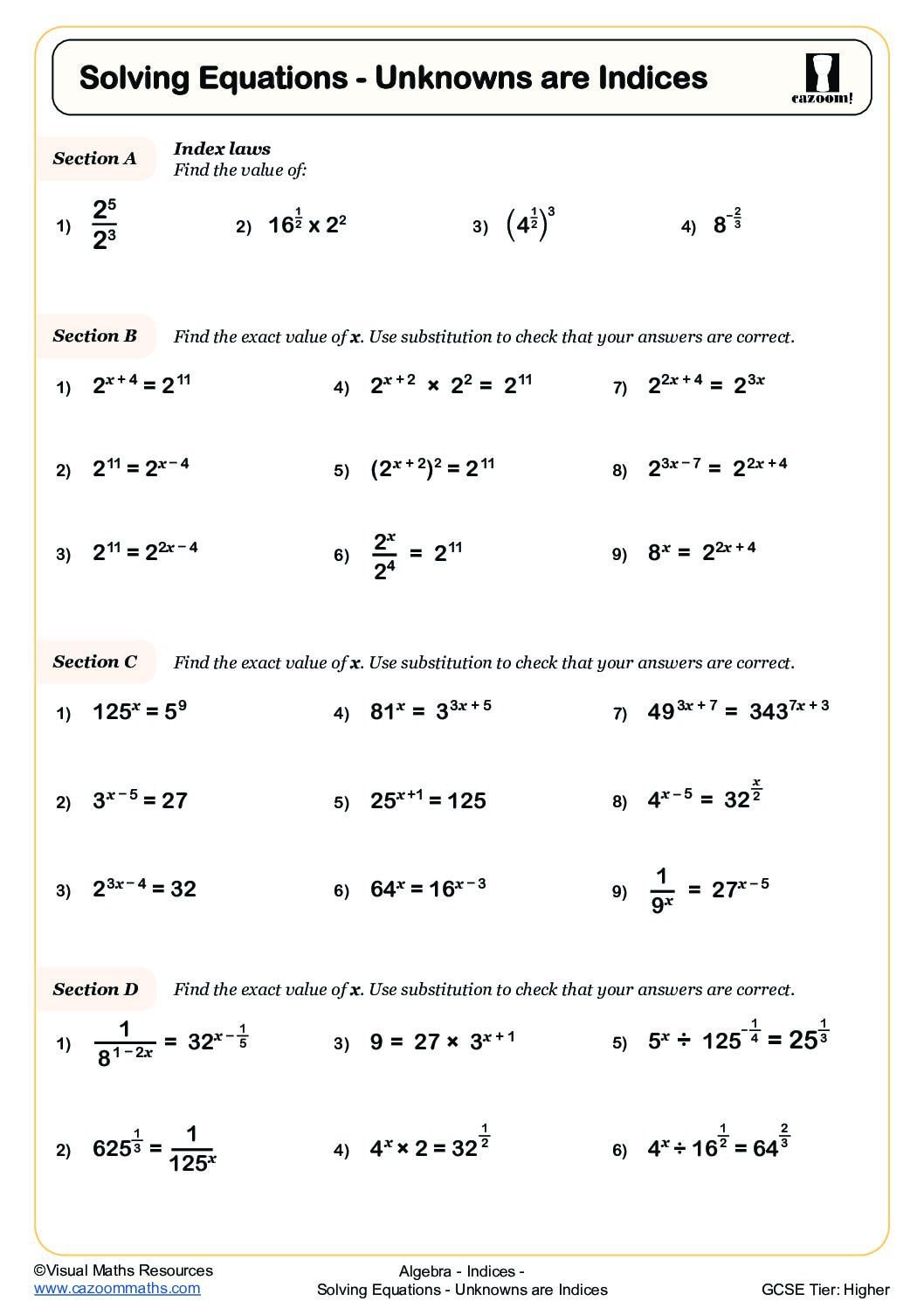
All worksheets are created by the team of experienced teachers at Cazoom Maths.
What are the index laws students need to know for GCSE?
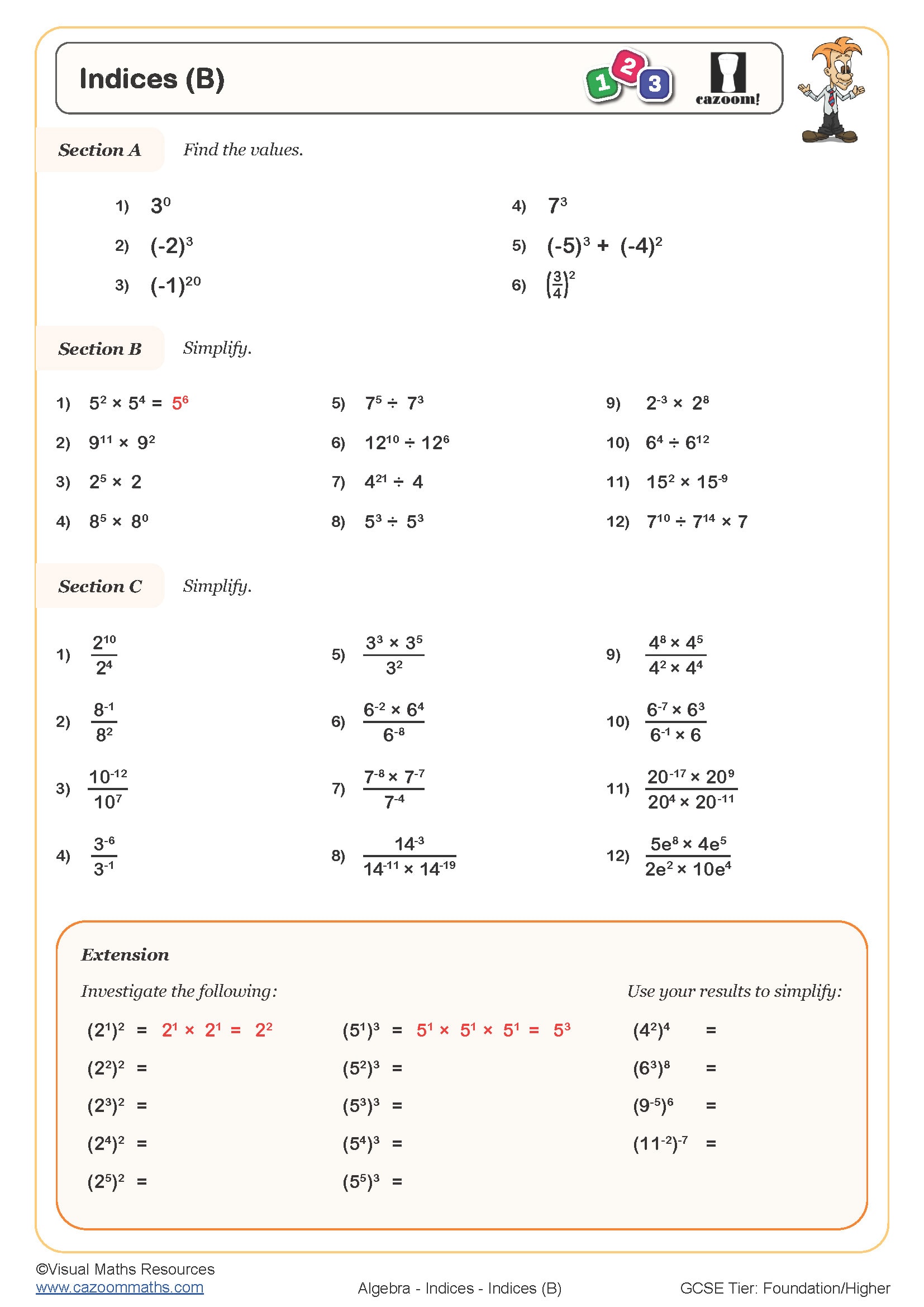
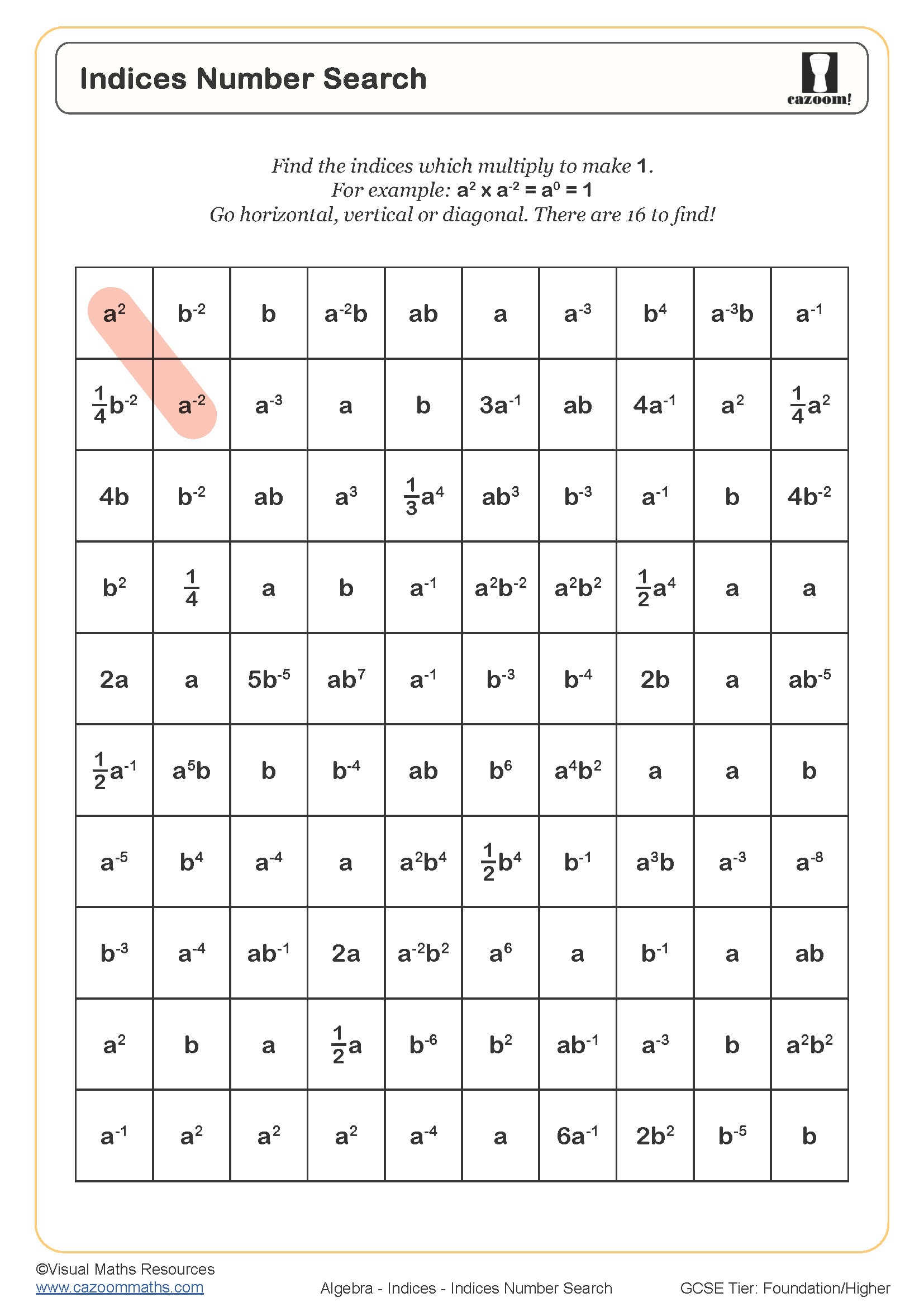
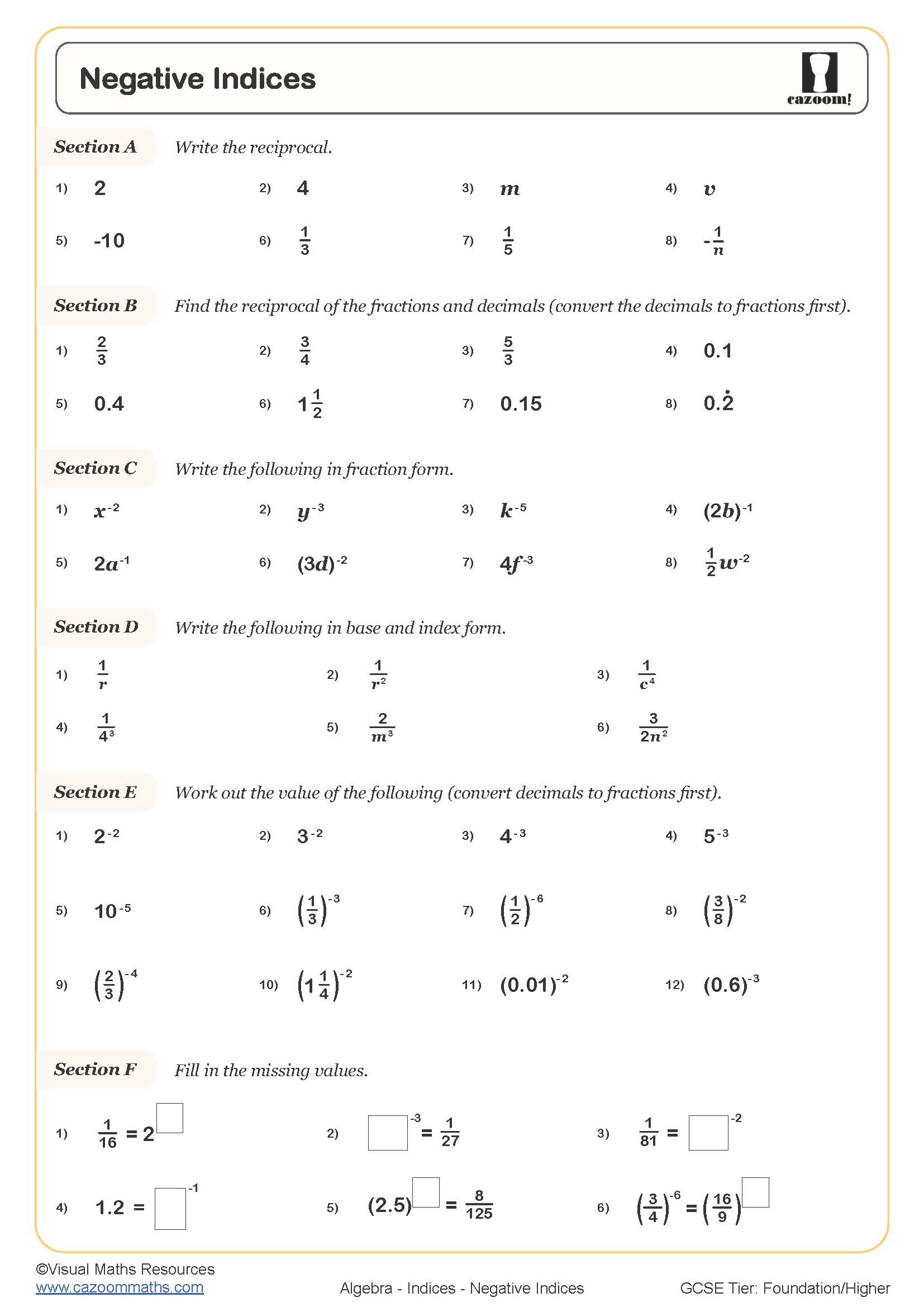
Students must know five fundamental index laws for GCSE maths: multiplying indices (add the powers), dividing indices (subtract the powers), power of a power (multiply the powers), the zero index (anything to power zero equals one), and negative indices (become reciprocals). These appear across both Foundation and Higher tiers, though Higher tier expects fluency with fractional indices and more complex combinations.
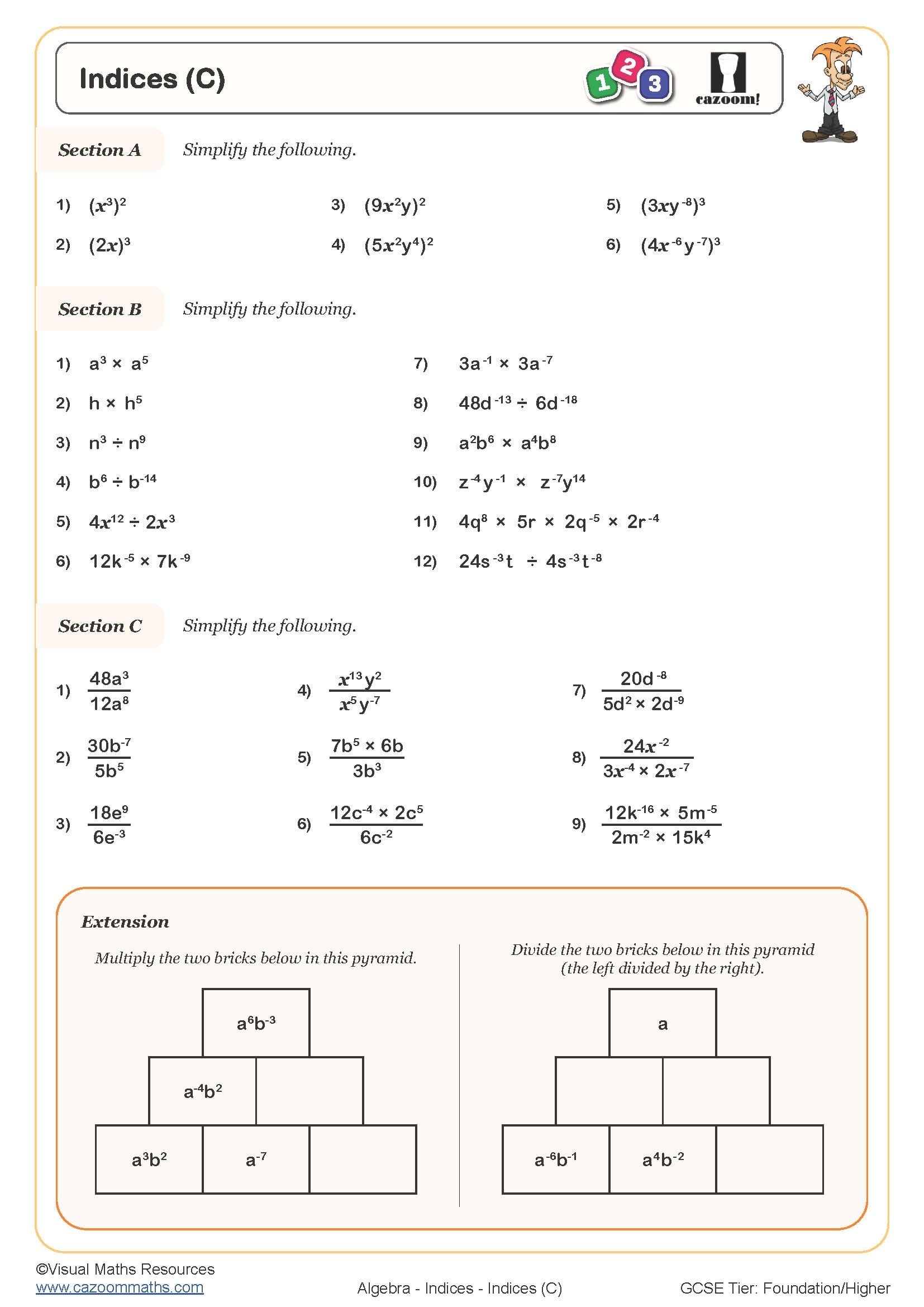
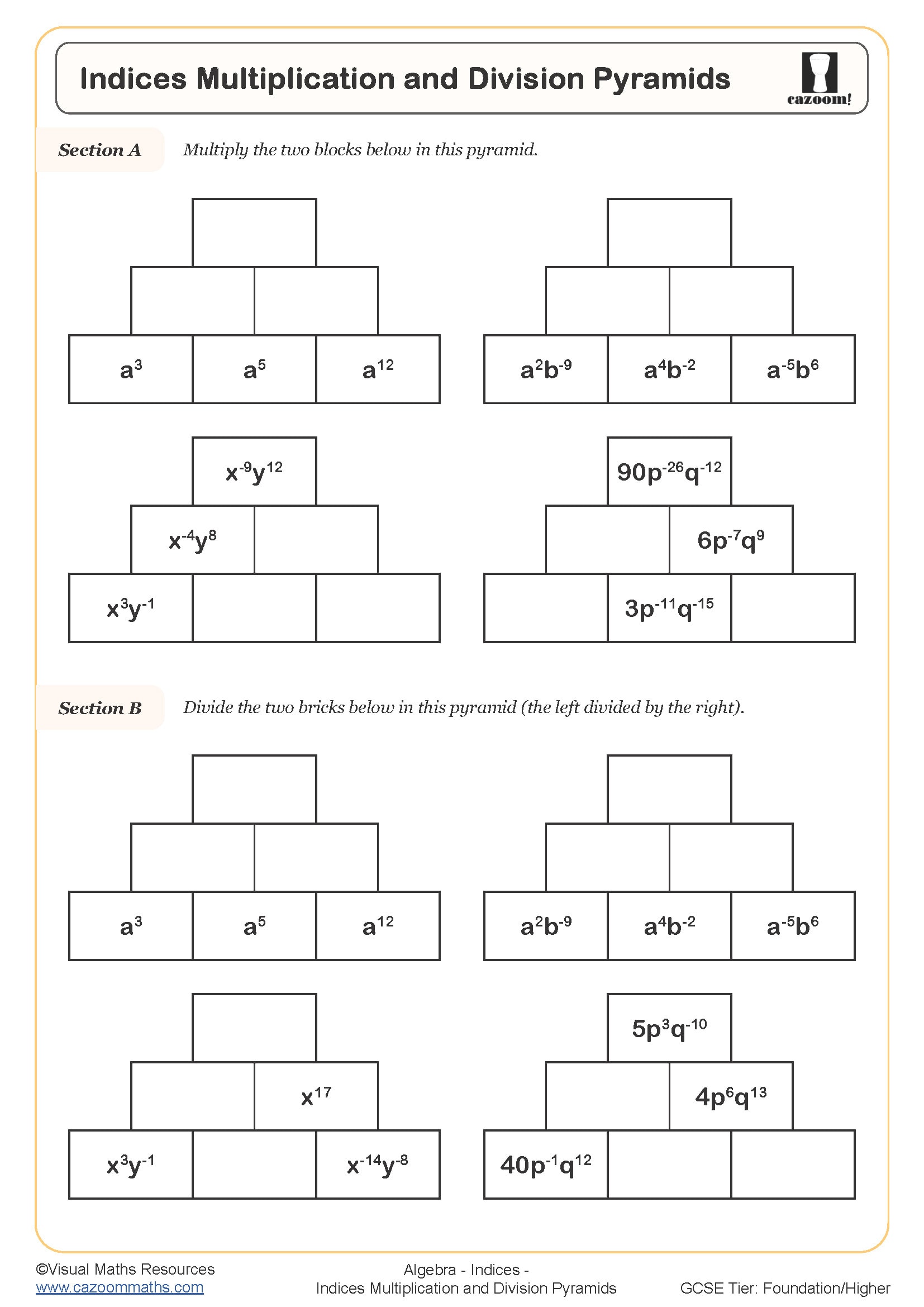
A common error occurs with division - students often write a² ÷ a⁵ = a⁻³ correctly but then leave the answer in this form rather than converting to 1/a³. Exam mark schemes specifically look for final answers expressed with positive indices unless the question explicitly asks for negative form. Division pyramids provide structured practice with this skill, helping students recognise when to convert between forms.
Which year groups study indices?
These indices worksheets cover Year 10 and Year 11 content within Key Stage 4, where students encounter index notation as part of their GCSE maths preparation. The National Curriculum expects students to calculate with roots and integer indices, extend to fractional indices, and understand the equivalence between roots and fractional powers by the end of KS4.
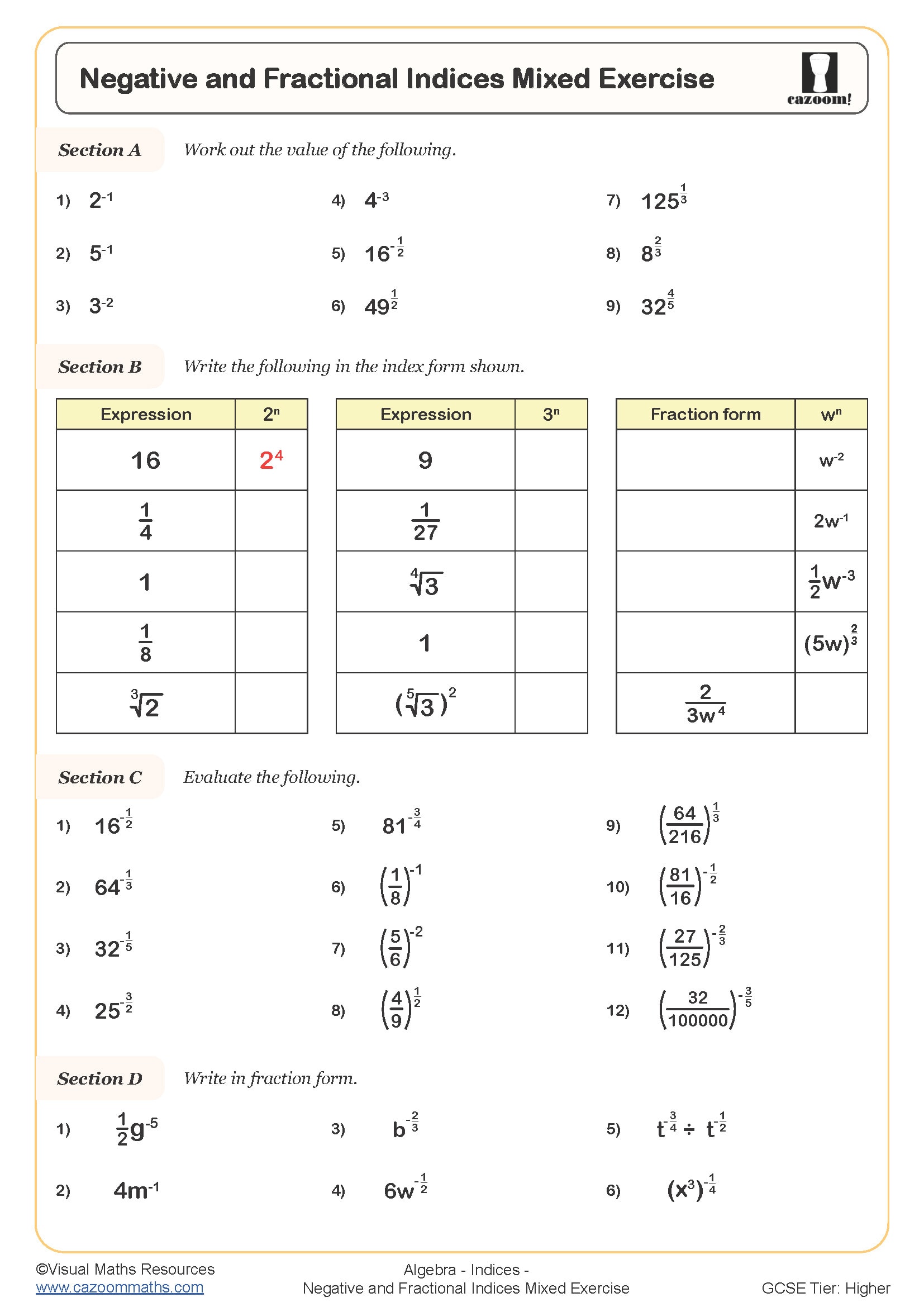
Year 10 students typically begin with integer indices and simple calculations, building confidence with multiplication and division laws before tackling negative and zero indices. By Year 11, students work with fractional indices, understanding that a^(1/2) represents the square root and a^(2/3) means the cube root of a squared, whilst also handling complex expressions where changing the subject requires index manipulation. The worksheets reflect this progression through increasingly demanding problem types.
How do fractional indices work?
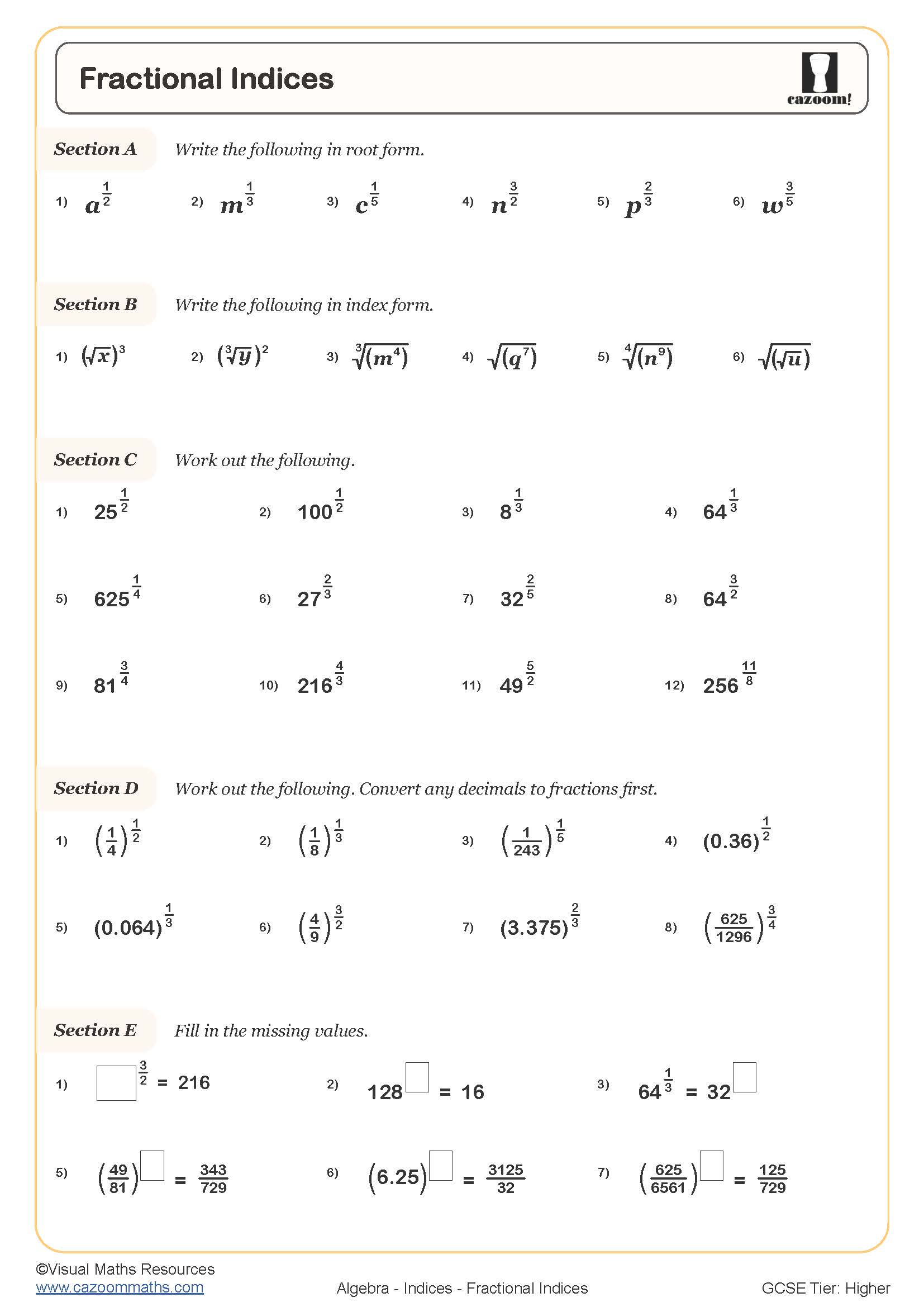
Fractional indices connect powers and roots: the denominator indicates the root type whilst the numerator shows the power. For example, 16^(3/4) means take the fourth root of 16 (giving 2), then cube the result (giving 8). Students can approach this either as (¹⁶√16)³ or as ¹⁶√(16³), though the former usually produces more manageable numbers. Teachers observe that students often apply operations in the wrong order or forget that 8^(2/3) and (∛8)² yield the same result.
This notation appears extensively in physics and engineering contexts. Electrical engineers use fractional indices when calculating impedance in AC circuits, whilst civil engineers apply them in stress-strain relationships for materials. The Poiseuille equation for fluid flow through pipes includes terms with fractional powers, demonstrating how this abstract maths enables real calculations in hydraulics and medical applications like blood flow modelling.
How should teachers use these indices worksheets?
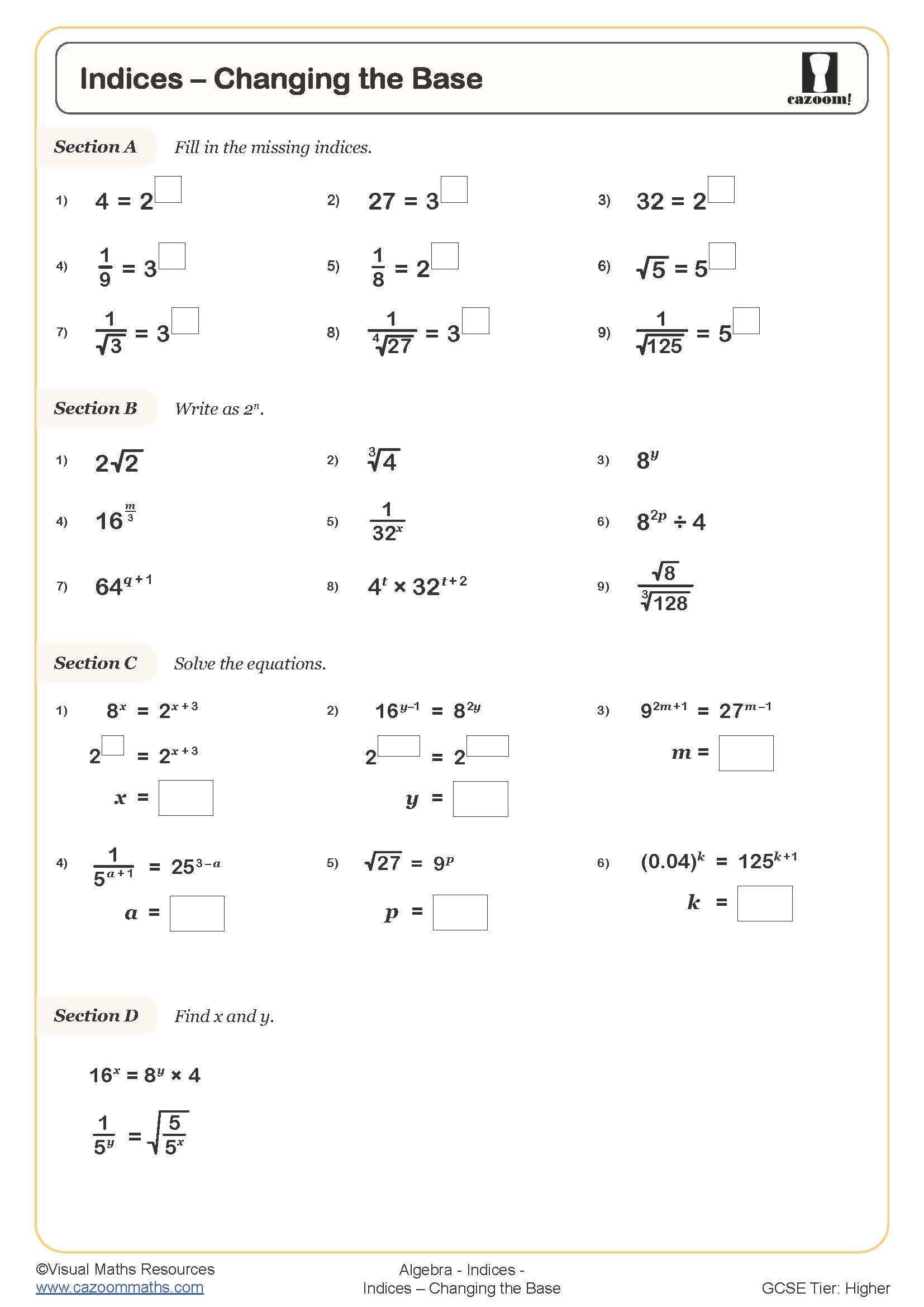
The worksheets scaffold learning by separating individual index laws before combining them in multi-step problems. Division pyramids offer a visual structure that helps students see relationships between terms, whilst questions involving unknowns push students beyond numerical calculation into algebraic reasoning. The progression from basic calculations through to introducing brackets mirrors how exam questions layer complexity, preparing students for Higher tier papers where indices appear within equations and formulae.
Many teachers use these for targeted intervention with students who've grasped basic arithmetic but struggle when index laws meet algebra. The answer sheets support peer marking during lessons, allowing students to identify errors immediately rather than practising mistakes. They work well as homework following initial teaching, as starter activities to revisit prior learning, or during revision periods when students need concentrated practice on specific weak areas identified through mock papers.