KS4 Sequences Worksheets
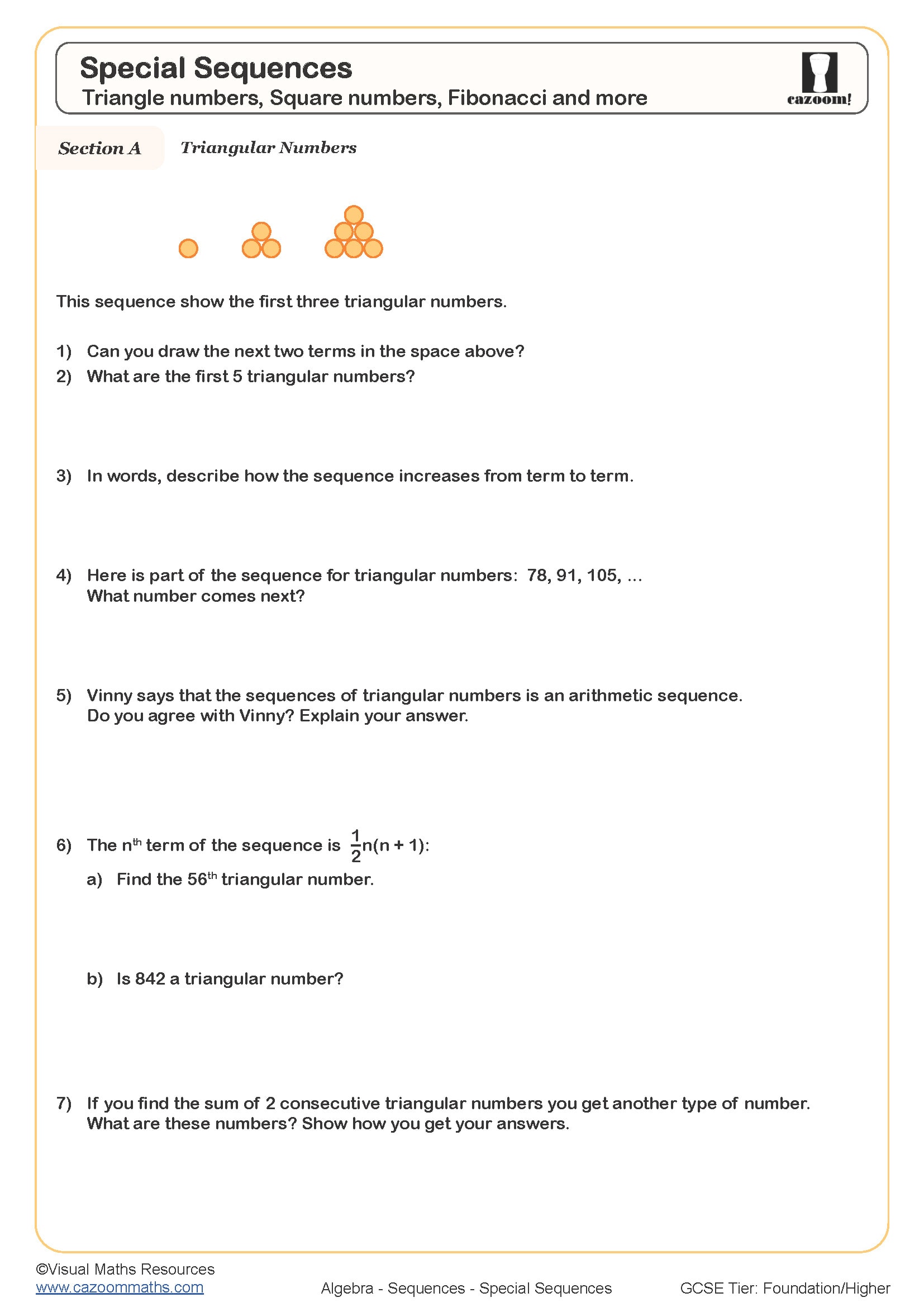
All worksheets are created by the team of experienced teachers at Cazoom Maths.
What Are the Different Types of Sequences in KS4 Maths?
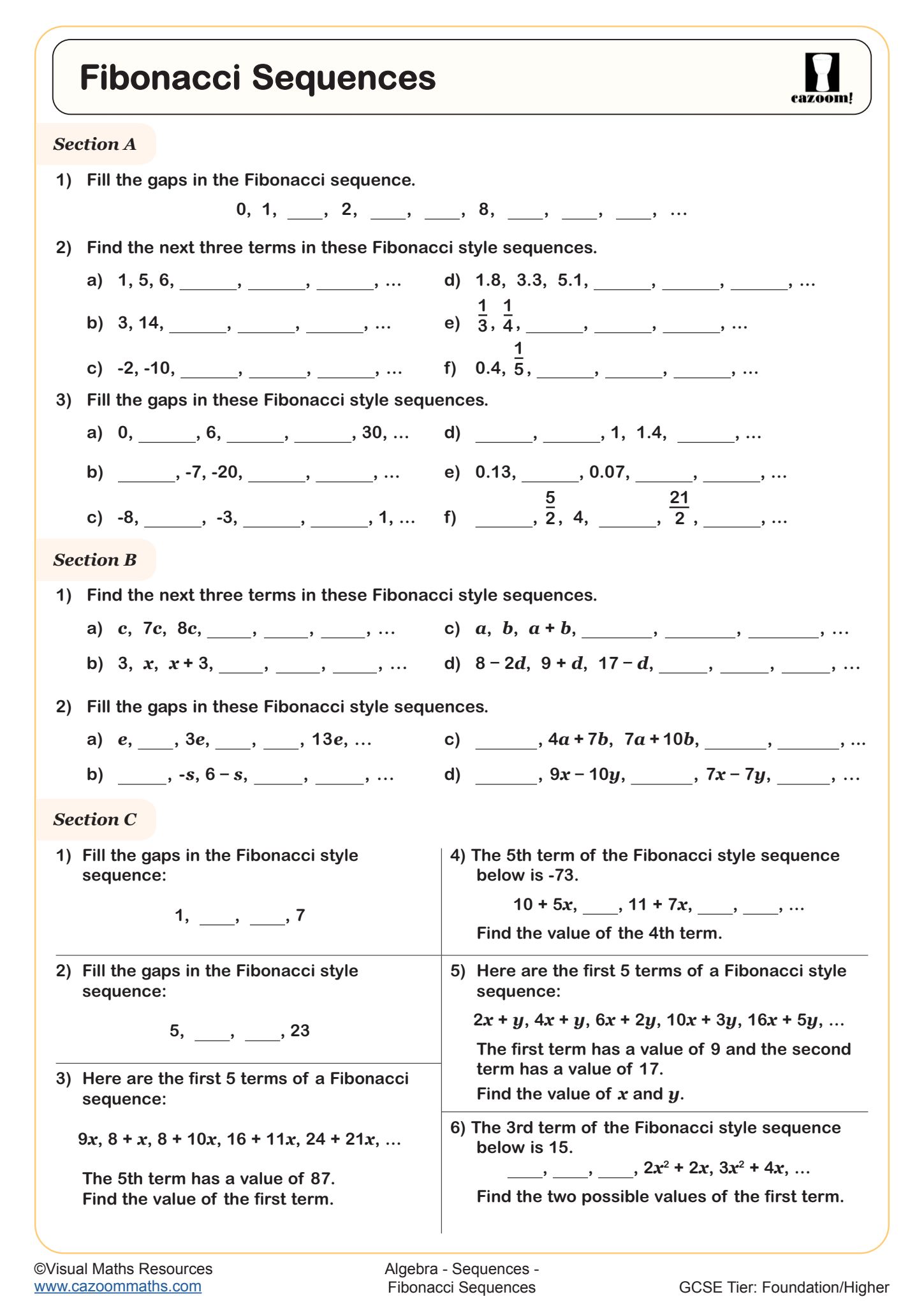
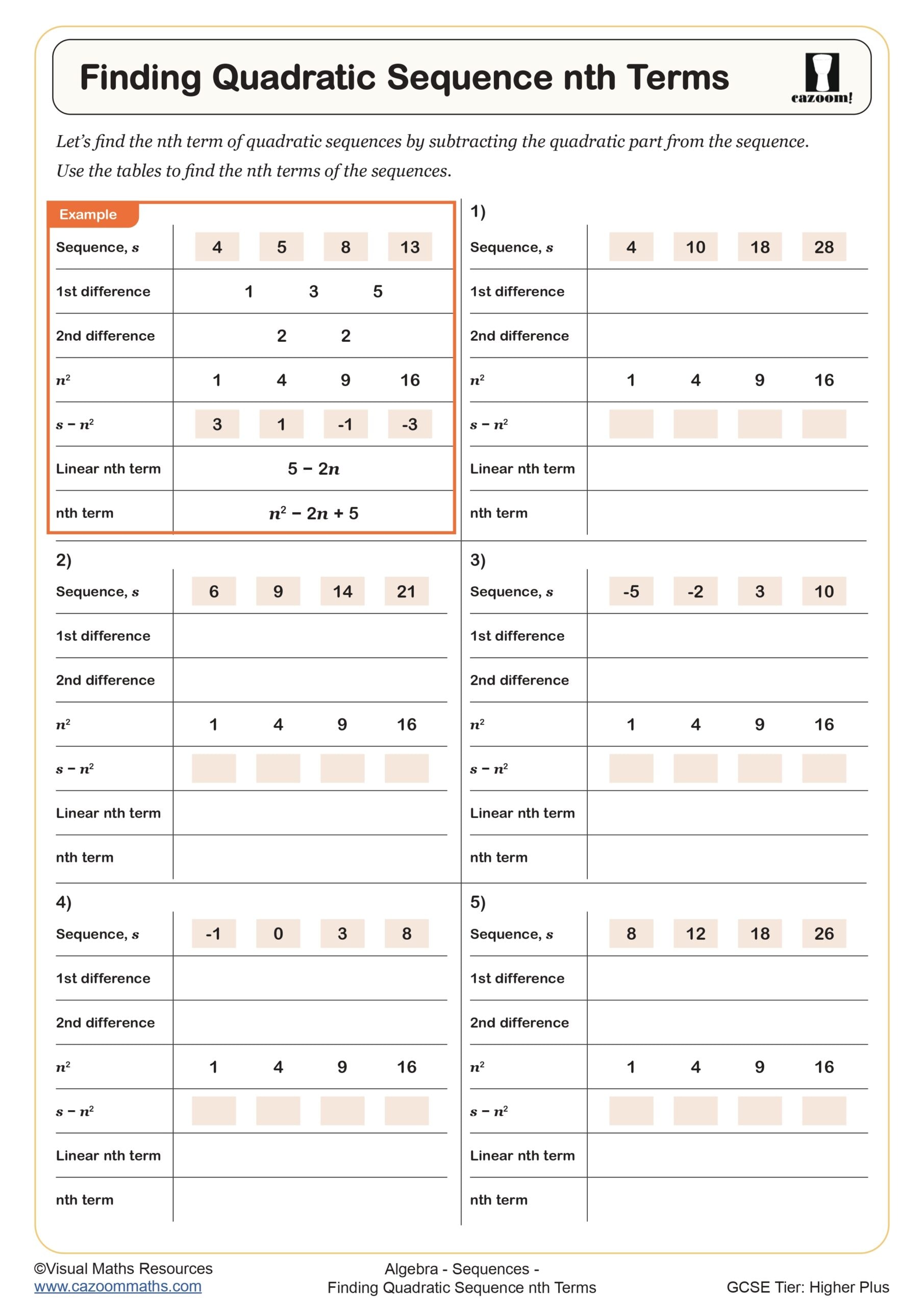
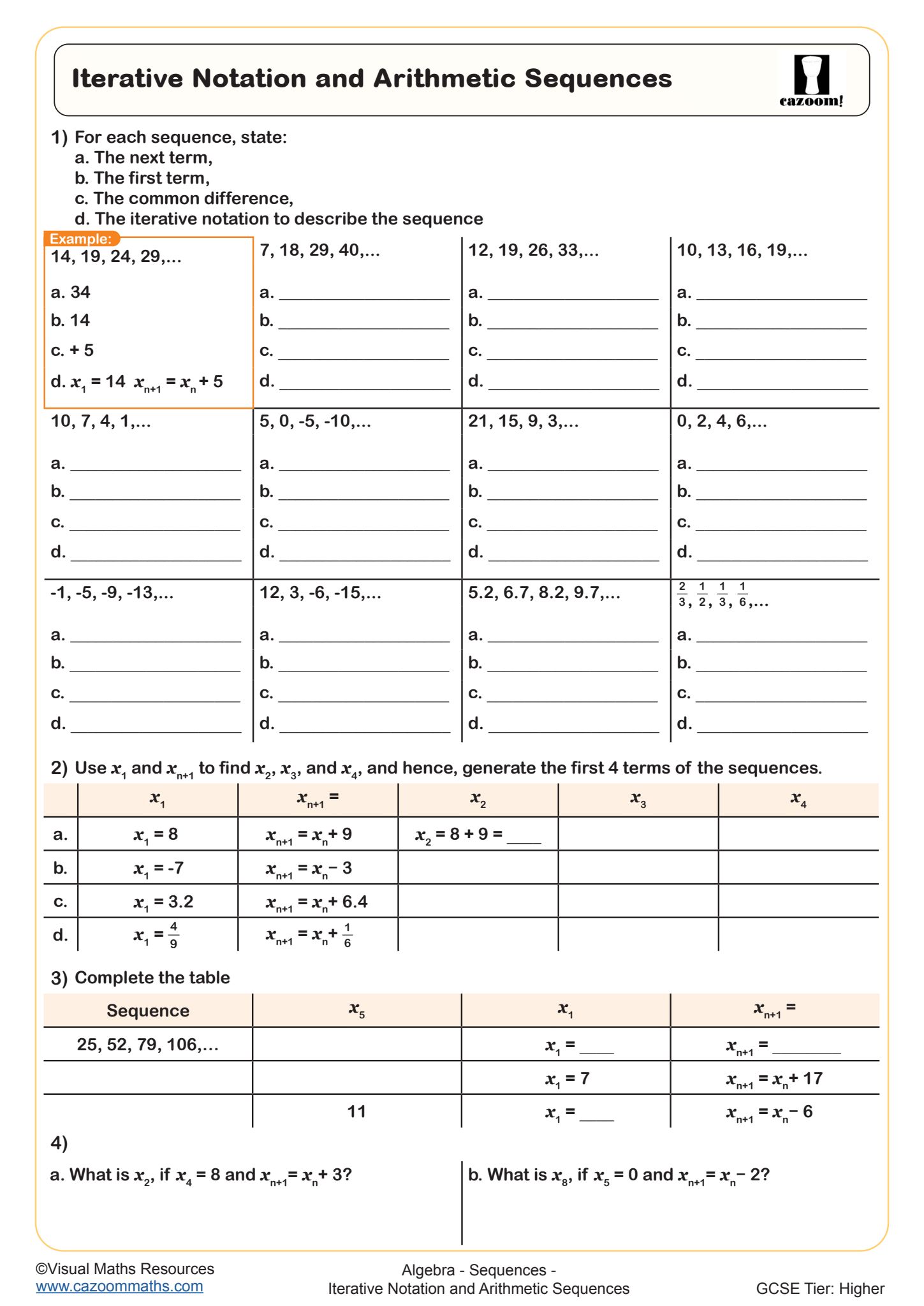
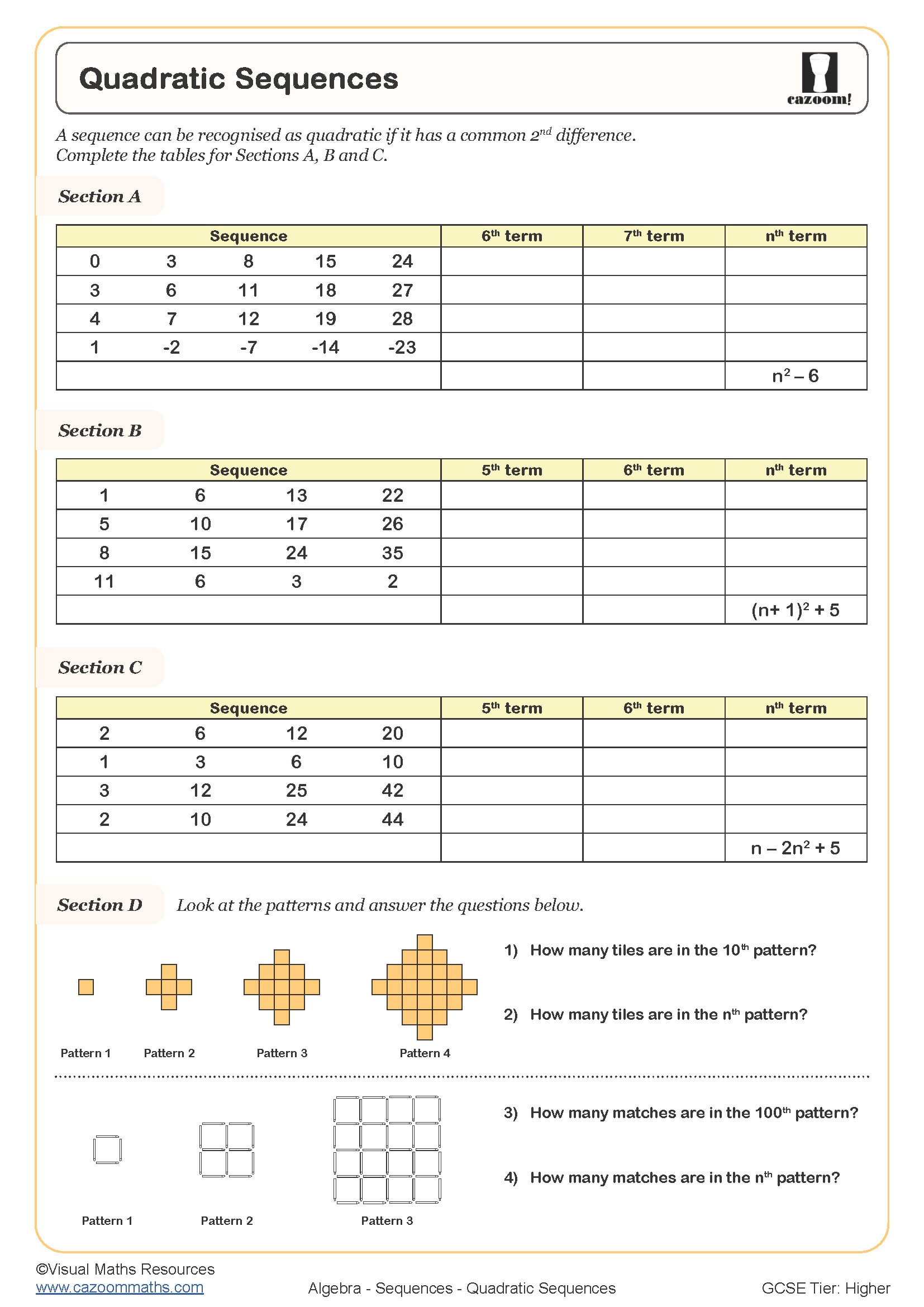
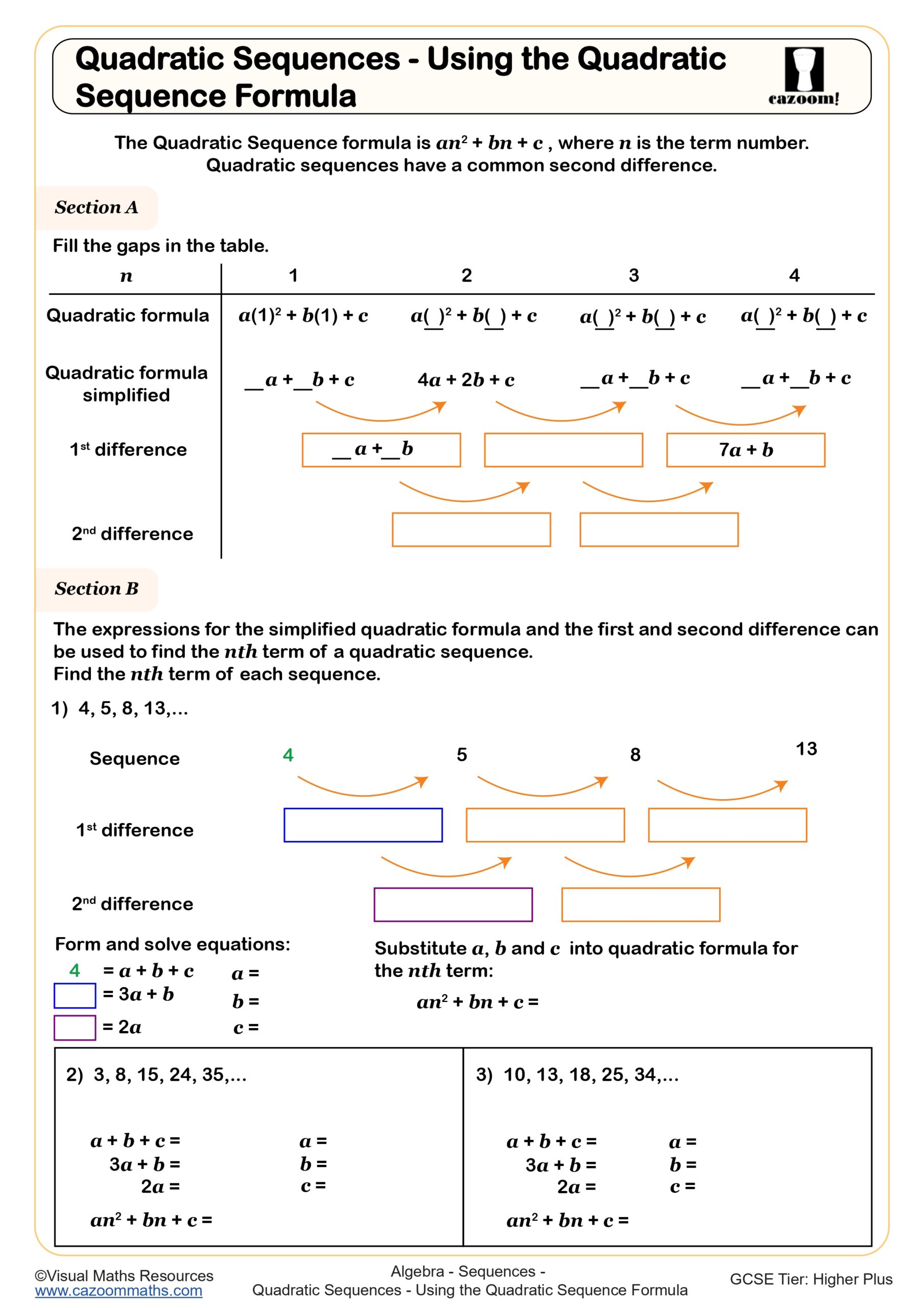
KS4 students work with arithmetic sequences (constant difference between terms), geometric sequences (constant multiplicative ratio), quadratic sequences (second difference is constant), and other sequences including Fibonacci-type patterns and alternating sequences. The National Curriculum requires students to generate terms, find the nth term rule, and use these formulas to solve problems, with higher tier students also working with geometric progression sums.
A common misconception occurs when students assume all sequences are arithmetic and simply add the same amount each time. Teachers often see this when students encounter the sequence 3, 6, 12, 24 and write the next term as 36 instead of 48, missing the doubling pattern entirely. Exam mark schemes specifically assess whether students can identify sequence type before applying the appropriate method, so recognising these patterns is as important as the calculation itself.
Which Year Groups Study Sequences at KS4?
These sequences worksheets cover content taught in Year 10 and Year 11 as part of the GCSE maths curriculum. Sequences appear in both foundation and higher tier papers, though the complexity differs significantly. Foundation students focus primarily on arithmetic sequences and simple quadratic patterns, whilst higher tier students must handle geometric sequences, prove general results, and work with more complex algebraic manipulation.
The progression across Year 10 and Year 11 involves moving from recognising patterns and finding specific terms to generating nth term formulas and solving inverse problems. By Year 11, students should determine whether given values belong to a sequence by forming and solving equations, connect sequences to straight-line graphs (where the term number is the x-coordinate), and handle sequences defined recursively where each term depends on the previous one.
How Do Geometric Sequences Work in GCSE Maths?
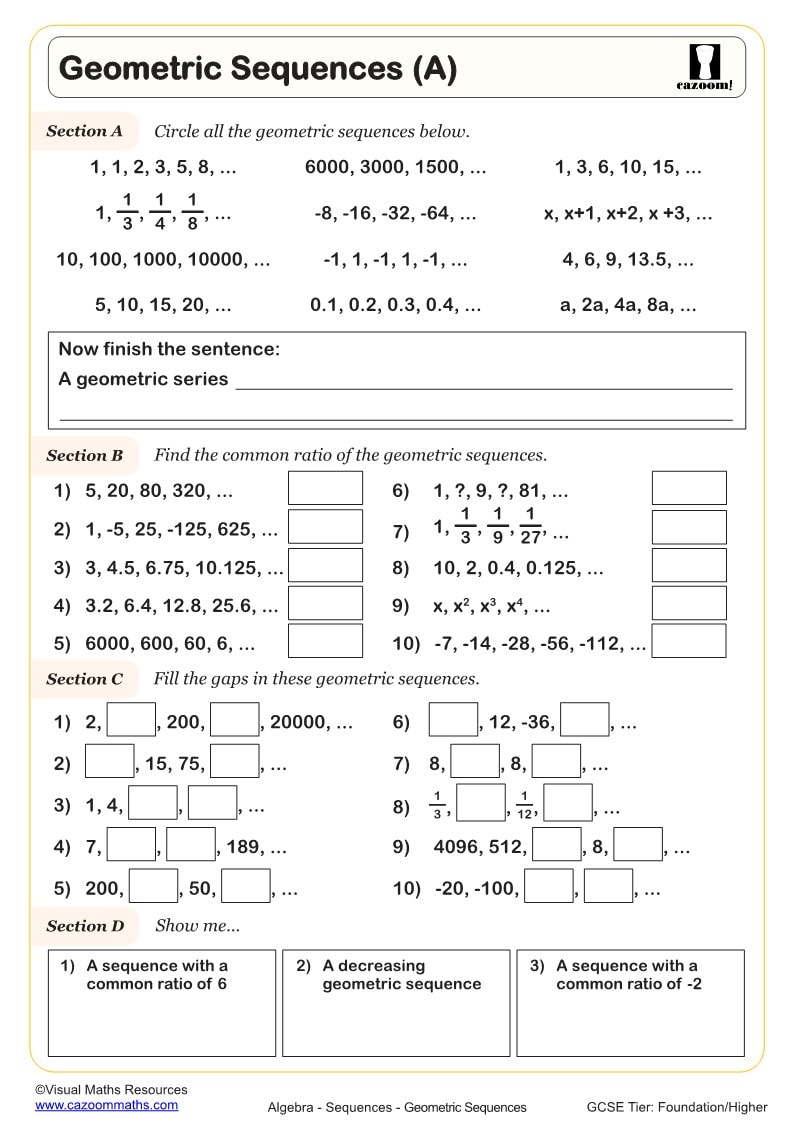
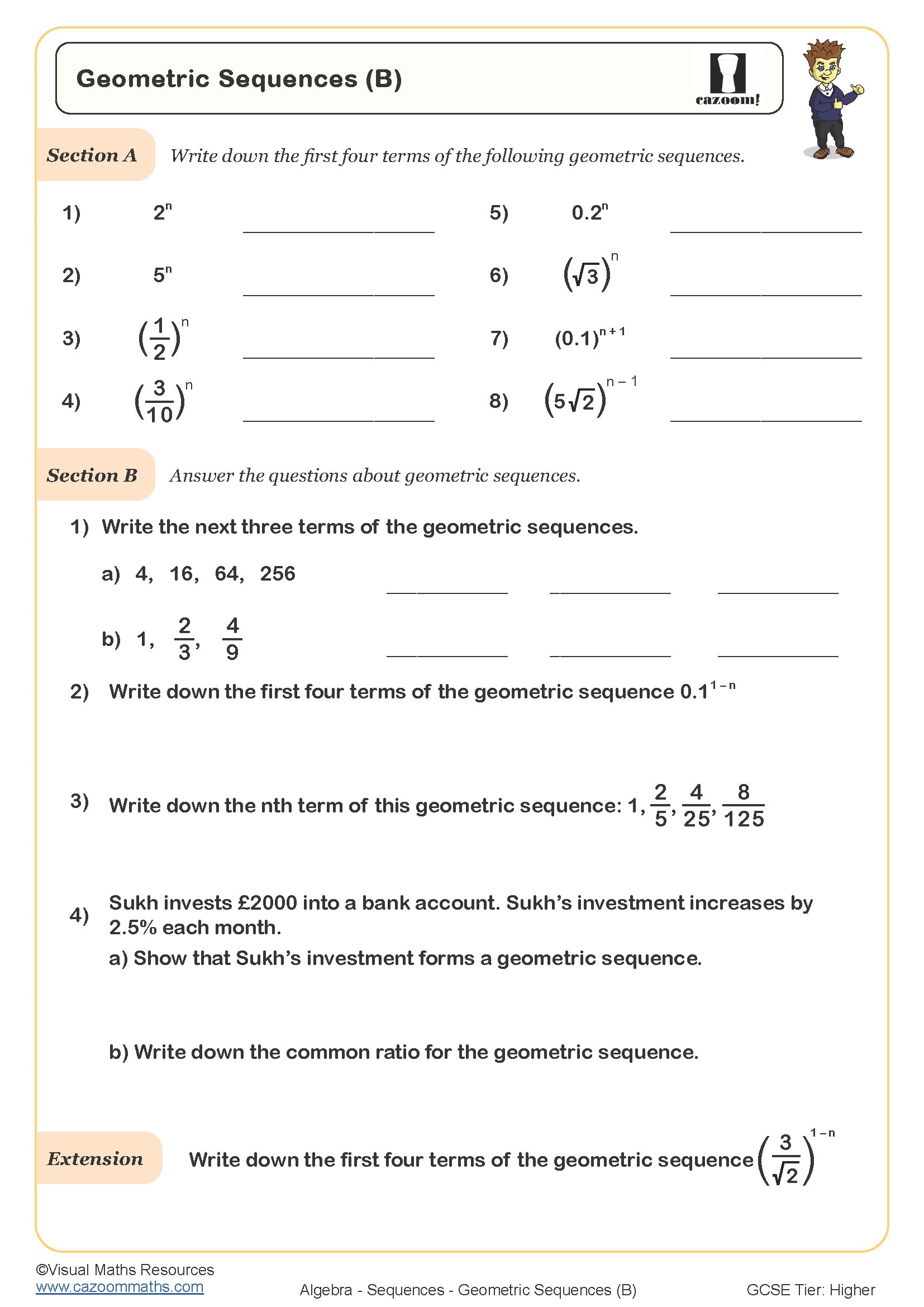
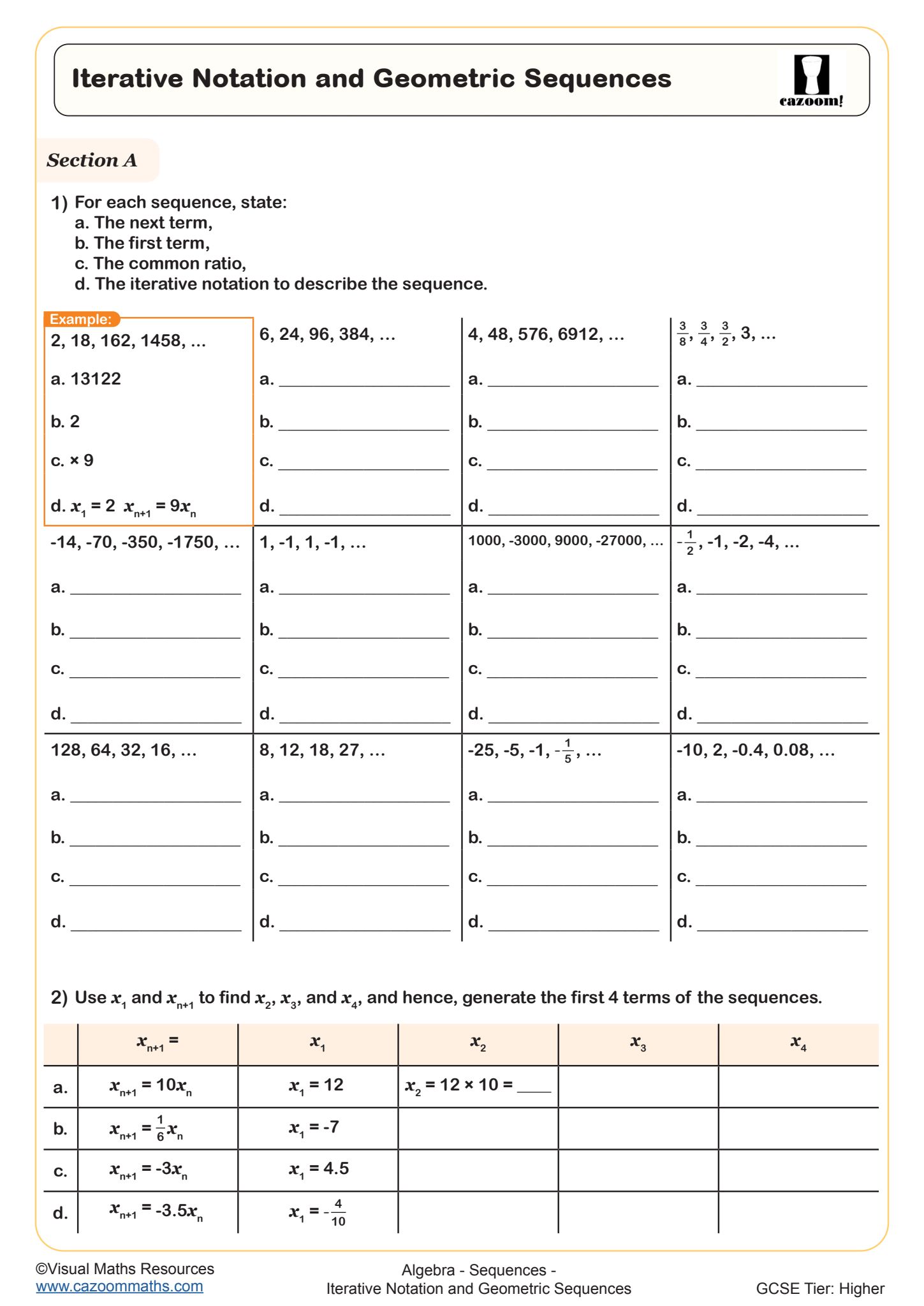
Geometric sequences multiply by a constant ratio between consecutive terms, unlike arithmetic sequences which add a constant difference. For example, in the sequence 5, 15, 45, 135, each term multiplies by 3. The nth term formula takes the form ar^(n-1), where 'a' is the first term and 'r' is the common ratio. Students must identify this ratio by dividing consecutive terms, then substitute values to find specific terms or work backwards to find how many terms reach a certain threshold.
Geometric sequences model exponential growth and decay in real-world contexts including compound interest calculations, population growth in biology, and radioactive decay in physics. Understanding that the ratio remains constant helps students recognise when situations involve repeated percentage changes rather than fixed amounts, such as calculating how bacteria colonies double every hour or how medication concentration halves in the bloodstream over time, connecting abstract algebra to practical STEM applications.
How Can Teachers Use These Sequences Worksheets Effectively?
The worksheets build skills progressively within each sequence type, starting with term-to-term rules before moving to position-to-term (nth term) formulas. This scaffolding helps students see the connection between recursive patterns and algebraic generalisation. Answer sheets allow students to self-assess during independent practice, particularly useful when working through the algebraic manipulation required for finding nth term rules where intermediate steps matter as much as final answers.
Many teachers use these worksheets for targeted intervention with students who struggle to distinguish between sequence types, setting up sorting activities where students classify sequences before solving them. The resources work well for homework following initial teaching, as paired work where students explain their reasoning to each other, or as low-stakes retrieval practice at lesson starts. Because sequences questions often combine multiple skills (substitution, solving equations, simplifying expressions), they provide useful revision that reinforces broader algebraic competence without feeling repetitive.