KS4 Simplification Worksheets
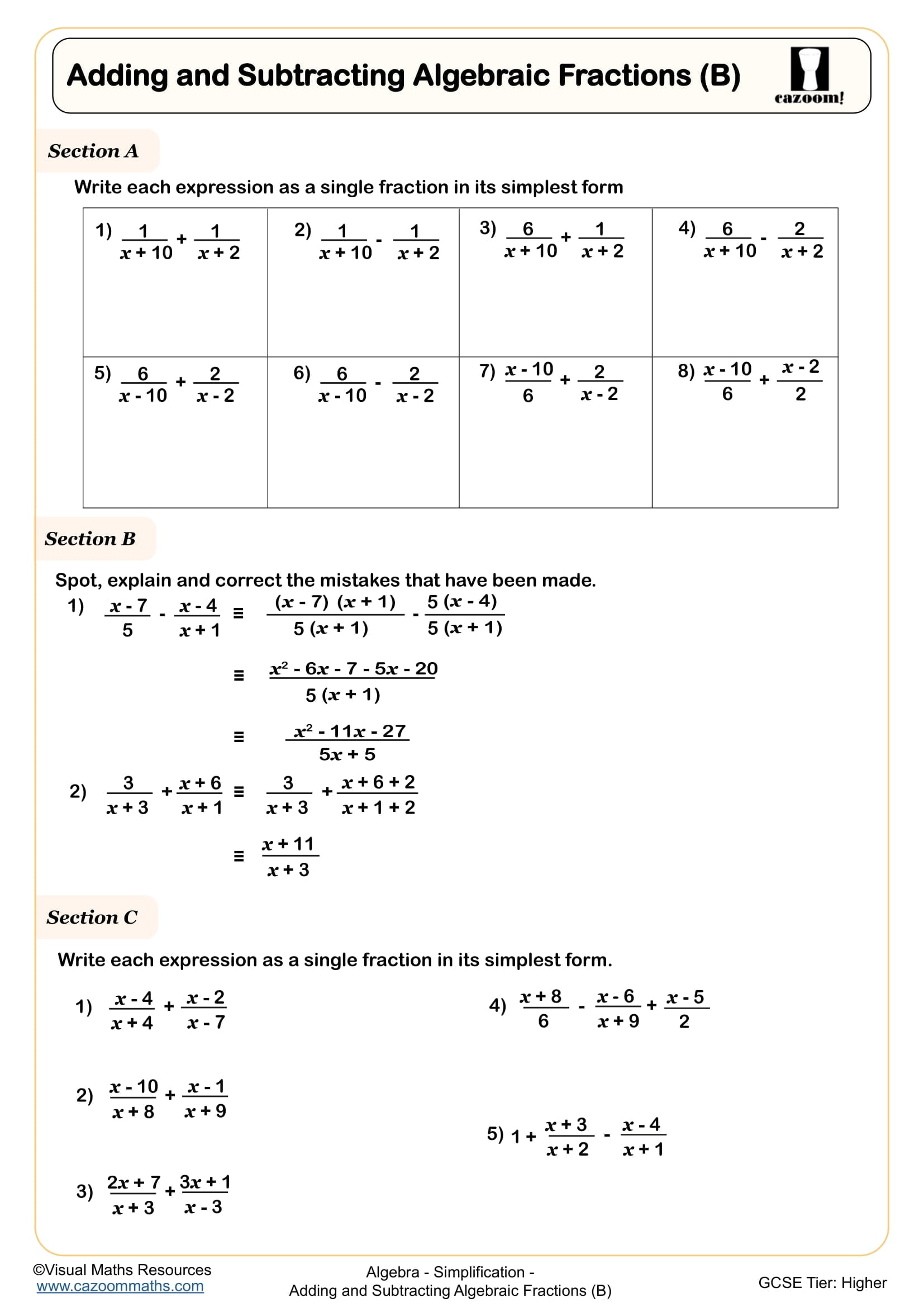
Add and Subtract Algebraic Fractions (B)
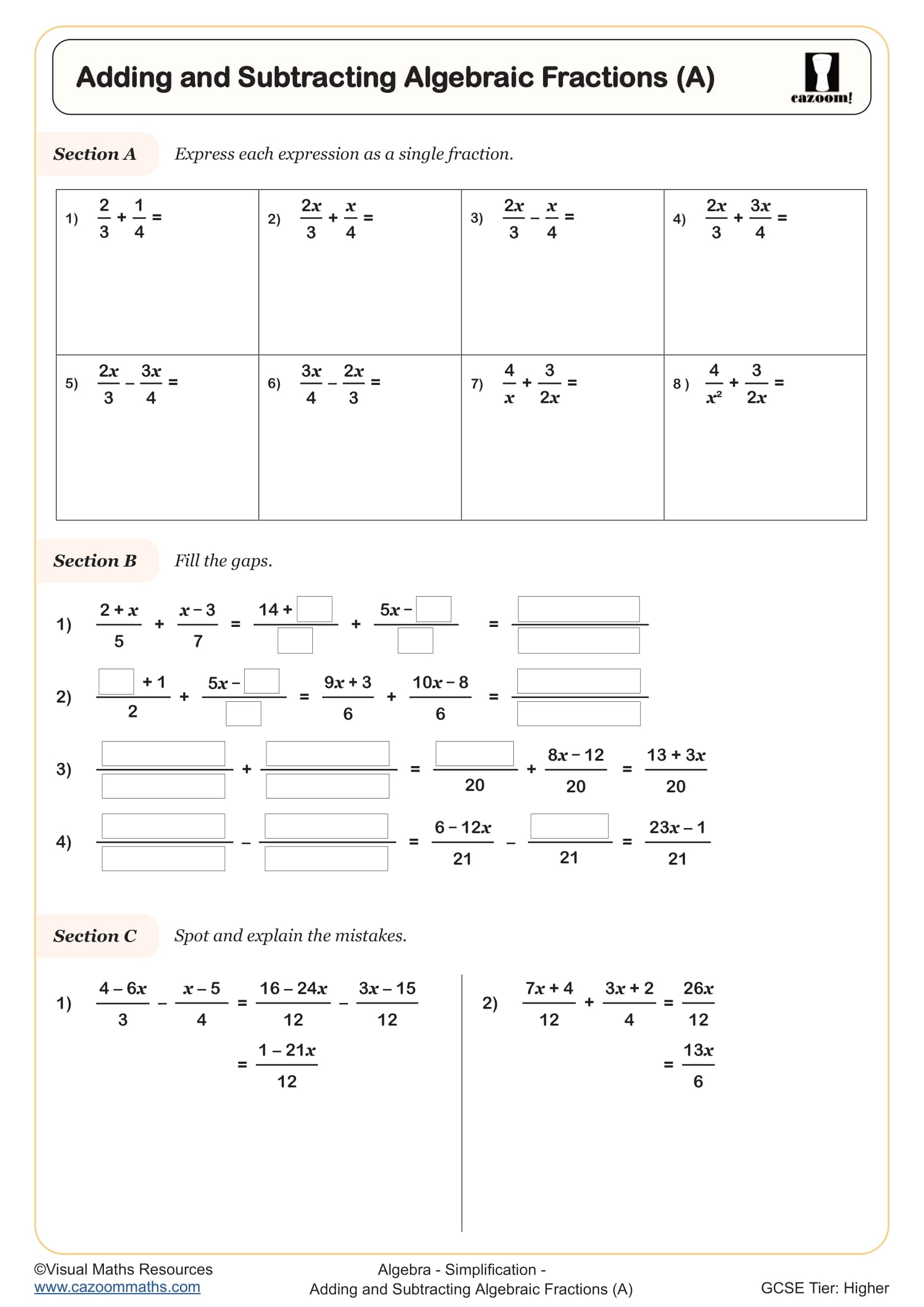
Adding and Subtracting Algebraic Fractions (A)
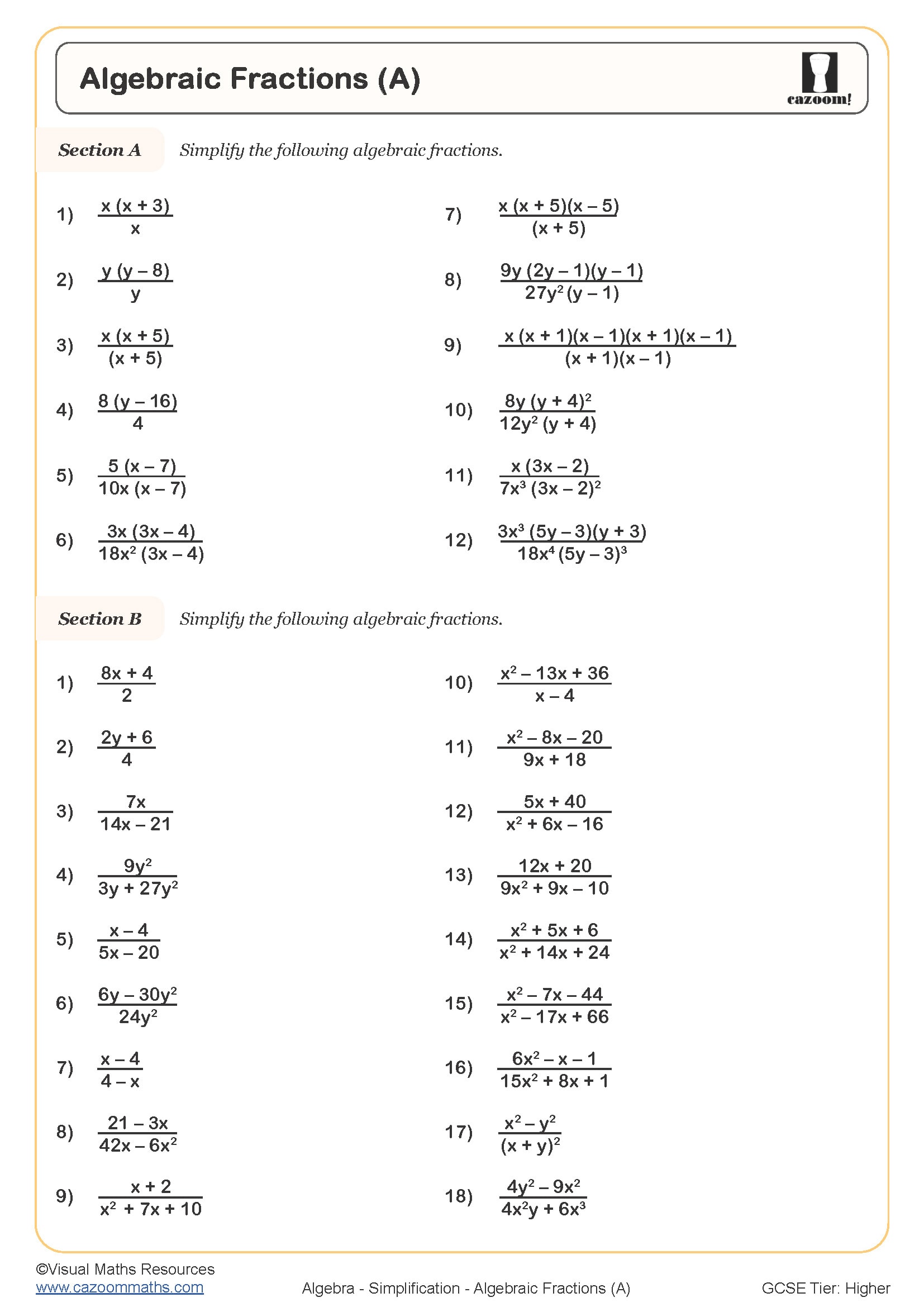
Algebraic Fractions (A)
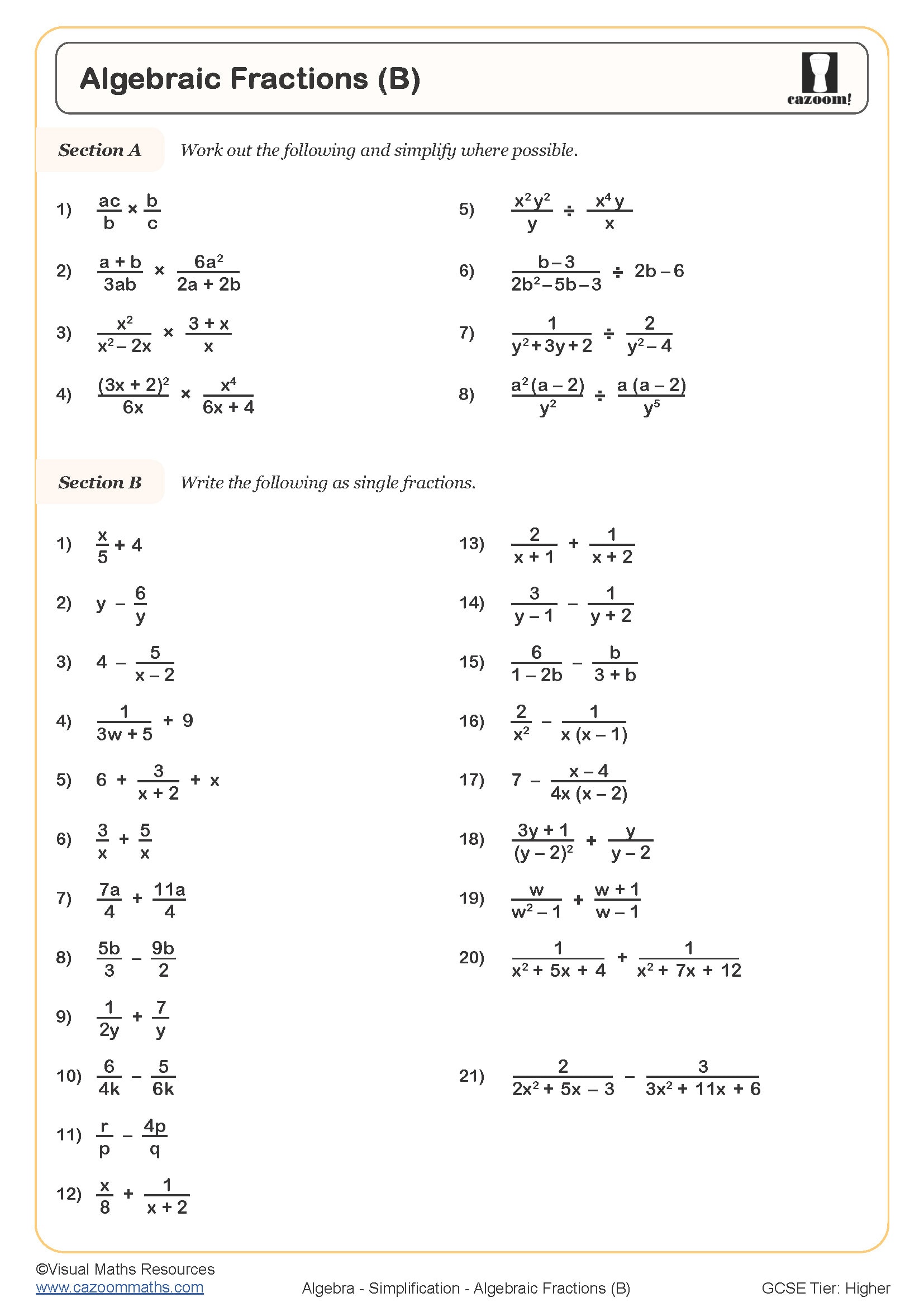
Algebraic Fractions (B)
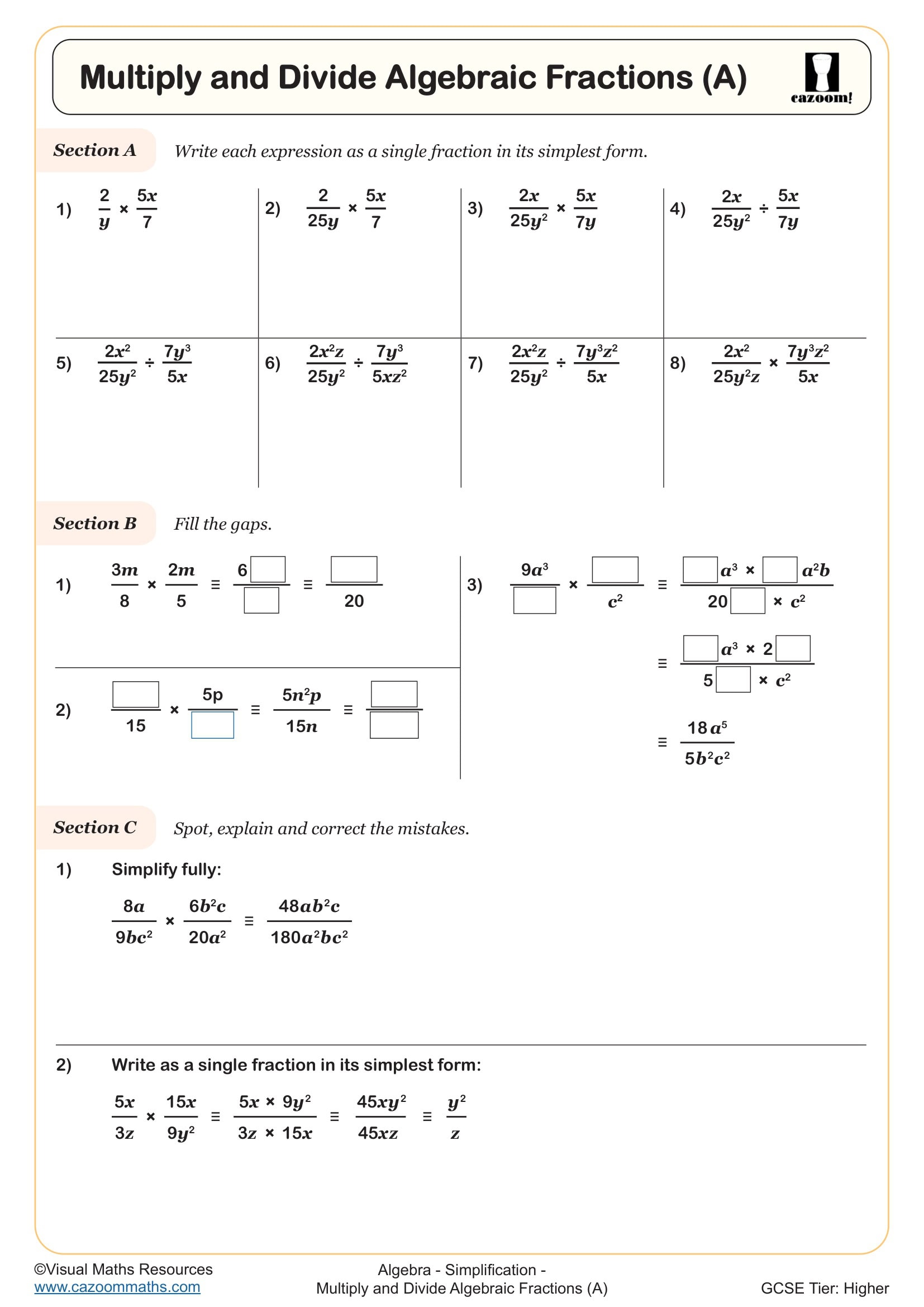
Multiply and Divide Algebraic Fractions (A)
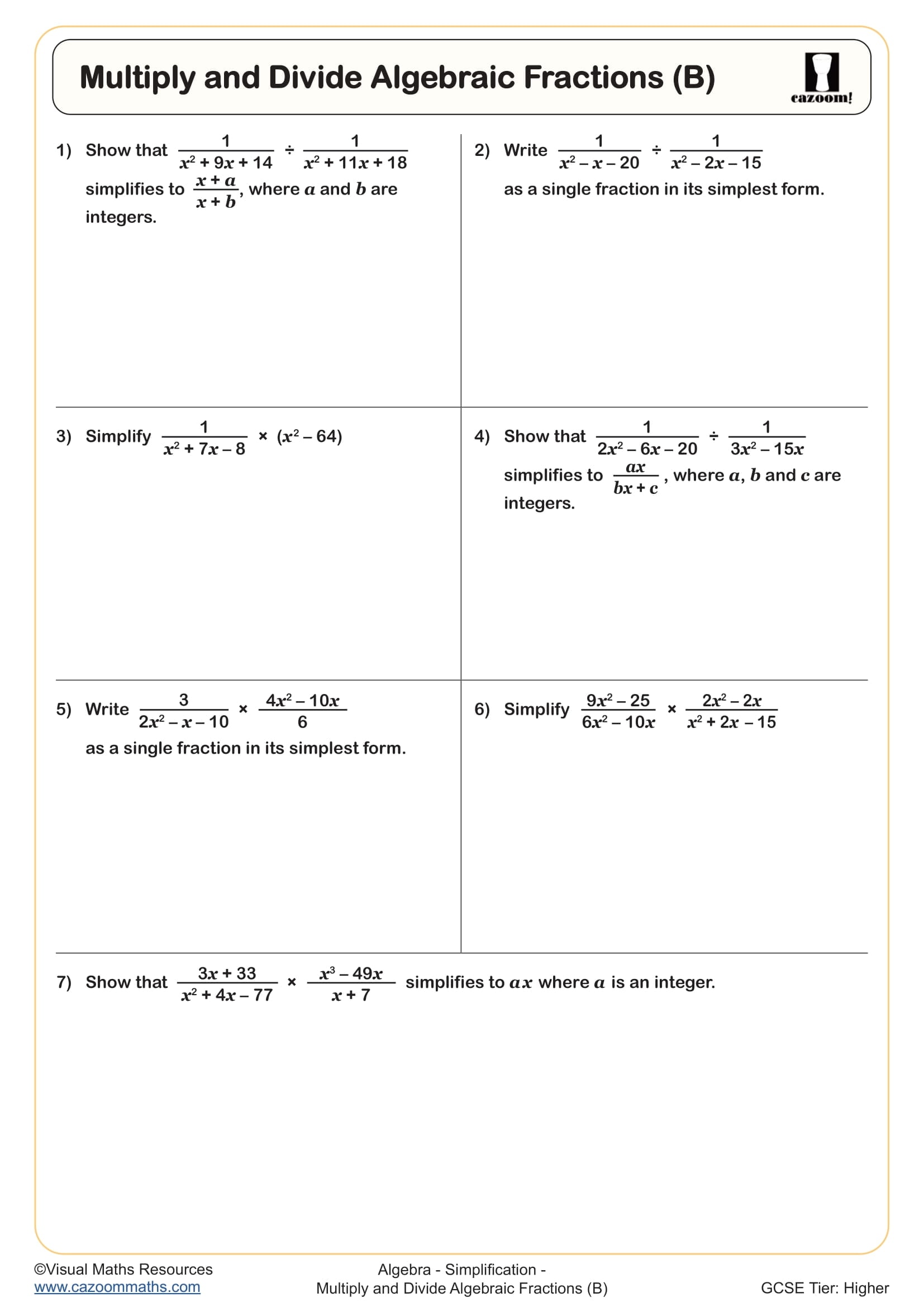
Multiply and Divide Algebraic Fractions (B)
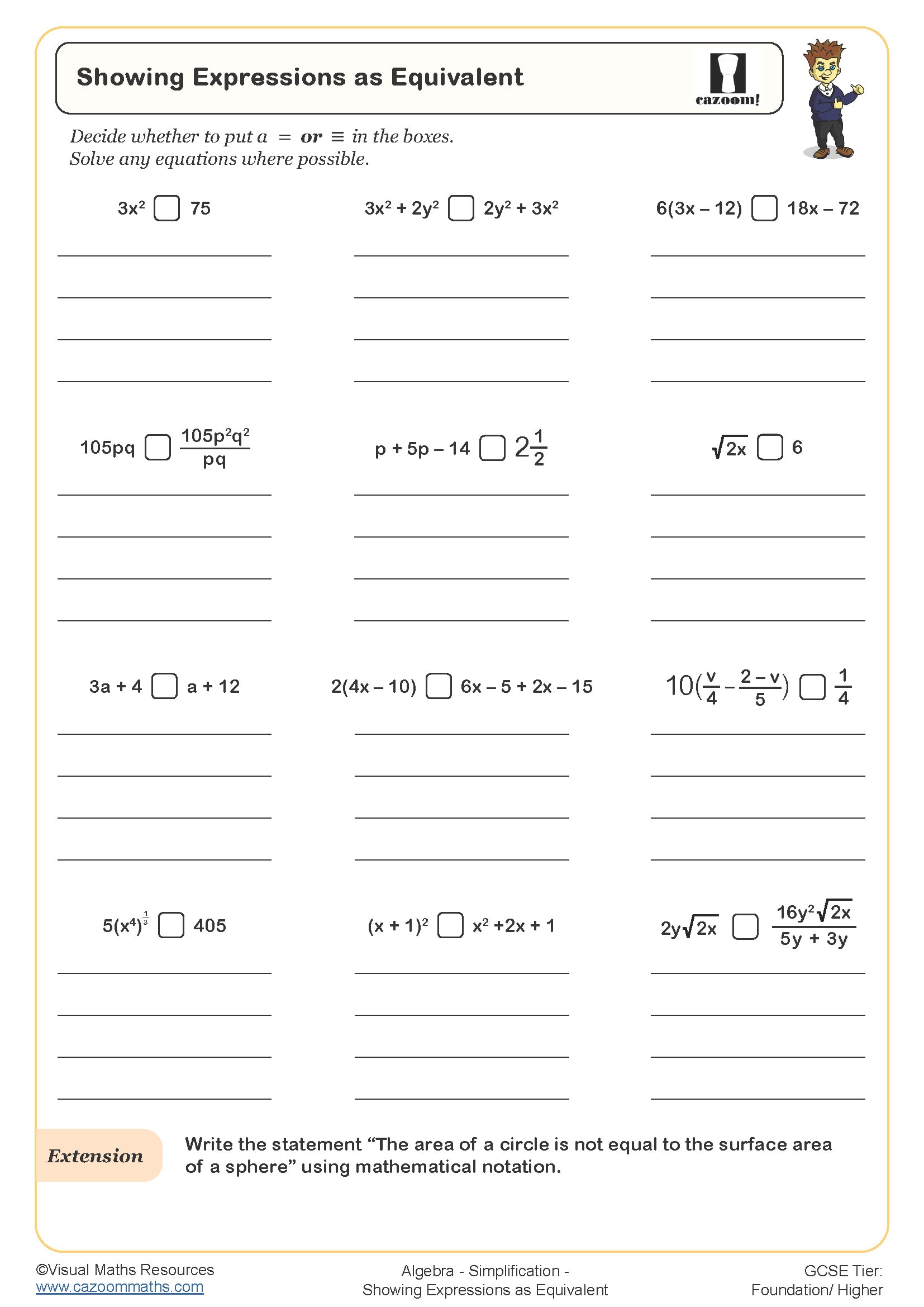
Showing Expressions as Equivalent
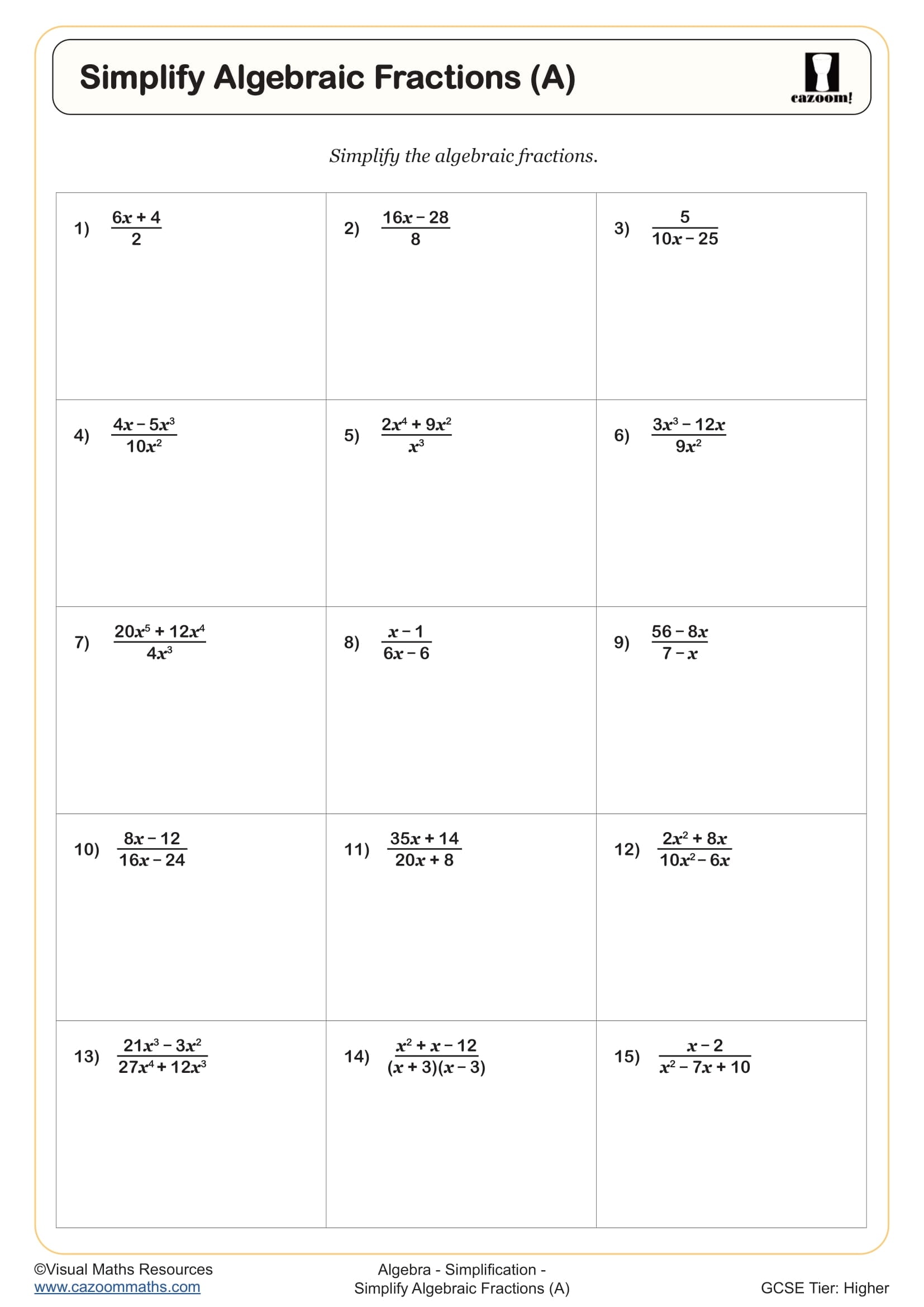
Simplify Algebraic Fractions (A)
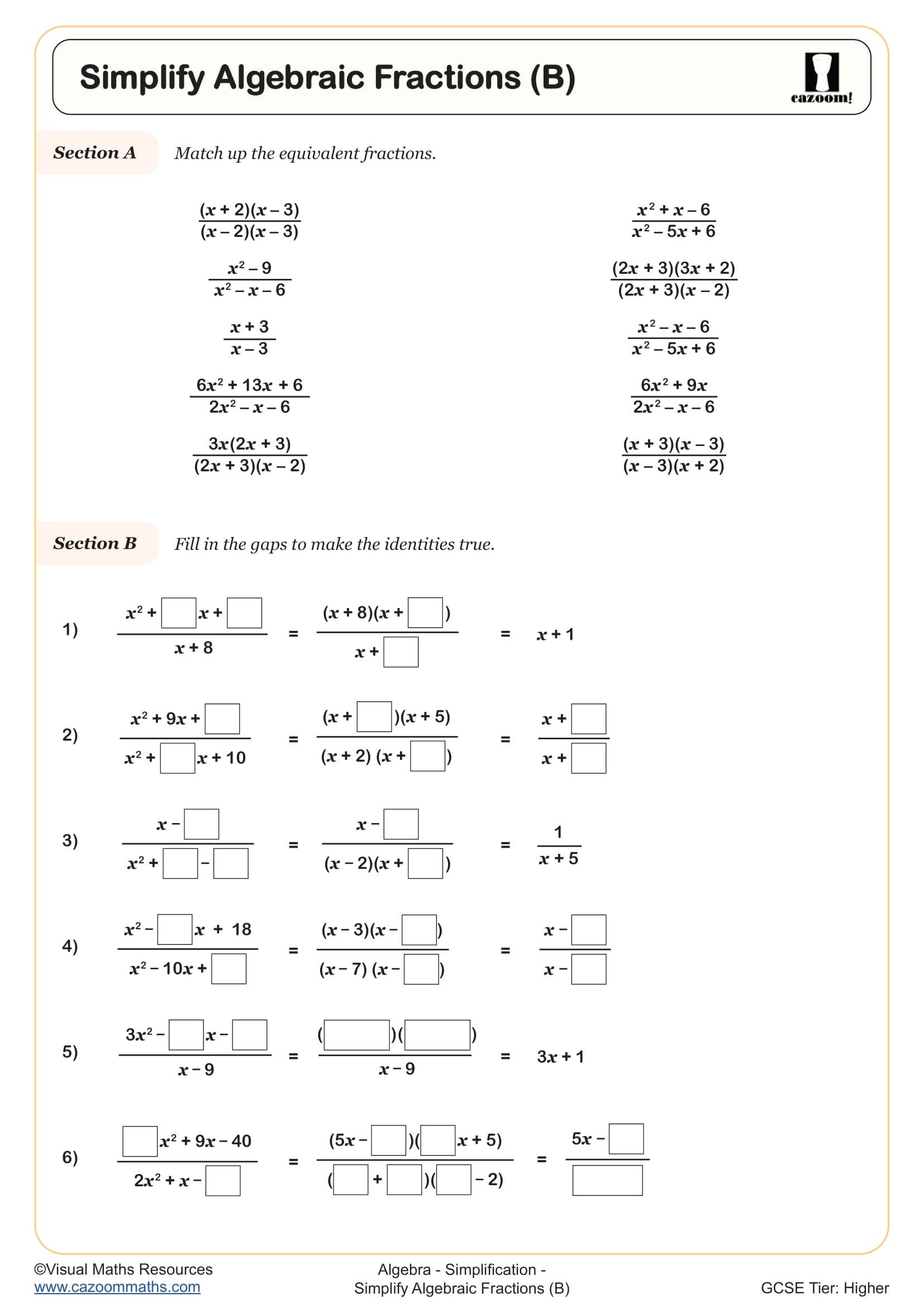
Simplify Algebraic Fractions (B)
All worksheets are created by the team of experienced teachers at Cazoom Maths.
What does simplification mean in GCSE maths?
Simplification in GCSE maths refers to writing algebraic expressions in their most concise form by combining like terms, applying index laws, and reducing fractions. At KS4, this extends beyond basic term collection to include manipulating expressions with negative and fractional coefficients, simplifying surds, and working with algebraic fractions where students must factorise before cancelling.
A common error occurs when students try to combine terms that aren't like terms, such as attempting to simplify 3x + 5y into 8xy. Exam mark schemes consistently penalise this, particularly in questions worth 2-3 marks where the method mark depends on correct identification of like terms. Students also lose marks when they simplify correctly but fail to show intermediate steps, which examiners need to award partial credit.
Which year groups study simplification?
These simplification worksheets are designed for Year 10 and Year 11 students following the GCSE curriculum. Simplification appears throughout KS4, underpinning topics like solving equations, rearranging formulae, and working with quadratic expressions. It's assessed across both Foundation and Higher tier papers, though the complexity differs significantly between tiers.
Progression from Year 10 to Year 11 typically involves increasing the number of terms and introducing more complex coefficients. Year 10 work focuses on building confidence with basic simplification and index laws, whilst Year 11 materials incorporate algebraic fractions and nested brackets that require multiple simplification steps. Higher tier students encounter expressions involving surds and negative indices that demand secure understanding of all simplification rules.
How do you simplify expressions with indices?
Simplifying expressions with indices requires applying the multiplication and division laws: when multiplying terms with the same base, add the powers (x³ × x⁵ = x⁸); when dividing, subtract the powers (x⁷ ÷ x² = x⁵). Students must also recognise that x⁰ = 1 and handle negative indices by understanding x⁻ⁿ = 1/xⁿ. Teachers often find that students apply these rules mechanically without understanding why they work, leading to errors with expressions like (x²)³ where they might add rather than multiply the powers.
Index laws are fundamental in scientific notation, crucial for STEM subjects where students handle very large or small quantities. In physics, simplifying expressions like (2 × 10⁵) × (3 × 10⁻²) requires confident application of index laws. Engineering calculations involving electrical resistance or compound interest in economics similarly depend on manipulating expressions with powers, making this skill essential beyond the maths classroom.
How can these worksheets support GCSE preparation?
The worksheets provide structured practise with questions that gradually increase in demand, mirroring the progression seen in GCSE papers. Each sheet includes worked examples that demonstrate clear algebraic method, helping students understand the expected standard of working. The answer sheets show complete solutions rather than just final answers, allowing students to identify exactly where their method differs if they've made errors.
Many teachers use these sheets for targeted intervention with students who lose marks on algebra questions despite understanding the underlying concepts. They work well for homework when practising specific techniques before assessments, and as starter activities to maintain fluency with simplification throughout Year 11. Paired work is particularly effective, with students checking each other's working against the answer sheets and discussing where mistakes occur, building the error-spotting skills that improve exam performance.