KS4 Substitution Worksheets
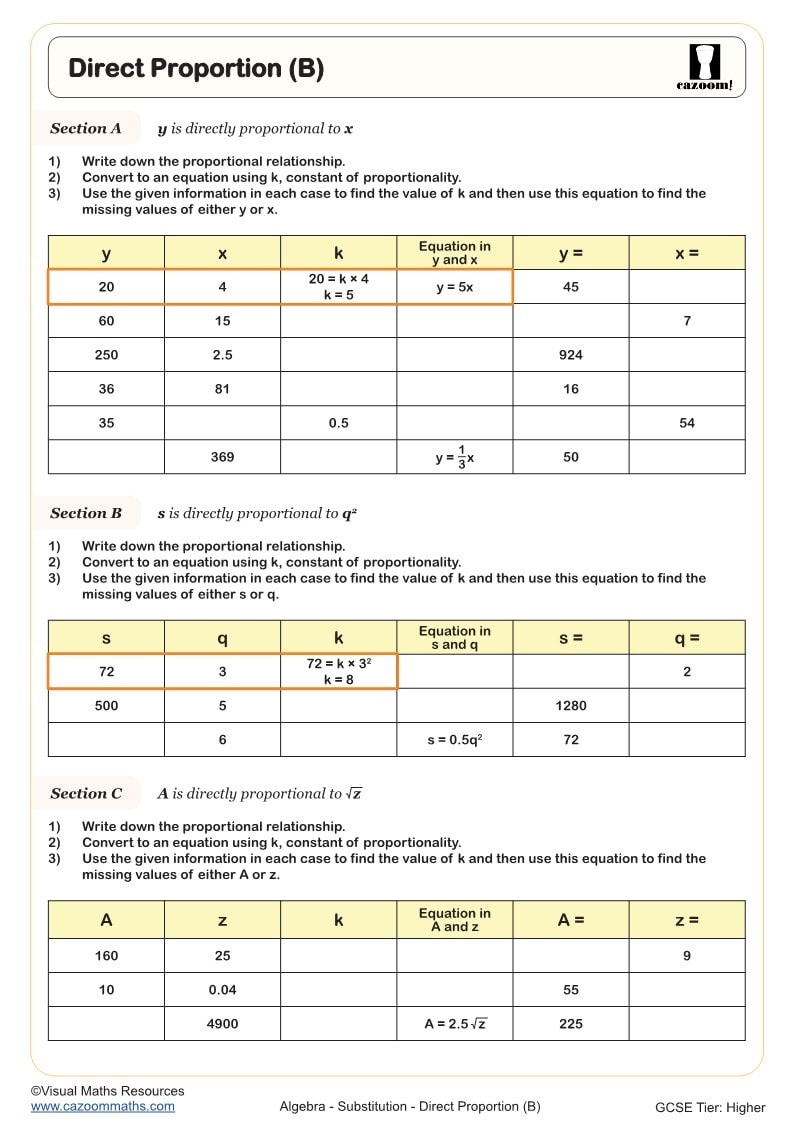
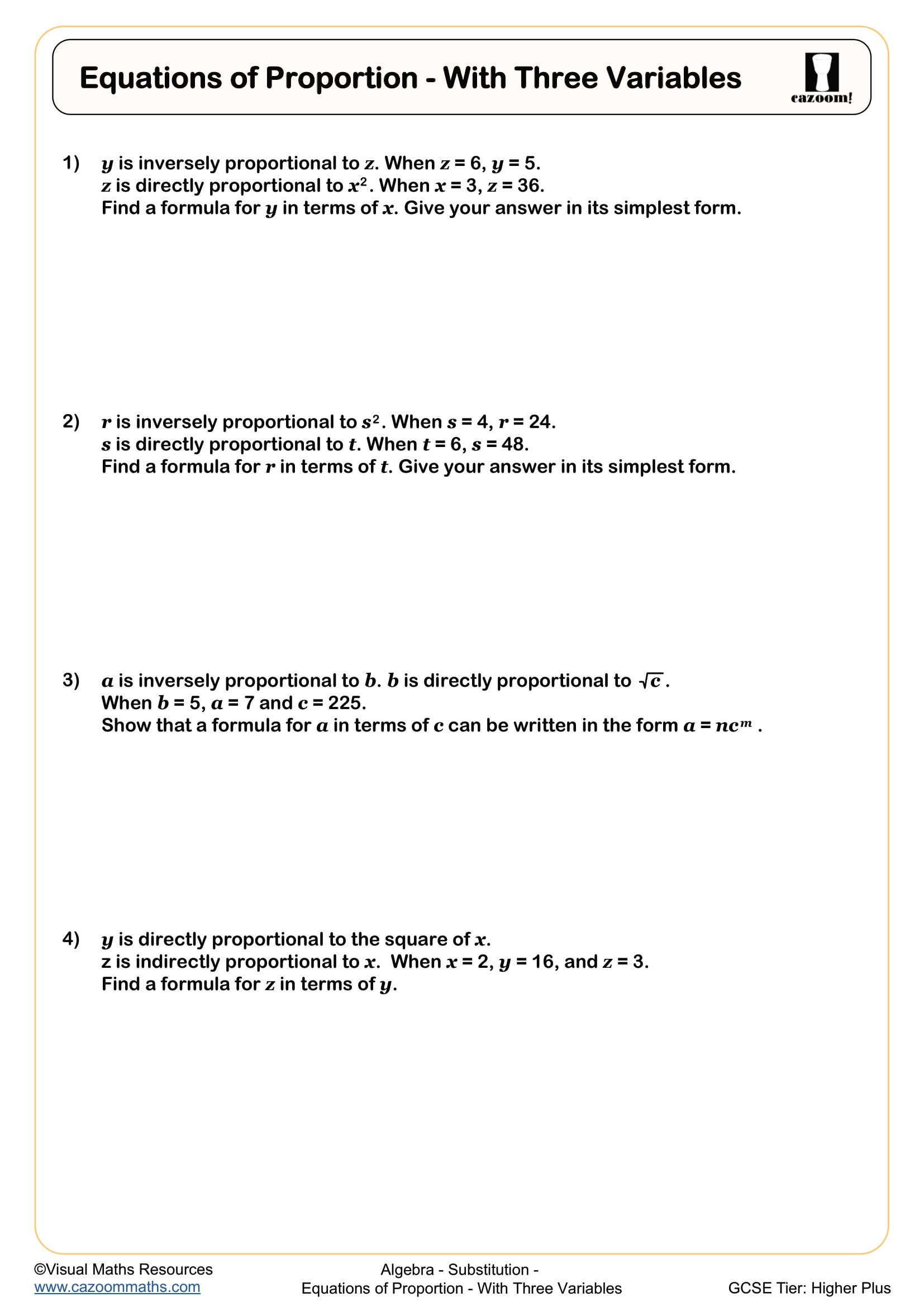
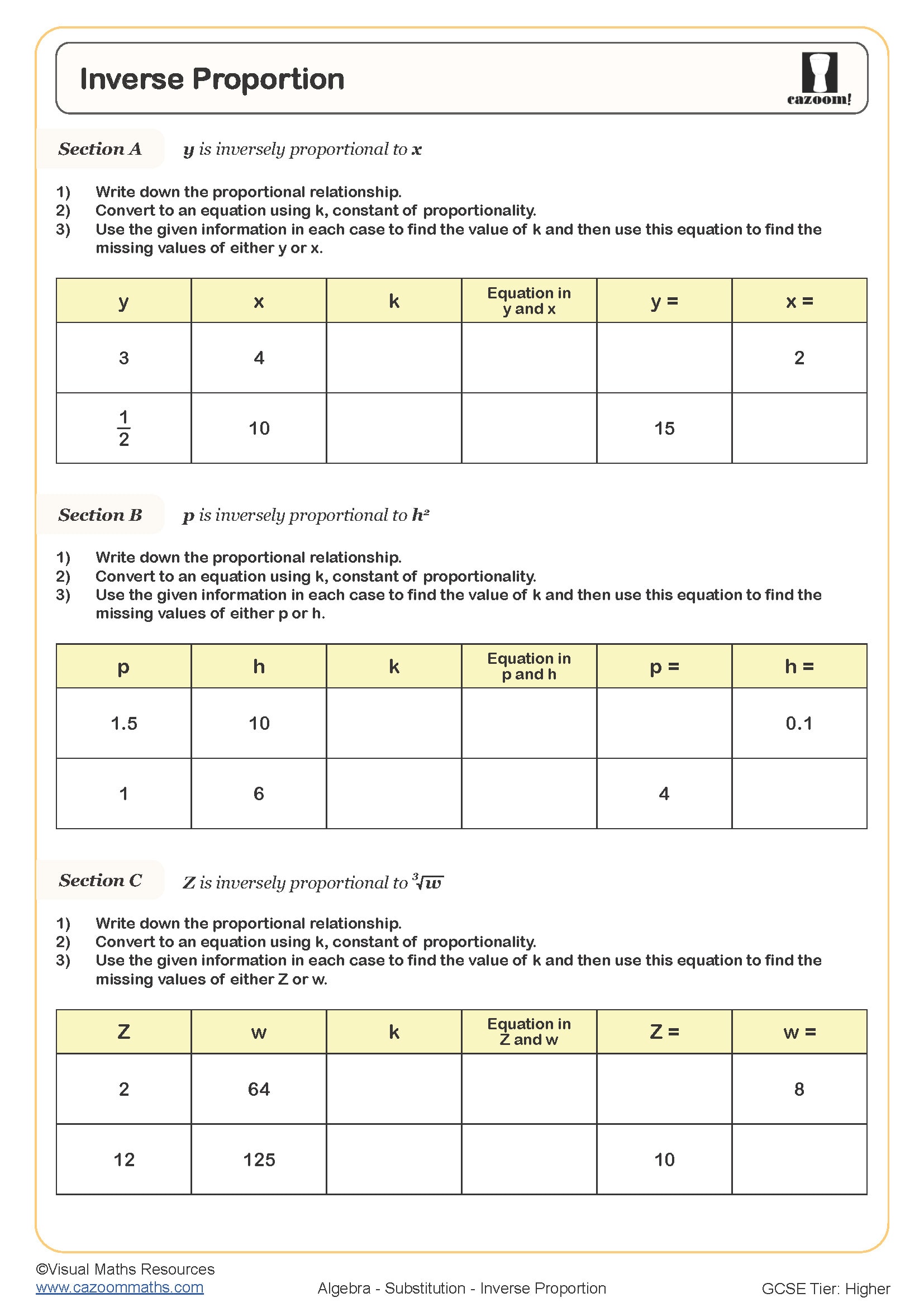
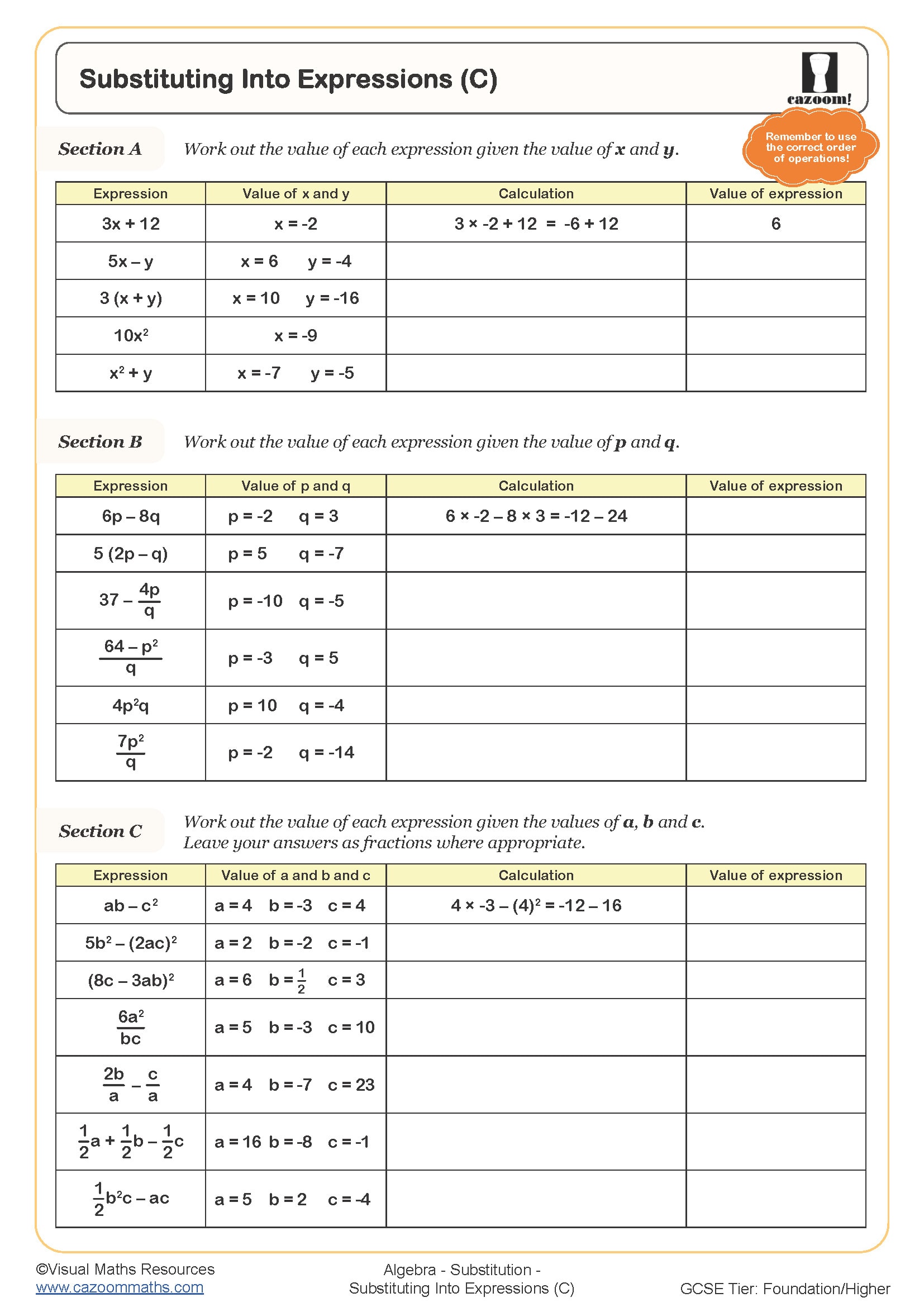
All worksheets are created by the team of experienced teachers at Cazoom Maths.
What is substitution in maths and why do students find it challenging?
Substitution in maths means replacing letters (variables) in an algebraic expression or formula with given numerical values, then calculating the result following the correct order of operations. At KS4, this extends beyond simple linear expressions to include quadratic terms, negative indices, fractions, and formulae from other subjects like science.
Students typically lose marks when they forget to apply BIDMAS correctly after substitution, particularly with expressions like 3x² when x = -2. Many incorrectly calculate 3 × -2² as -12 rather than 12, missing that the square applies only to the 2, not the product. Teachers also observe confusion when substituting into expressions with subtraction: substituting a = -3 into 5 - 2a often becomes 5 - 2 × -3 = -1 instead of the correct 11, because students don't recognise that subtracting a negative creates addition.
Which year groups study substitution at KS4?
Substitution appears in both Year 10 and Year 11, building on foundations from KS3 where students first encounter the concept with simple linear expressions. At KS4, the National Curriculum expects students to substitute values into increasingly complex formulae, including those with multiple variables, powers, and fractional terms, preparing them for both Foundation and Higher tier GCSE papers.
The progression across Year 10 and Year 11 focuses on complexity and application. Year 10 typically consolidates substitution into quadratic expressions and subject-specific formulae (such as kinematic equations in science), while Year 11 revision emphasises exam-style questions that combine substitution with rearranging, simultaneous equations, or iterative methods. Higher tier students also encounter substitution in proof questions and when verifying solutions to equations.
How does substitution connect to real-world applications?
Substitution allows students to use formulae as practical tools rather than abstract notation. Any formula in science, engineering, or finance requires substitution to generate actual values: calculating electrical resistance using R = V/I, determining stopping distances with kinematic formulae, or finding compound interest from A = P(1 + r)ⁿ all depend on accurate substitution of known values.
In STEM careers, substitution underpins spreadsheet modelling, computer programming, and engineering calculations. A civil engineer calculating load-bearing capacity substitutes measurements into structural formulae; a data analyst substitutes variables into statistical models to generate predictions. When students recognise substitution as the bridge between theoretical formulae and practical answers, they understand why accuracy with negative numbers and order of operations matters beyond the maths classroom—a single sign error in a construction calculation could have serious real-world consequences.
How can teachers use these substitution worksheets effectively in the classroom?
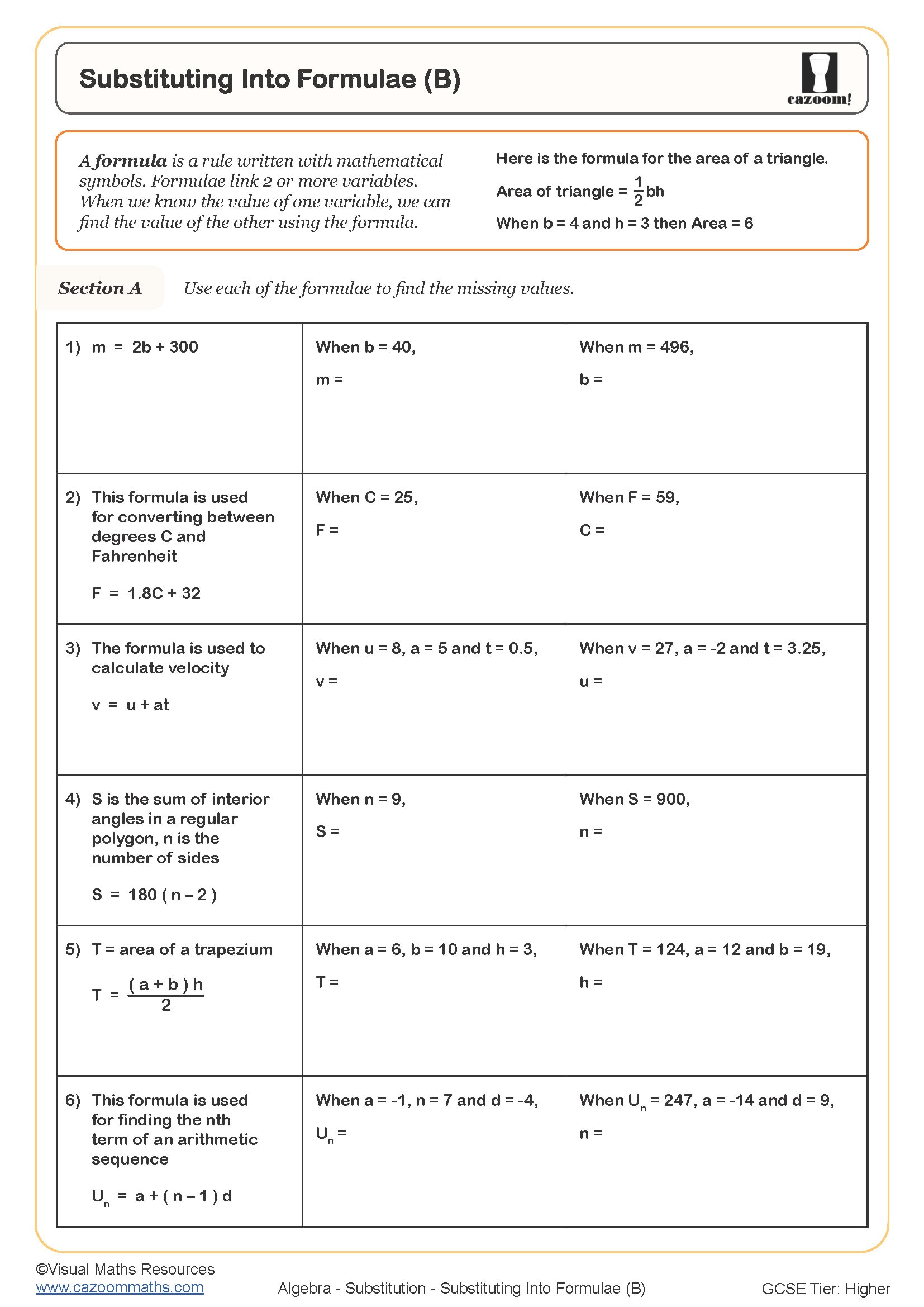
The worksheets provide structured practice that builds from straightforward single-variable substitution through to multi-step problems involving brackets, powers, and negative values. Answer sheets allow students to self-check their working, helping them identify whether errors stem from incorrect substitution or miscalculation during the order of operations—a distinction that's important for targeted improvement.
Many teachers use these resources for starters to activate prior knowledge before tackling equation-solving or formula rearrangement, since fluency in substitution is prerequisite for checking solutions. They work well as intervention materials for students who struggle with algebraic manipulation, offering a concrete entry point where letters have defined values. The worksheets also suit homework tasks that complement science lessons using formulae, or revision sessions where students need repeated practice with expressions involving indices and negative numbers before mock exams.