KS4 Trigonometry Worksheets
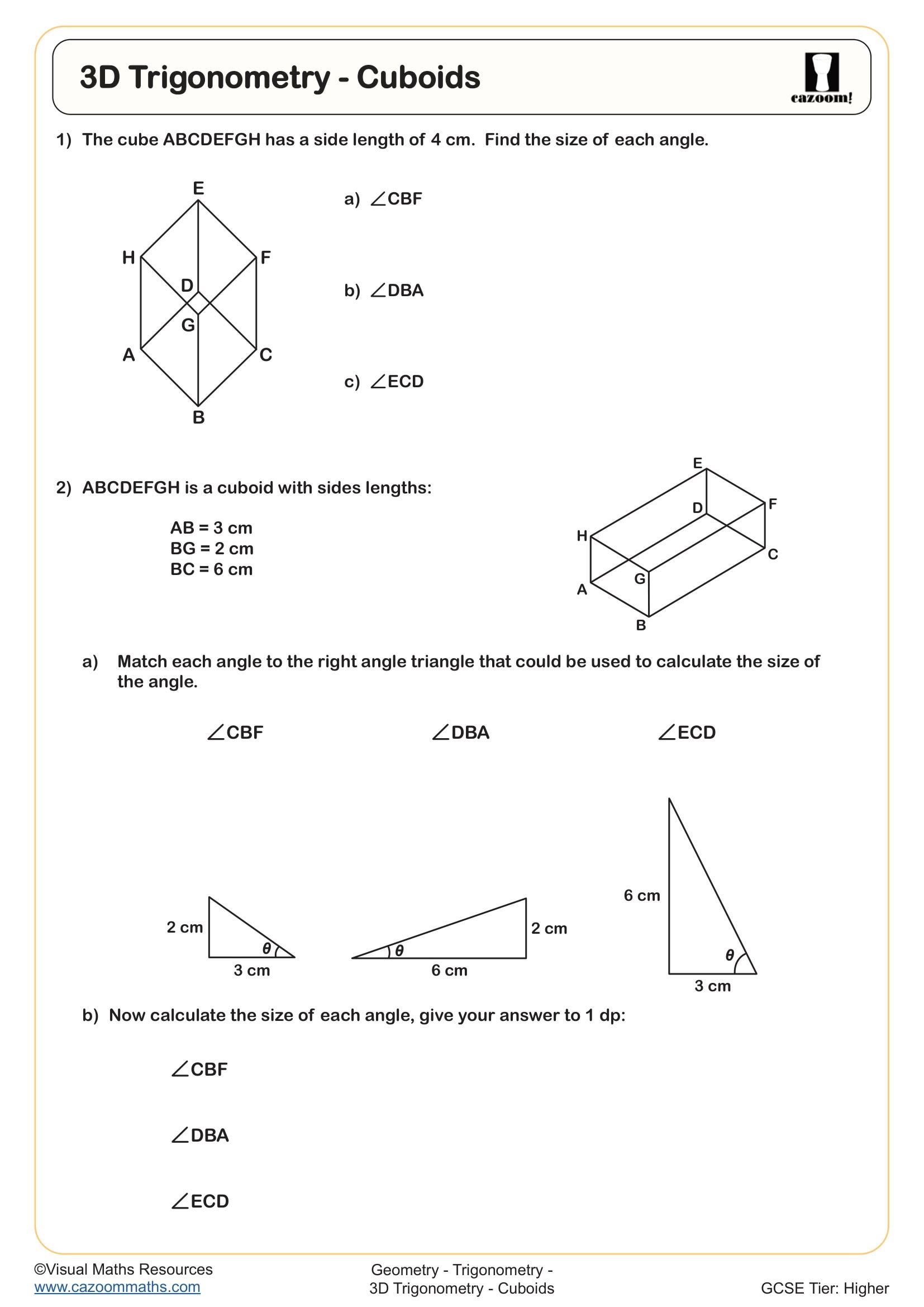
3D Trigonometry - Cuboids
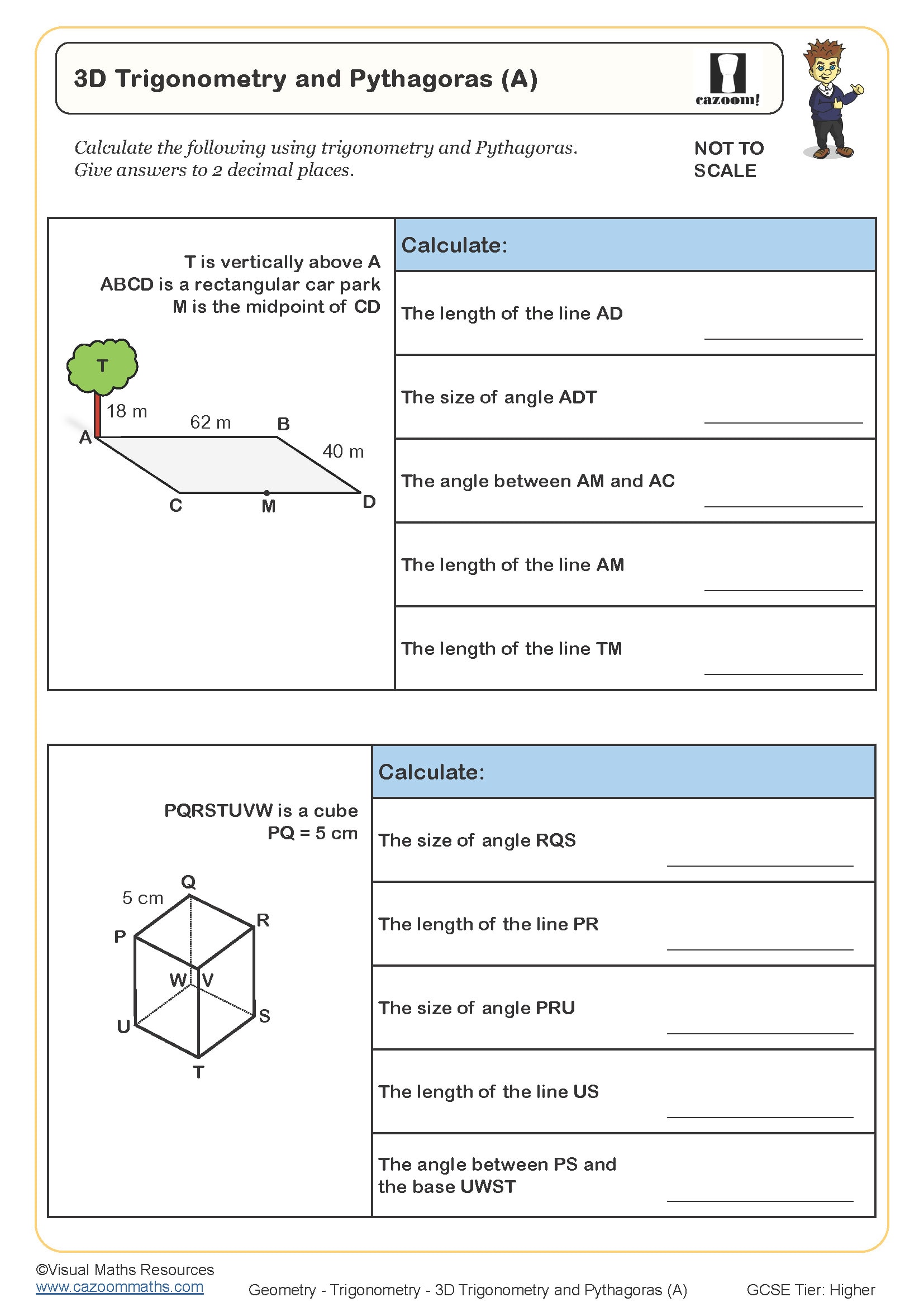
3D Trigonometry and Pythagoras (A)
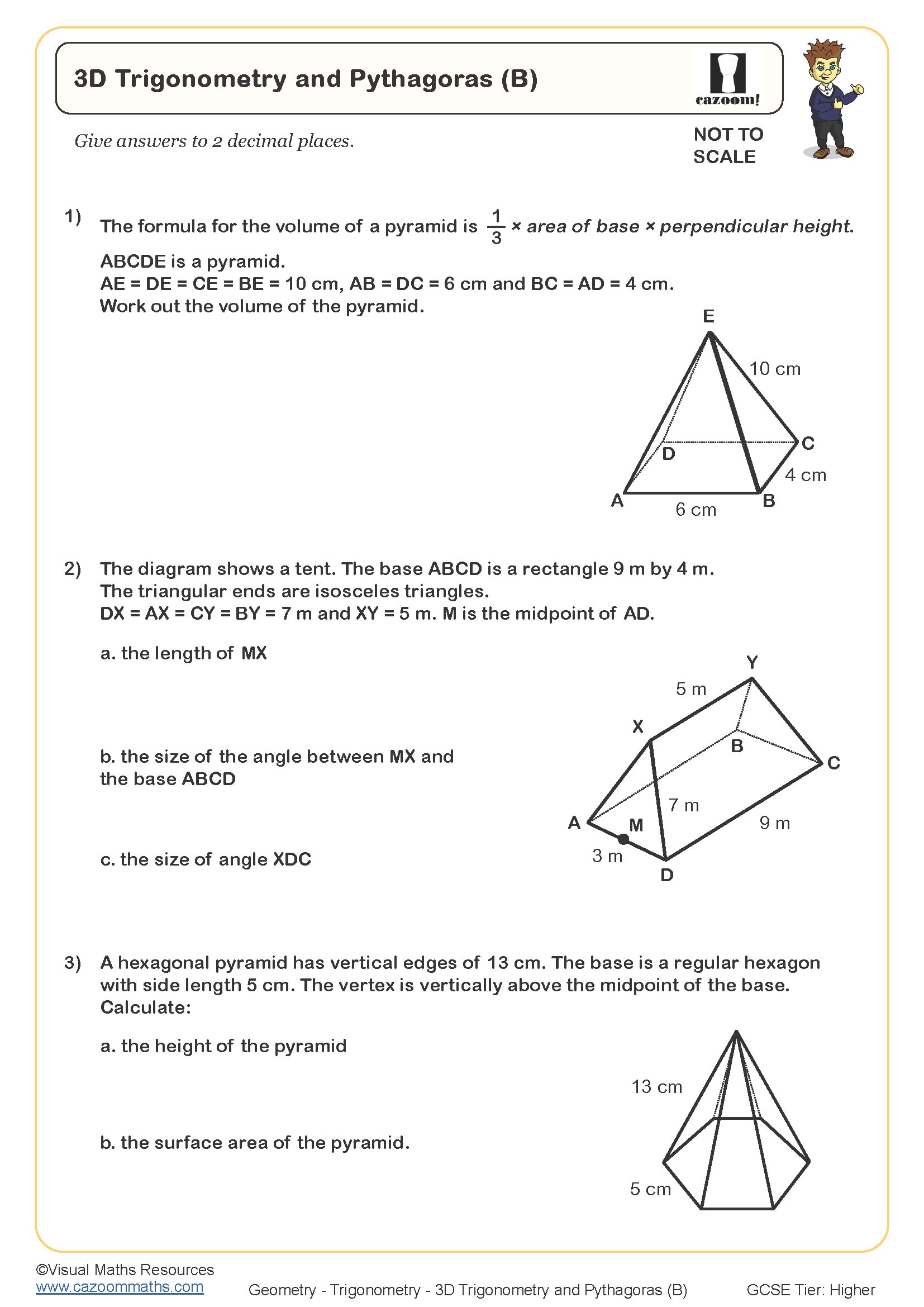
3D Trigonometry and Pythagoras (B)
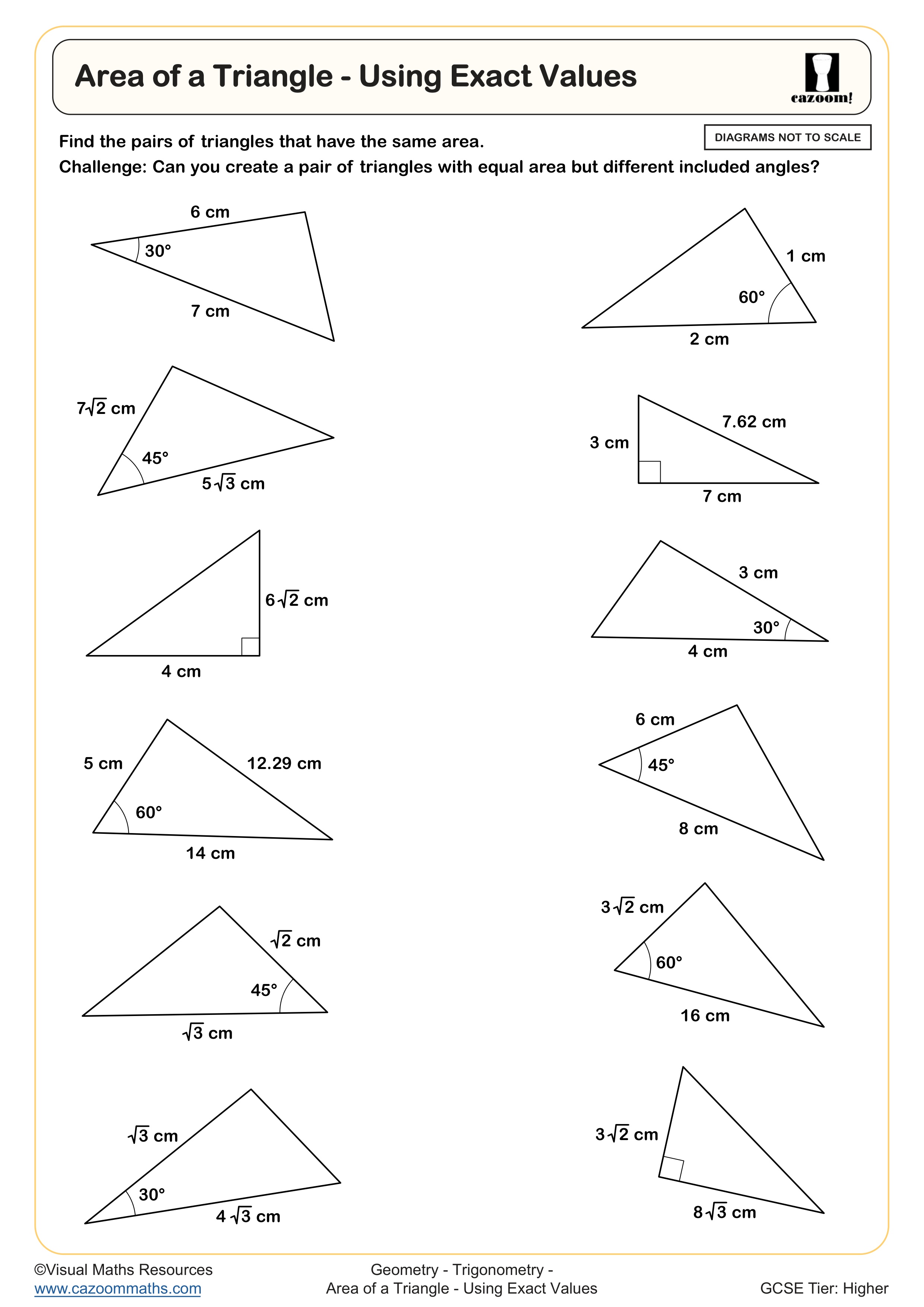
Area of a Triangle - Using Exact Values
Area of Triangles
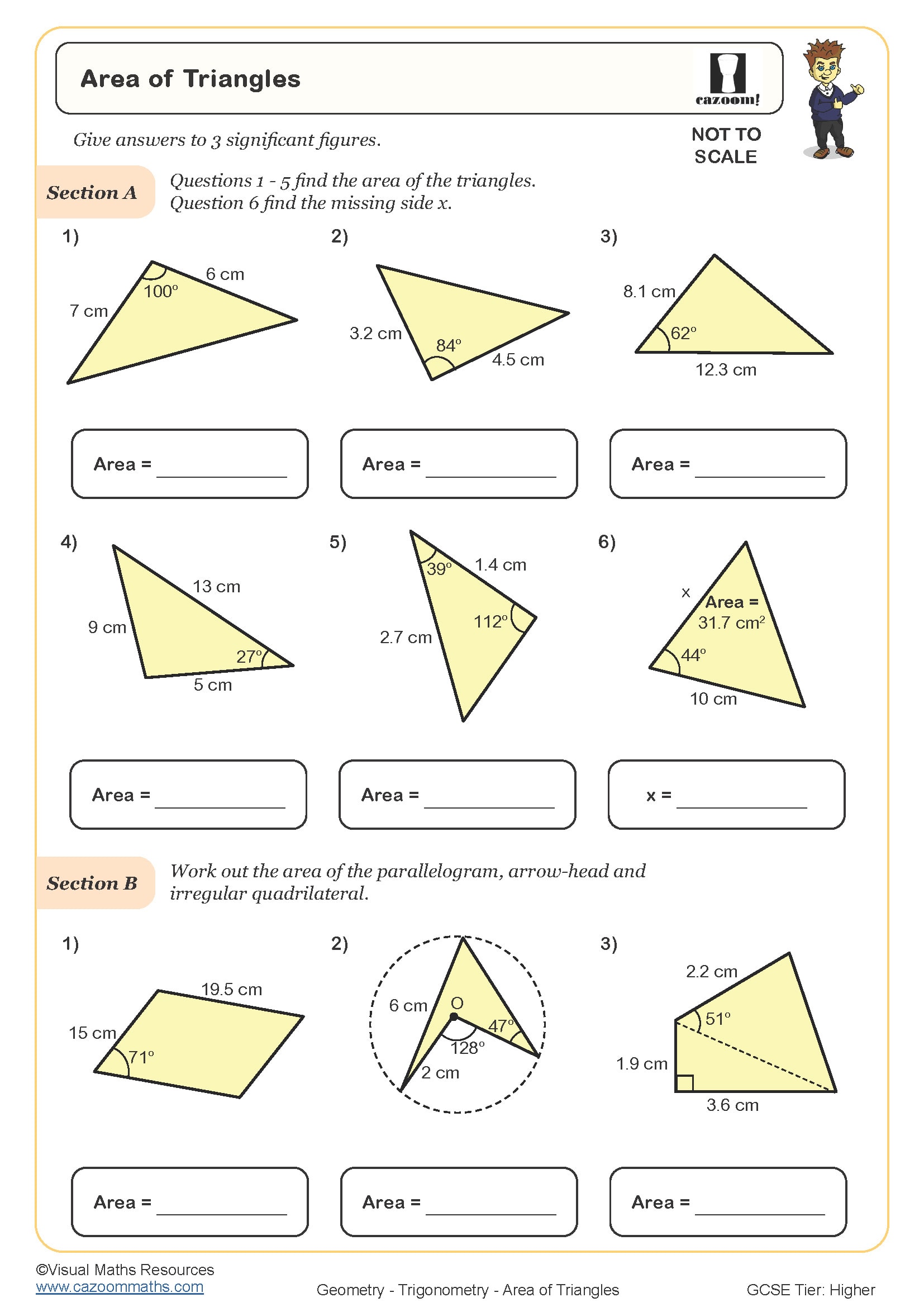
Area of Triangles (With Clues)
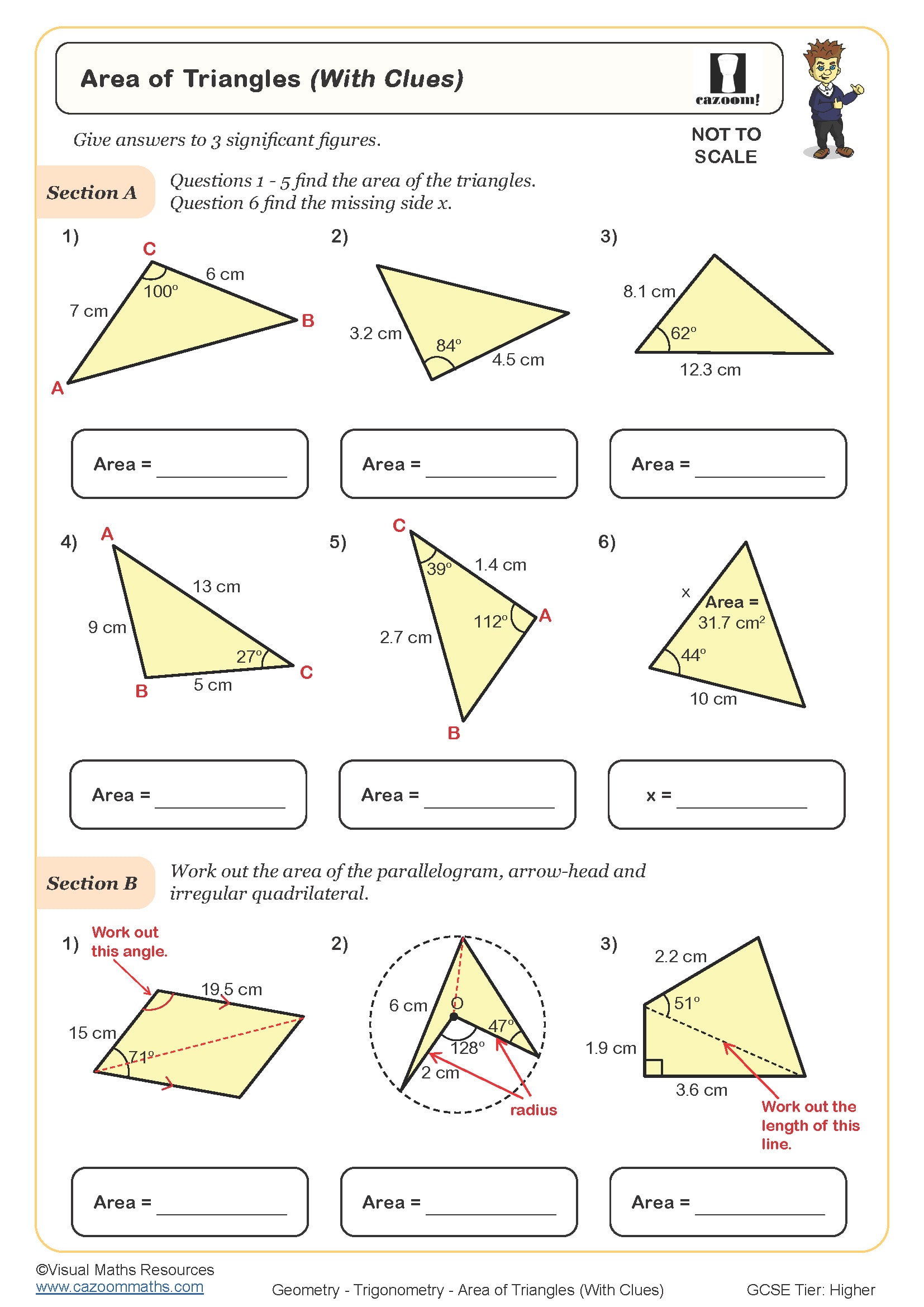
Choosing the Correct Trig Rule
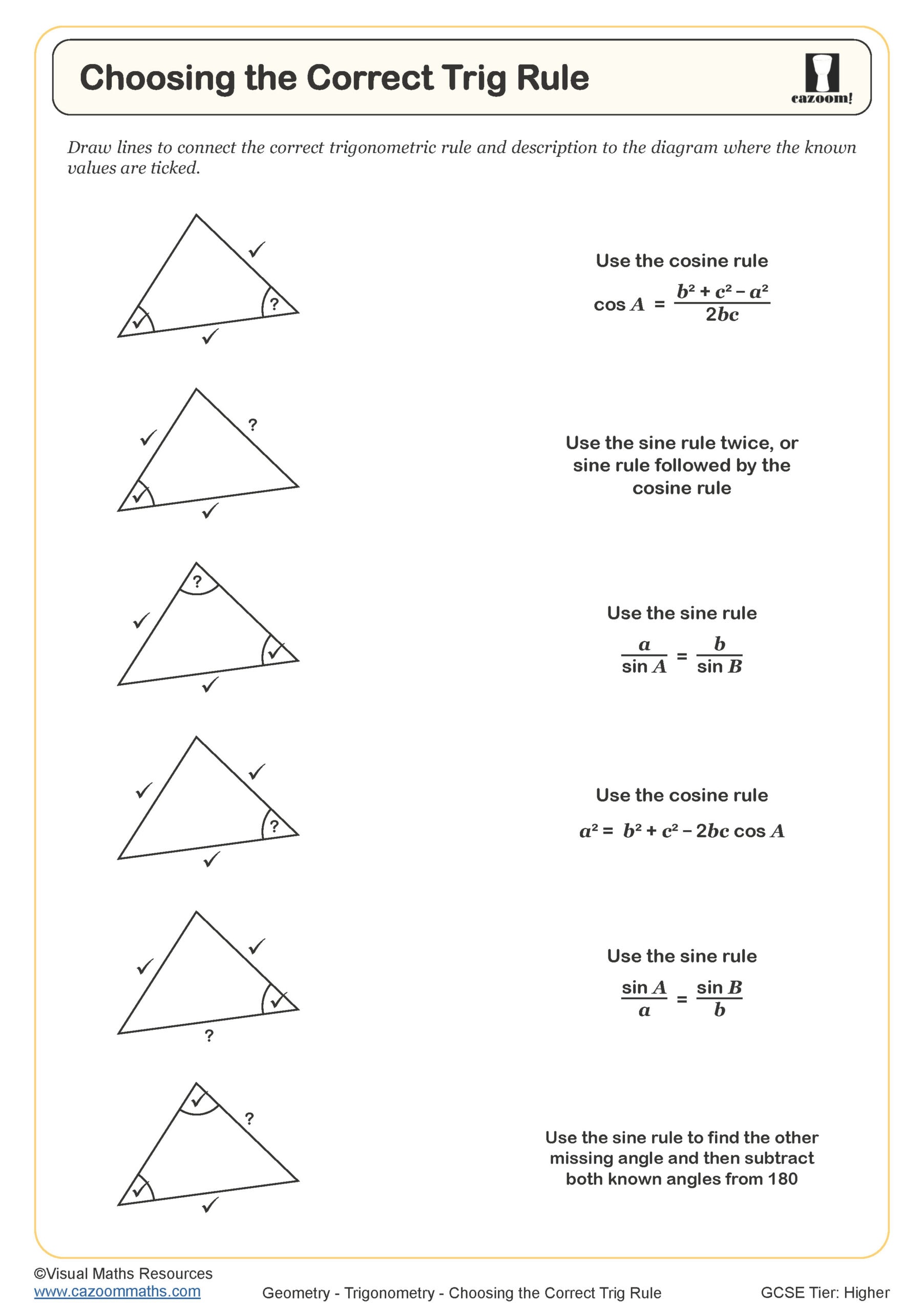
Describing Transformations of Trig Graphs
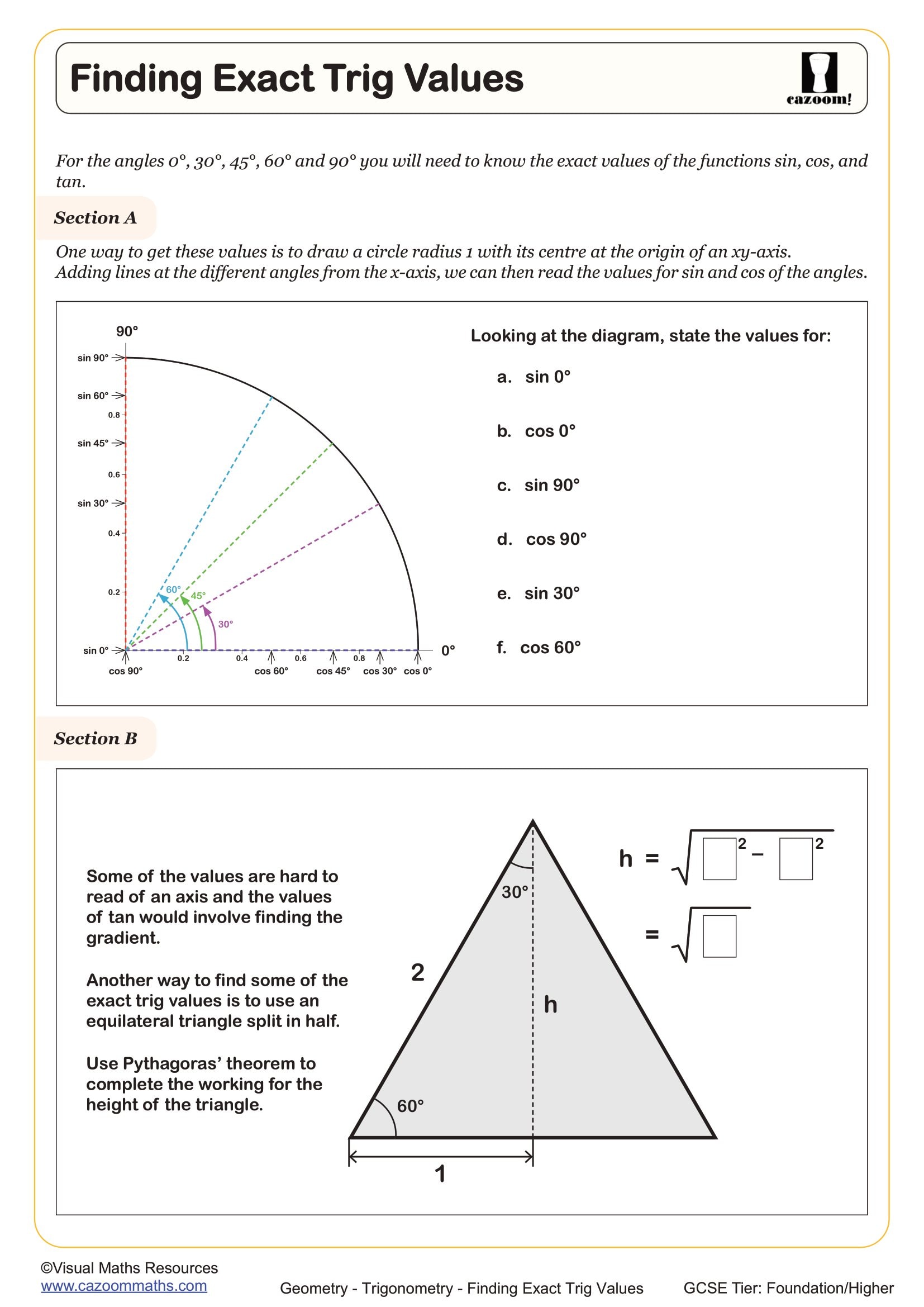
Finding Exact Trig Values
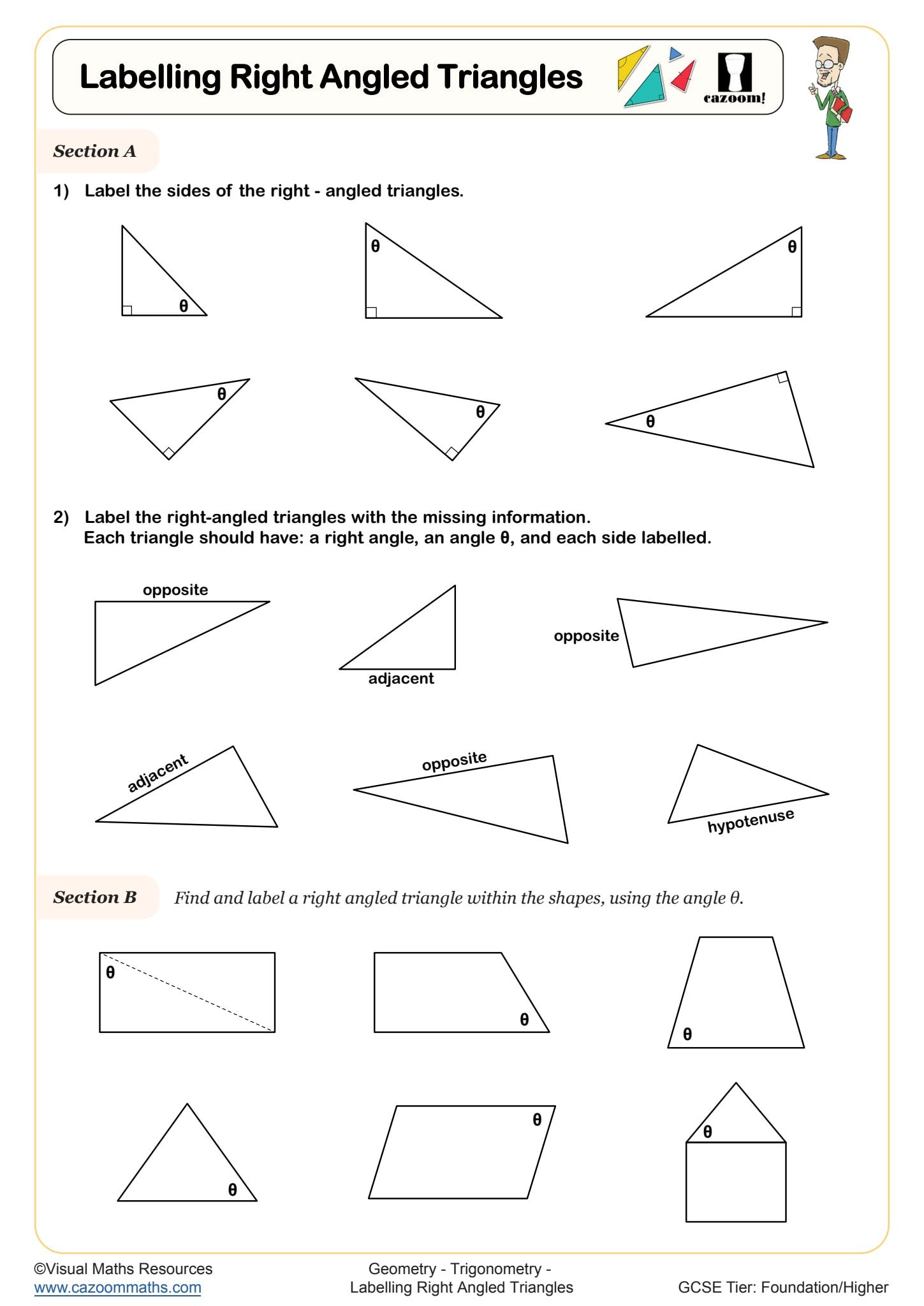
Labelling Right Angled Triangles
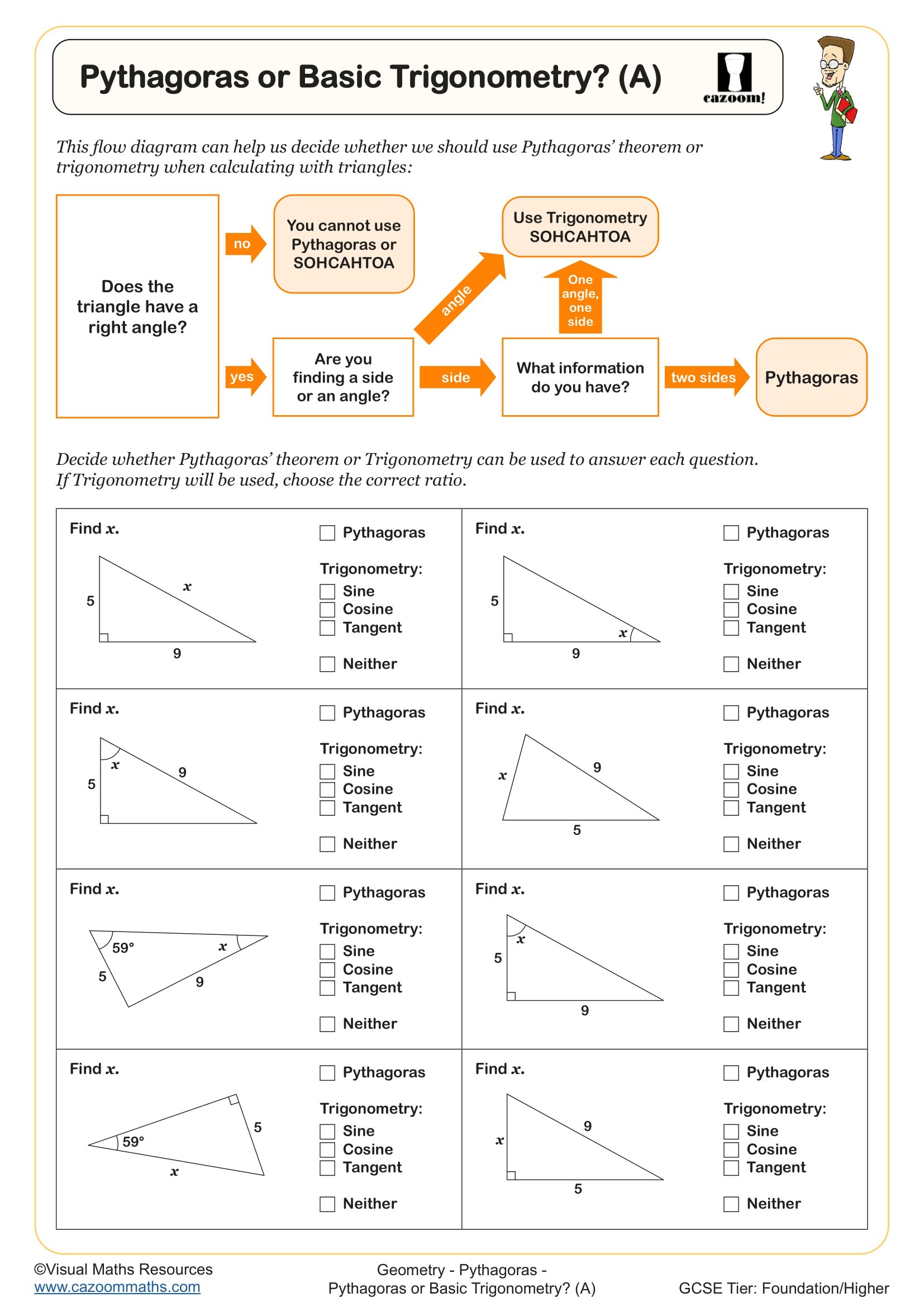
Pythagoras or Trigonometry? (A)
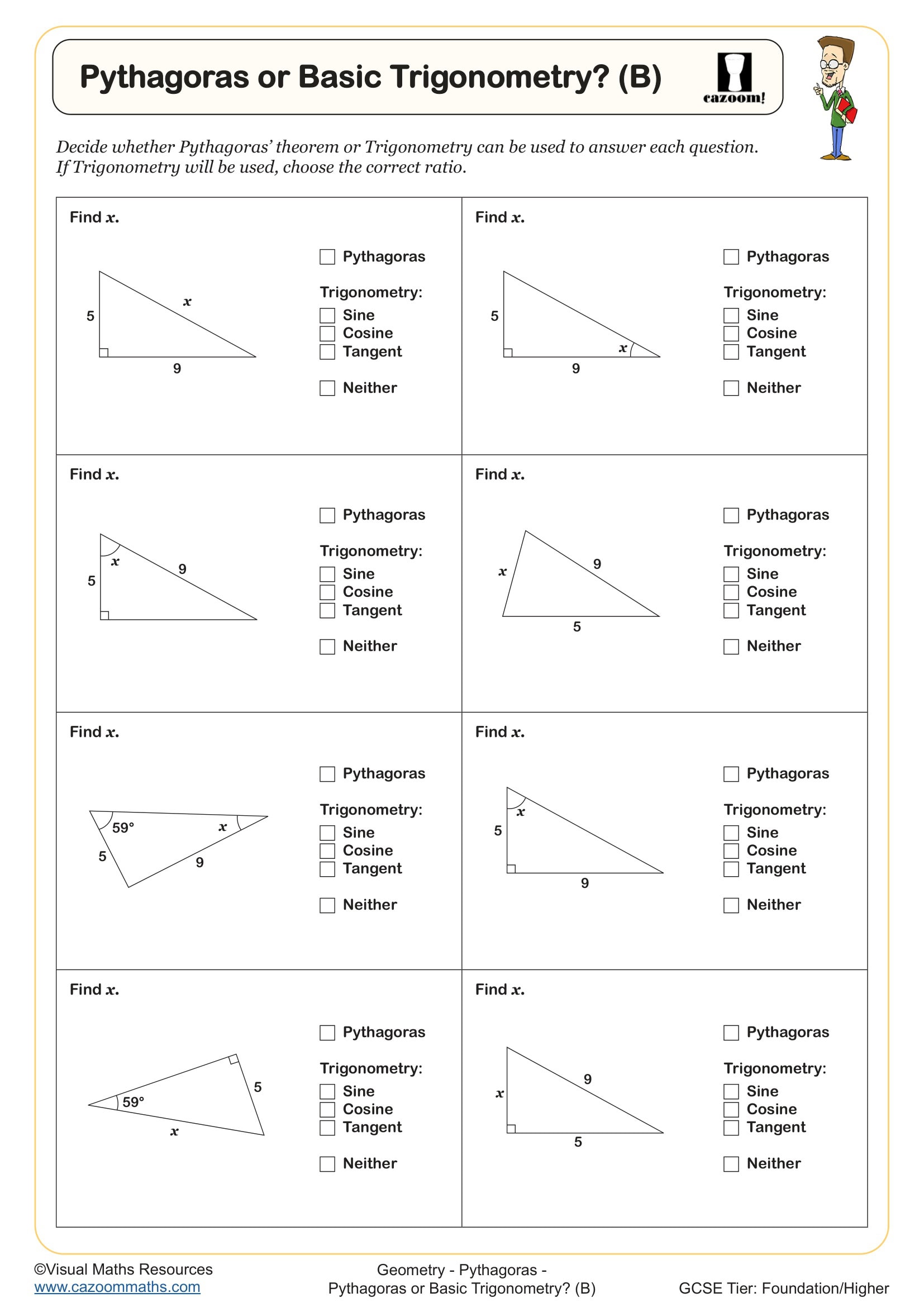
Pythagoras or Trigonometry? (B)
Sine Rule Cosine Rule and Area Mixed Exercise
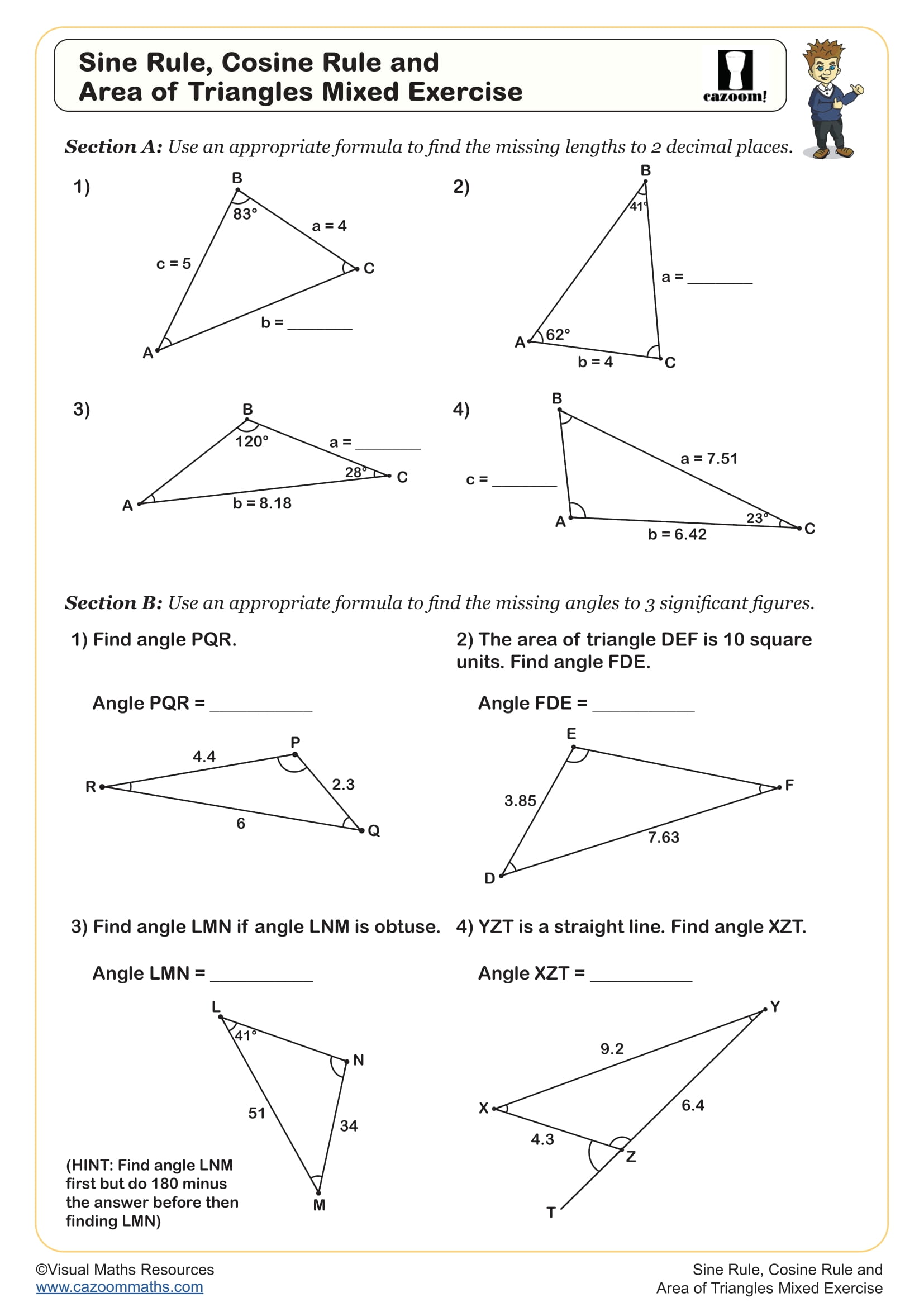
Solving Trigonometric Equations
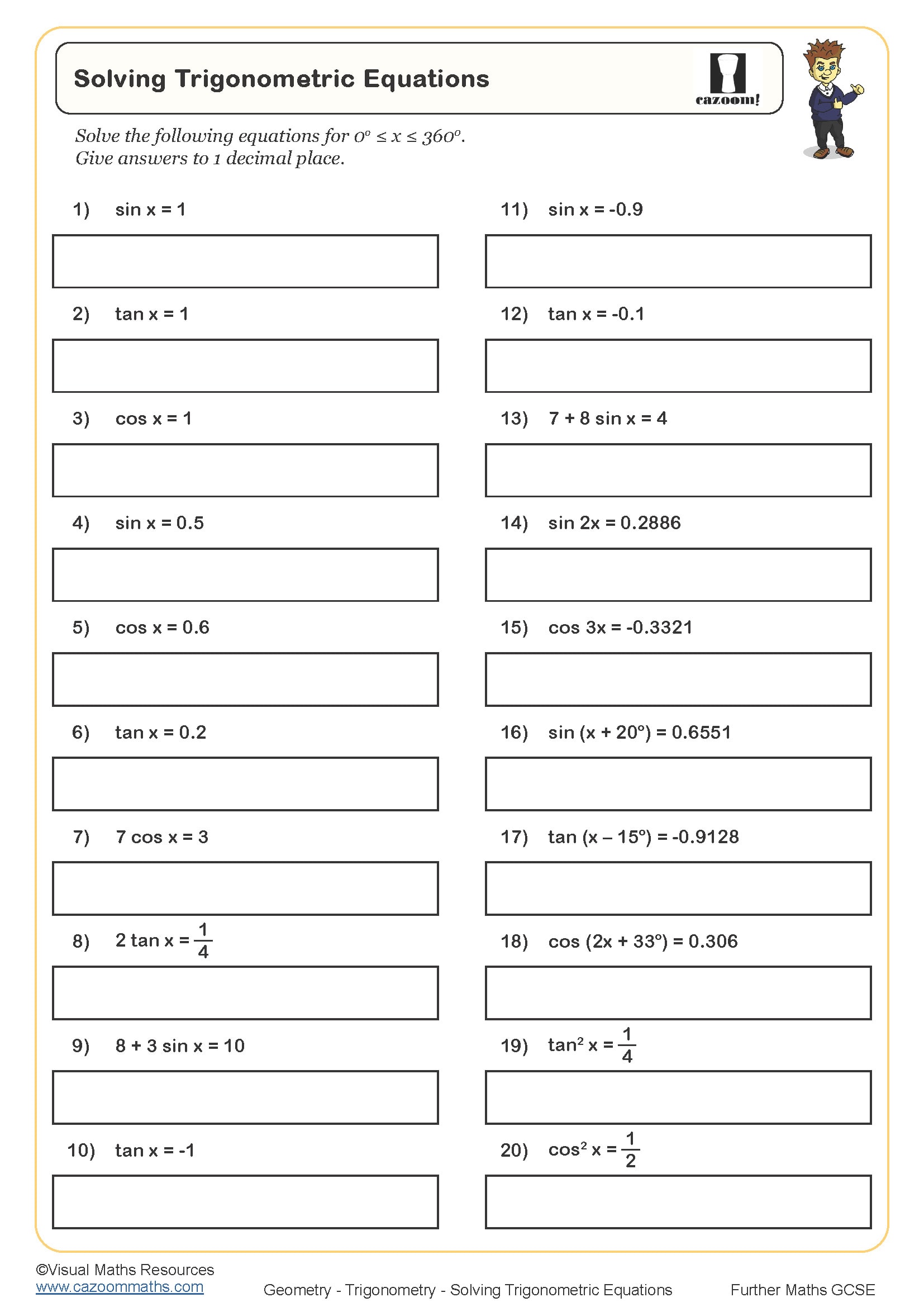
The Cosine Rule
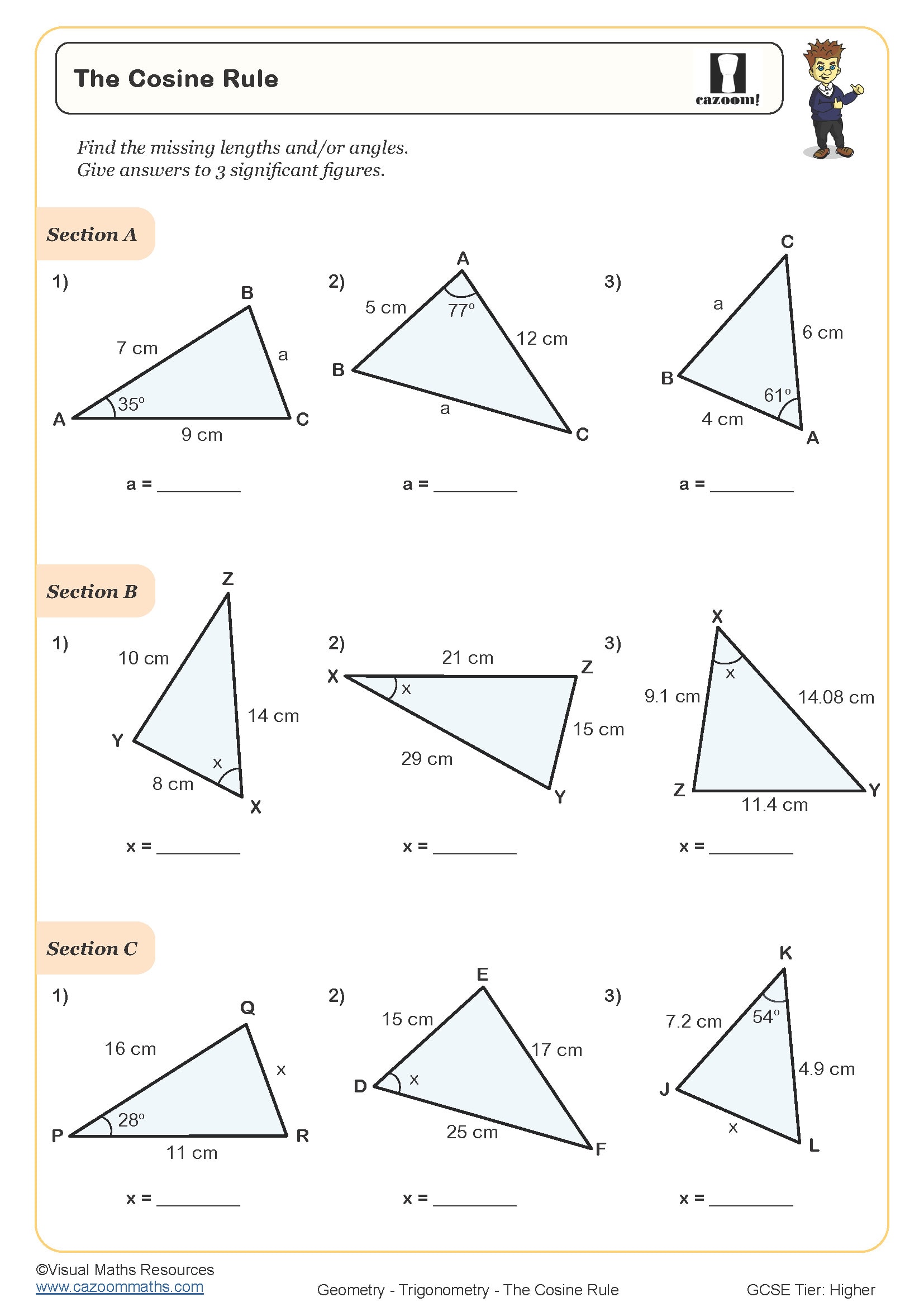
The Cosine Rule - Finding Angles
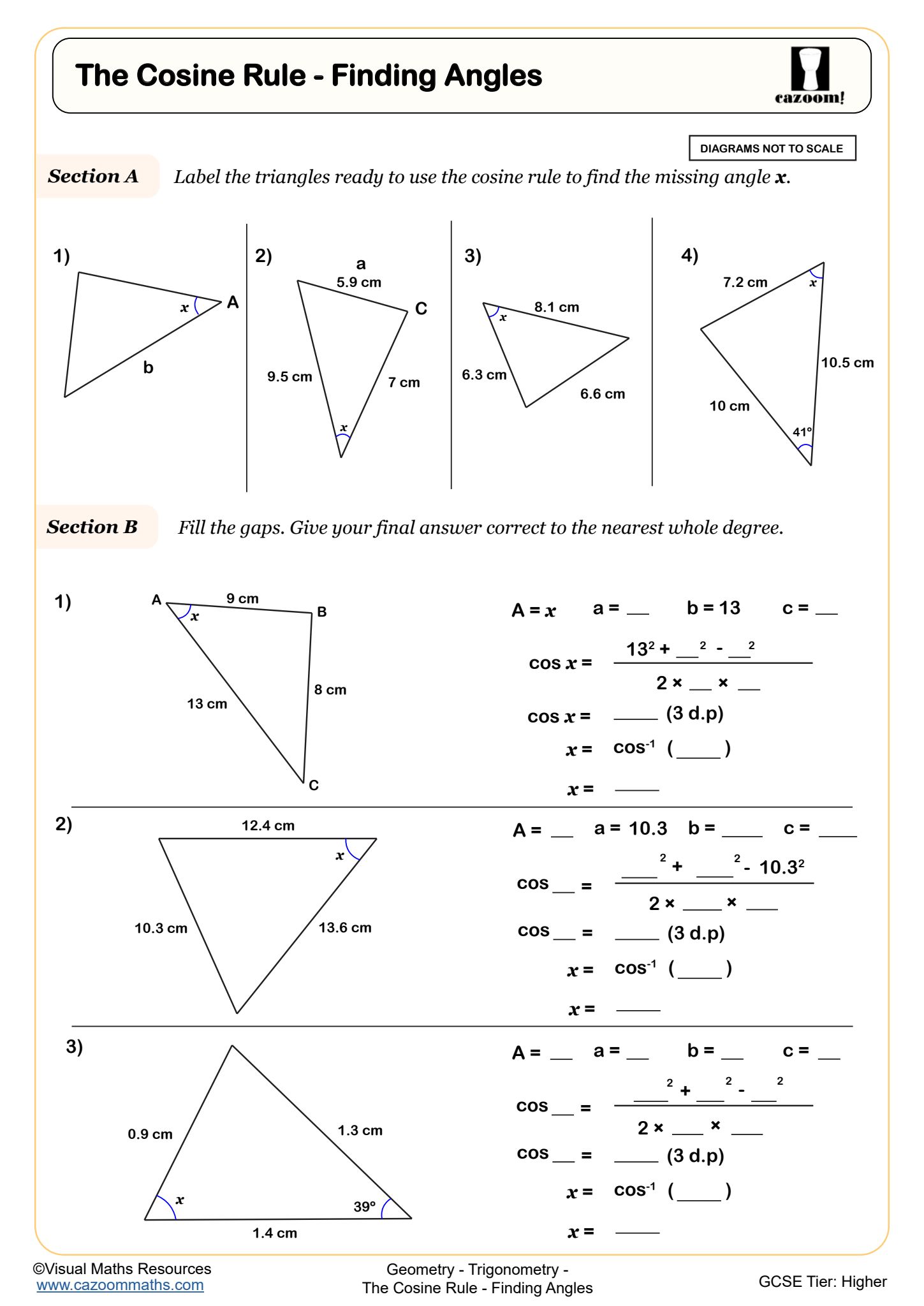
The Cosine Rule - Finding Lengths
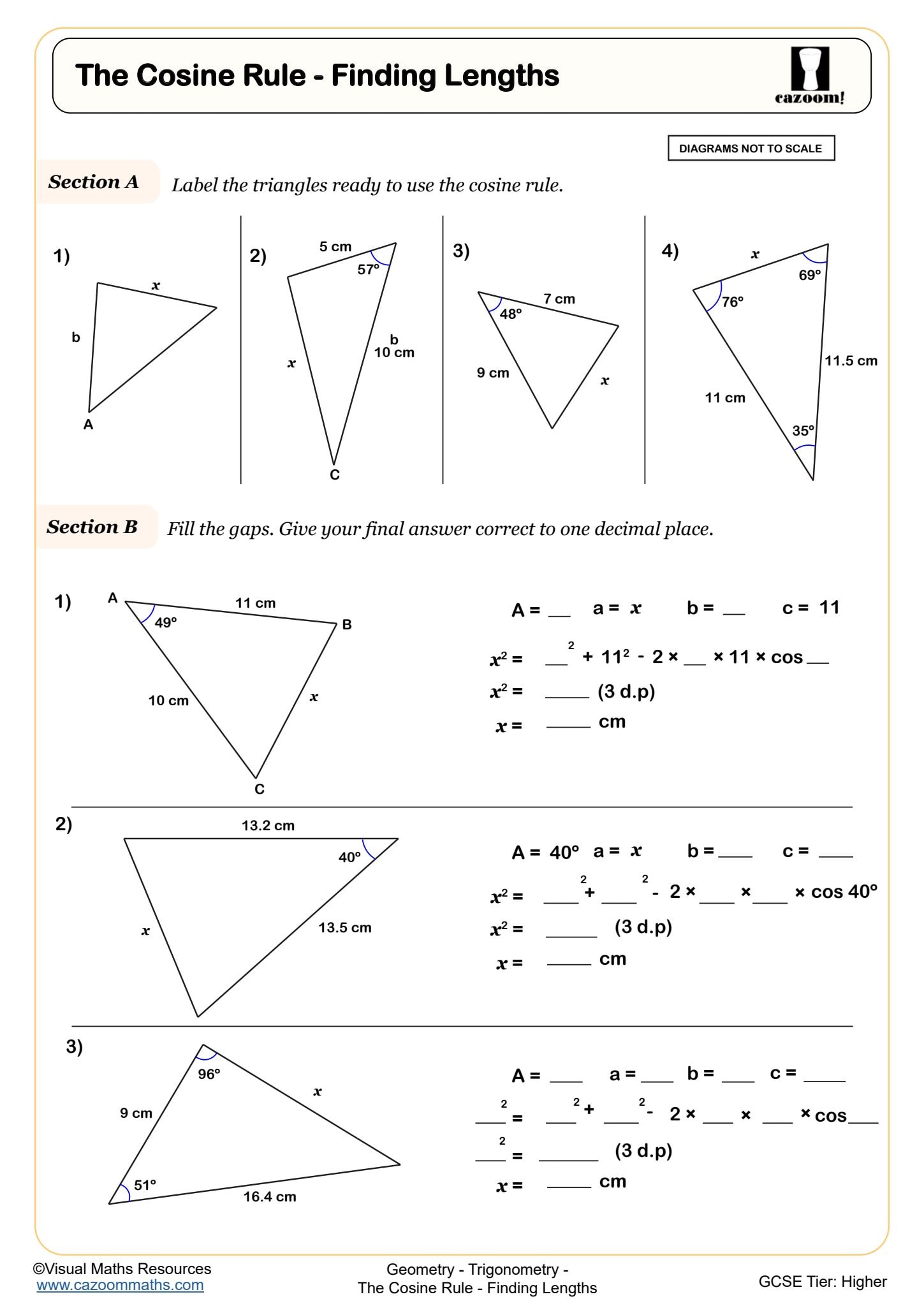
The Sine Rule
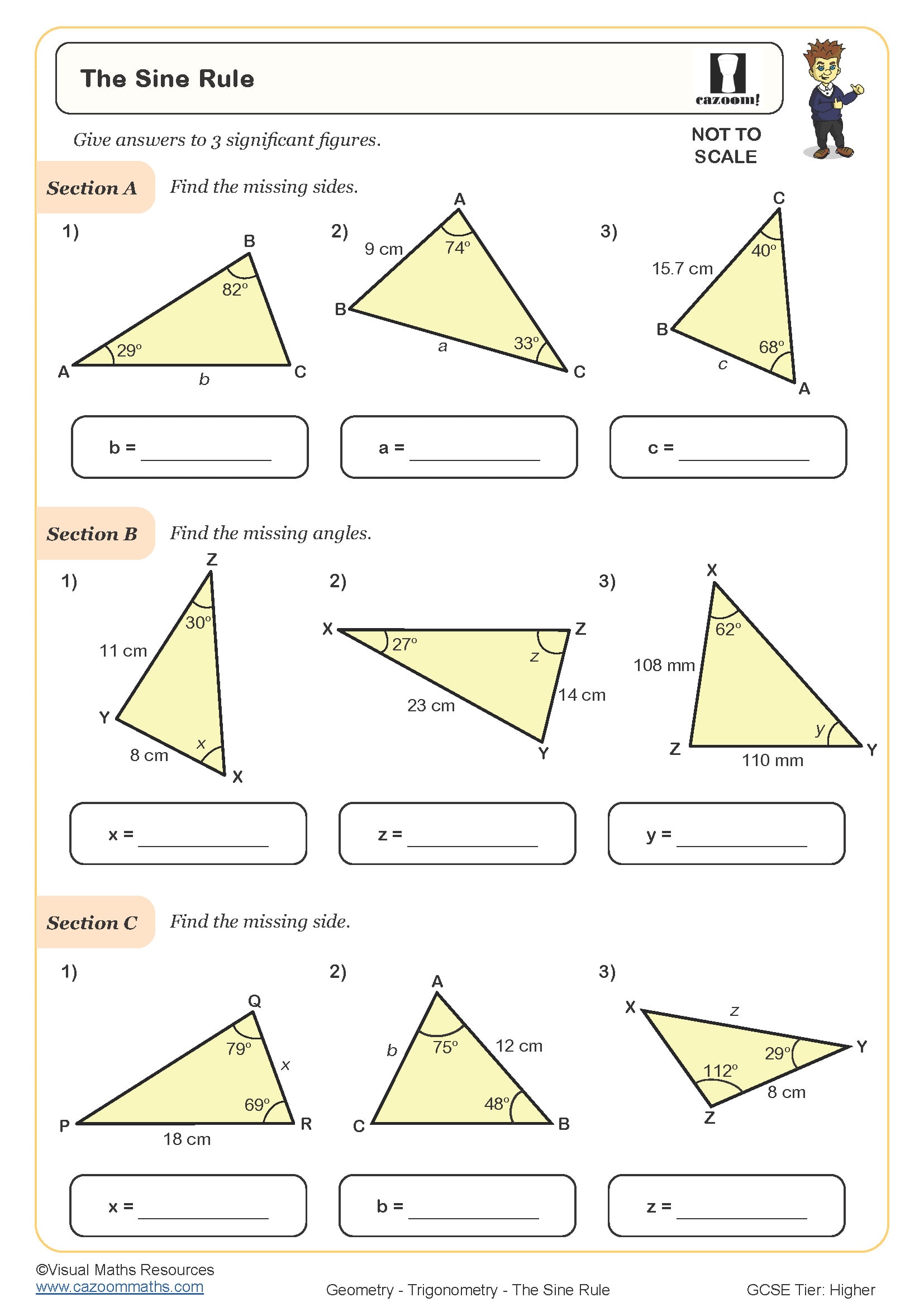
The Sine Rule - Finding Angles
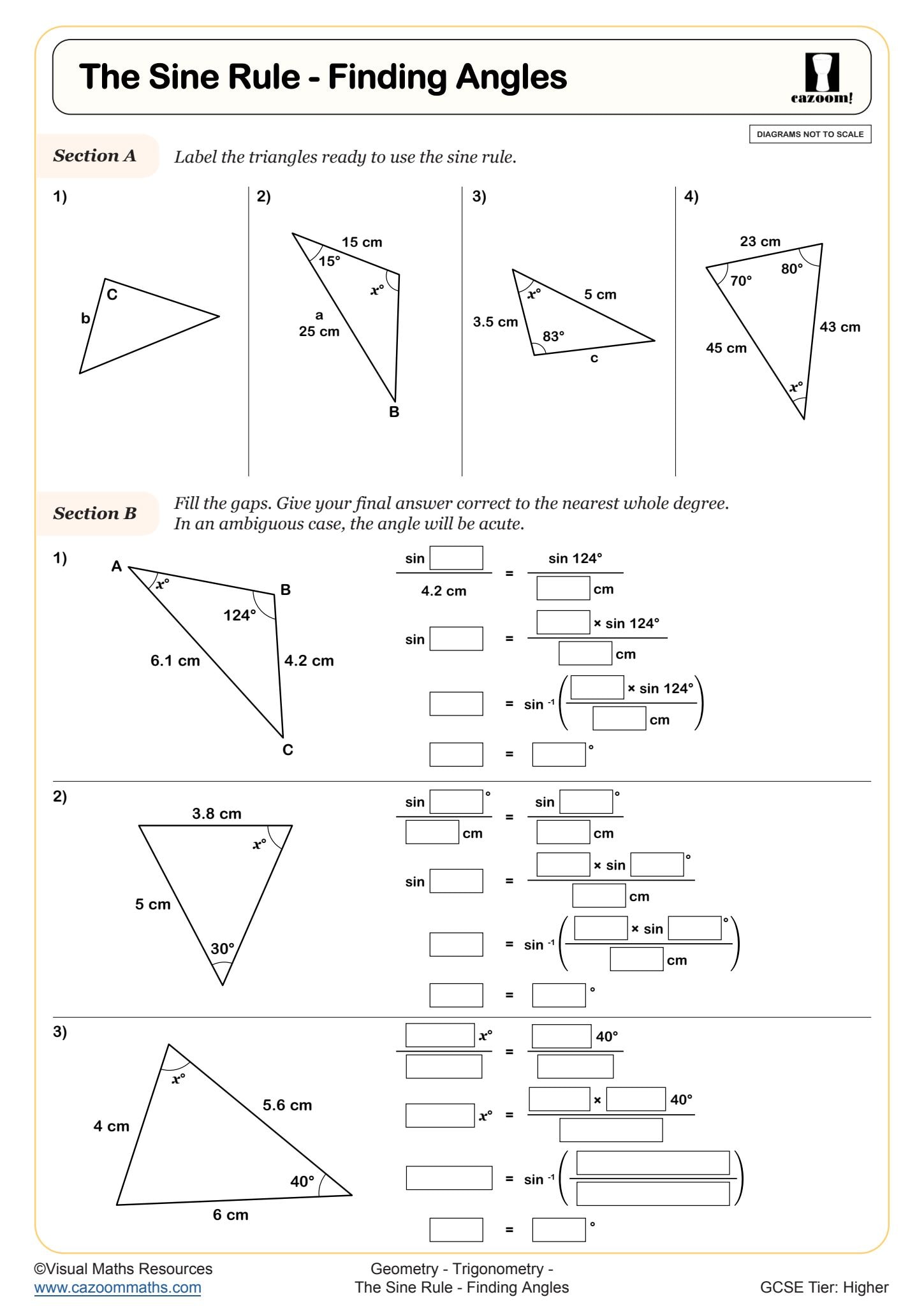
The Sine Rule - Finding Lengths
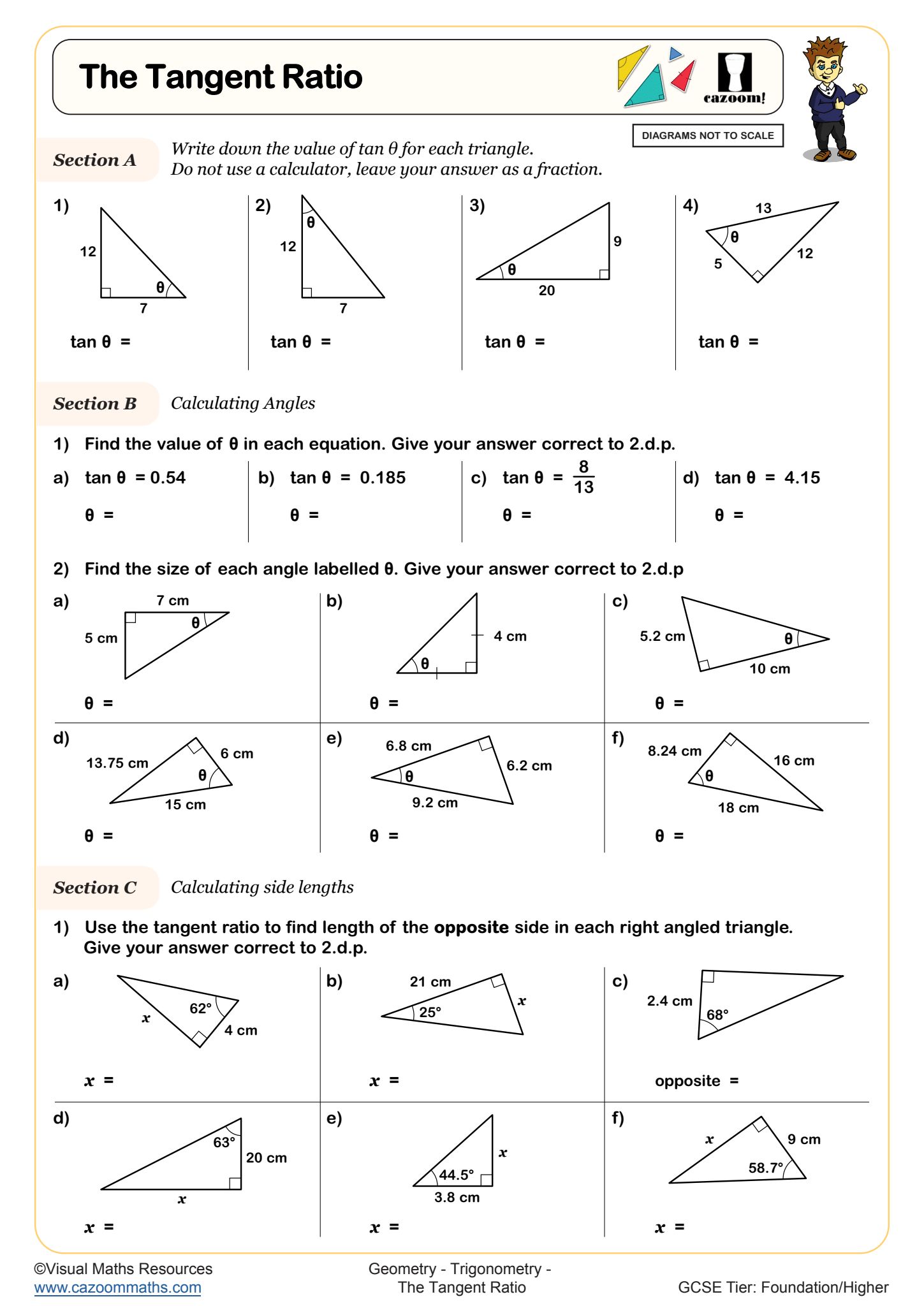
The Tangent Ratio
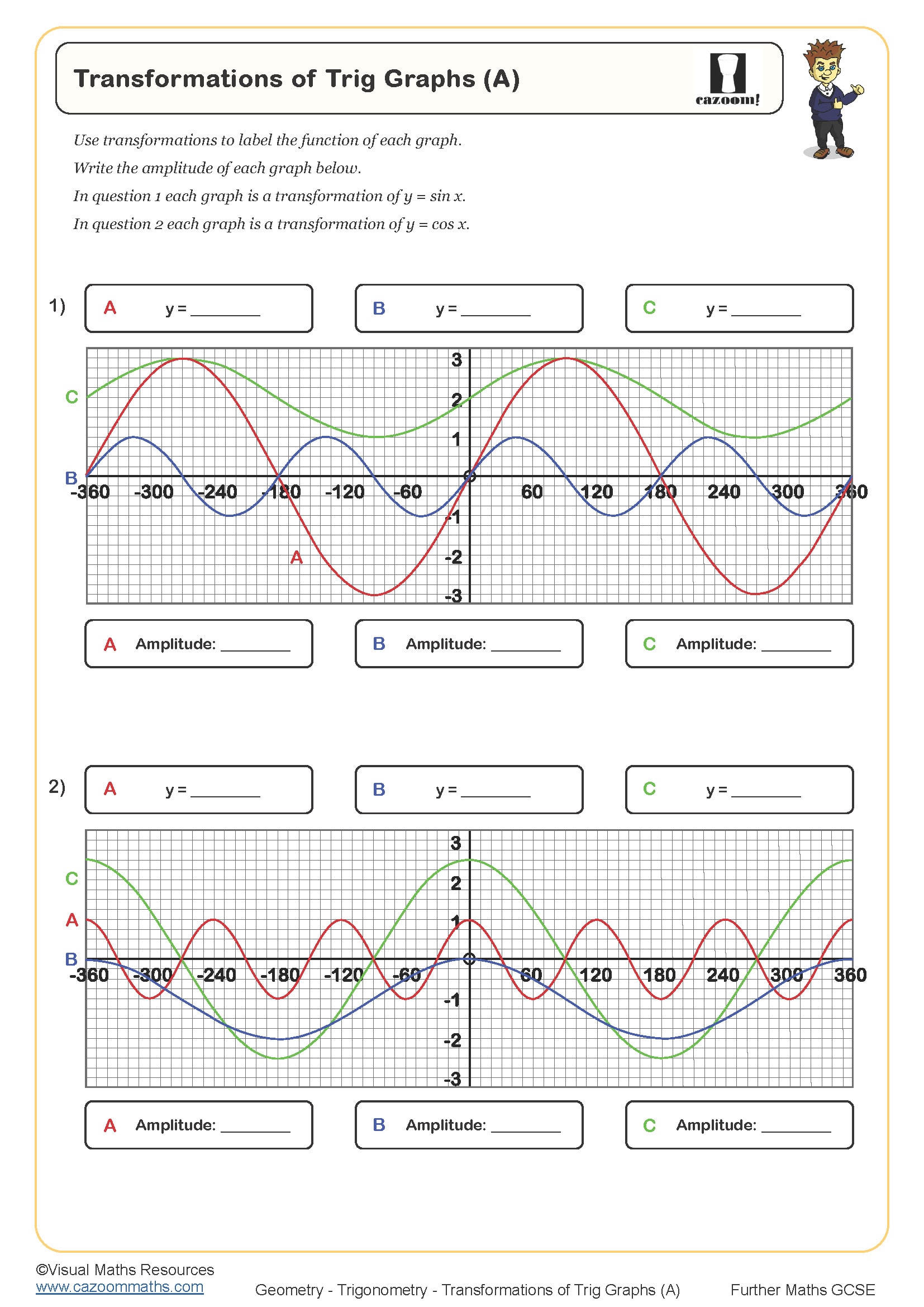
Transformations of Trig Graphs (A)
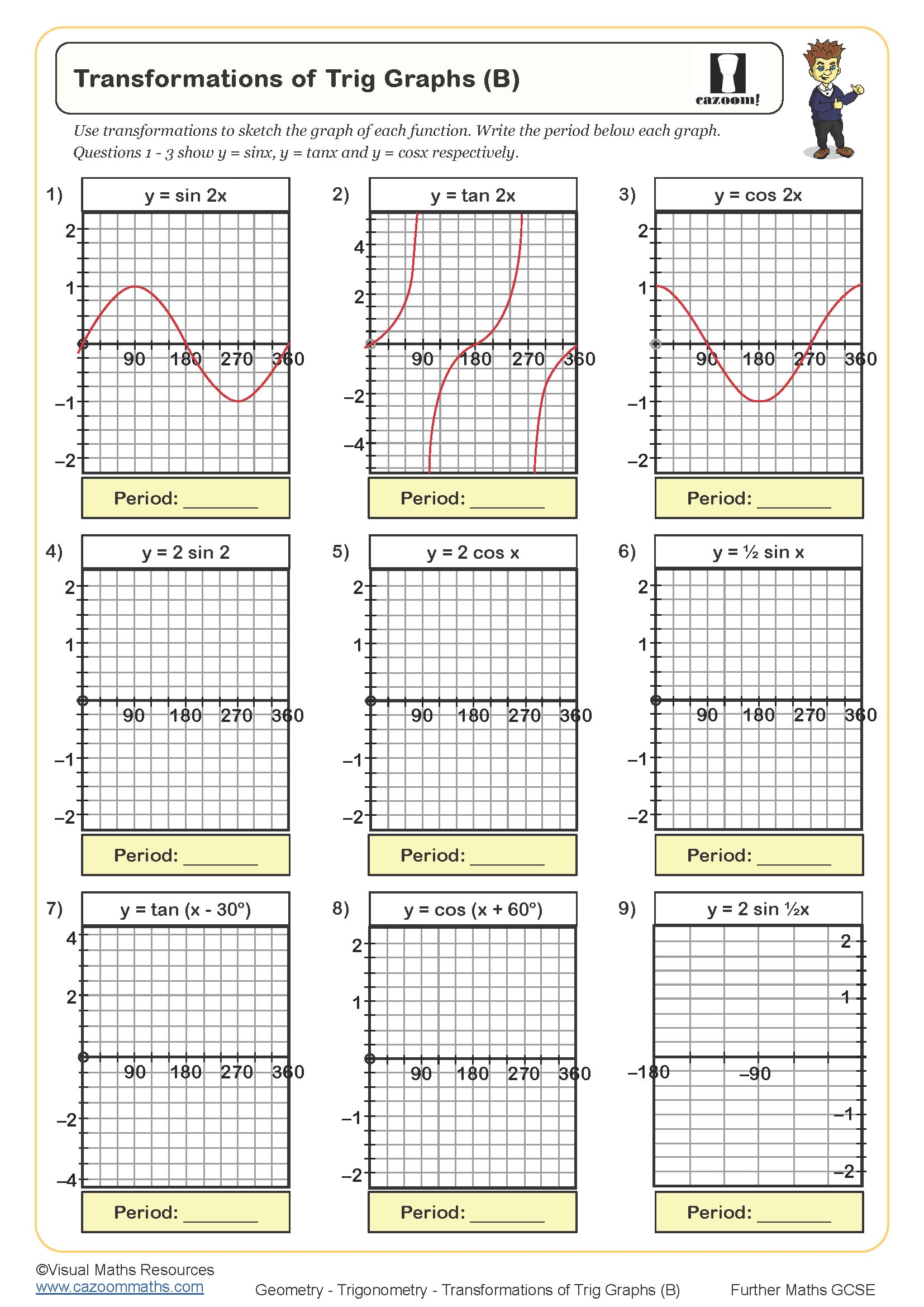
Transformations of Trig Graphs (B)
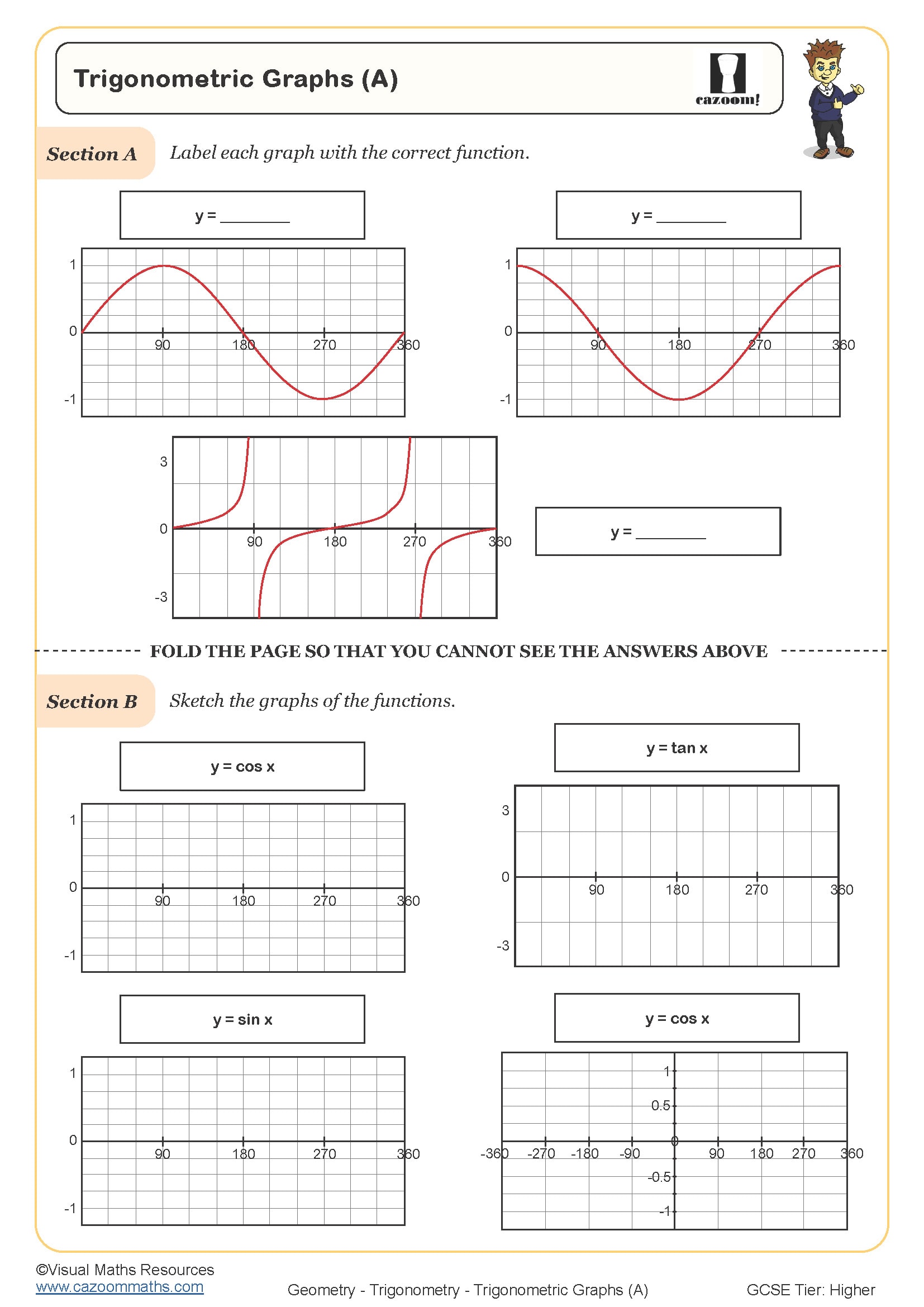
Trigonometric Graphs (A)
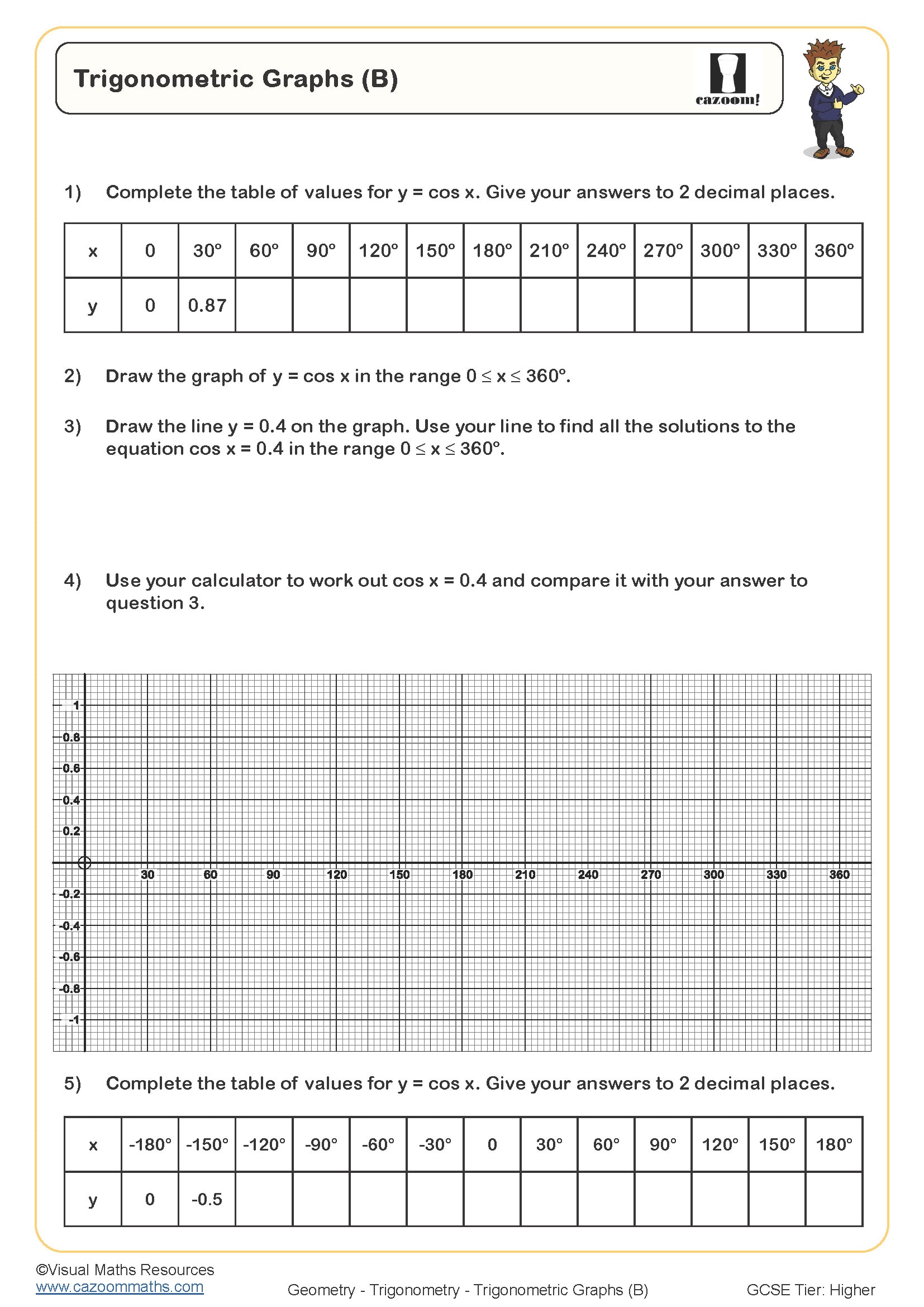
Trigonometric Graphs (B)
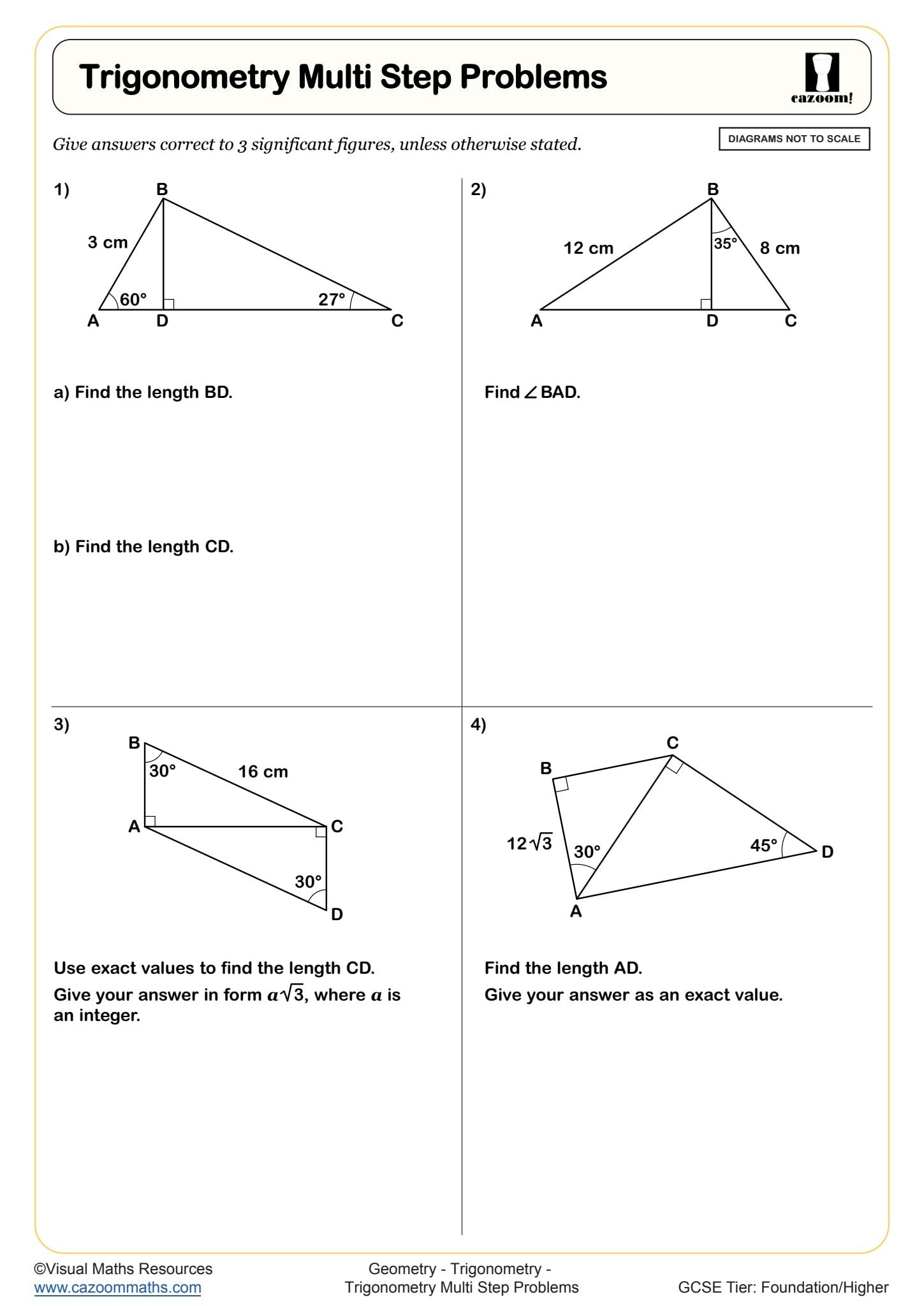
Trigonometry Multi Step Problems
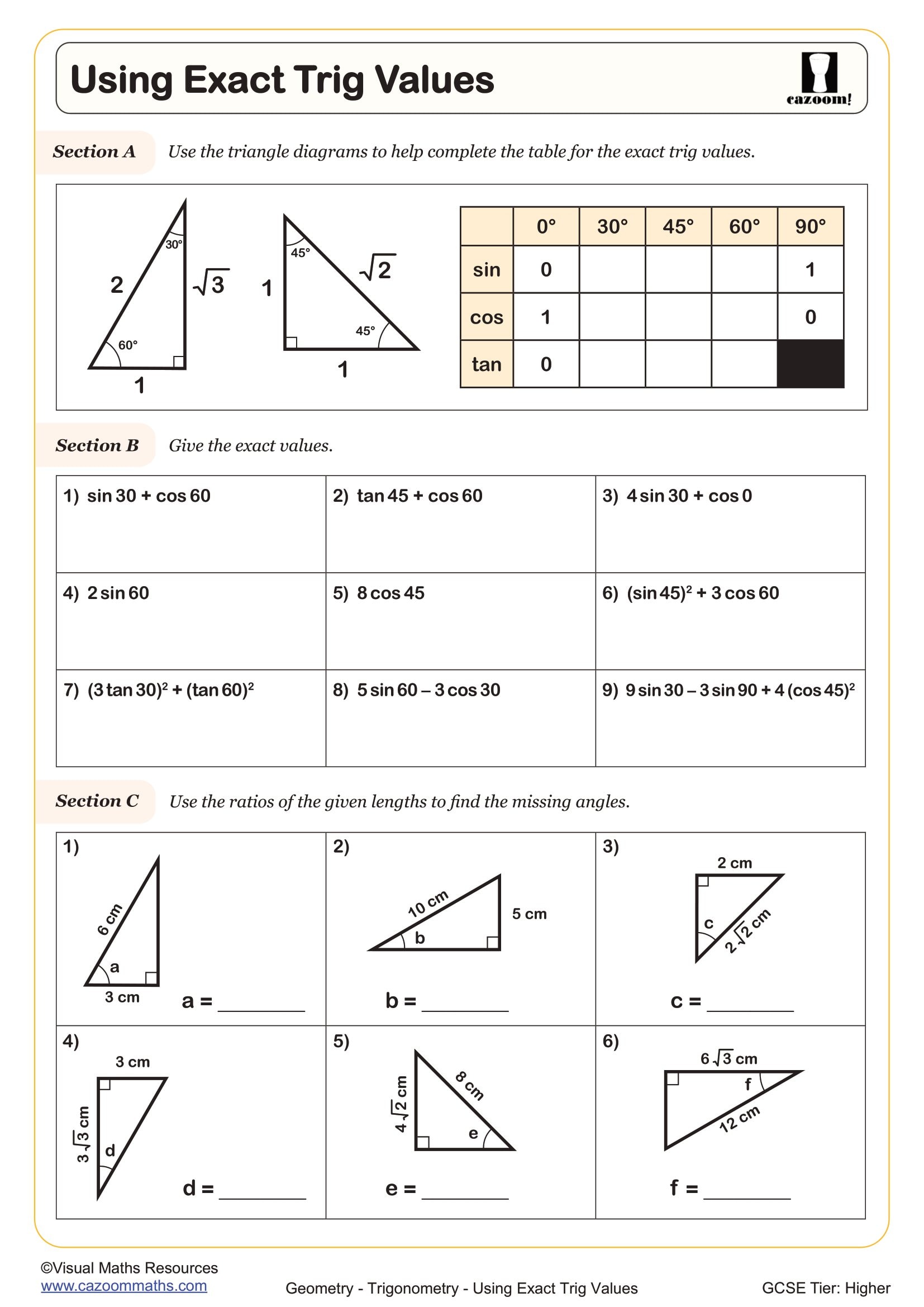
Using Exact Trig Values
All worksheets are created by the team of experienced teachers at Cazoom Maths.
What do trigonometry worksheets cover at GCSE level?
Trigonometry worksheets at KS4 focus on the three primary ratios—sine, cosine and tangent—used to solve problems in right-angled triangles. Students practise identifying the hypotenuse, opposite and adjacent sides relative to a given angle, then apply SOH CAH TOA to calculate missing angles or lengths. More advanced worksheets combine trigonometry with Pythagoras' theorem, extend problems into three dimensions using cuboids and other prisms, and include multi-step questions where students must decide which method applies.
A frequent error occurs when students confuse sin⁻¹, cos⁻¹ and tan⁻¹ with reciprocals rather than inverse functions. Exam mark schemes penalise students who write their calculator display exactly as shown (eight decimal places) instead of rounding appropriately to three significant figures, so worksheets that reinforce proper rounding conventions prove particularly valuable during revision periods.
Which year groups study trigonometry?
Trigonometry forms part of the KS4 curriculum, typically introduced in Year 10 and developed further in Year 11 as students prepare for GCSE examinations. At foundation tier, students encounter basic trigonometric ratios in straightforward right-angled triangles, whilst higher tier extends to exact values, angles of elevation and depression, and problems requiring multiple steps across 2D and 3D contexts.
Progression across Year 10 and Year 11 shifts from procedural recall—applying the correct ratio when the triangle is clearly labelled—to interpretive problem-solving where students must extract information from diagrams, worded scenarios or composite shapes. By Year 11, exam-style questions frequently embed trigonometry within topics like bearings, vectors or circle theorems, expecting students to recognise when trigonometric methods apply even when not explicitly prompted.
How does trigonometry apply to three-dimensional shapes like cuboids?
Applying trigonometry to cuboids and other 3D shapes requires students to visualise right-angled triangles within the solid, often working across faces or through the interior. For example, calculating the angle between a space diagonal and the base involves first using Pythagoras' theorem to find the base diagonal, then constructing a right-angled triangle in the vertical plane. Students must sketch appropriate 2D cross-sections, label dimensions accurately, then select the correct trigonometric ratio—a process many find challenging initially.
This skill connects directly to fields like architecture, engineering and computer graphics, where professionals calculate structural angles, roof pitches or camera perspectives in 3D modelling software. Telecommunications engineers use similar methods when determining optimal antenna angles for signal coverage across terrain, demonstrating how seemingly abstract maths underpins practical STEM applications students encounter in everyday technology.
How can teachers use these trigonometry worksheets effectively?
The worksheets scaffold learning by isolating specific skills—such as finding missing angles only, then lengths only—before progressing to mixed problems where students must identify which calculation applies. This structure helps teachers diagnose precisely where understanding breaks down, whether students struggle with ratio selection, calculator use, or interpreting diagrams. Complete answer sheets enable students to check working independently, making the resources particularly effective for flipped learning or catch-up sessions where immediate feedback matters.
Many teachers use shorter worksheets during starter activities to refresh prior knowledge before introducing 3D applications, whilst longer mixed exercises work well for end-of-topic assessments or pre-exam revision. Paired work often proves valuable when tackling cuboid problems—one student describes the triangle they've identified whilst their partner attempts the calculation, building both communication skills and geometric reasoning that exam mark schemes increasingly reward.