KS4 Vectors Worksheets
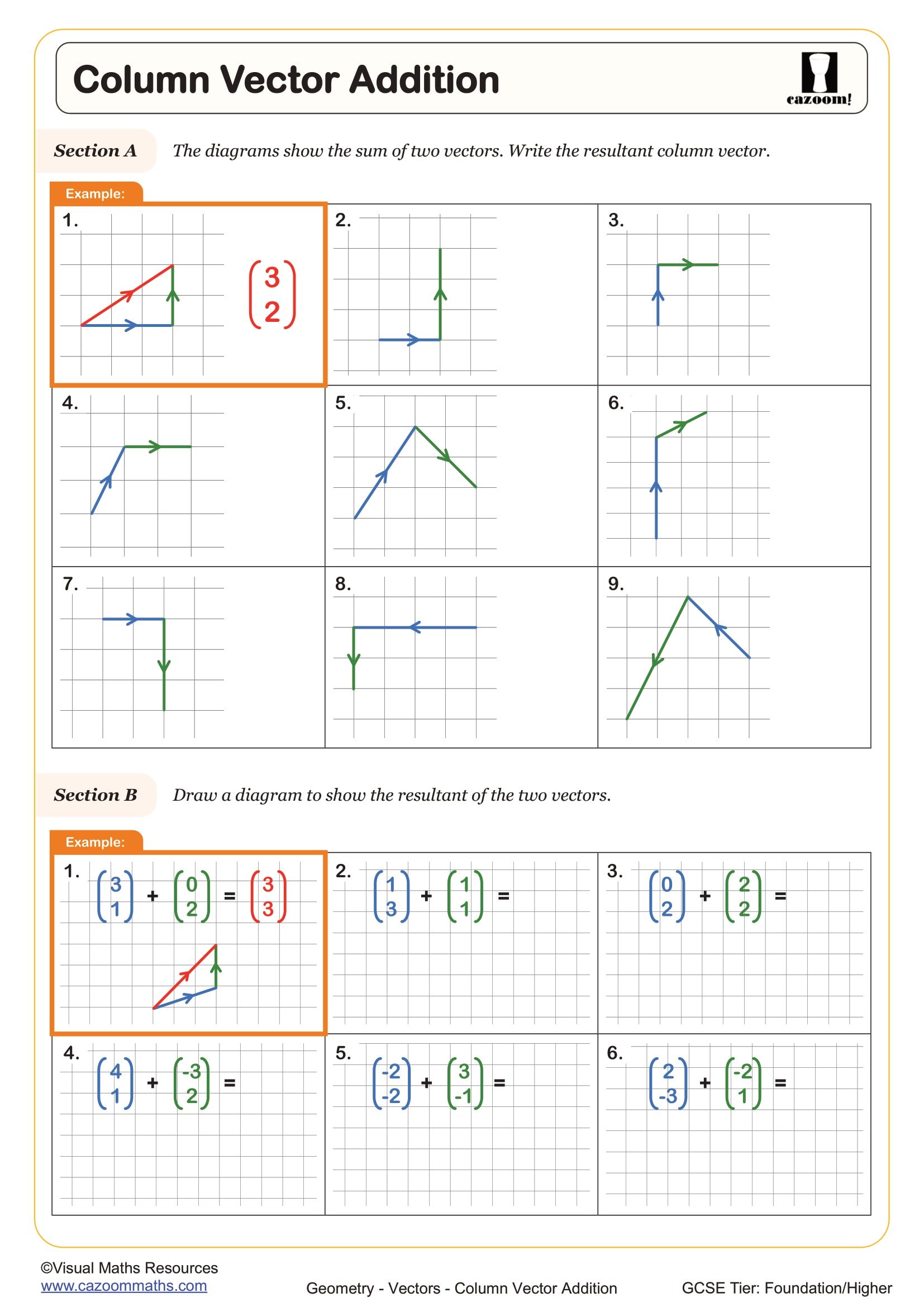
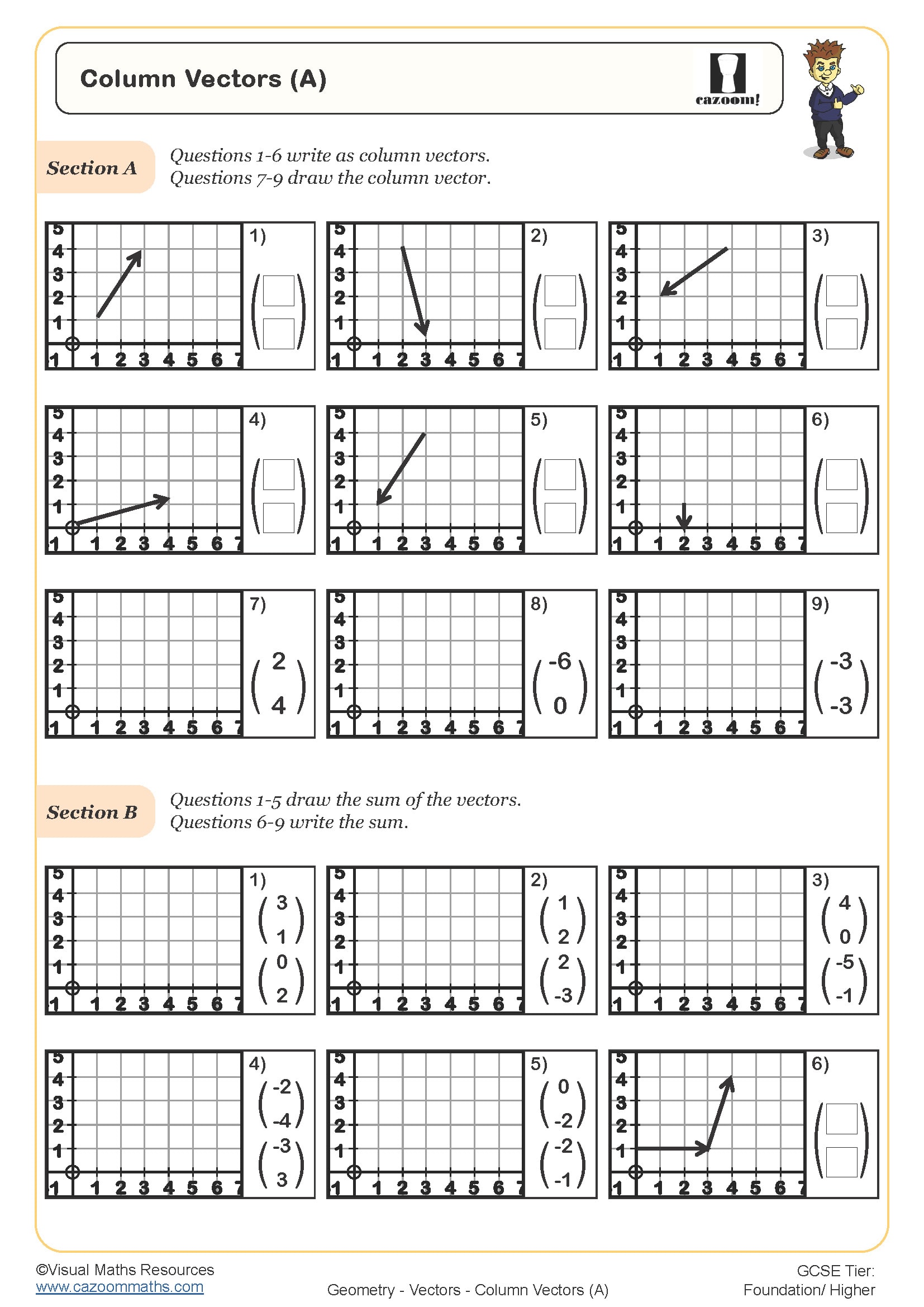
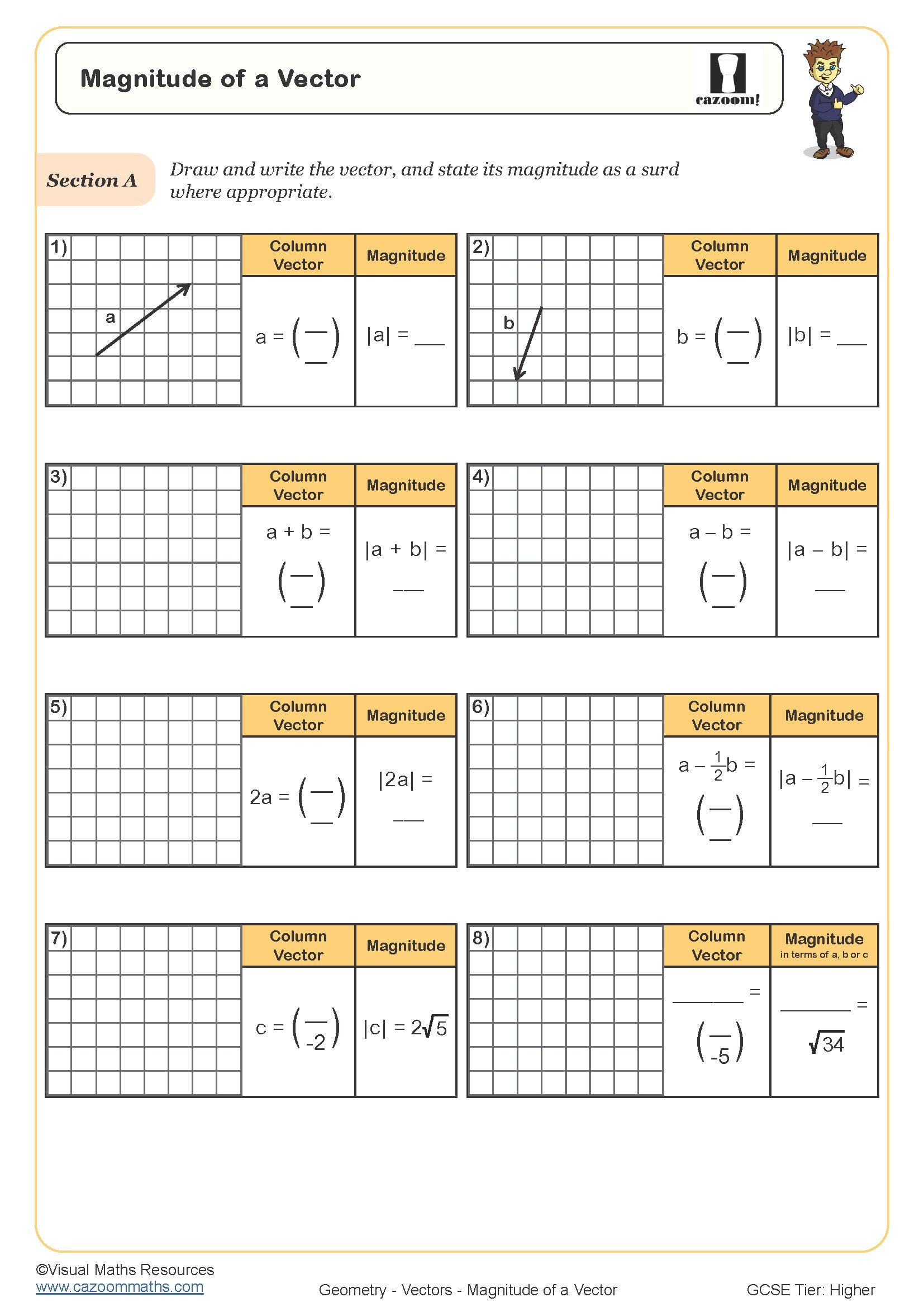
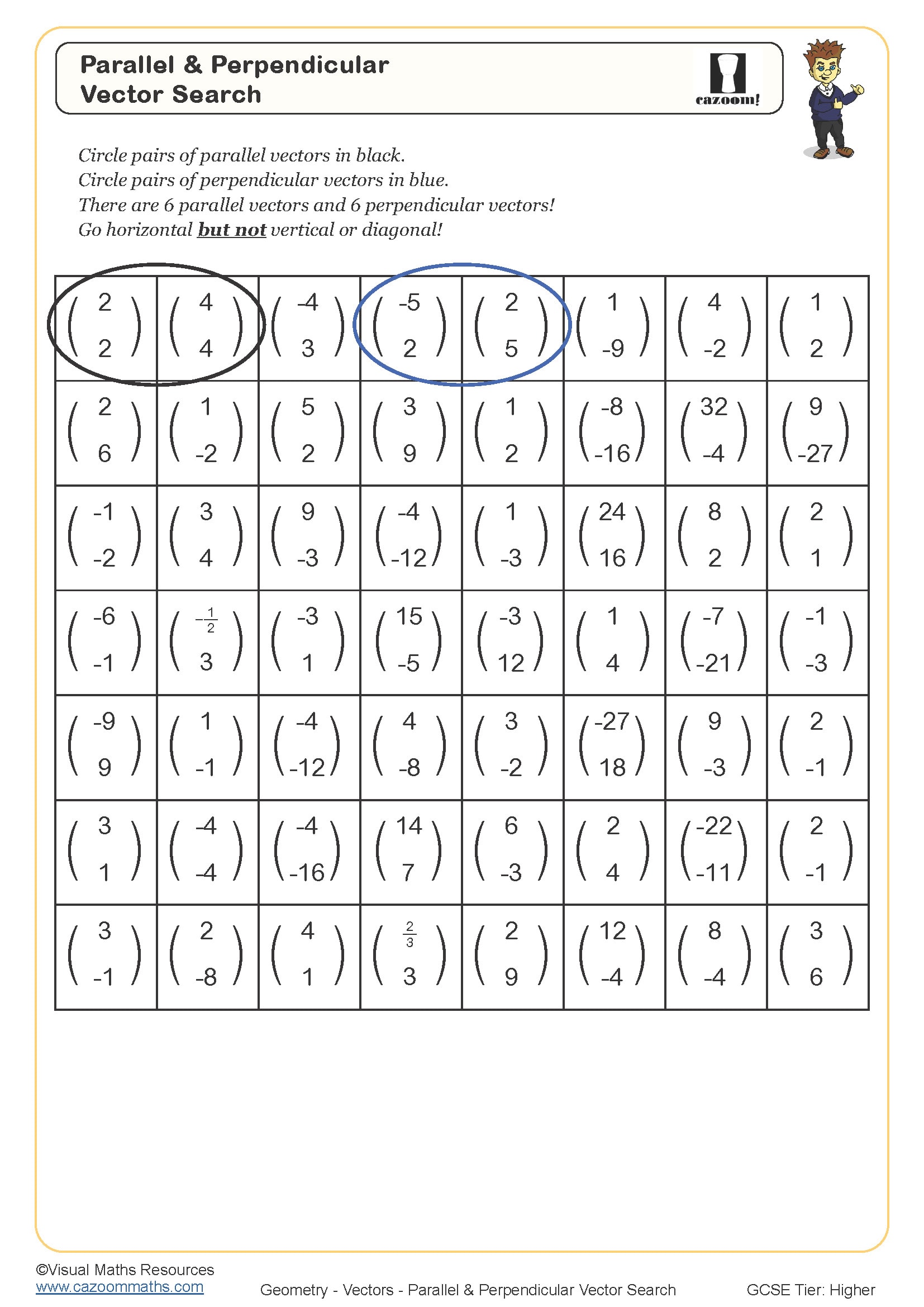
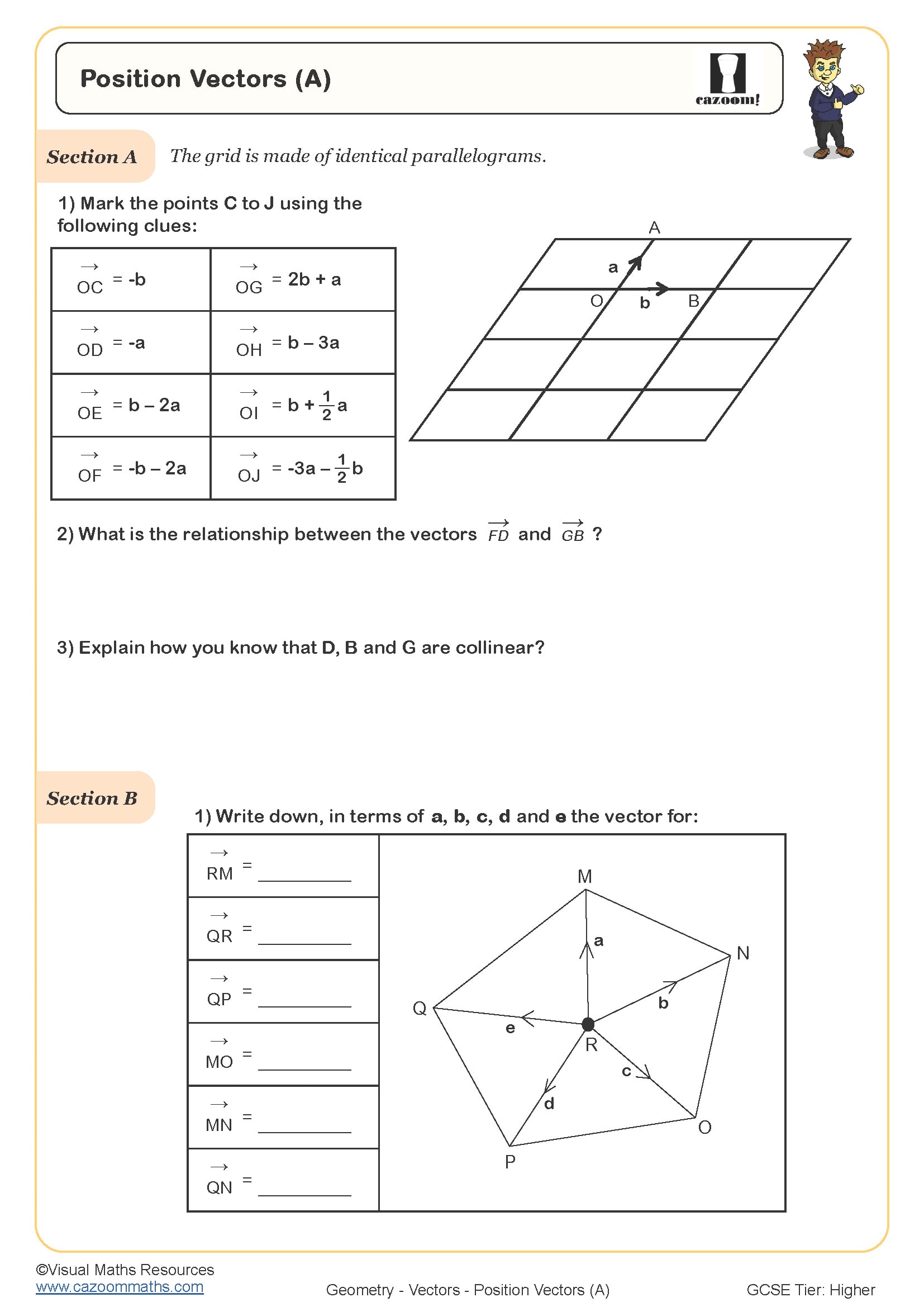
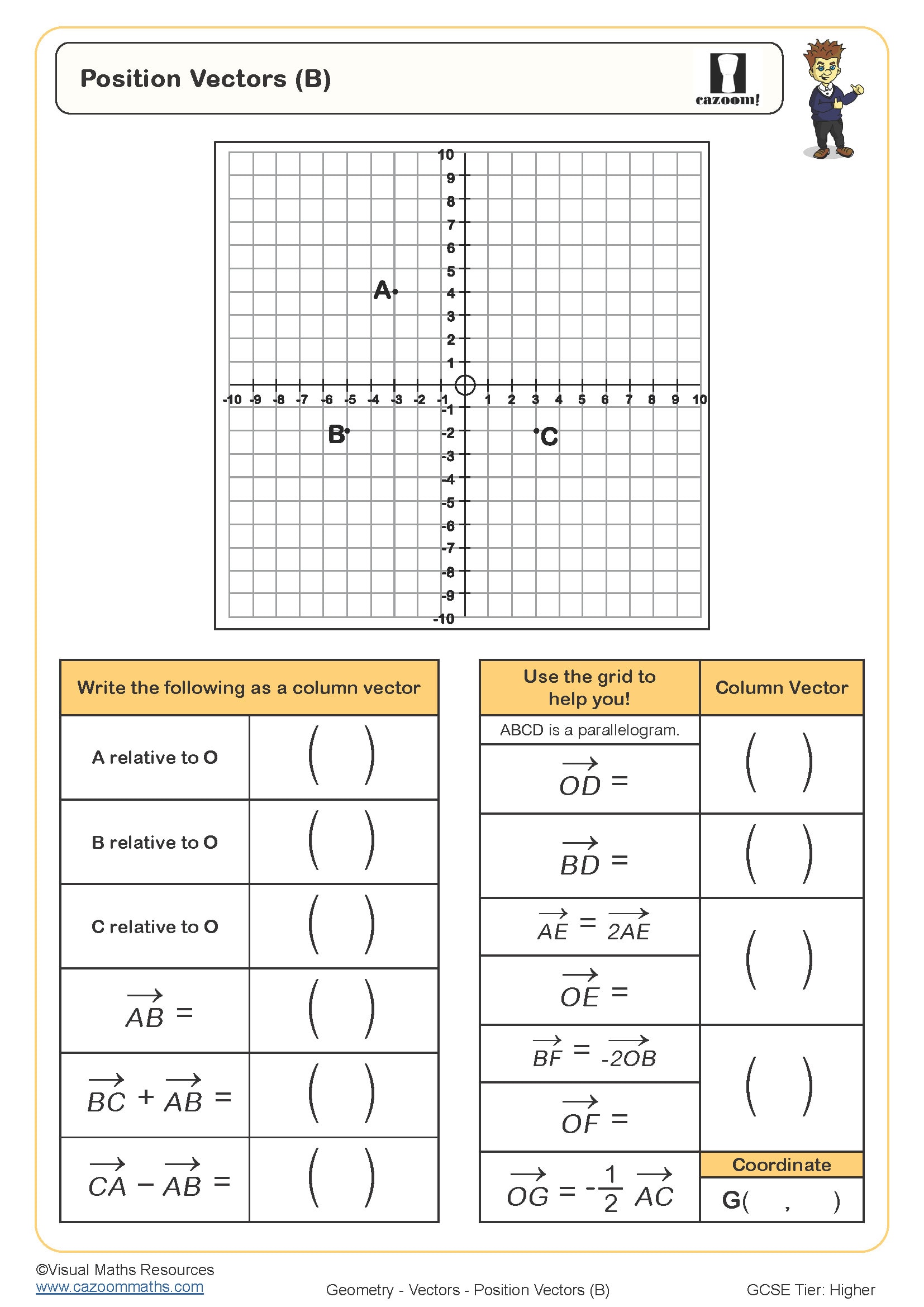
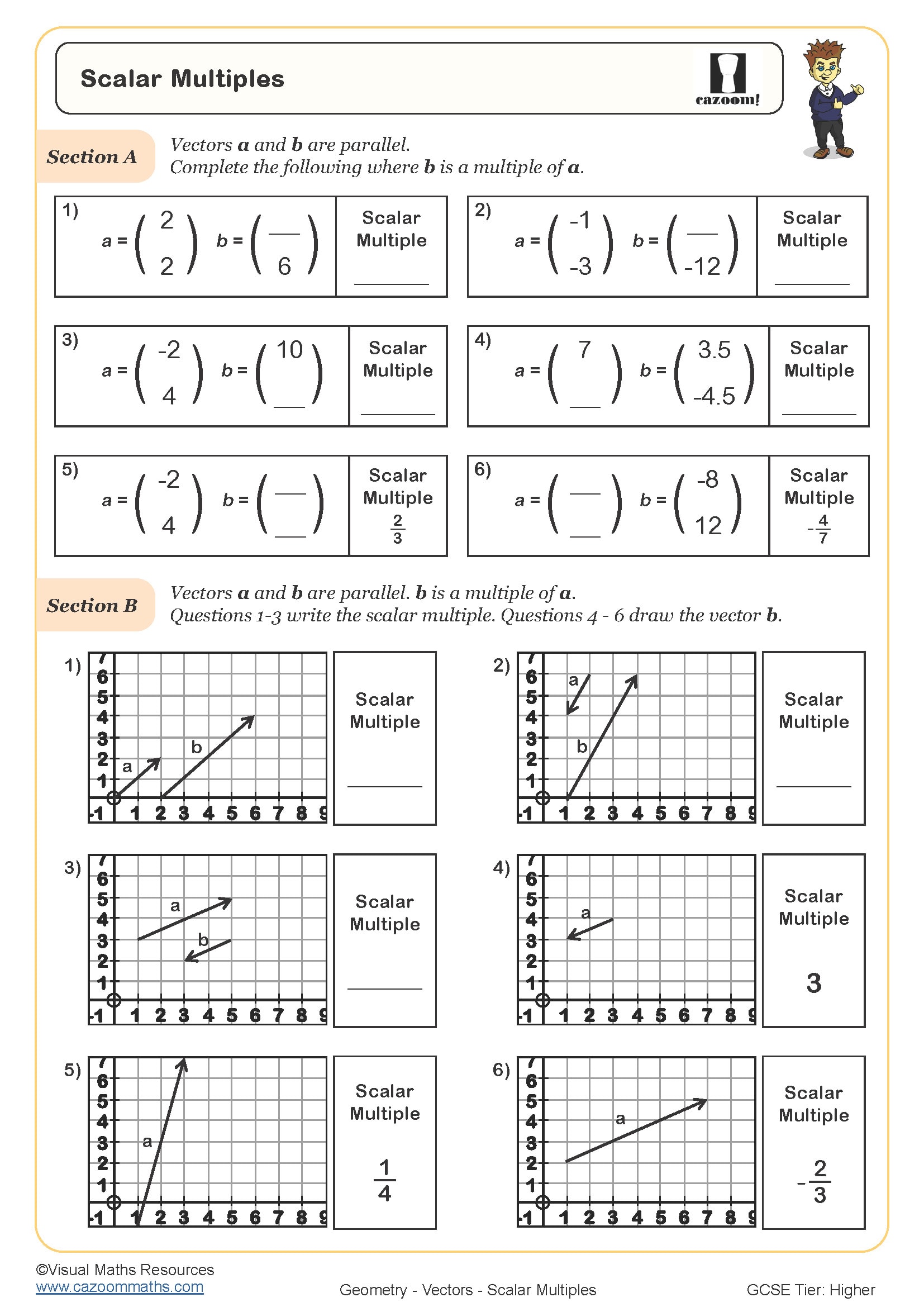
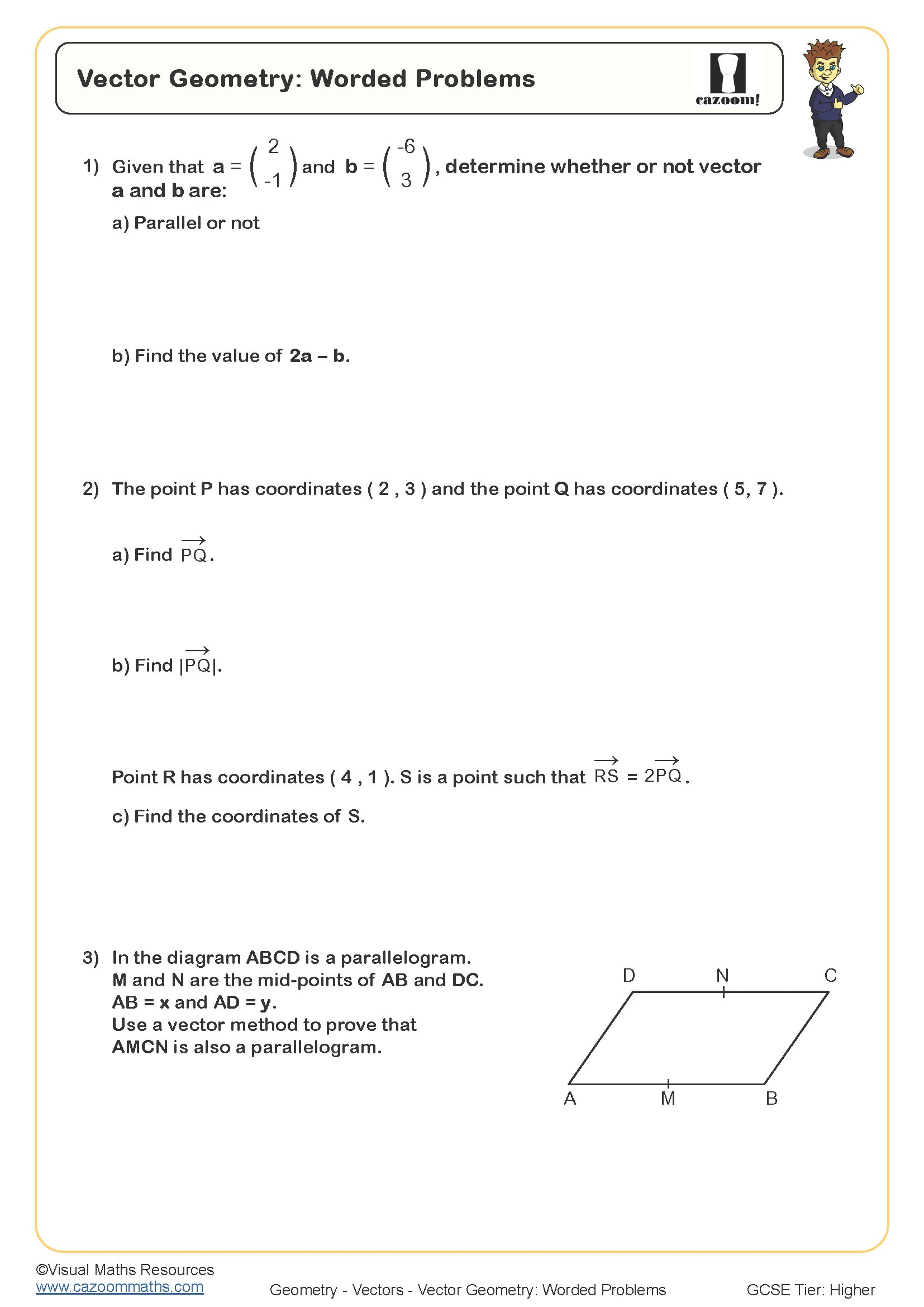
All worksheets are created by the team of experienced teachers at Cazoom Maths.
What do students learn in vectors at GCSE?
GCSE vectors covers representing translations as column vectors, adding and subtracting vectors both diagrammatically and algebraically, and multiplying vectors by scalars. Students learn to use vectors to describe position and displacement, prove that points are collinear, and demonstrate that lines are parallel. The topic appears in both Foundation and Higher tier papers, though Higher tier questions involve more complex problem-solving and proof.
A common misconception occurs when students confuse the vector notation for movement with coordinate points. For instance, students might write the vector from (2, 3) to (5, 7) as (5, 7) rather than (3, 4). Exam mark schemes consistently penalise this confusion, particularly in questions asking students to express one vector in terms of others using shape properties.
Which year groups study vectors?
Vectors appears in the KS4 curriculum, typically introduced in Year 10 and developed further in Year 11. The topic sits within the geometry and measures strand of the National Curriculum, connecting to transformations and coordinate geometry. Schools often teach vectors after students have secure understanding of coordinates and basic algebraic manipulation, as the notation requires comfort with both systems.
The progression moves from interpreting and drawing column vectors through to algebraic manipulation and geometric reasoning. Year 10 work establishes notation, addition, subtraction and scalar multiplication, while Year 11 consolidates these skills within problem-solving contexts. Higher tier students tackle proof questions requiring them to show parallel lines or express complex position vectors using given information about shape properties like midpoints or ratios.
How are vectors used in real life?
Vectors describe any quantity with both magnitude and direction, making them fundamental to physics and engineering. Column vectors represent forces, velocities, accelerations and displacements. When engineers design structures, they use vectors to calculate resultant forces and ensure stability. Navigation systems use vector calculations to determine routes, whilst game developers use vectors constantly to control character movement and camera angles in three-dimensional environments.
This real-world application helps students understand why adding vectors involves adding corresponding components rather than treating them as single numbers. When physicists calculate the resultant of two forces acting on an object, they're performing exactly the same vector addition that students practise algebraically. The connection between column vectors and physical quantities like velocity also reinforces why scalar multiplication makes sense: doubling the velocity vector represents doubling the speed in the same direction.
How do these worksheets build vector skills?
The worksheets develop vector understanding through carefully sequenced questions that build from notation and basic operations through to multi-step problems. Questions include diagrammatic representations alongside algebraic working, helping students connect visual and symbolic representations. Worked examples demonstrate the notation conventions and calculation methods, whilst varied question styles ensure students can apply their understanding flexibly rather than following memorised procedures without comprehension.
Teachers use these resources effectively for targeted intervention with students who find the notation challenging, as homework to consolidate lesson content, or as revision materials before assessments. The answer sheets enable students to self-check their work, making the worksheets valuable for independent study periods. Many teachers find that pairing students to discuss vector problems helps address the visualisation difficulties, as explaining their reasoning to peers forces students to articulate whether they're thinking about vectors as movements or simply as number pairs.