Addition and Subtraction with Negative Numbers Worksheets
Directed Number - Addition Using Directed Counters
Year groups: 7, 8
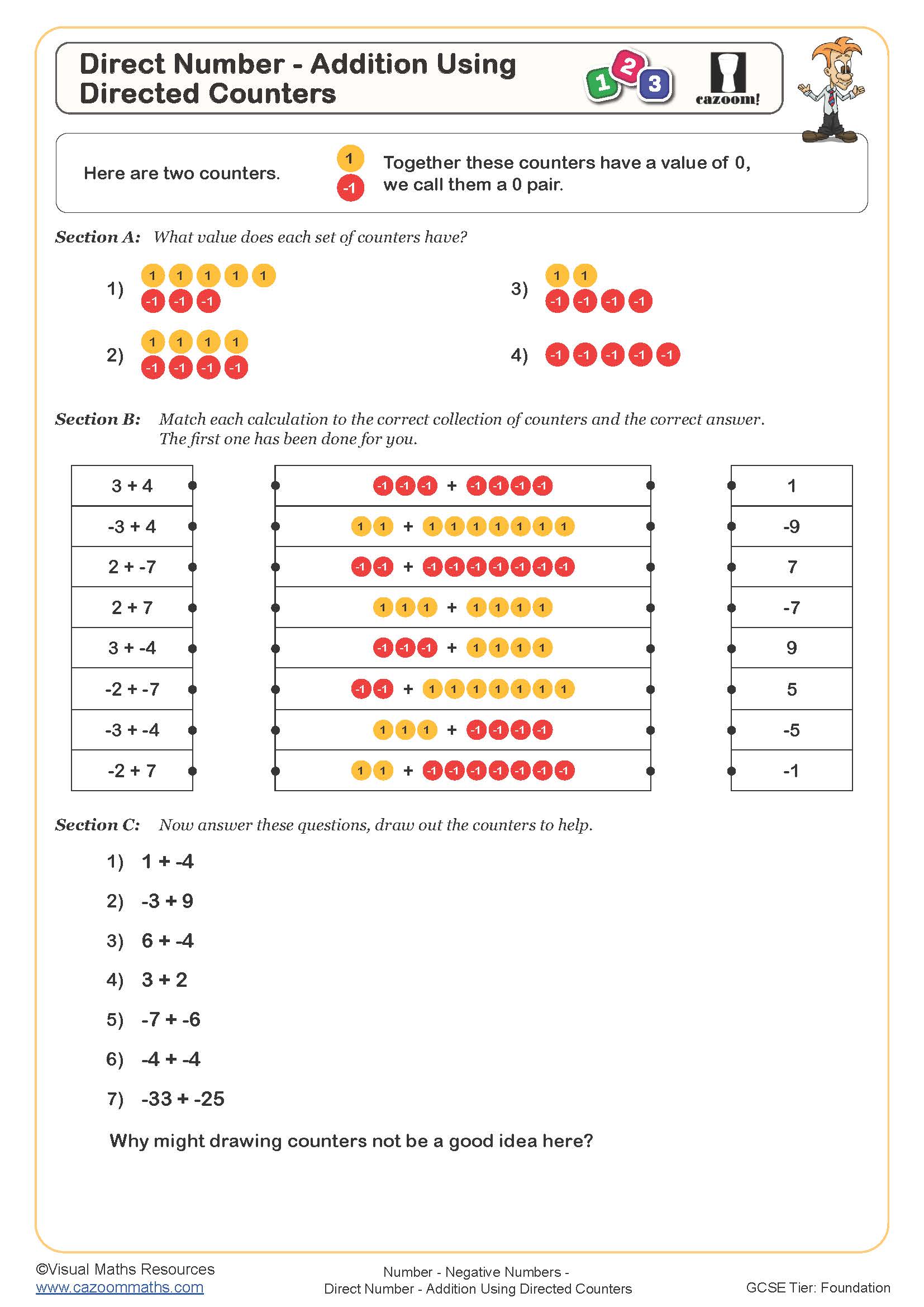
Directed Number - Subtraction Using Directed Counters
Year groups: 7, 8
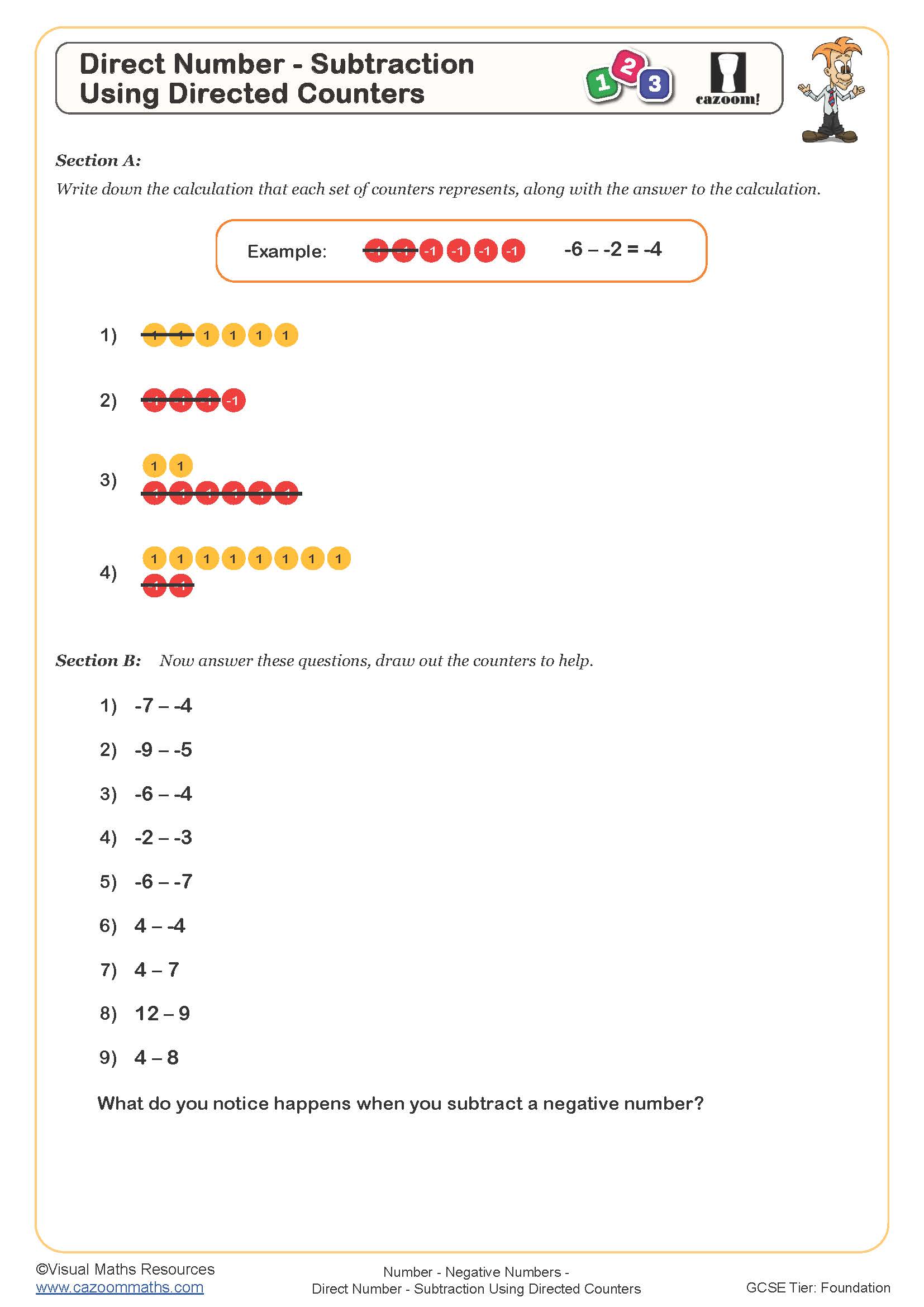
Directed Number – Addition by Pattern Spotting
Year groups: 7, 8
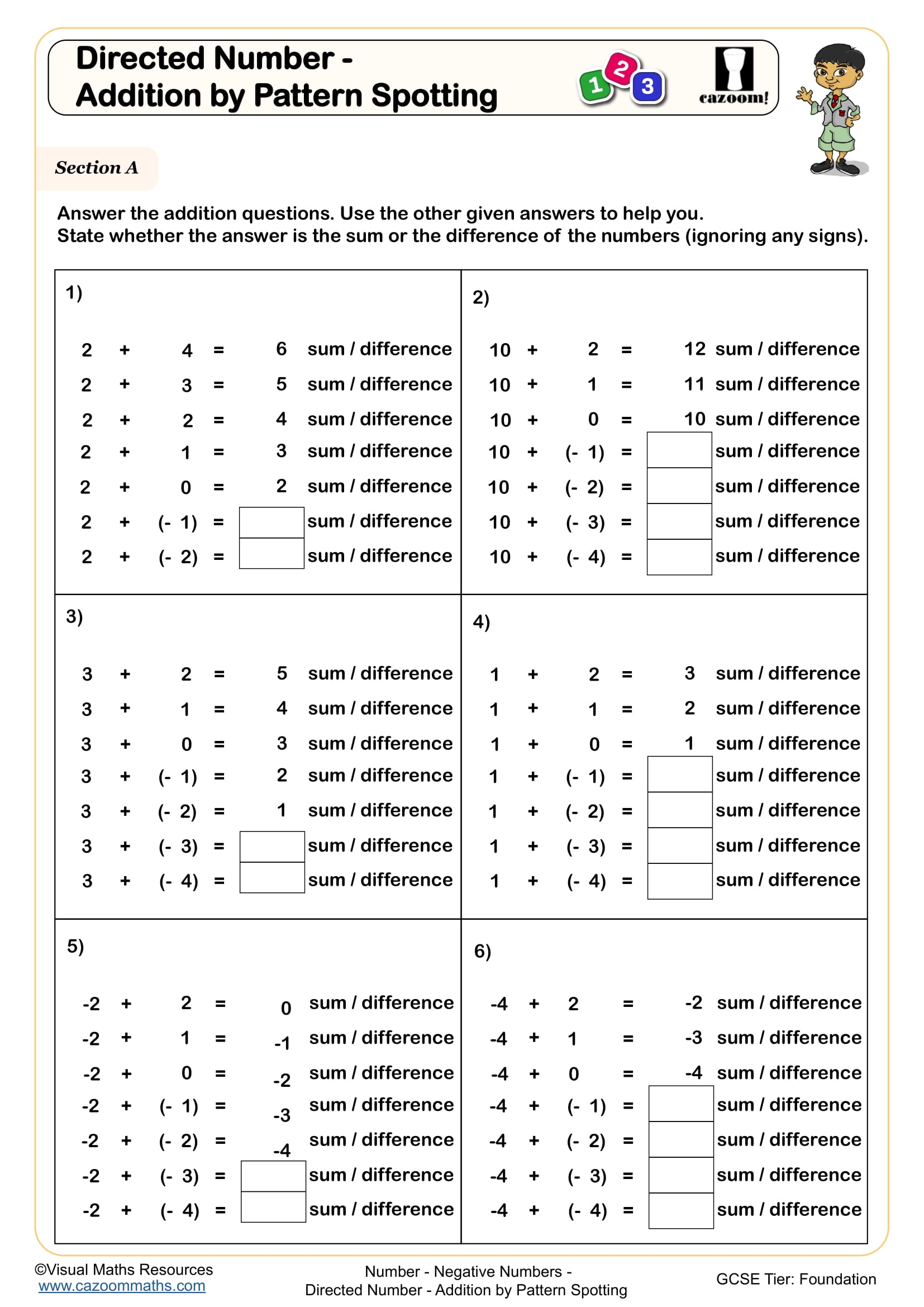
Directed Number – Subtraction by Pattern Spotting
Year groups: 7, 8
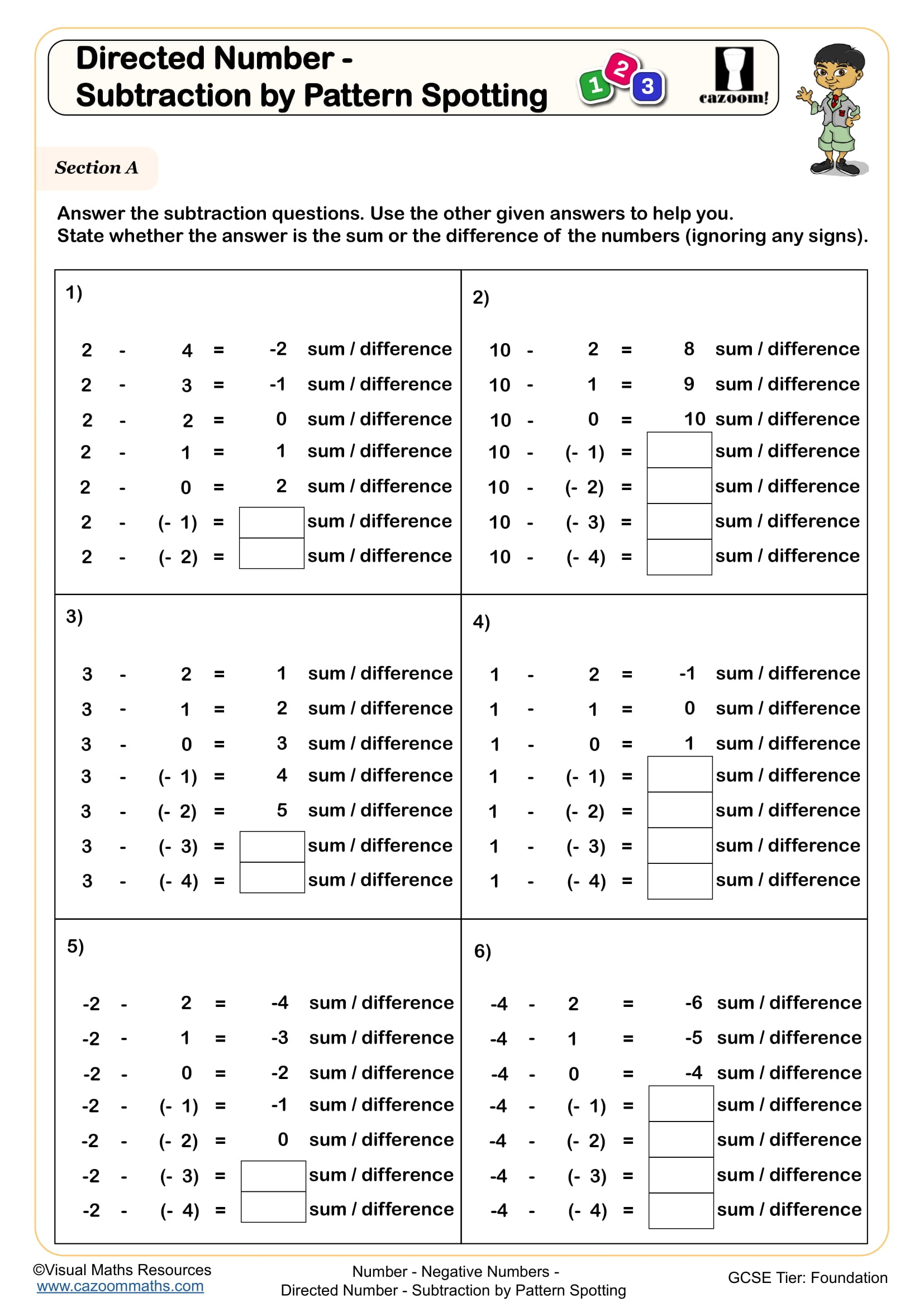
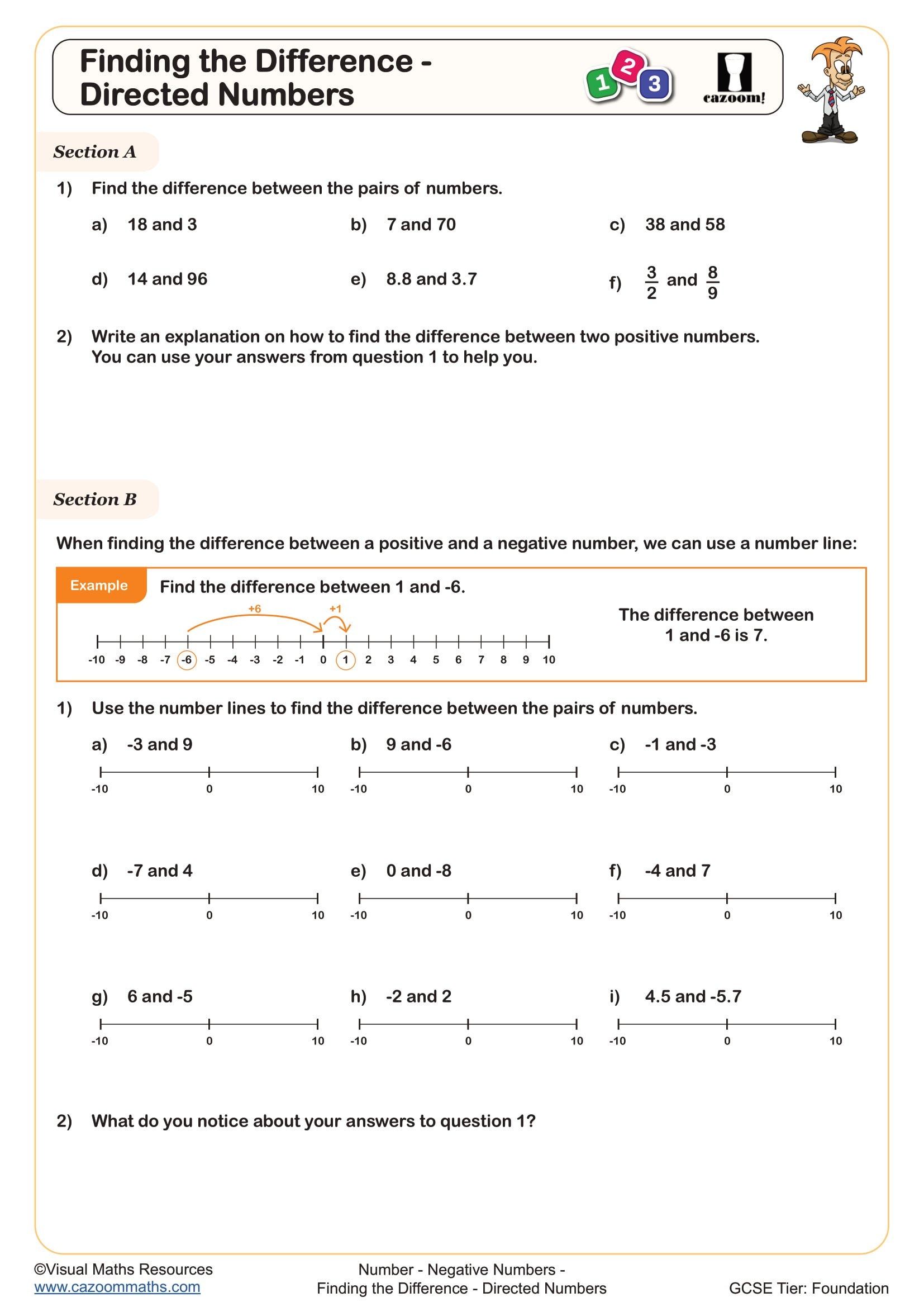
Finding the Difference - Directed Numbers
Year groups: 7, 8
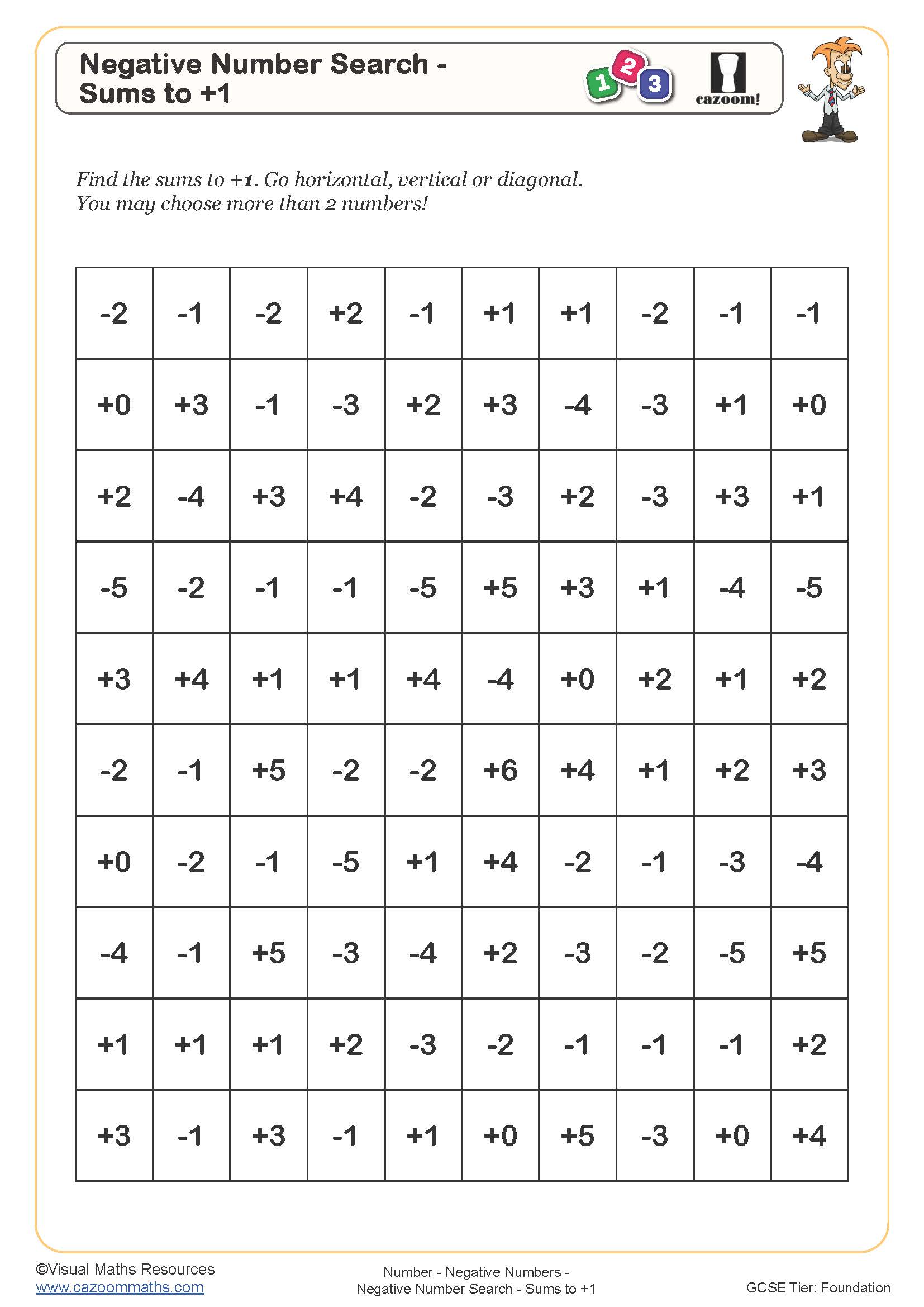
Negative number search - sums to +1
Year groups: 7, 8
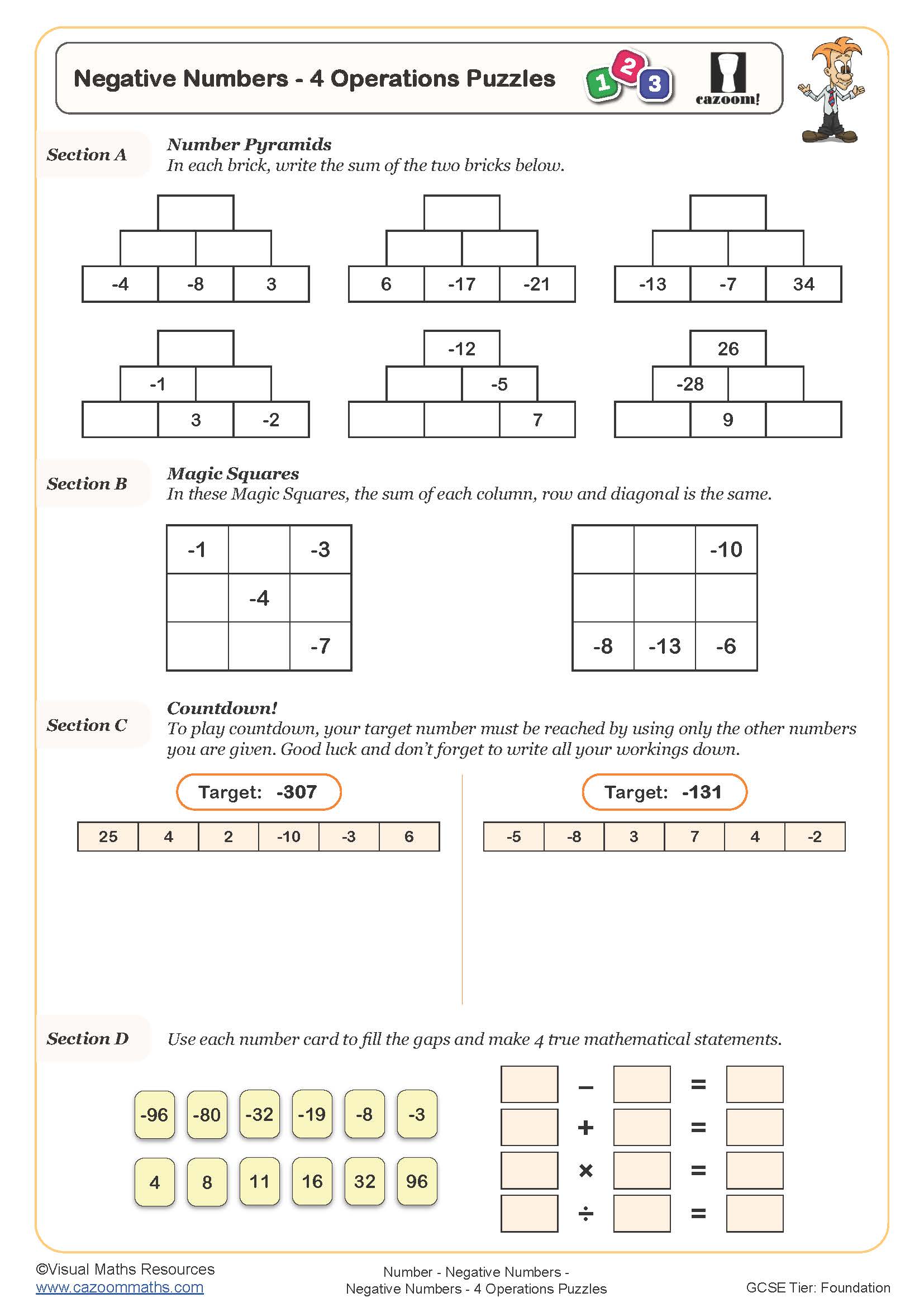
Negative Numbers - 4 Operations Puzzles
Year groups: 7, 8
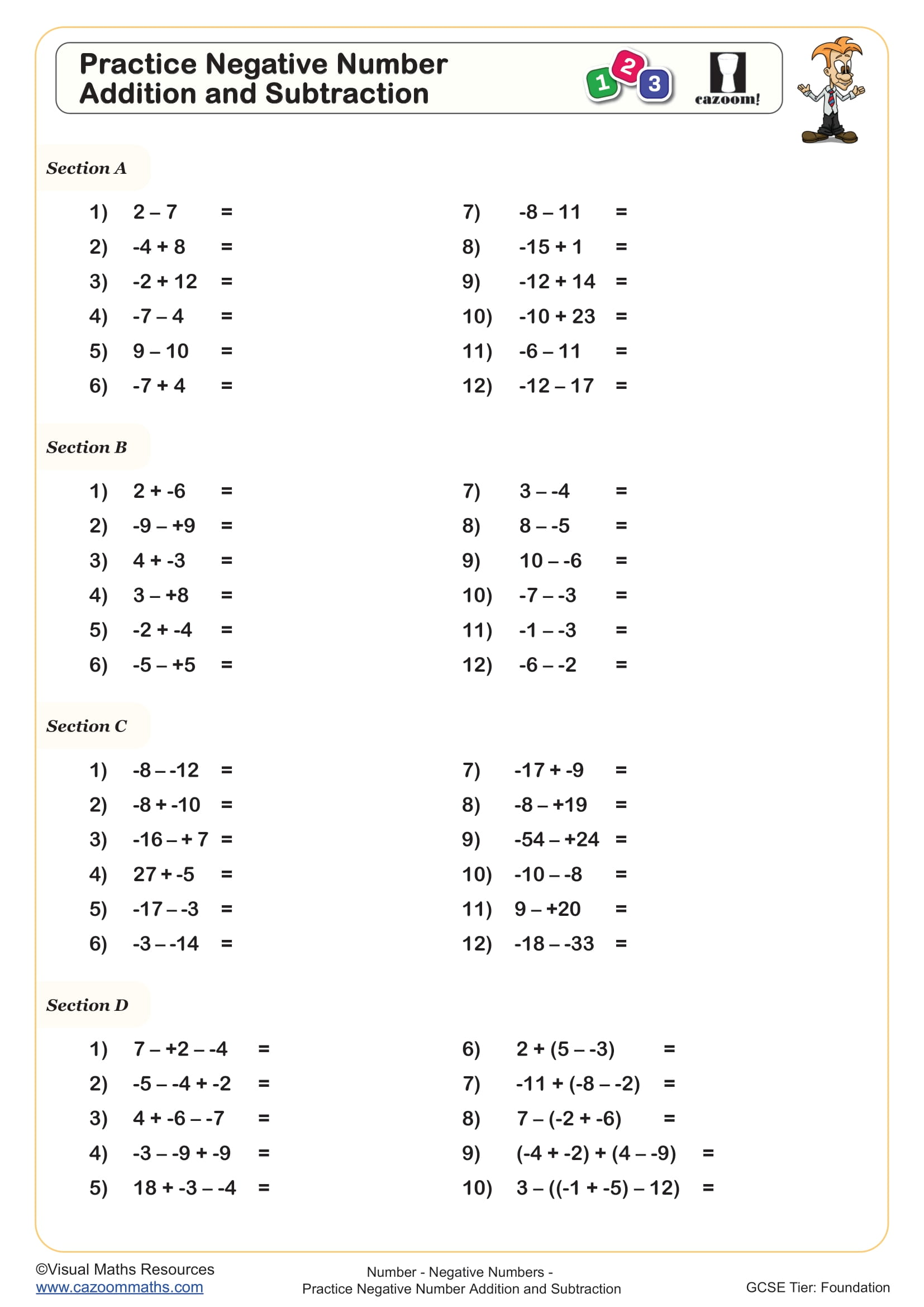
Practice Negative Number Addition and Subtraction
Year groups: 7, 8, 9
All worksheets are created by the team of experienced teachers at Cazoom Maths.
Why do students find adding and subtracting negative numbers difficult?
The main difficulty stems from overturning years of experience where subtraction always makes numbers smaller. When students encounter 5 − (−3), they must reconcile that removing a negative actually increases the value. Many students also confuse the operation sign with the sign of the number itself, particularly in expressions like −4 + −7.
Exam mark schemes regularly penalise students who abandon number sense when working with negatives. For instance, when calculating −8 − 3, students might write −5 instead of −11 because they subtract the smaller number from the larger by habit. Teachers find that using temperature contexts or bank account models helps students visualise why these operations work as they do, though translating this understanding to abstract calculations requires consistent practice.
Which year groups study addition and subtraction with negative numbers?
This topic appears in Year 7, Year 8, and Year 9 as part of the KS3 National Curriculum for number and place value. Year 7 students begin with straightforward calculations involving negative integers, typically on number lines or in simple expressions. The emphasis at this stage is on understanding what negative numbers represent and building fluency with basic operations.
By Year 8 and Year 9, the complexity increases substantially. Students tackle multi-step problems, combine negative numbers with algebraic thinking, and work with decimals and fractions alongside negative values. Year 9 worksheets often incorporate directed numbers within problem-solving contexts, requiring students to select appropriate operations and interpret answers in context—skills that feed directly into GCSE Foundation and Higher content.
What strategies help with subtracting negative numbers?
The most robust approach teaches students to rewrite subtraction of a negative as addition of its opposite: 7 − (−4) becomes 7 + 4. This method works because subtracting a debt has the same effect as gaining an asset. Some teachers use the phrase 'subtracting a negative is the same as adding' though this requires students to identify the positive equivalent correctly.
This skill has genuine applications in accounting and science. Financial analysts calculate profit margins by subtracting negative values when reversing losses, whilst physicists work with vectors where subtracting a negative displacement means moving in the opposite direction. In climate science, temperature changes over decades involve subtracting negative anomalies—if temperatures were −2°C below average and the deviation reduces by −1°C, the actual change is +1°C towards the mean. These contexts give students a reason to master what initially seems abstract.
How should teachers use these negative number worksheets?
The worksheets scaffold learning by starting with number line representations before moving to abstract calculations. Early questions typically show the working visually, helping students connect the symbolic notation to what actually happens on a number line. Later questions remove this support, requiring students to apply the methods independently. The answer sheets allow students to self-check during independent practice, which is particularly valuable for building confidence with a topic where many students doubt their answers.
Many teachers use these worksheets for targeted intervention with students who missed this foundation in Year 7, as negative number errors persist through GCSE if not addressed. They work well as retrieval practice starters in Year 9 to maintain fluency before tackling equations with negative solutions. For homework, the answer sheets enable parents to support their children without needing to recall the methods themselves. Paired work also proves effective—students explain their reasoning to partners, which reveals misconceptions that silent practice often hides.