Bounds and Error Intervals Worksheets
All worksheets are created by the team of experienced teachers at Cazoom Maths.
What are bounds and error intervals in maths?
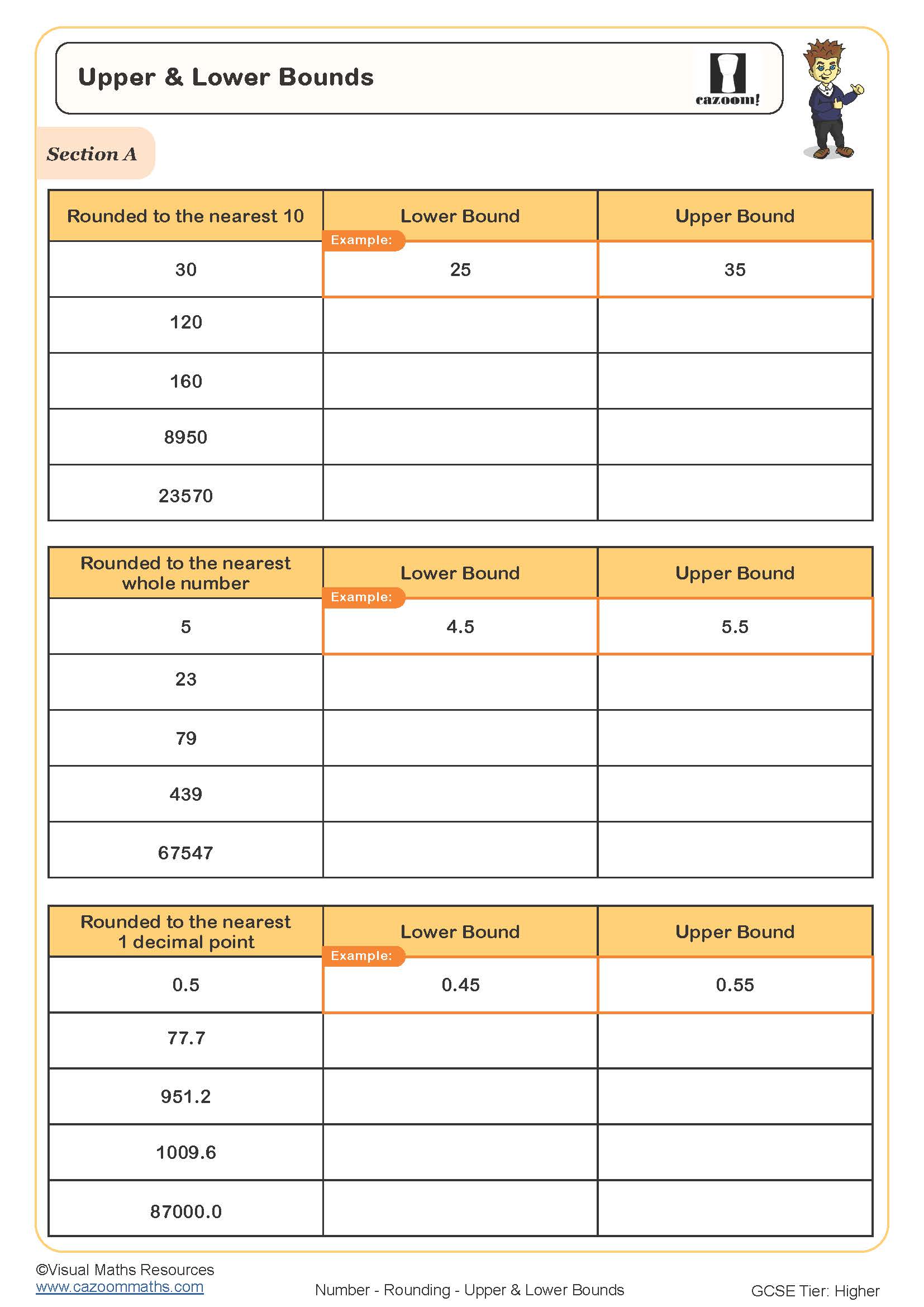
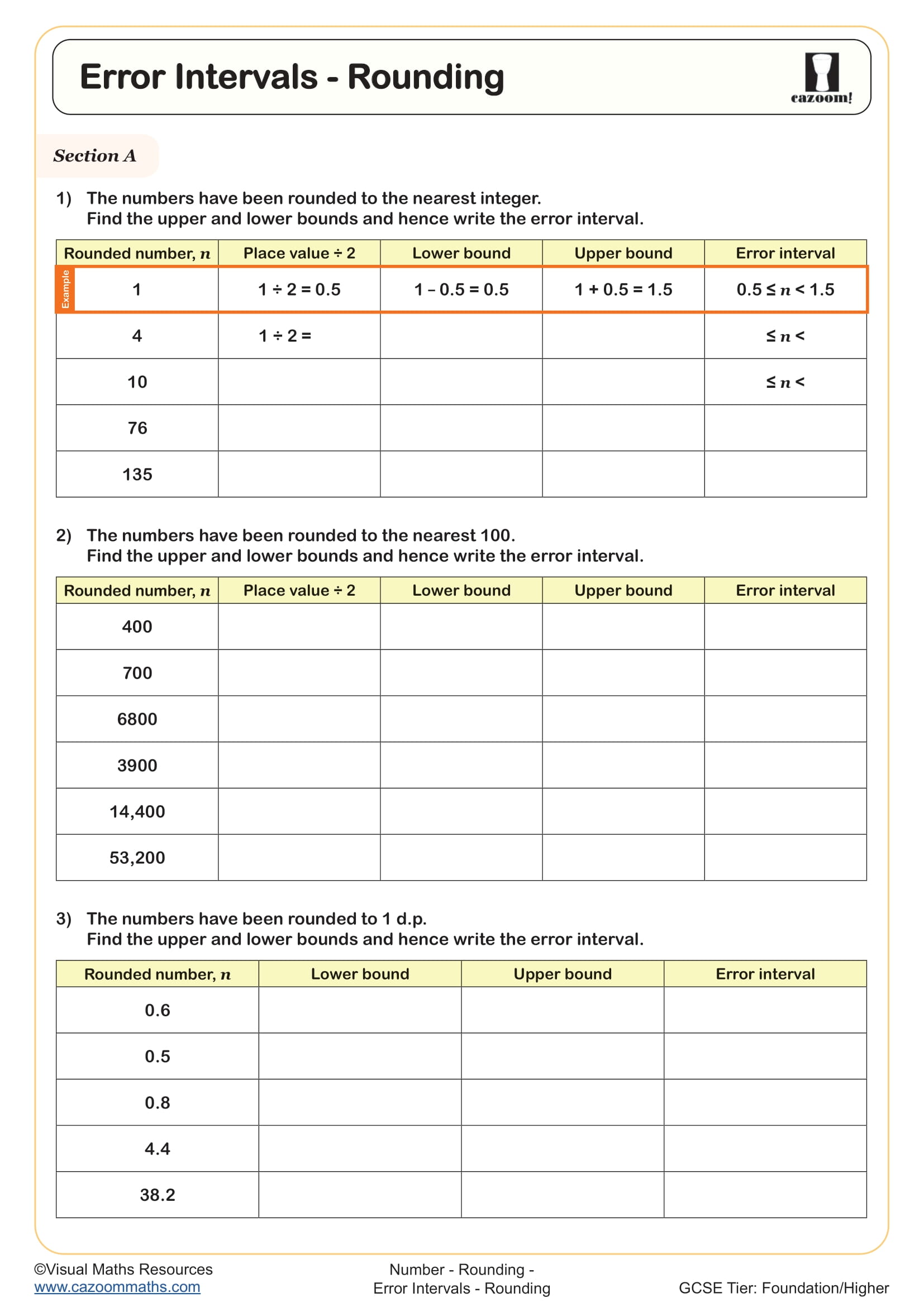
Bounds and error intervals describe the range of possible actual values when a number has been rounded or measured to a given degree of accuracy. The lower bound is the smallest value that would round to the given number, whilst the upper bound is the smallest value that would round up to the next interval. These concepts appear in the National Curriculum from Year 8 onwards and become crucial for GCSE problem-solving questions.
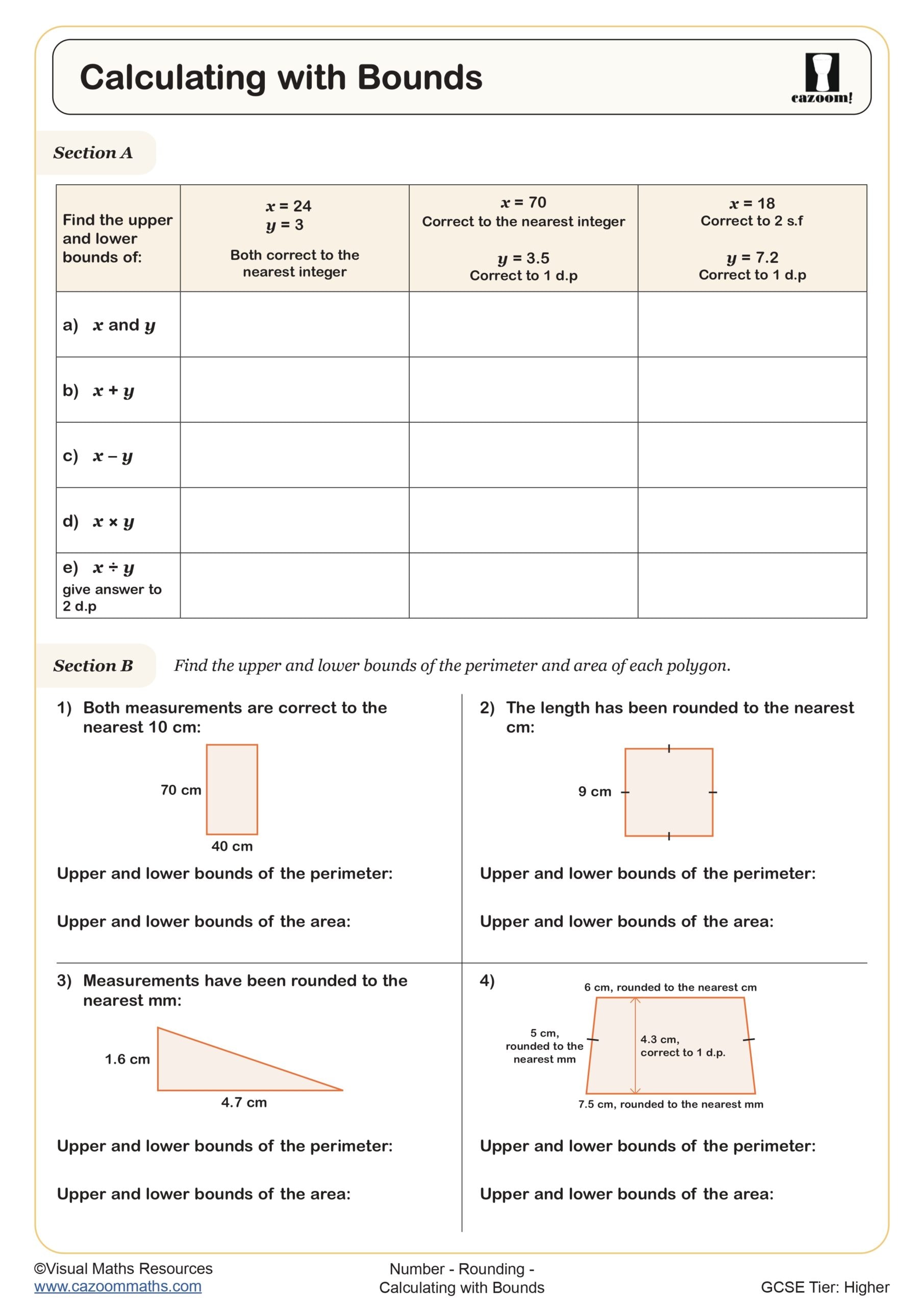
Students often make errors when determining upper bounds for calculations involving division or subtraction. A typical misconception involves thinking that dividing two upper bounds gives the maximum possible answer, when actually the maximum quotient comes from dividing the upper bound of the numerator by the lower bound of the denominator. Exam mark schemes regularly penalise this misunderstanding, making systematic practice with varied calculation types particularly valuable.
Which year groups study bounds and error intervals?
These worksheets support students in Year 8, Year 9, Year 10, and Year 11, spanning both Key Stage 3 and Key Stage 4. The topic is introduced at KS3 when students begin working with rounded measurements and understand that 7.3 cm (to 1 decimal place) represents any measurement from 7.25 cm up to but not including 7.35 cm. This foundation supports later work in science practicals where measurement uncertainty matters.
Progression through the year groups involves increasing complexity in calculations. Year 8 students typically work with finding simple bounds for single rounded numbers, whilst Year 10 and 11 students tackle compound problems requiring them to calculate maximum and minimum values for expressions involving multiple operations. GCSE questions often combine bounds with area, perimeter, or speed calculations, expecting students to select appropriate bounds for different operations within the same problem.
How do you use bounds in area and perimeter calculations?
When calculating with bounds in area and perimeter problems, students must determine which combination of upper and lower bounds produces the maximum or minimum result. For perimeter, the maximum occurs when all measurements are at their upper bounds, whilst the minimum uses all lower bounds. Area calculations follow the same principle, but with multiplication, meaning maximum area comes from multiplying upper bounds together whilst minimum area requires lower bounds.
These skills connect directly to real-world applications in construction and manufacturing, where tolerances matter significantly. An engineer designing components that must fit together needs to ensure that even when measurements are at their maximum bounds, parts will still assemble correctly. Similarly, when calculating material requirements for flooring or fencing, understanding error intervals helps contractors order sufficient materials whilst minimising waste, demonstrating why precision in these calculations has genuine financial and practical consequences in STEM industries.
How can these bounds worksheets support classroom teaching?
The worksheets build understanding through carefully structured questions that progress from identifying bounds for single values to applying them in multi-step calculations. Each sheet typically includes worked examples showing the reasoning process, particularly for determining which bounds to use in different operations. This scaffolding helps students develop the logical thinking required for GCSE problem-solving questions, where showing method marks depends on clear reasoning about bound selection.
Many teachers use these resources for targeted intervention with students who struggle to translate word problems into bound calculations, or as homework to reinforce classwork on measurement and accuracy. The answer sheets make them suitable for independent revision before assessments, allowing students to check their working and identify specific areas needing attention. Paired work also proves effective, with students explaining to each other why particular bounds produce maximum or minimum values, strengthening their conceptual understanding through mathematical discussion.