Calculations Crossing Zero Worksheets
All worksheets are created by the team of experienced teachers at Cazoom Maths.
What are calculations crossing zero?
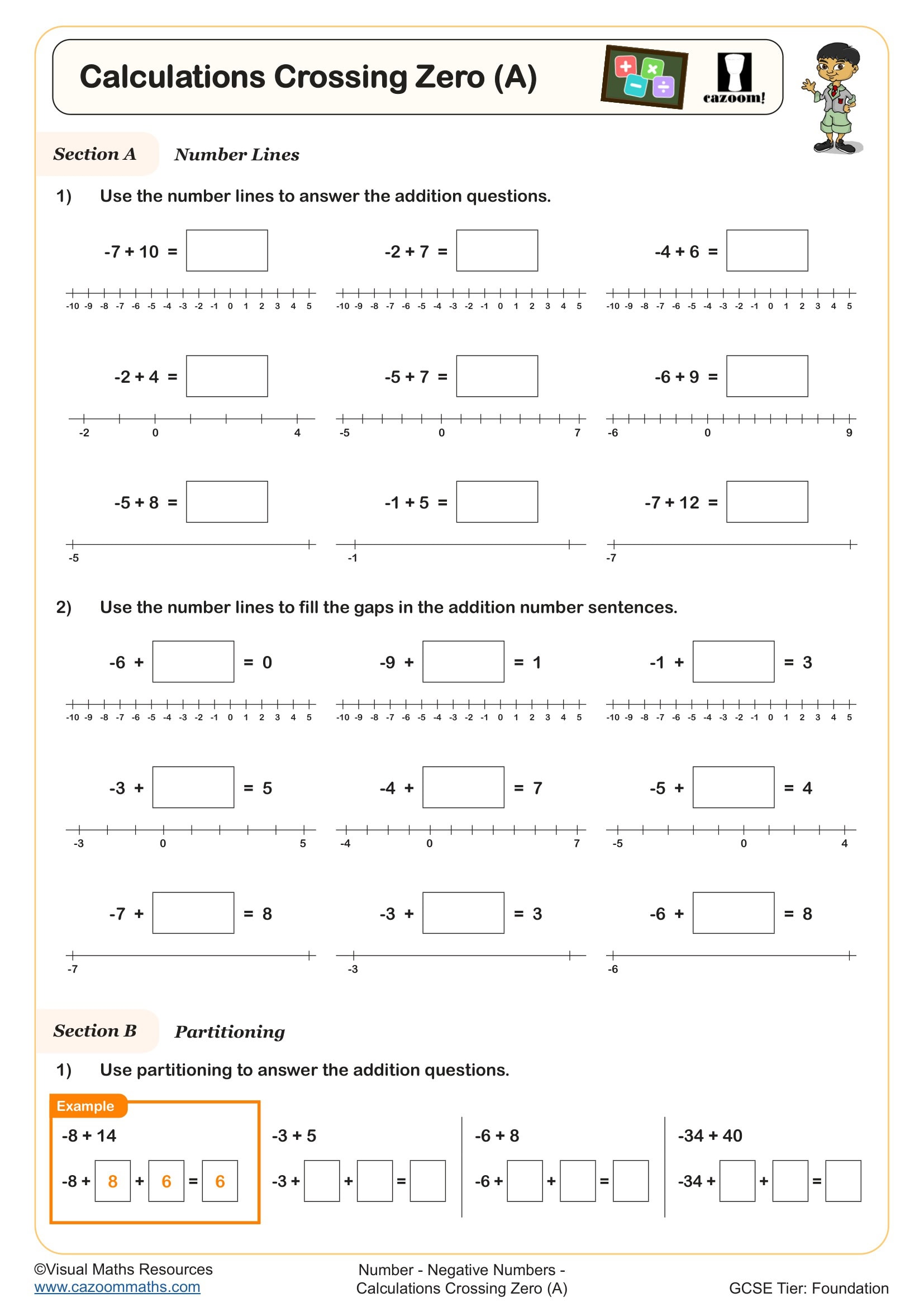
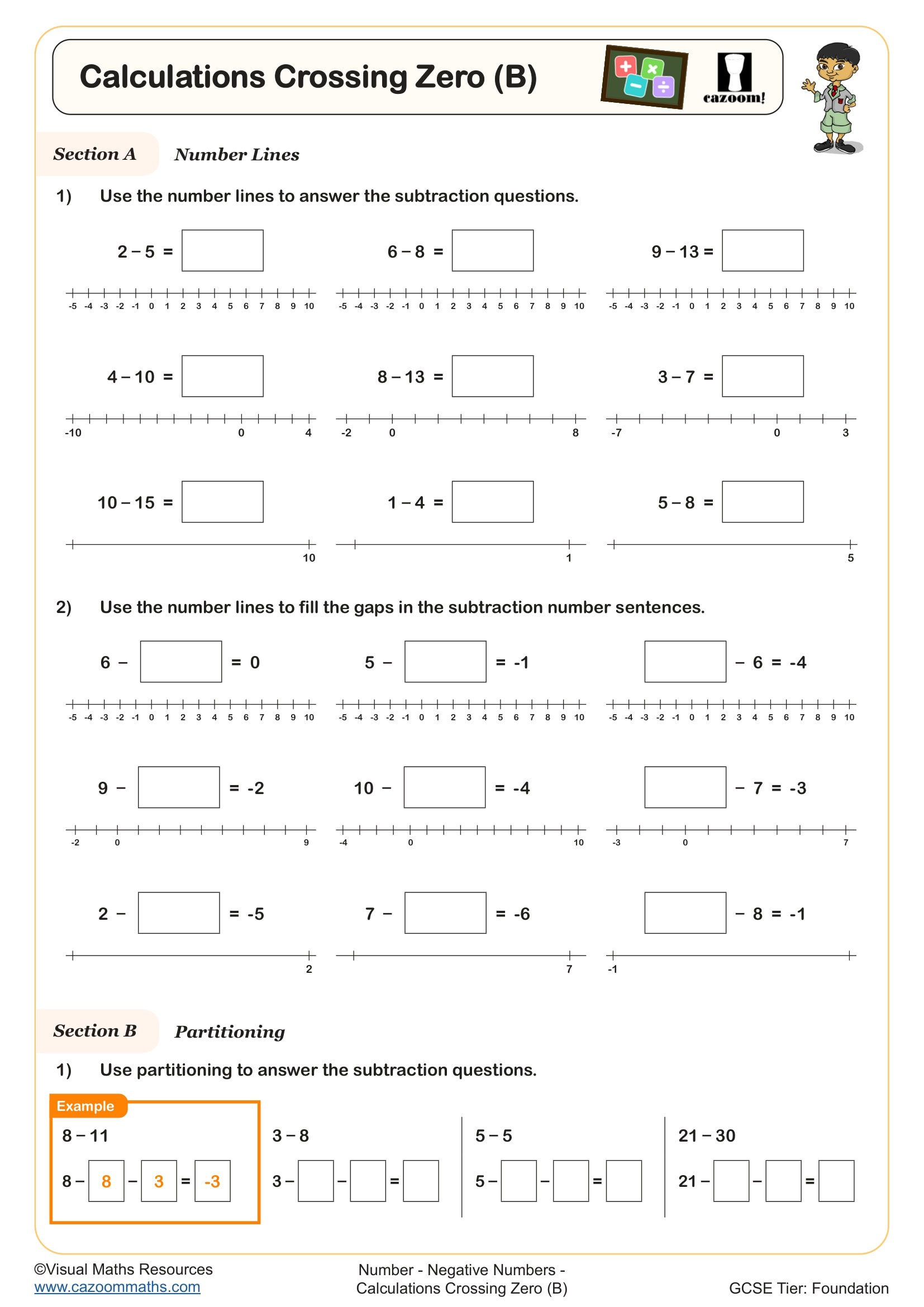
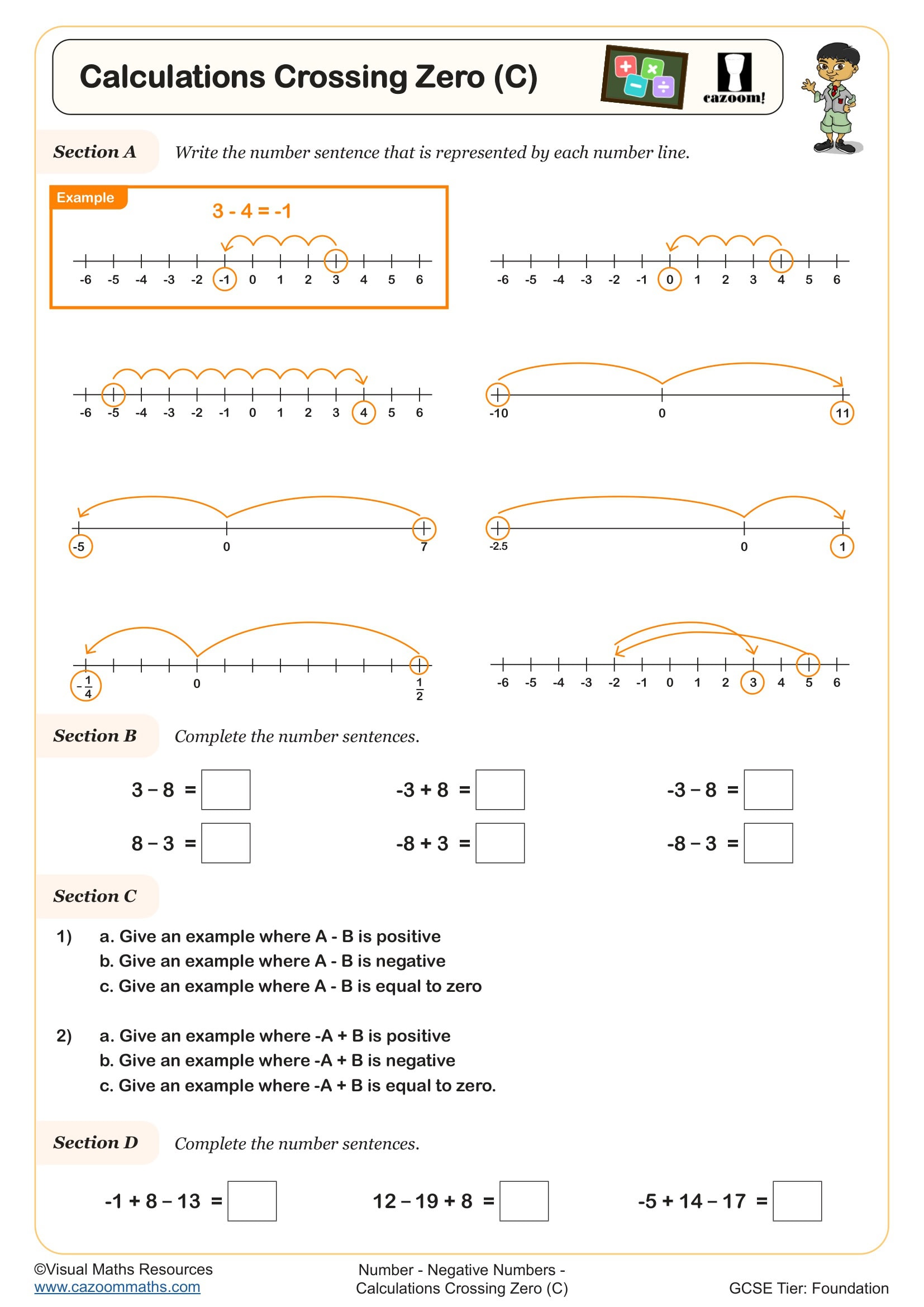
Calculations crossing zero involve arithmetic operations where the result moves from positive to negative numbers or vice versa, requiring students to work confidently with integers on both sides of zero. These appear throughout KS3 mathematics in contexts like temperature changes, bank balances, altitude differences, and algebraic simplification.
A typical example would be 5 - 8 = -3, where the calculation crosses from positive into negative territory. Students often lose marks by writing just '3' without the negative sign, or by trying to rearrange the calculation as 8 - 5 to avoid the negative result. Understanding that -3 is the correct answer, not an error, represents an important conceptual shift from primary arithmetic where answers were predominantly positive.
Which year groups study calculations crossing zero?
These worksheets cover Key Stage 3, specifically Year 7 and Year 8, where the National Curriculum expects students to extend their understanding of number to include negative integers. Year 7 introduces calculations crossing zero through addition and subtraction contexts, whilst Year 8 deepens this with multiplication, division, and multi-step problems involving all four operations.
Progression across these year groups moves from simple one-step calculations like 3 - 7 to more complex problems involving multiple operations and larger numbers. By the end of Year 8, students should apply these skills automatically when solving equations, plotting coordinates in all four quadrants, and tackling GCSE Foundation-level problems that assume fluency with negative number calculations.
Why do students need to understand negative number operations?
Negative number operations form the foundation for algebraic thinking and appear throughout GCSE mathematics, from solving linear equations to working with inequalities and functions. The ability to calculate accurately when crossing zero directly impacts student success in collecting like terms, rearranging formulae, and understanding gradient in coordinate geometry.
Beyond the classroom, negative numbers model real-world quantities like debt, temperature below freezing, floors below ground level, and depths below sea level. Engineers use negative values for forces acting in opposite directions, financial analysts track negative cash flow, and climate scientists measure temperature anomalies. The mathematical rules students learn for calculations crossing zero enable them to make sense of these authentic contexts, particularly in STEM careers where bidirectional measurements are routine.
How can these worksheets support student progress?
The worksheets build understanding through carefully sequenced questions that progress from straightforward single-step calculations to more demanding multi-step problems. Answer sheets allow students to identify errors in their working immediately, helping them recognise whether mistakes stem from sign errors, calculation errors, or conceptual misunderstandings about how negative numbers behave.
Teachers use these resources for targeted intervention with students who avoid negative answers, for homework to reinforce classroom teaching, and for retrieval practice before moving onto algebraic manipulation. They work particularly well in paired activities where students compare answers and explain their reasoning, as verbalising why 4 - 9 equals -5 rather than 5 strengthens conceptual understanding. The worksheets also support mixed-ability teaching, allowing confident students to work independently whilst teachers address misconceptions through small-group support.