Compare and Order Decimals Worksheets
All worksheets are created by the team of experienced teachers at Cazoom Maths.
What are the common mistakes when comparing decimals?
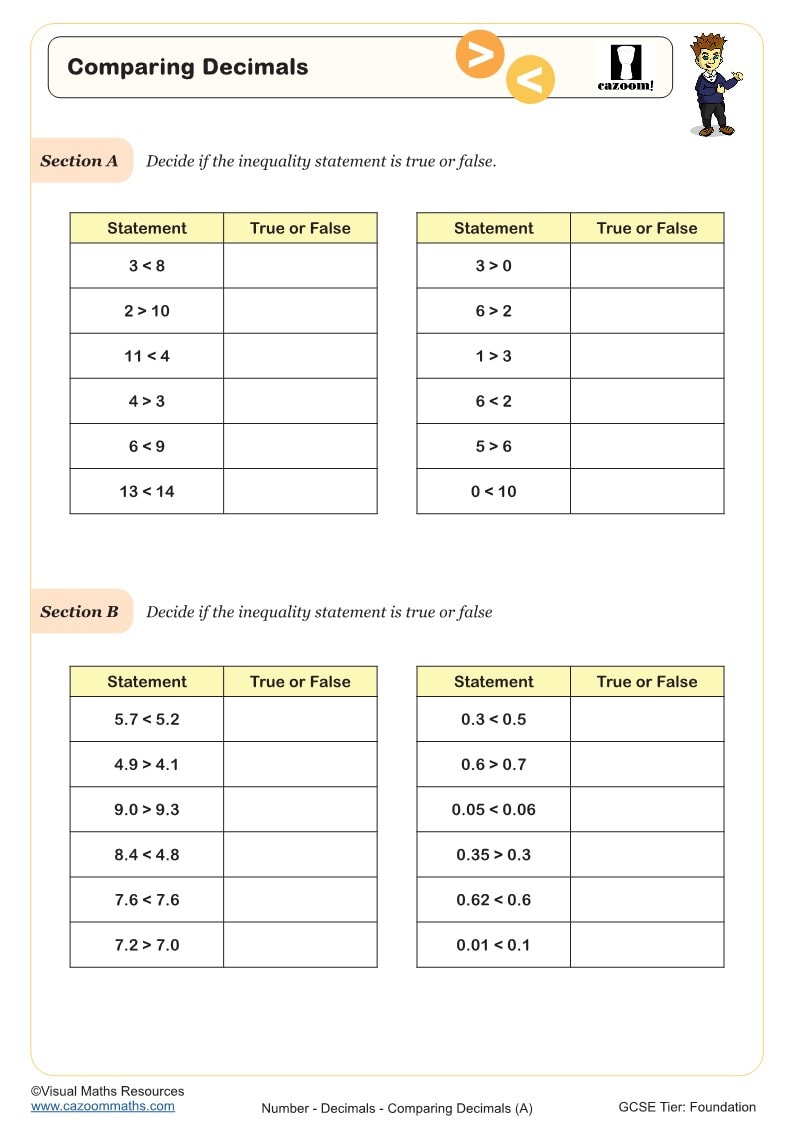
The most persistent error occurs when students treat the digits after the decimal point as whole numbers rather than considering place value. Many will incorrectly claim that 0.125 is greater than 0.8 because they compare 125 with 8, ignoring that the 8 represents eight tenths whilst the 1 represents just one tenth. Another frequent mistake involves assuming that more decimal places means a larger number, leading students to think 0.3333 must be bigger than 0.5.
Teachers often find success by encouraging students to write decimals with the same number of decimal places—converting 0.8 to 0.800 makes the comparison with 0.125 immediately clearer. Students also lose marks in assessments when they misread inequality symbols, particularly when ordering several decimals in one go. Practising with explicit place value columns helps students visualise why 0.45 sits between 0.4 and 0.5, rather than treating it as a number closer to 45.
Which year groups learn to compare and order decimals?
These worksheets cover compare and order decimals for Year 7 and Year 8 students at Key Stage 3. By this stage, students are expected to work confidently with decimals up to three decimal places and apply their understanding to increasingly complex problems. The National Curriculum expects students to order positive and negative decimals and justify their reasoning using place value knowledge.
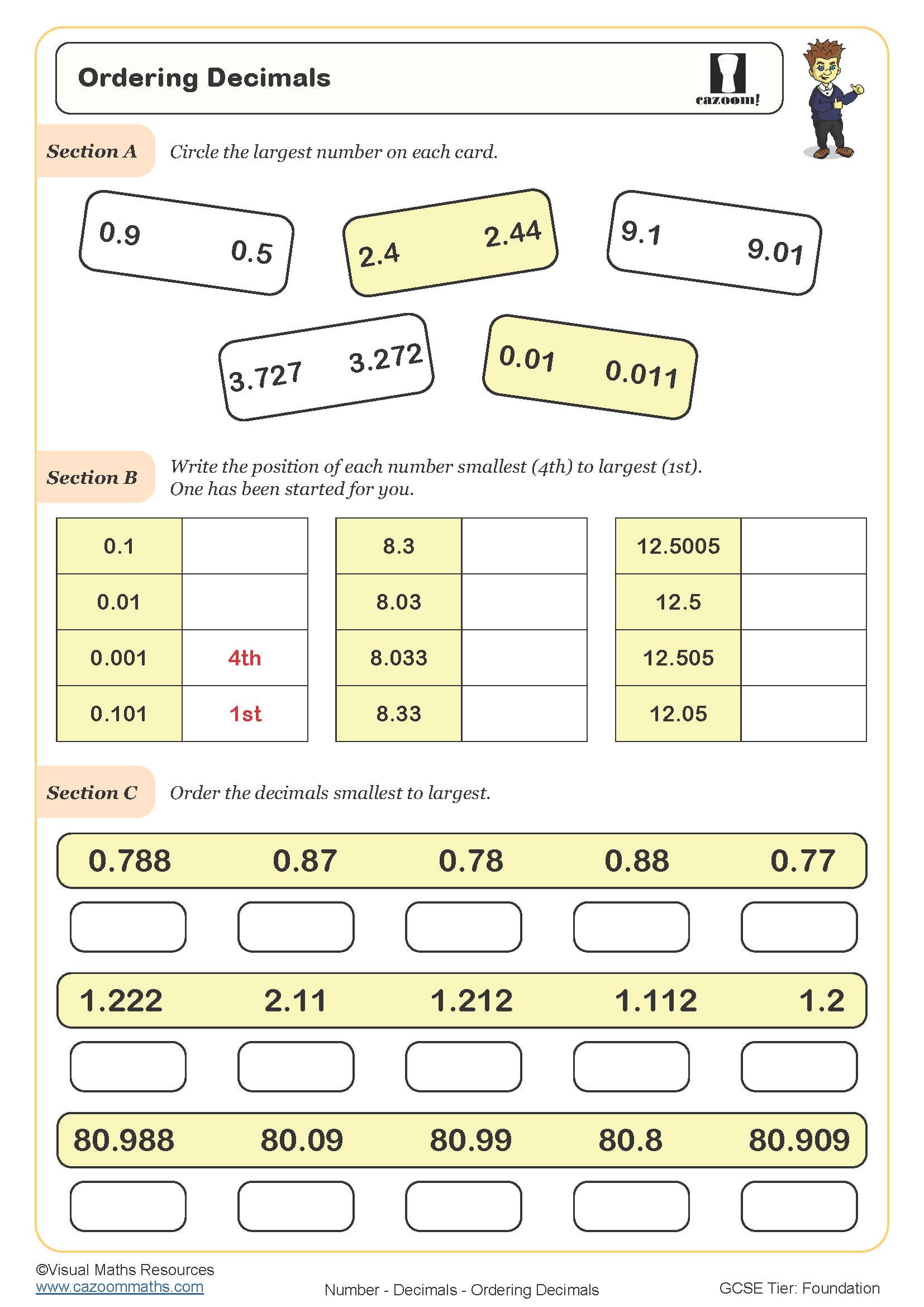
Progression across these year groups moves from straightforward comparisons of positive decimals with one or two decimal places towards problems involving negative decimals, recurring decimals, and mixed sets that include fractions and percentages. Year 8 students tackle questions where they must convert between forms before ordering, such as arranging 0.6, ⅔, and 65% in size order. This builds towards GCSE Foundation tier, where students must demonstrate fluency in comparing decimals within multi-step problems involving measurement, money, and data interpretation.
How do you use place value to compare decimals?
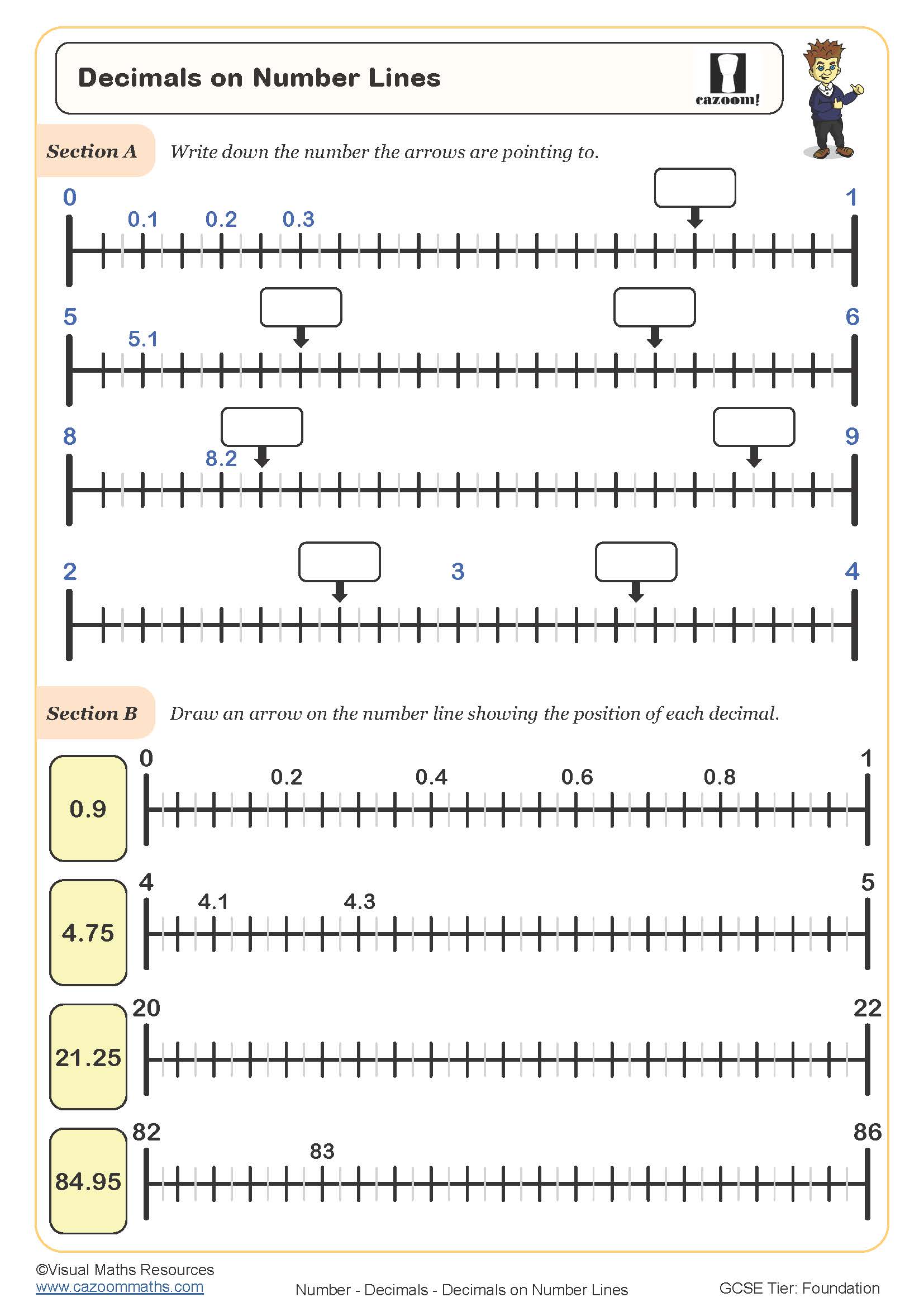
Comparing decimals systematically requires students to examine each place value column from left to right, starting with the units, then tenths, then hundredths, and so on. If two decimals have the same digit in the tenths column, students move to the hundredths column to determine which is larger. Writing numbers in a place value grid or aligning decimal points vertically helps students see which positions to compare—a method that prevents the common error of comparing digit quantities rather than their values.
This skill connects directly to measurement in science and engineering, where precision matters enormously. When a machinist reads 0.08mm and 0.125mm on a digital calliper, understanding that 0.125mm is the larger measurement prevents costly manufacturing errors. Scientists comparing experimental results recorded as 0.034g and 0.04g need accurate decimal comparison to draw valid conclusions. The ability to order decimals quickly and accurately appears throughout STEM careers, from pharmacists calculating dosages to engineers interpreting sensor data.
How can these worksheets support decimal understanding?
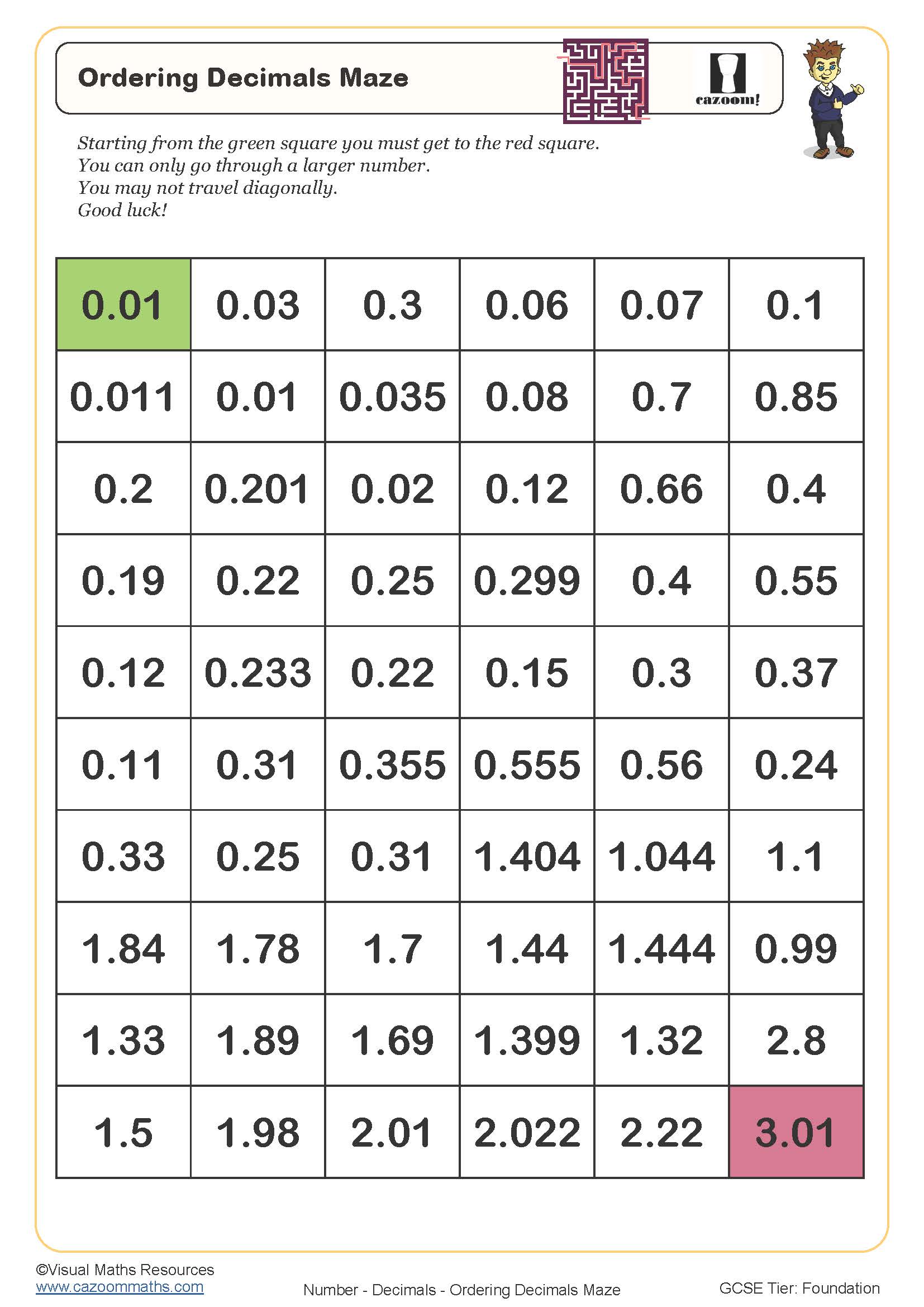
The worksheets provide structured practice that builds from comparing pairs of decimals towards ordering longer sequences and tackling worded problems. Many questions encourage students to explain their reasoning, which helps teachers identify whether errors stem from place value misunderstandings or simple calculation slips. The inclusion of answer sheets means students can check their work independently, reinforcing correct methods and allowing them to identify patterns in their mistakes without waiting for teacher feedback.
These resources work effectively as targeted intervention for students who haven't fully grasped decimal place value, as homework to consolidate classwork, or as low-stakes assessment to check understanding before moving on to decimal calculations. Some teachers use them for paired work where students must agree on an answer and justify it to each other, which surfaces misconceptions quickly. The worksheets also serve as useful revision material before end-of-unit tests or as starter activities to refresh knowledge before introducing operations with decimals.