Compare and Order Negative Numbers Worksheets
All worksheets are created by the team of experienced teachers at Cazoom Maths.
What are the rules for ordering negative numbers?
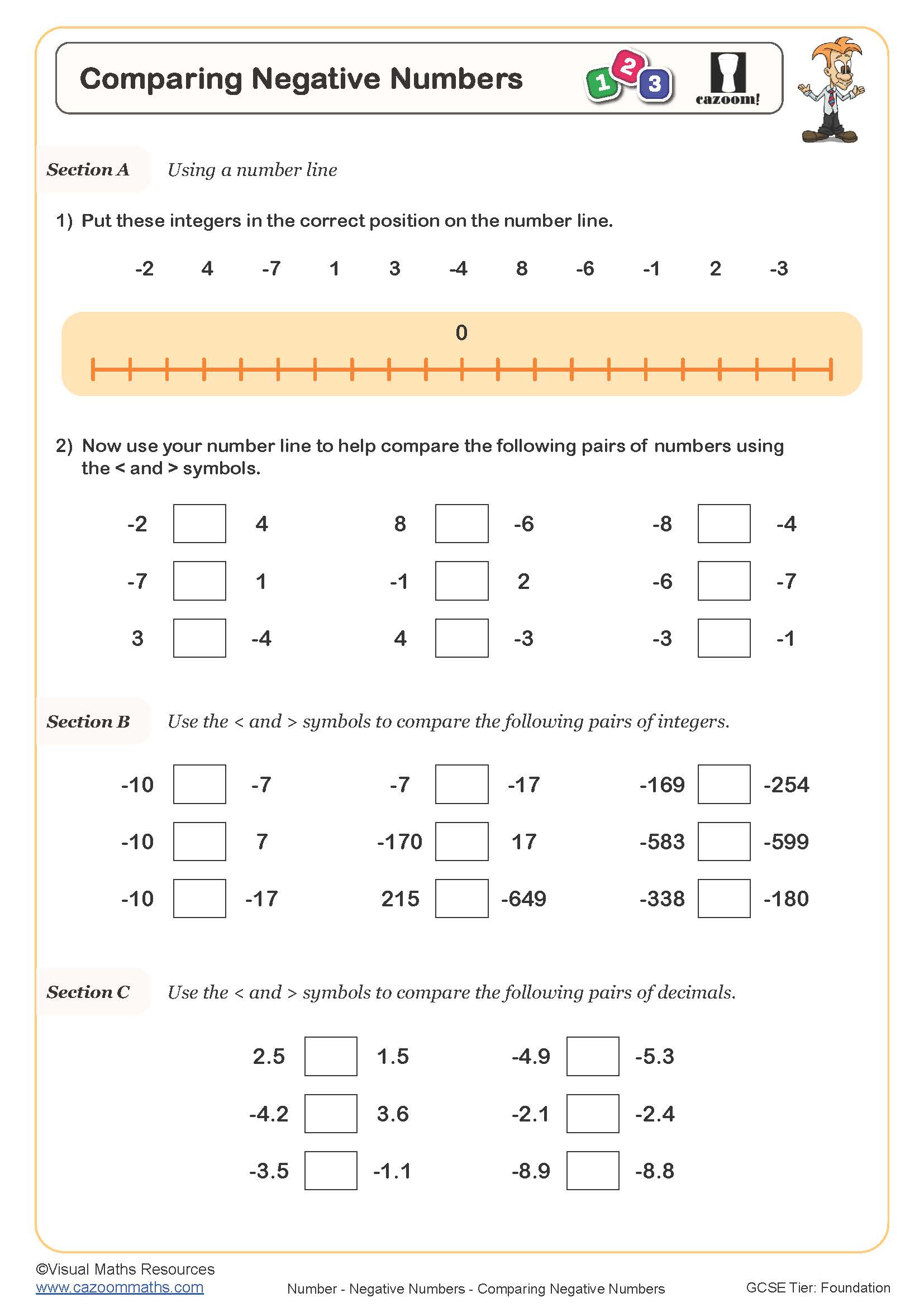
When ordering negative numbers, the most important rule is that numbers further to the left on a number line are smaller, regardless of their magnitude. This means -15 is smaller than -2, even though 15 is greater than 2. Students use the inequality symbols < (less than) and > (greater than) to compare pairs of integers, remembering that the symbol always opens towards the larger number.
A common error occurs when students focus on the numerical value rather than the position on the number line. Teachers often observe students writing -20 > -5 because they see 20 as bigger than 5, ignoring the negative signs. Exam mark schemes consistently penalise this mistake, so worksheets that provide repeated practise with varied integer pairs help students internalise the correct ordering principle before they encounter more complex contexts like coordinates or thermometer scales.
Which year group learns to compare and order negative numbers?
Comparing and ordering negative numbers appears in the Year 7 National Curriculum as part of the Number strand. Students at KS3 extend their understanding of integers beyond whole numbers and begin working systematically with negative values, building on informal exposure to temperatures and altitude from primary school. This topic typically appears early in Year 7 to establish secure foundations before moving into directed number operations.
The skill progresses throughout KS3 as students encounter increasingly complex scenarios. In Year 7, worksheets focus on straightforward ordering tasks and direct comparisons. By Year 8, these negative numbers appear within algebraic expressions and equations, whilst Year 9 students apply ordering skills to inequalities on number lines and solution sets. Secure understanding at Year 7 prevents persistent errors that otherwise resurface in GCSE topics like compound inequalities and gradient calculations.
How do you use a number line to compare negative numbers?
A number line provides a visual representation where zero sits centrally, positive numbers extend to the right, and negative numbers extend to the left. To compare two negative numbers, students locate both values on the line and recognise that any number positioned to the left is smaller. For example, when comparing -4 and -9, plotting both shows that -9 sits further left, making it the smaller value. This concrete visual method helps students move beyond memorising rules to understanding why -9 < -4.
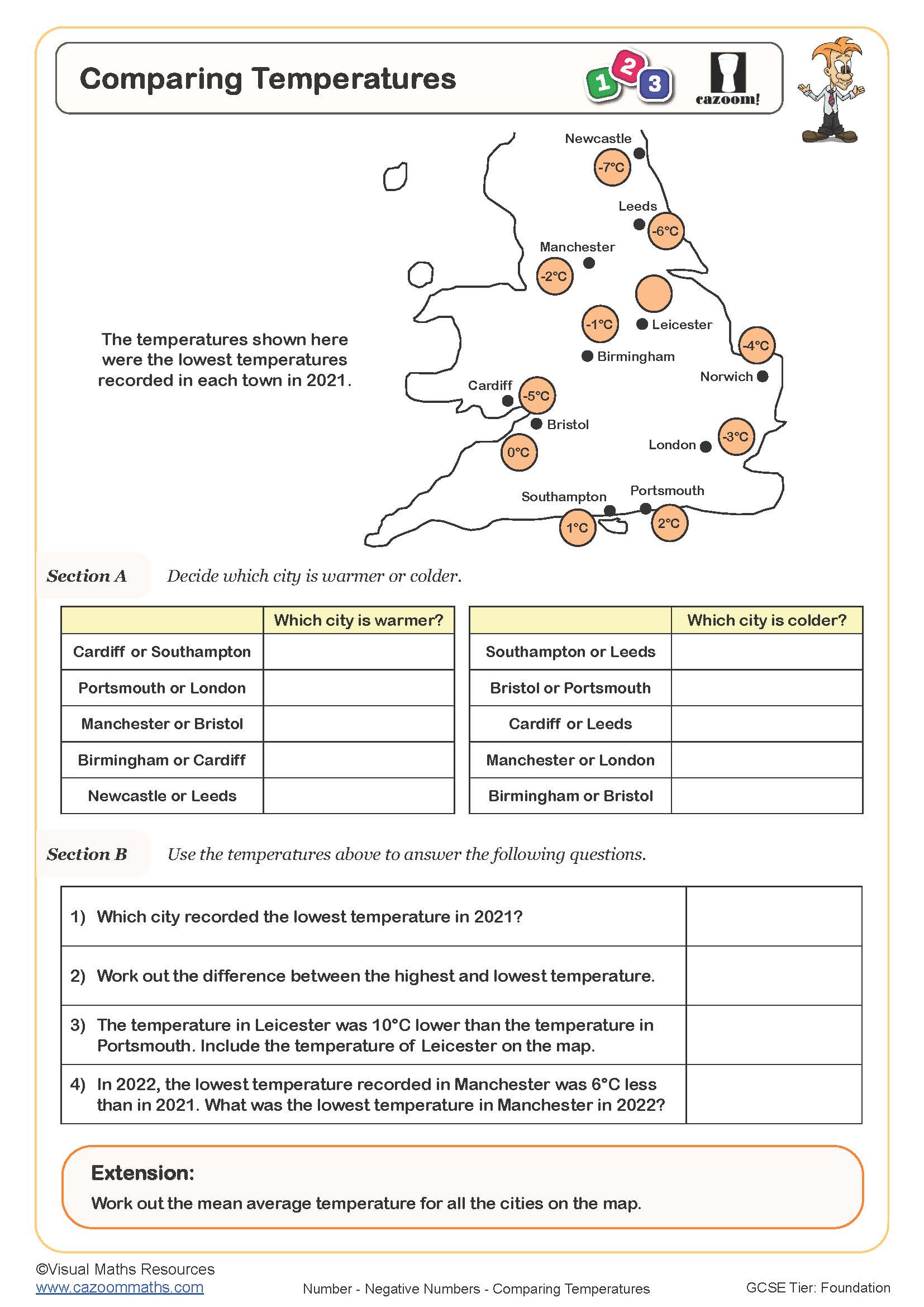
Number lines connect directly to real-world temperature scales, where understanding negative values has practical implications. Meteorologists use negative Celsius values for freezing conditions, and students who grasp number line positioning can quickly determine that -12°C is colder than -5°C. This skill also underpins coordinate geometry in STEM subjects, where plotting points in all four quadrants requires accurate comparison of both negative x and y coordinates to position points correctly on Cartesian planes.
How do these worksheets help students master comparing negative numbers?
The worksheets provide structured practise that moves from placing individual negative numbers on marked number lines to ordering sets of mixed positive and negative integers without visual aids. This gradual progression builds confidence whilst addressing the common misconception that larger numerical values always mean larger numbers. Answer sheets included with each worksheet enable students to identify errors immediately and understand where their reasoning breaks down, particularly when they've applied magnitude thinking instead of positional thinking.
Teachers use these resources flexibly across different classroom settings. They work well for intervention sessions with small groups who need additional support before tackling directed number calculations, and as homework tasks that consolidate lesson content without requiring extensive teacher input. Many teachers also deploy them during starter activities to refresh KS3 students' understanding before introducing integer arithmetic, or as paired work where students explain their ordering decisions to each other, reinforcing mathematical vocabulary around inequality symbols and number line positioning.