Converting Between Units of Time Worksheets
All worksheets are created by the team of experienced teachers at Cazoom Maths.
What Should Students Practise with Converting Time Worksheets?
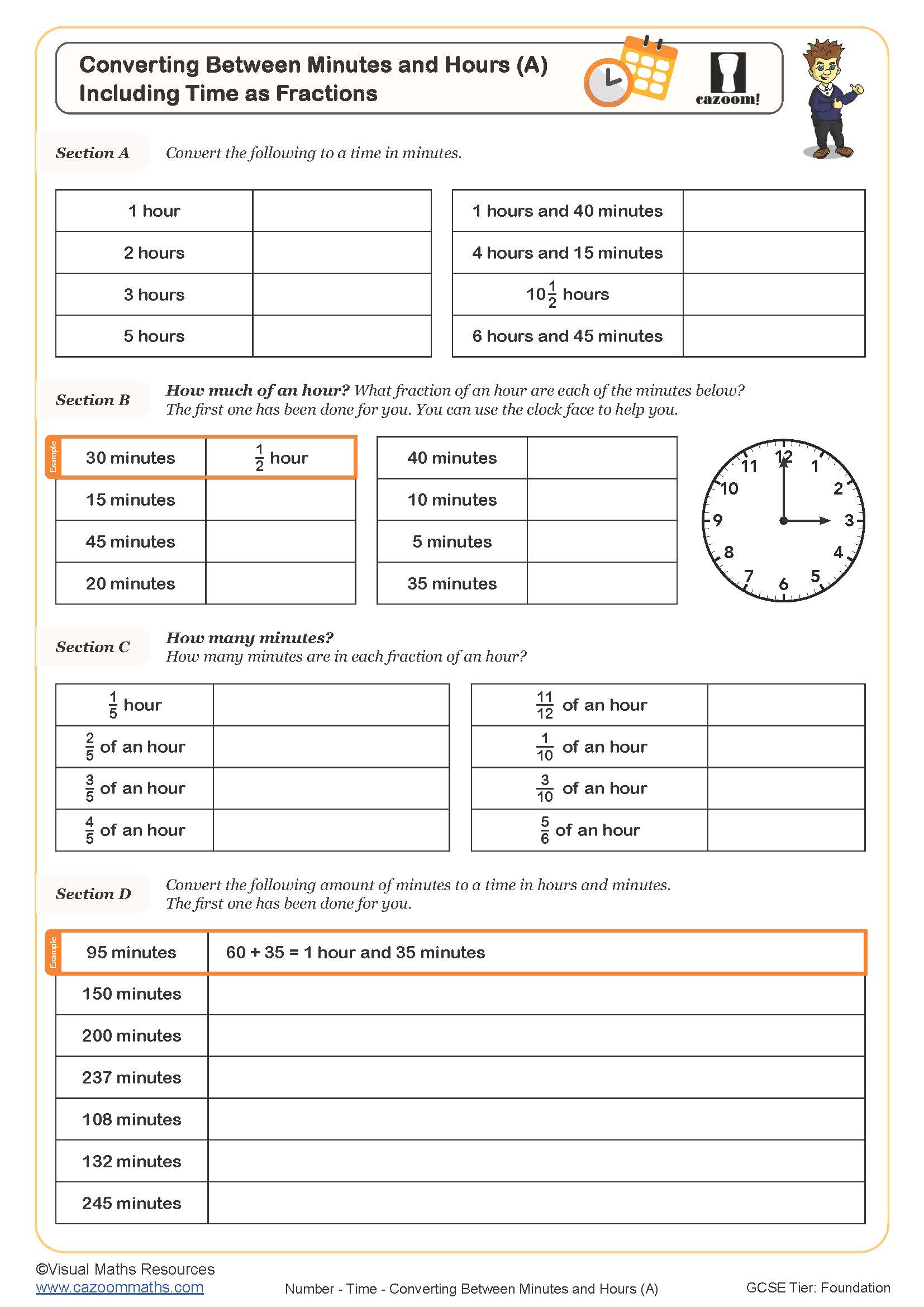
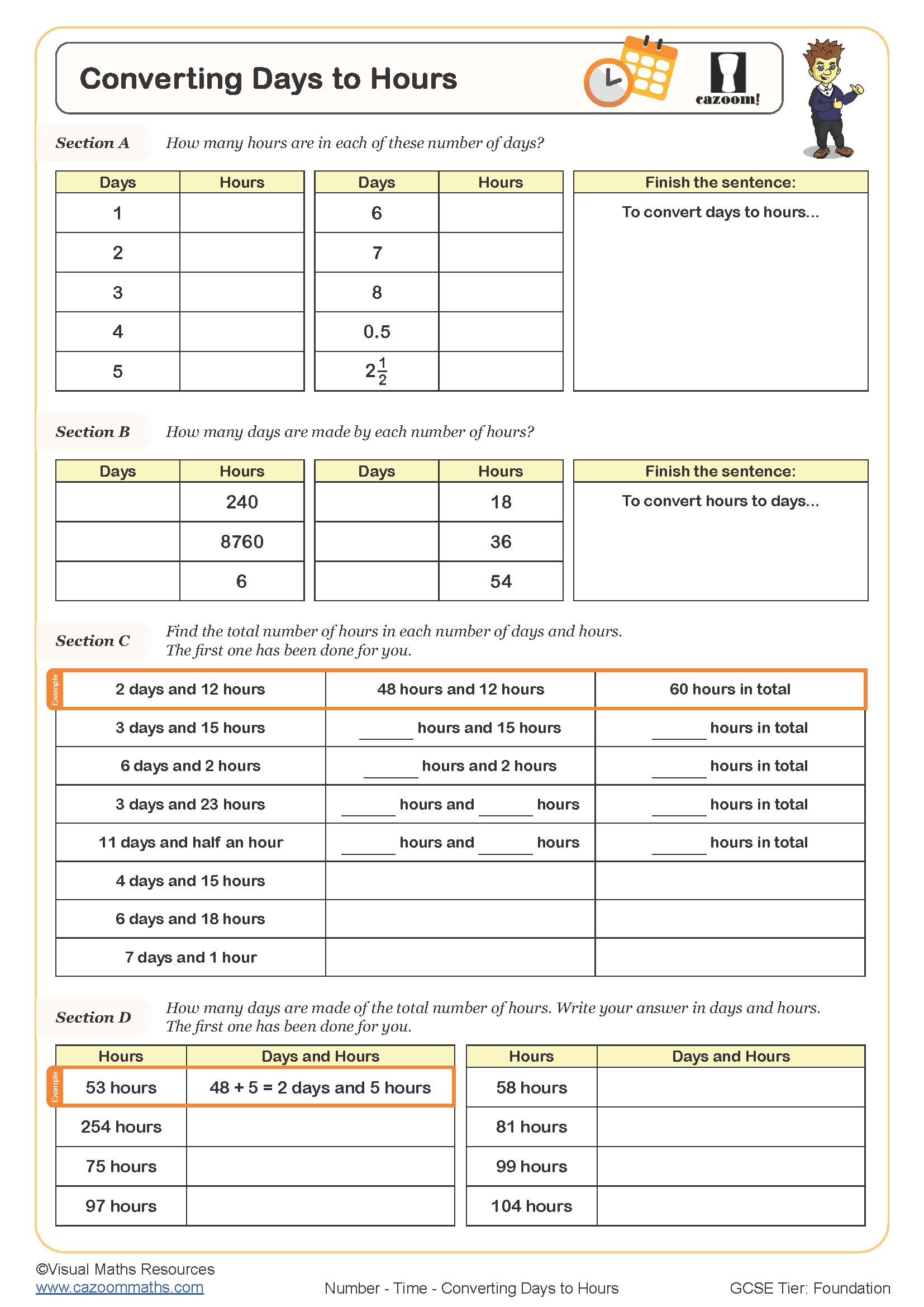
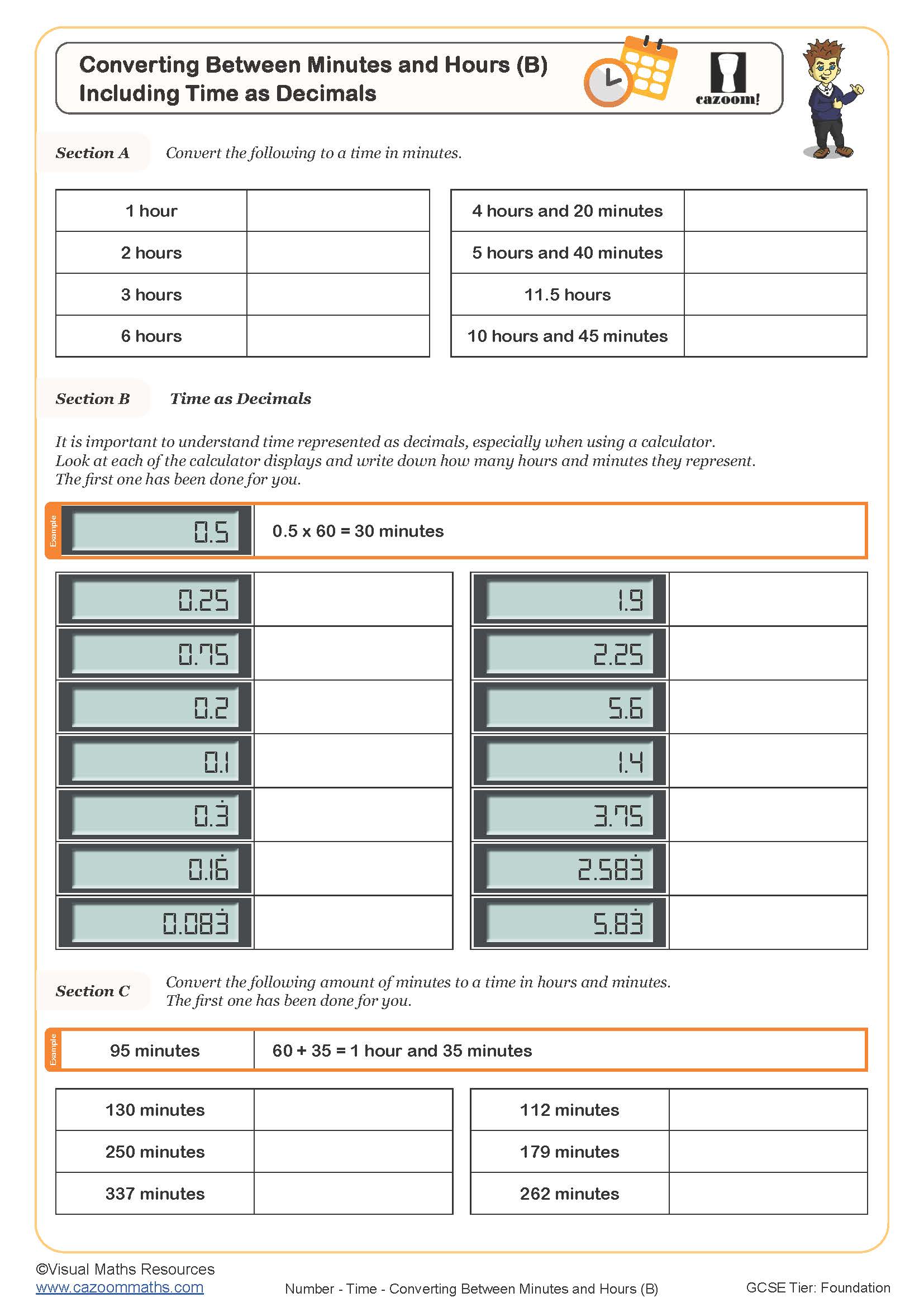
Converting time worksheets focus on building fluency with the non-decimal relationships between time units, which differs from the base-10 conversions students use elsewhere in the metric system. Students practise converting between seconds and minutes (60:1), minutes and hours (60:1), hours and days (24:1), days and weeks (7:1), and approximate conversions involving months and years. This includes both multiplying to convert to smaller units and dividing to convert to larger units.
A common error occurs when students apply decimal thinking to time conversions, writing 1.5 hours as 1 hour 50 minutes instead of 1 hour 30 minutes. The conversion of time worksheet tasks specifically address this misconception by including mixed conversions that require students to recognise whether they're working with fractions of an hour (which are sixtieths) or decimal calculations. Teachers often use these tasks to reinforce that time doesn't follow the patterns students have become comfortable with in other measurement contexts.
Which Year Groups Cover Time Unit Conversion?
These worksheets are designed for Year 7, Year 8, and Year 9 students working within the KS3 National Curriculum. Converting between units of time appears in the ratio, proportion, and rates of change strand, where students apply their understanding of multiplicative relationships to non-standard units. Students typically encounter basic time conversions in primary school but revisit them in KS3 within more complex problem-solving contexts.
Progression across these year groups involves increasing complexity rather than introducing new units. Year 7 students work on direct conversions with whole numbers, whilst Year 8 and Year 9 tasks incorporate fractional and decimal amounts that require multi-step reasoning. Later worksheets combine time conversion with rate calculations, such as converting speeds given in different time units or calculating journey times across multiple stages, which prepares students for GCSE-level problem-solving.
Why Do Time Conversions Matter for Real-World Applications?
Time conversion skills underpin calculations in numerous practical and STEM contexts. Students need these skills to interpret timetables, calculate hourly rates from annual salaries, work out cooking times when scaling recipes, and understand data presented across different time scales. The ability to convert fluently between time units prevents errors in everyday situations from booking travel to managing project timelines.
In science, time conversions are particularly relevant when calculating rates of reaction, analysing motion in physics, or interpreting biological rhythms. For example, heart rate is typically measured in beats per minute, but students studying exercise physiology might need to convert this to beats per second for kinetic calculations, or to beats per hour when analysing long-term data trends. Engineers working with rotational speed convert between revolutions per minute and revolutions per second depending on the application, demonstrating how these foundational conversion skills extend into technical careers.
How Do These Worksheets Support Learning?
The time conversions worksheet collection provides graduated practice that builds from straightforward single-step conversions to multi-step problems requiring students to select appropriate conversion factors. Each worksheet includes clearly structured questions that allow teachers to identify whether students understand the underlying multiplicative relationships or are simply applying procedures without conceptual understanding. The answer sheets enable students to self-check their work, which is particularly valuable for identifying systematic errors in their approach.
These resources work well as retrieval practice at the start of lessons, targeted intervention for students who struggle with compound measures, or homework tasks that reinforce classroom teaching. Teachers often use individual questions from these worksheets as worked examples on the board before setting similar problems for independent practice. The convert units of time worksheet format also supports paired work, where one student completes conversions whilst their partner checks answers and explains any errors, building both fluency and mathematical communication skills.