Equations of Proportionality Worksheets
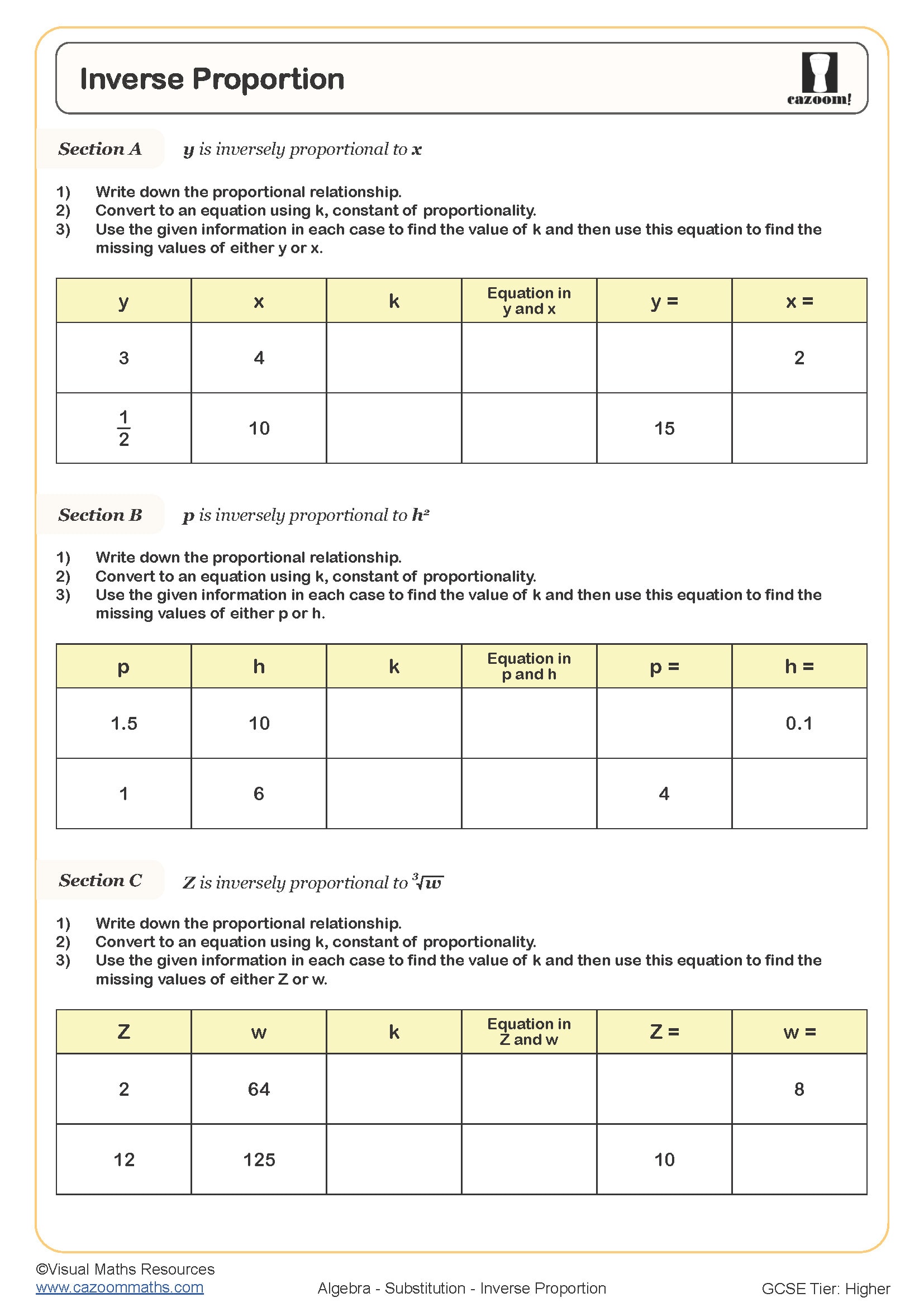
All worksheets are created by the team of experienced teachers at Cazoom Maths.
What are equations of proportionality in maths?
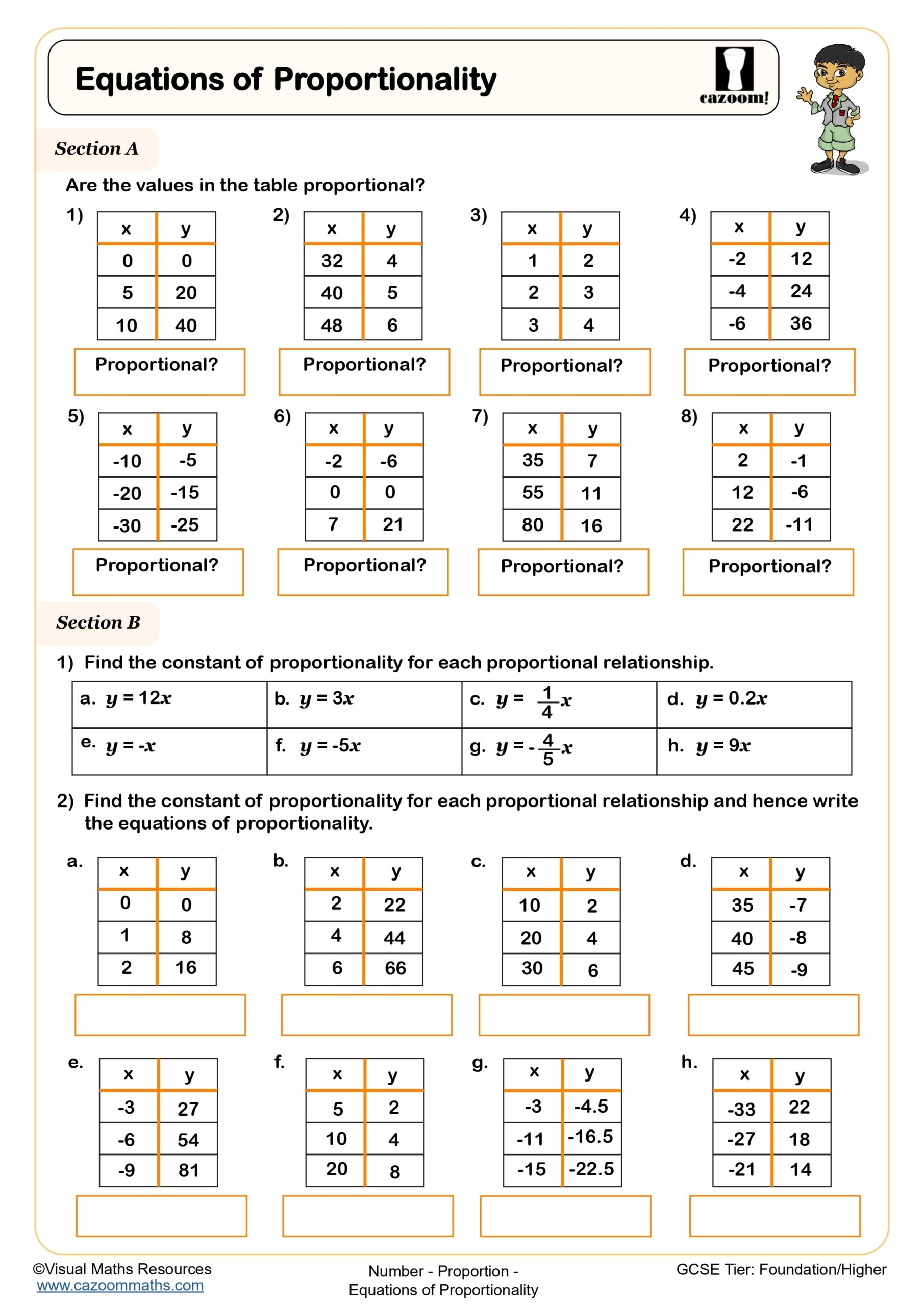
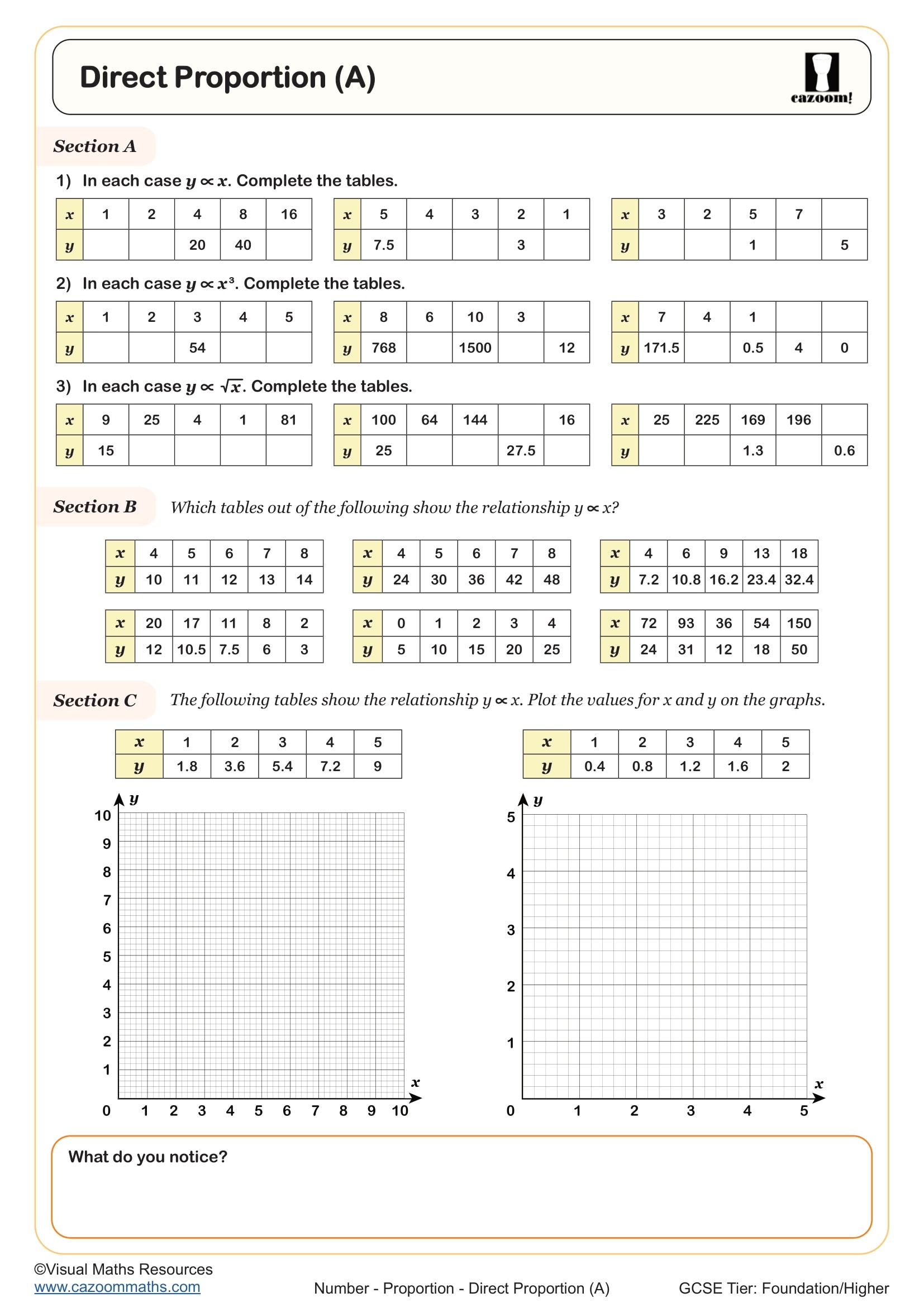
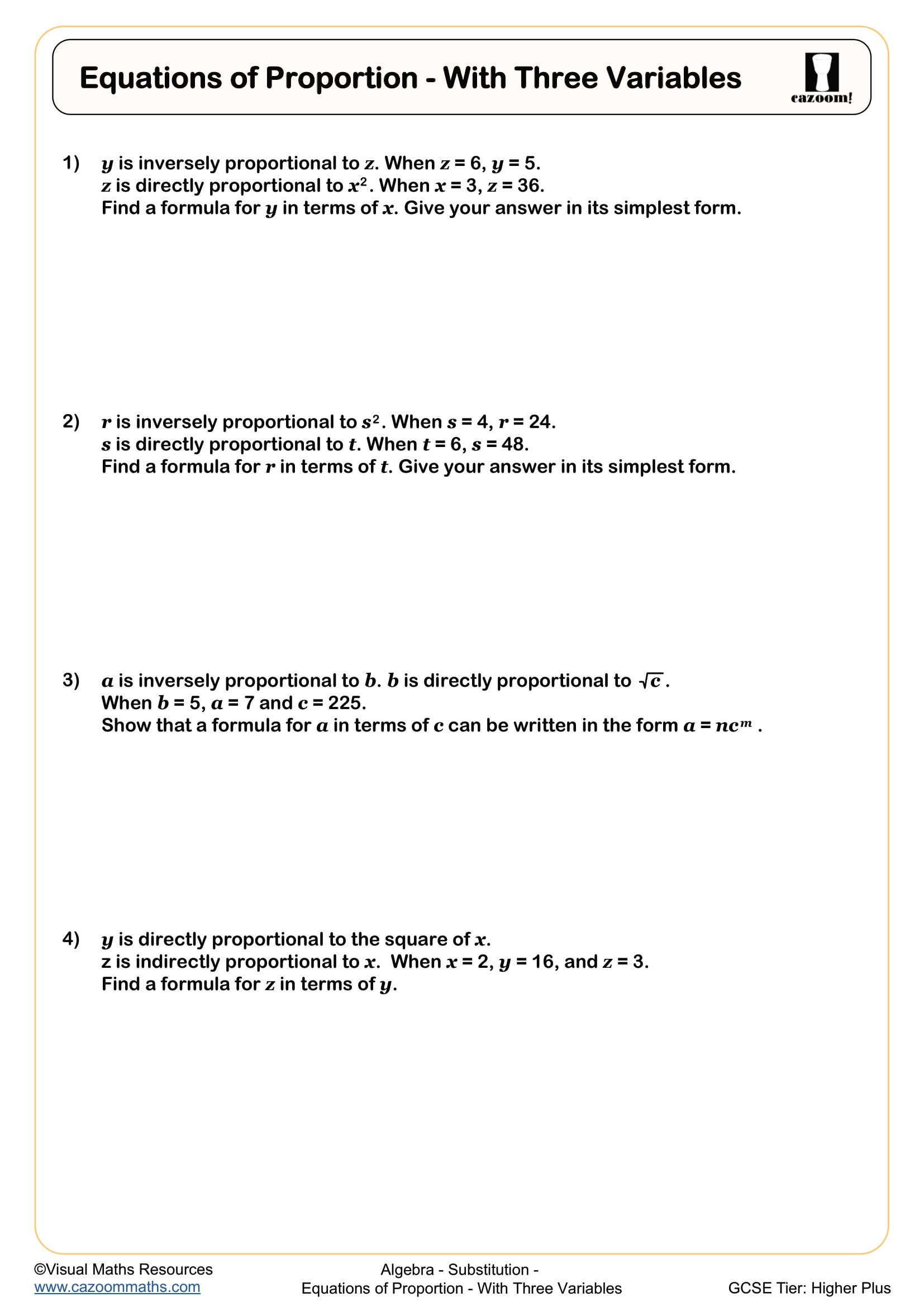
Equations of proportionality describe mathematical relationships where two quantities change at a constant rate relative to each other. In direct proportion (y = kx), when one variable doubles, the other doubles too. In inverse proportion (y = k/x), when one variable doubles, the other halves. The constant k represents the relationship's strength and must be calculated from given information before the equation can be used for predictions.
Students often lose marks by writing the correct equation structure but failing to substitute values correctly to find k first. Exam mark schemes expect clear working showing the k-calculation as a separate step, yet many students attempt to solve problems in one line, leading to algebraic errors. Teachers report that explicitly modelling the three-step process (identify proportion type, find k, write final equation) significantly reduces these mistakes.
Which year groups study equations of proportionality?
Equations of proportionality appear in the National Curriculum from Year 8 onwards, continuing through Year 9, Year 10, and Year 11 as students prepare for GCSE examinations. At KS3, the focus sits on recognising proportional relationships from tables and graphs, then deriving the equation y = kx. The concept extends into inverse proportion during late Year 9 or early Year 10, depending on scheme of work.
Progression increases through problem complexity rather than new formulae. Year 8 worksheets typically provide straightforward contexts with clear variable labels, whilst Year 11 materials include multi-step problems requiring algebraic manipulation before proportionality methods apply. Higher tier GCSE questions often combine proportionality with other topics such as surds or standard form, testing whether students can recognise when these techniques apply within unfamiliar contexts.
How do you find the constant of proportionality?
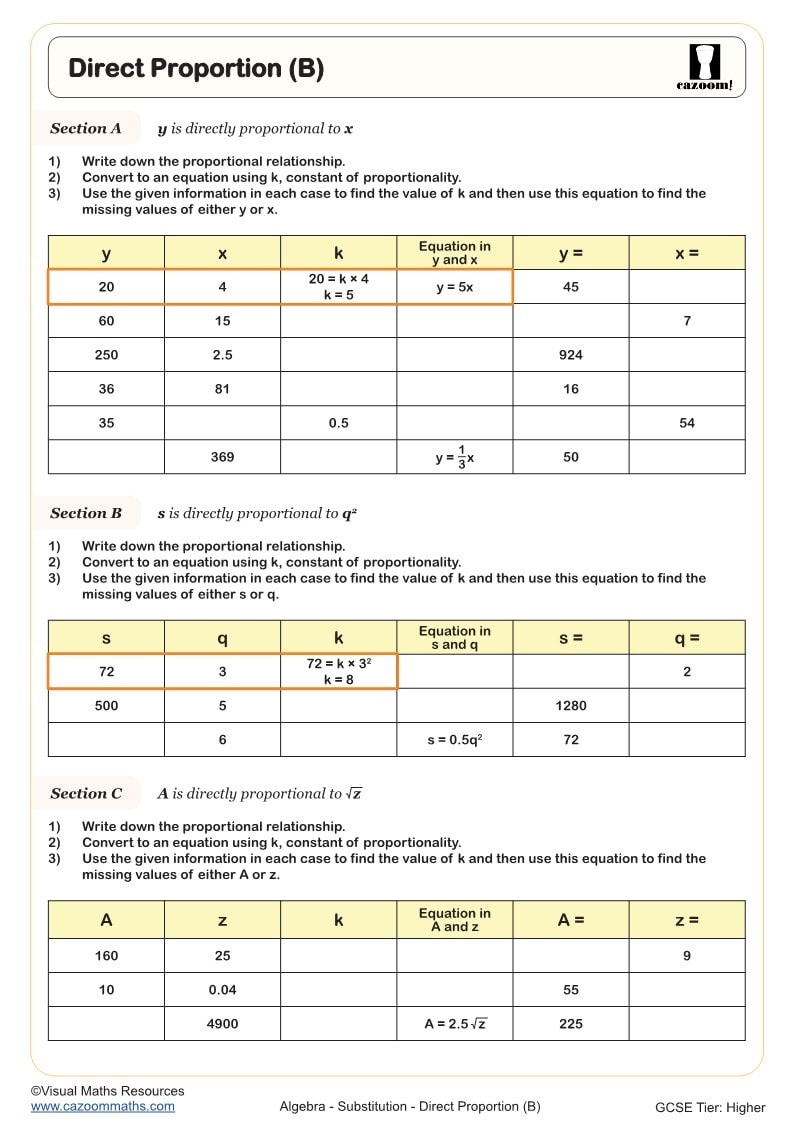
Finding the constant of proportionality requires substituting a known pair of values into the appropriate formula, then solving for k. For direct proportion (y = kx), divide the y-value by the x-value. For inverse proportion (y = k/x), multiply the two values together. Once k is calculated, it remains constant for all other value pairs in that relationship and forms part of the final equation used for predictions.
This skill connects directly to scientific contexts students encounter in physics and chemistry. Hooke's Law (force = k × extension) uses direct proportionality to model spring behaviour, whilst Boyle's Law (pressure × volume = k) demonstrates inverse proportion in gas behaviour. Engineers apply these constants when designing structures or systems, making proportionality equations fundamental to STEM careers. Students who understand k as a measurable real-world property, not just an abstract letter, show stronger problem-solving abilities.
How can these worksheets support students learning proportionality equations?
The worksheets provide structured practice moving from identifying proportion types through tables and descriptions, to calculating constants, and finally applying equations to solve problems. Worked examples demonstrate the step-by-step method that exam mark schemes reward, whilst varied question styles prevent students from relying on pattern-spotting rather than understanding. The progressive difficulty within each sheet allows teachers to identify precisely where conceptual gaps exist.
Many teachers use these resources for targeted intervention with students who confuse direct and inverse proportion during exam preparation. The answer sheets enable paired peer-marking sessions where students explain their methods to each other, addressing misconceptions through discussion. They work equally well as homework to consolidate classroom teaching or as low-stakes assessments to check retention before moving onto compound measures or graphs of proportionality at KS4.