Estimation Worksheets
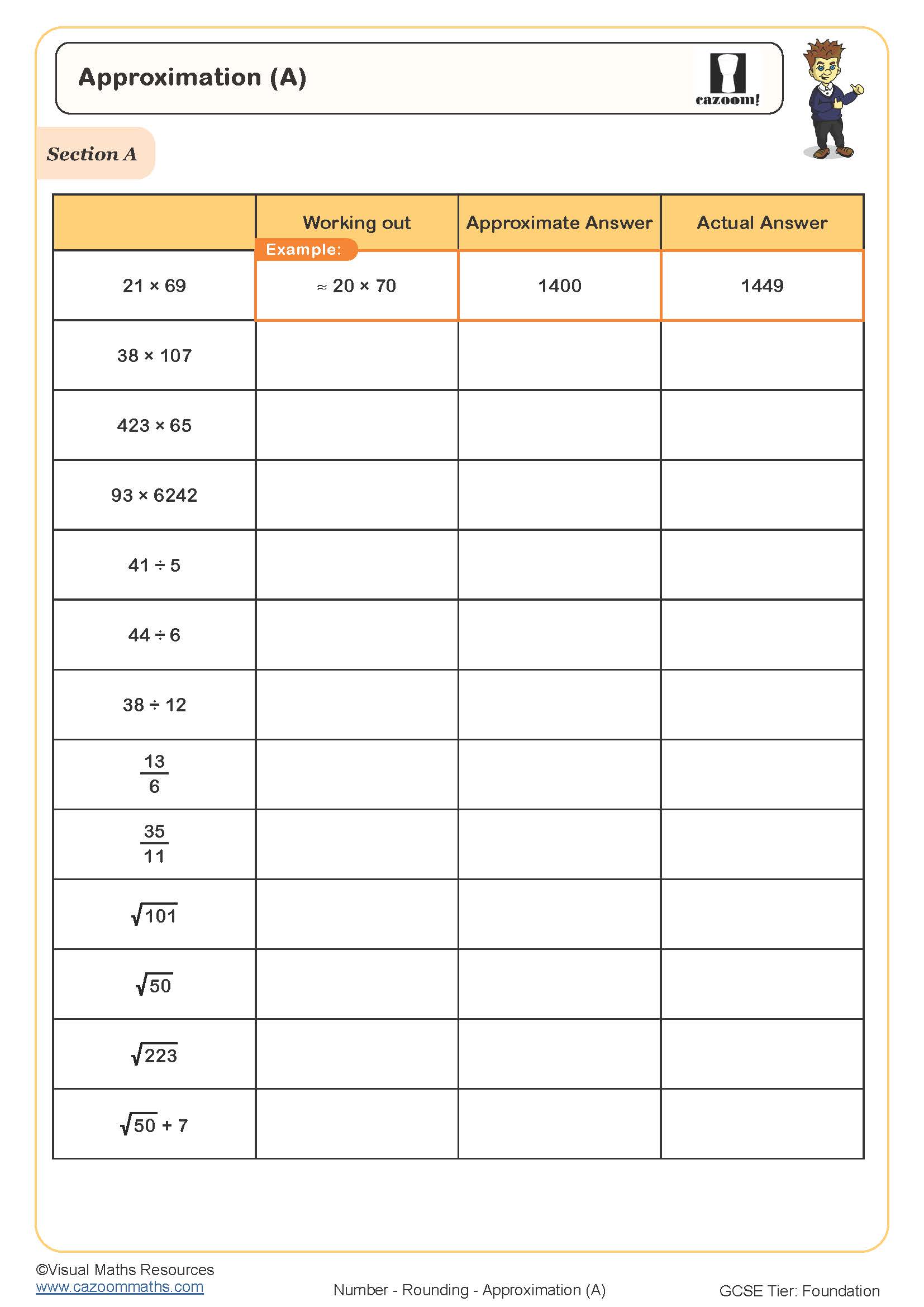
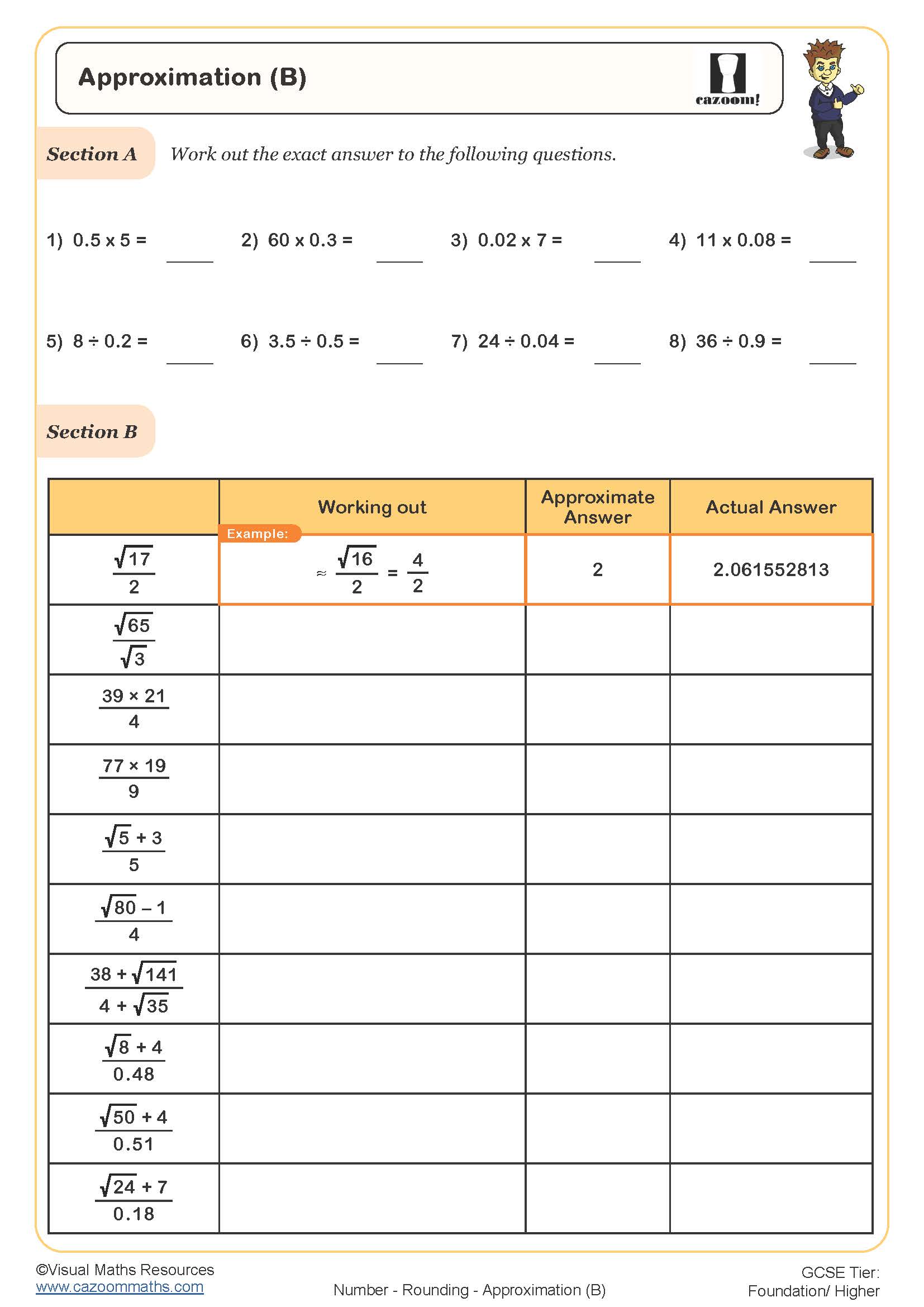
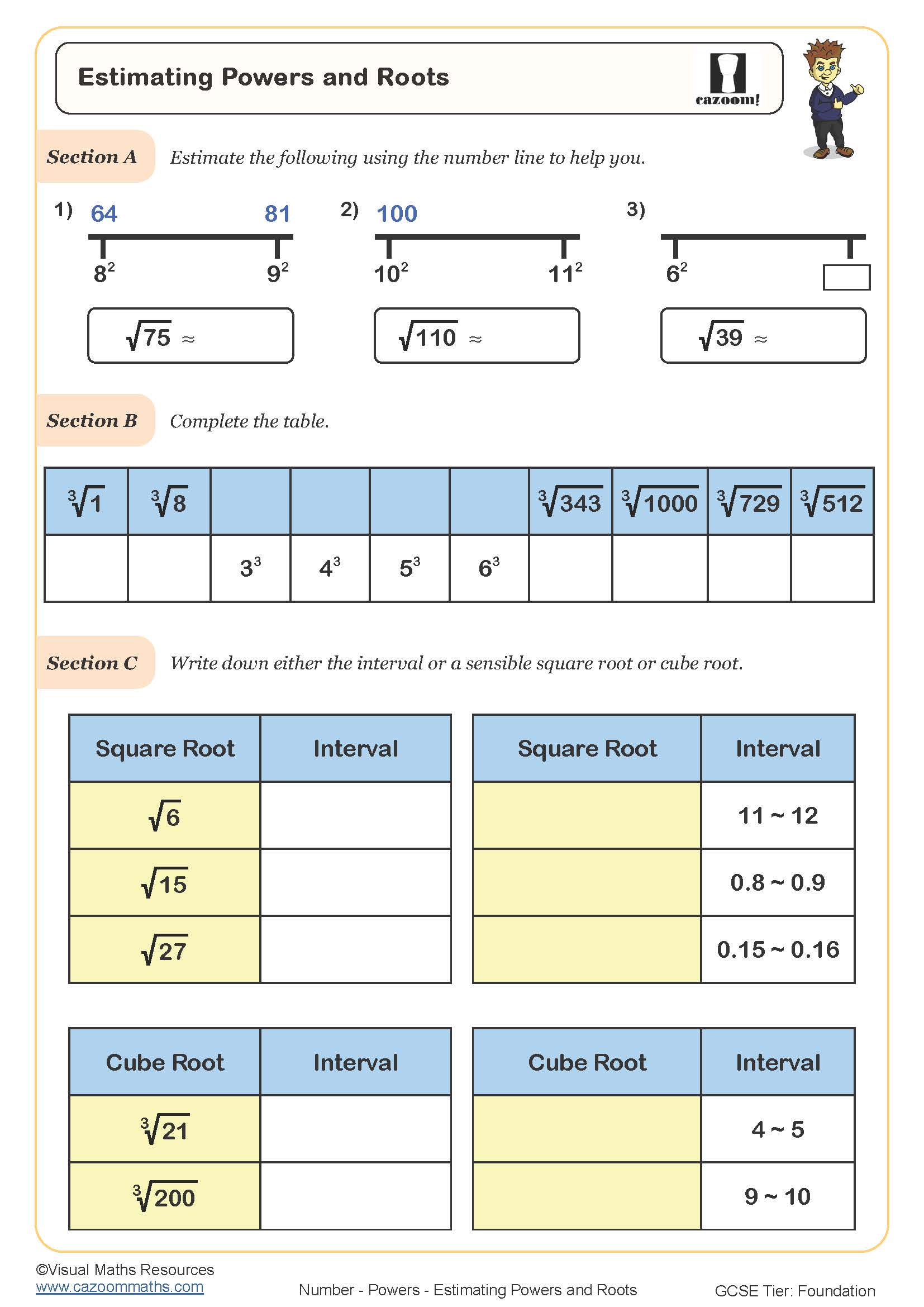
All worksheets are created by the team of experienced teachers at Cazoom Maths.
What is estimation in maths?
Estimation in maths involves approximating the result of a calculation by rounding numbers to make the working simpler, then using mental or written methods to find an answer that's close to the exact value. At KS3, students learn to round to different degrees of accuracy, including to the nearest ten, hundred, or thousand, and to one significant figure for more complex numbers. This National Curriculum strand connects directly to number sense and proportional reasoning.
A common mistake occurs when students round all numbers to the nearest ten regardless of the calculation's size—estimating 3,876 + 4,123 as 3,880 + 4,120 instead of 4,000 + 4,000. Exam mark schemes expect students to show sensible rounding that simplifies the calculation whilst maintaining a reasonable approximation. Teachers notice this particularly affects weaker students who treat estimation as guesswork rather than a systematic process.
Which year groups learn estimation?
These worksheets cover estimation for Year 7 and Year 8 students working within Key Stage 3 of the National Curriculum. At this stage, students move beyond the basic rounding covered in primary school to estimating more complex calculations involving decimals, larger numbers, and eventually calculations with powers and roots. The topic bridges arithmetic and algebra, preparing students for estimating answers in GCSE questions across all maths strands.
Progression across KS3 involves increasing sophistication in rounding choices. Year 7 students typically estimate using straightforward rounding rules for addition, subtraction, and multiplication, whilst Year 8 introduces estimating with division, understanding when to round up or down based on context, and estimating calculations involving measurements. By Year 9, students apply estimation to square roots, powers, and more complex multi-step problems.
How does rounding to significant figures help with estimation?
Rounding to one significant figure provides a powerful estimation method because it simplifies numbers to their most important digit, making mental calculations manageable regardless of the number's size. Students learn that 3,876 becomes 4,000, whilst 0.0482 becomes 0.05—both rounded to one significant figure. This technique works particularly well for multiplication and division where multiple rounding steps can otherwise accumulate errors.
This skill has direct applications in science and engineering where order-of-magnitude calculations inform decision-making. Structural engineers estimate loads on buildings using significant figure rounding before running detailed computer models, whilst chemists estimate reaction yields to determine whether experiments are worth pursuing. Students who understand this connection see estimation as a professional tool rather than just an exam technique, which strengthens their engagement with the process and its underlying mathematical reasoning.
How do these worksheets support learning estimation?
The worksheets provide structured practice that moves students from straightforward rounding exercises through to estimating multi-step calculations and checking calculator answers. Questions are sequenced to build confidence gradually, with early exercises focusing on choosing appropriate rounding strategies before applying them to estimate specific calculations. The answer sheets allow students to self-assess their rounding choices and understand where their estimation differs from the exact answer.
Many teachers use these resources for intervention with students who rush through calculations without checking their work, particularly those who over-rely on calculators. The worksheets work well as starter activities to activate number sense before tackling problem-solving, or as homework tasks that reinforce classroom teaching. Paired work can be effective here—students compare their estimation strategies and discuss which rounding approach gives the closest approximation, developing their mathematical reasoning alongside their calculation skills.