Forming Equations from Ratios Worksheets
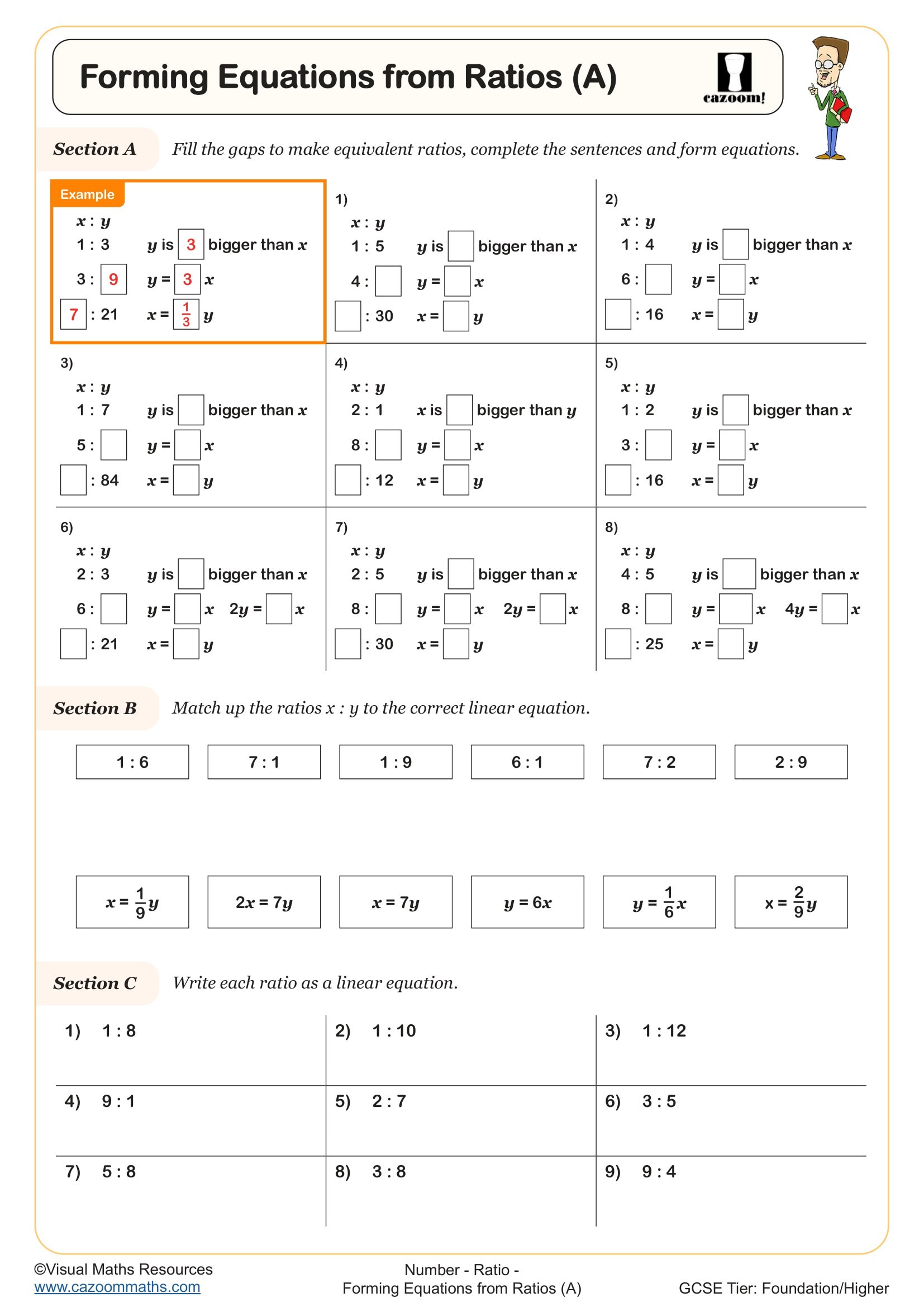
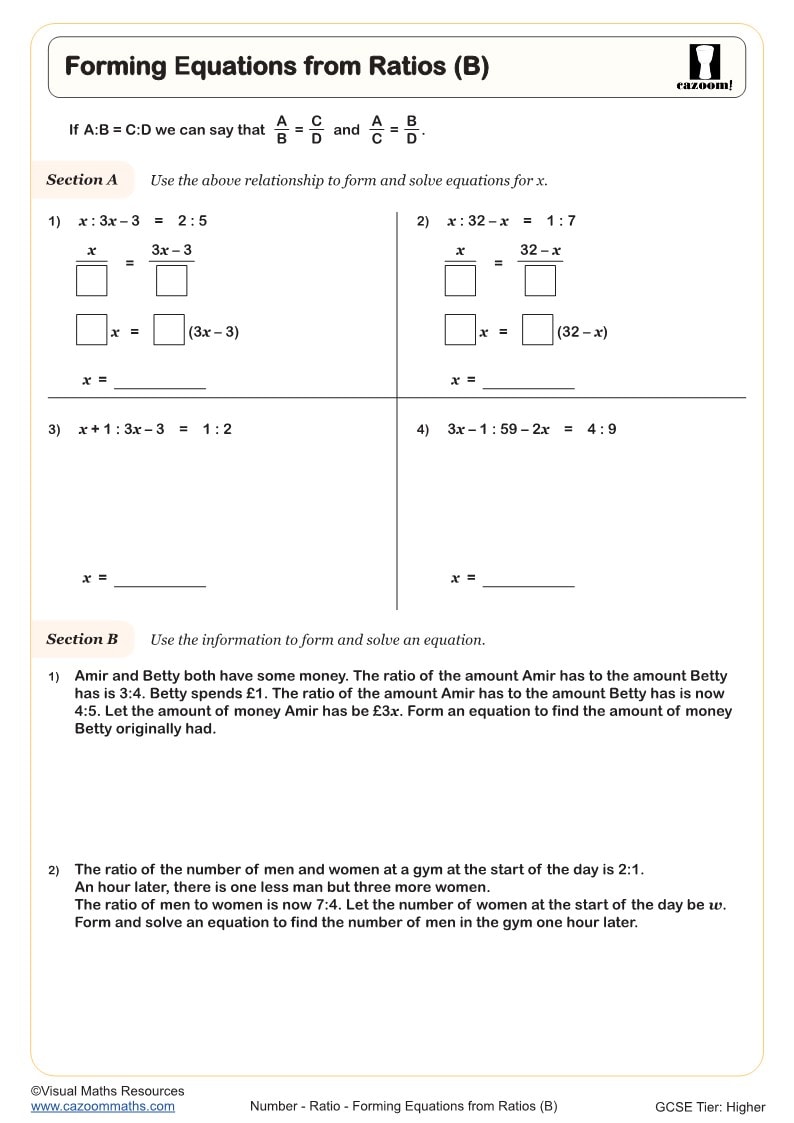
All worksheets are created by the team of experienced teachers at Cazoom Maths.
What does forming equations from ratios mean in maths?
Forming equations from ratios involves translating ratio information into algebraic equations that can be solved to find unknown quantities. Rather than using simple ratio methods, students assign a variable (typically x) to represent one part of the ratio, then express all parts algebraically before setting up an equation. For example, if two amounts are in the ratio 3:5 and total 96, students write the parts as 3x and 5x, then form the equation 3x + 5x = 96.
A common error occurs when students forget to multiply each part of the ratio by the same variable, instead writing something like 3x + 5y = 96, which introduces an unsolvable second unknown. Exam mark schemes specifically penalise this mistake. Students need to understand that the variable represents the value of one part, and all parts of the ratio must be expressed as multiples of that same part.
Which year groups learn forming equations from ratios?
These worksheets cover Year 9, Year 10, and Year 11, spanning both KS3 and KS4. The topic typically appears in Year 9 as students consolidate their understanding of both ratio and algebraic manipulation, building on ratio skills from Years 7-8 and equation-solving from earlier algebra work. The National Curriculum expects students to connect ratio and proportion with algebra, making this a key transition skill.
Progression across these year groups involves increasing complexity in the ratio contexts and equation structures. Year 9 work focuses on forming and solving straightforward equations from two-part ratios with given totals. By Years 10-11, students tackle three-part ratios, problems requiring additional steps before forming equations, and contexts where the difference or a single part is given rather than the total. GCSE questions often embed this skill within multi-step problems involving area, mixtures, or recipe adjustments.
How do you solve ratio problems using algebra?
Solving ratio problems using algebra requires identifying what the ratio represents, assigning a variable to one part, then expressing all quantities algebraically. Students multiply each part of the ratio by x (or another letter), form an equation using given information about totals or differences, then solve for x before calculating the actual quantities. For instance, with ages in ratio 2:7 and a difference of 35 years, students write 7x - 2x = 35, solve to find x = 7, then calculate the ages as 14 and 49.
This algebraic approach proves particularly valuable in real-world STEM contexts where ratios appear in chemical mixtures, engineering specifications, or scale models. Architects use ratio-based equations when converting between scale drawings and actual dimensions, whilst chemists apply this method when calculating reactant quantities in stoichiometric equations. Understanding the algebraic structure helps students tackle problems where simple ratio methods become cumbersome or unclear.
How can these worksheets help students improve at ratio equations?
The worksheets build confidence by breaking down the equation-forming process into clear steps, helping students recognise patterns in how ratio problems translate into algebra. Each question requires students to identify the parts, introduce the variable correctly, form the equation, and interpret their solution in context. The answer sheets show complete working, modelling the algebraic reasoning that exam mark schemes reward, which helps students self-correct and understand where errors occurred in their method.
Teachers find these worksheets particularly effective for intervention with students who can solve equations but struggle to set them up from worded ratio problems. They work well as homework to consolidate lesson content or as starter activities to maintain fluency with this skill. In paired work, students can compare how they've formed their equations, discussing why certain approaches work whilst others introduce errors, which strengthens their conceptual understanding alongside procedural skill.