Four Operations with Negative Numbers Worksheets
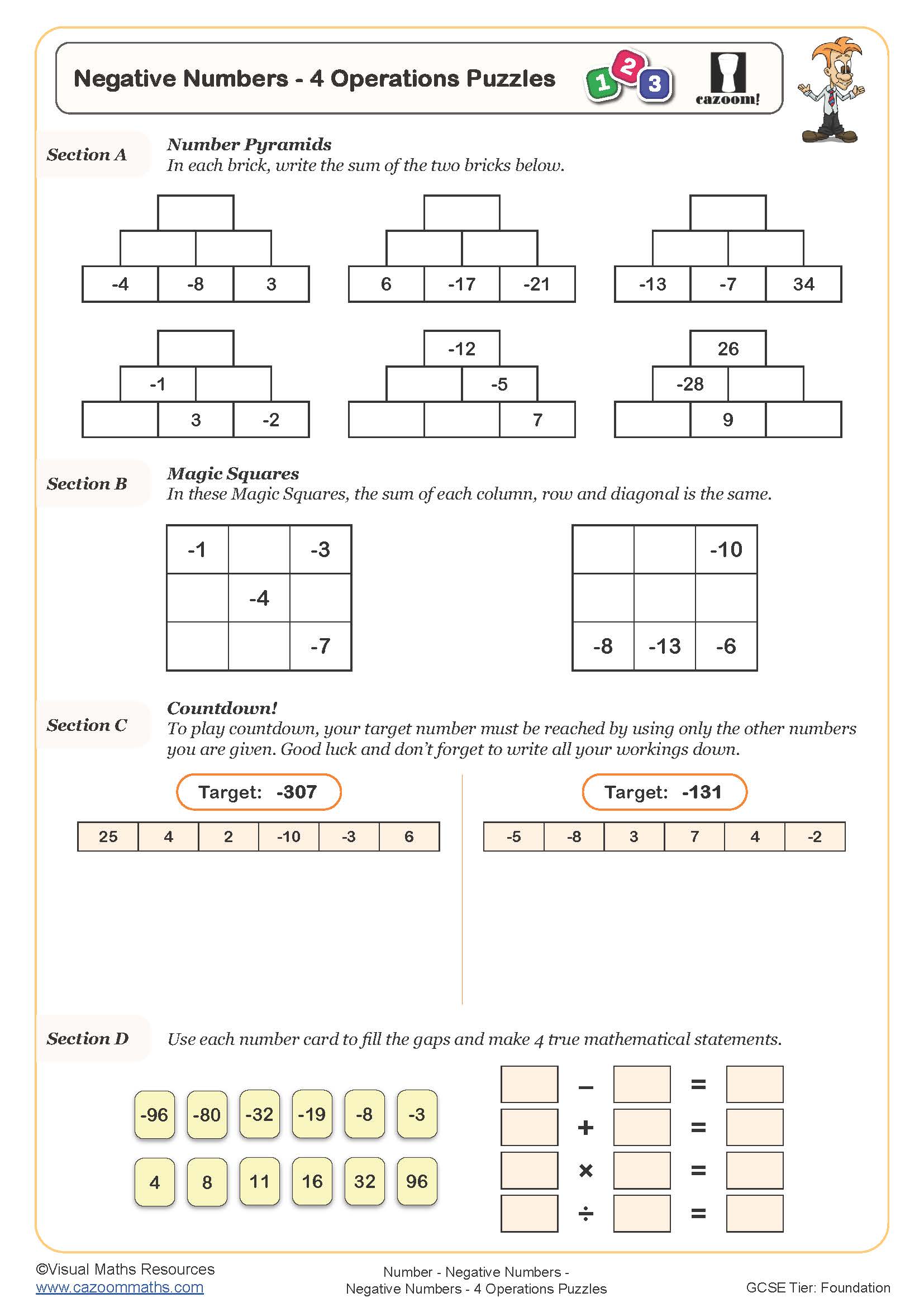
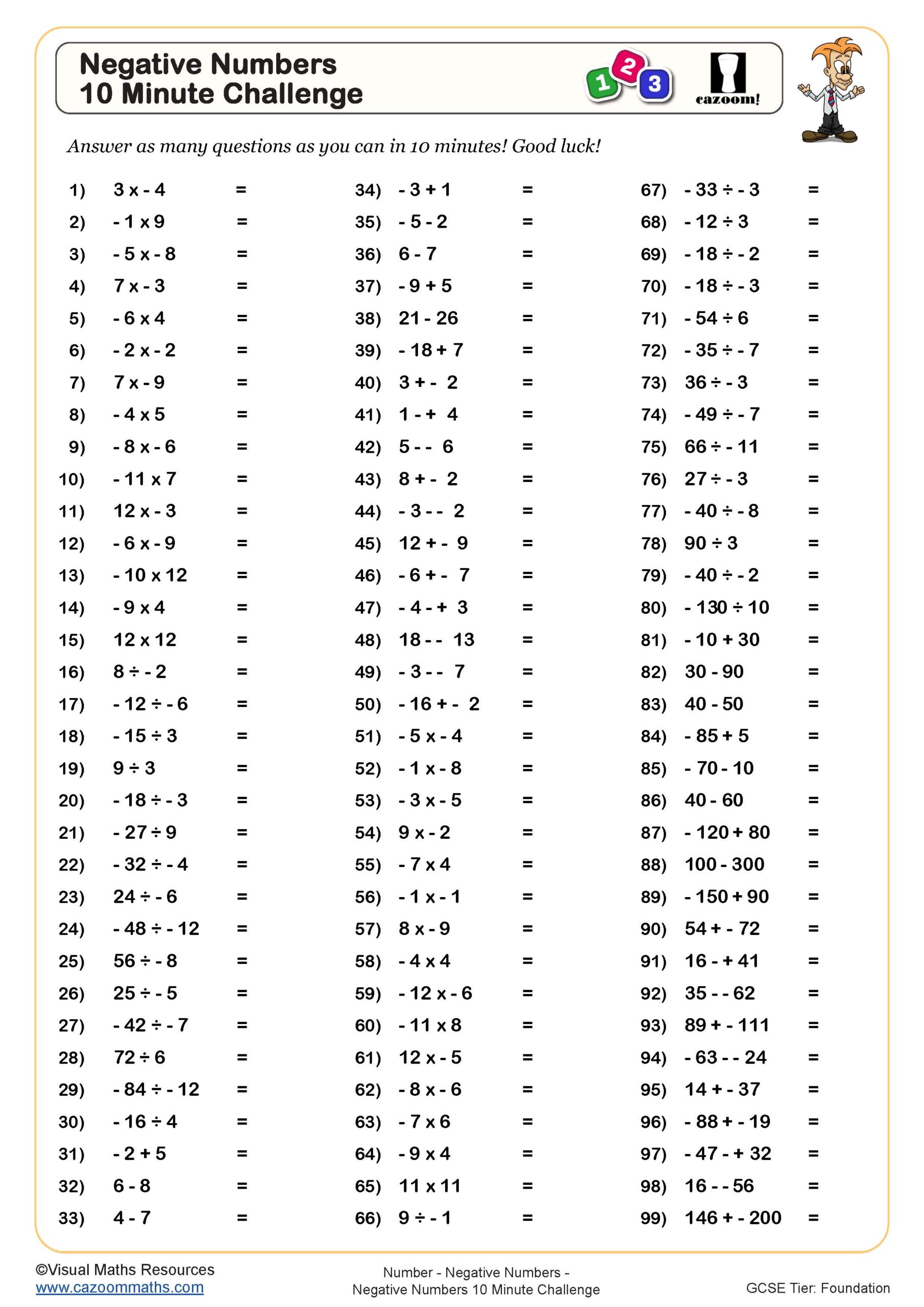
All worksheets are created by the team of experienced teachers at Cazoom Maths.
What are the four operations with negative numbers?
The four operations with negative numbers refer to addition, subtraction, multiplication, and division applied to integers, including both positive and negative values. At Key Stage 3, students move beyond simple number line work to develop fluency with all combinations: adding negatives, subtracting negatives, multiplying and dividing integers of different signs. The National Curriculum expects students to understand and apply the rules governing these operations, recognising patterns like "same signs give positive, different signs give negative" for multiplication and division.
A common error pattern emerges with subtraction: many students incorrectly apply multiplication rules to subtraction problems. When faced with 6 - (-2), they might write 6 - 2 = 4 instead of recognising that subtracting a negative is equivalent to addition, giving 8. Exam mark schemes regularly penalise this confusion, particularly in GCSE Foundation papers where directed number questions appear early. Using a four operations with negative numbers worksheet helps students distinguish between operation-specific rules rather than applying blanket patterns.
Which year groups study four operations with negative numbers?
These worksheets cover Year 7, Year 8, and Year 9 within Key Stage 3. Students first encounter negative numbers in primary school through temperature and number lines, but systematic work with all four operations begins properly in Year 7 as part of the Number strand. The National Curriculum requires students to "use the four operations, including formal written methods, applied to integers" during this key stage, establishing foundations for algebraic manipulation.
Progression typically moves from addition and subtraction in Year 7 (often using number lines or counters as models) through to confident multiplication and division of integers in Year 8. By Year 9, students combine all four operations in multi-step problems without scaffolding, preparing for GCSE questions that embed directed numbers within algebra, inequalities, and problem-solving contexts. Teachers often find that students need regular revisiting of these skills, as fluency diminishes rapidly without practice, particularly over summer breaks or when negative numbers don't appear explicitly in other topic areas.
Why do multiplying and dividing negative numbers follow different rules to adding and subtracting?
Multiplication and division of integers follow the "same signs positive, different signs negative" rule because these operations involve scaling and grouping rather than directional movement. When multiplying -3 × -4, you're essentially reversing a reversal (taking the opposite of a negative direction three times), which returns you to the positive. This differs fundamentally from subtraction like -3 - 4, which represents continued movement in the negative direction on a number line, giving -7. Understanding this conceptual difference helps students avoid mixing up operation rules.
This mathematical structure underpins countless real-world applications in science and finance. In physics, velocity and acceleration use directed numbers where multiplying negative values (decelerating whilst moving backwards) produces positive acceleration in the forward direction. Economic models use negative multipliers to represent contractionary effects, where reducing a negative input (like debt repayment) produces positive economic growth. Engineers working with vectors and forces routinely apply these rules when calculating resultant movements and tensions, making fluency with the four operations with negative numbers essential preparation for STEM careers.
How do these worksheets help students master negative number operations?
The worksheets build procedural fluency through carefully structured question sets that isolate each operation before combining them. Students encounter varied integer combinations across addition, subtraction, multiplication, and division, developing automatic recall of rules rather than relying on visual models like number lines for every calculation. The included answer sheets allow students to identify error patterns immediately, particularly valuable when self-correcting common mistakes like sign errors in subtraction or incorrectly applied multiplication rules.
Many teachers use these resources for intervention groups where students show persistent confusion between operations, setting targeted homework that focuses on whichever operation needs reinforcement. They work effectively in paired activities where students explain their reasoning to each other, as verbalising why -3 × -5 = 15 strengthens conceptual understanding. The PDF format makes them practical for printing selected questions for starters, displaying worked solutions via visualiser for whole-class teaching, or assigning as independent practice during revision blocks before mock examinations or end-of-unit assessments.