Four Operations with Surds Worksheets
All worksheets are created by the team of experienced teachers at Cazoom Maths.
What are the four operations with surds?
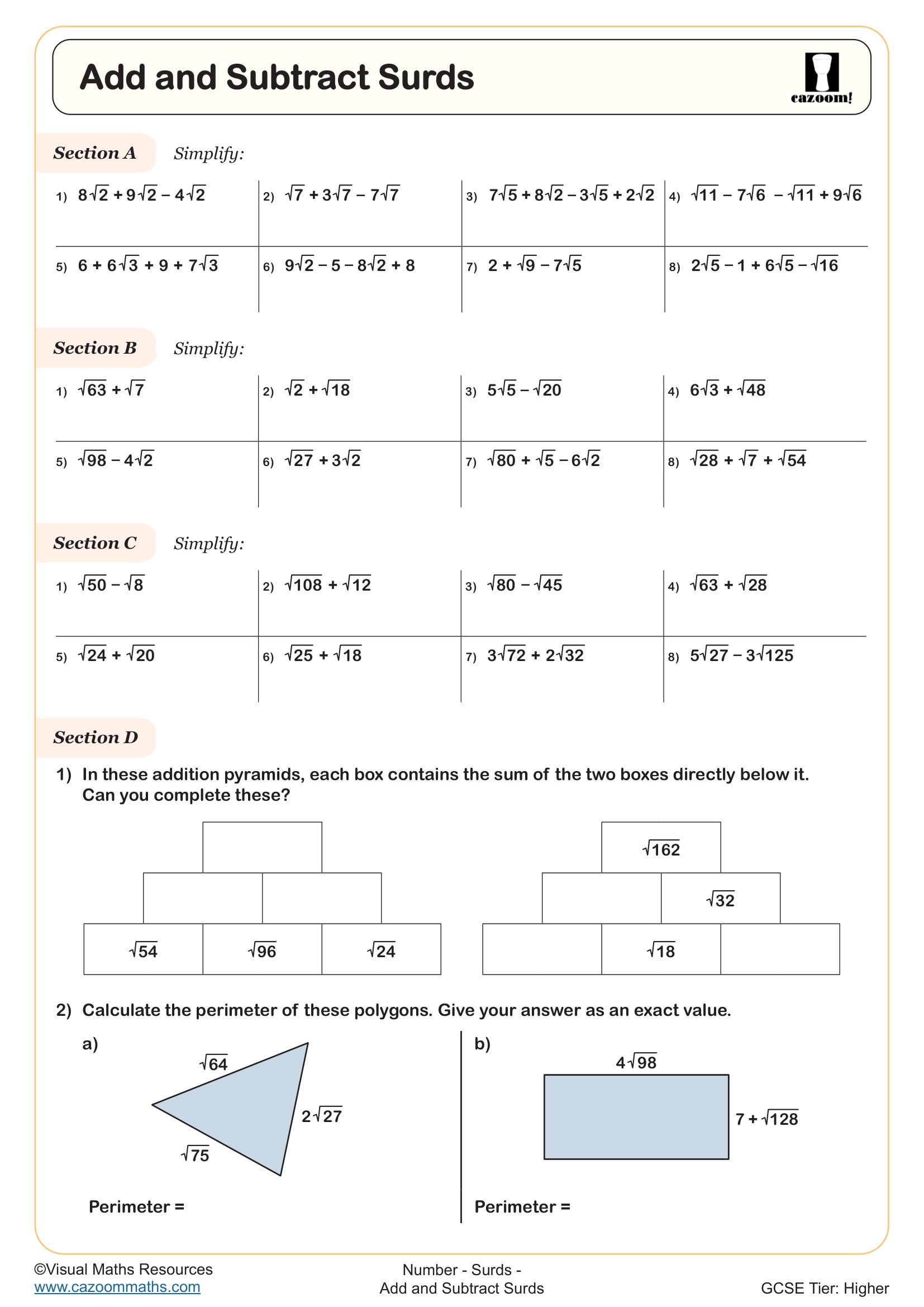
The four operations with surds involve applying addition, subtraction, multiplication and division to expressions containing square roots and other roots. Students learn that only like surds can be added or subtracted (such as 3√2 + 5√2 = 8√2), whilst multiplication and division require applying index laws and simplification techniques. This forms part of the KS4 Number curriculum under working with surds and appears regularly in GCSE Higher tier papers.
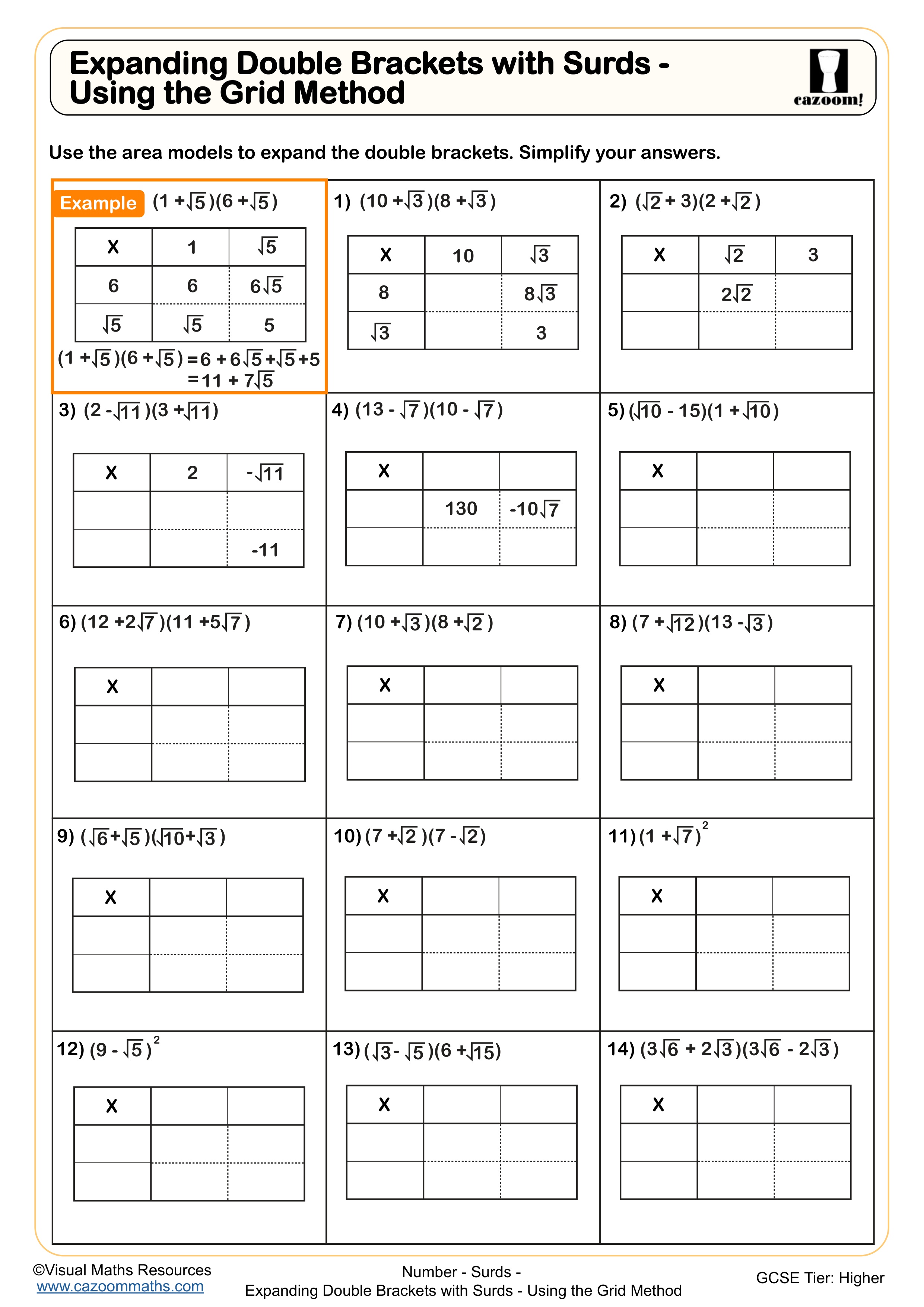
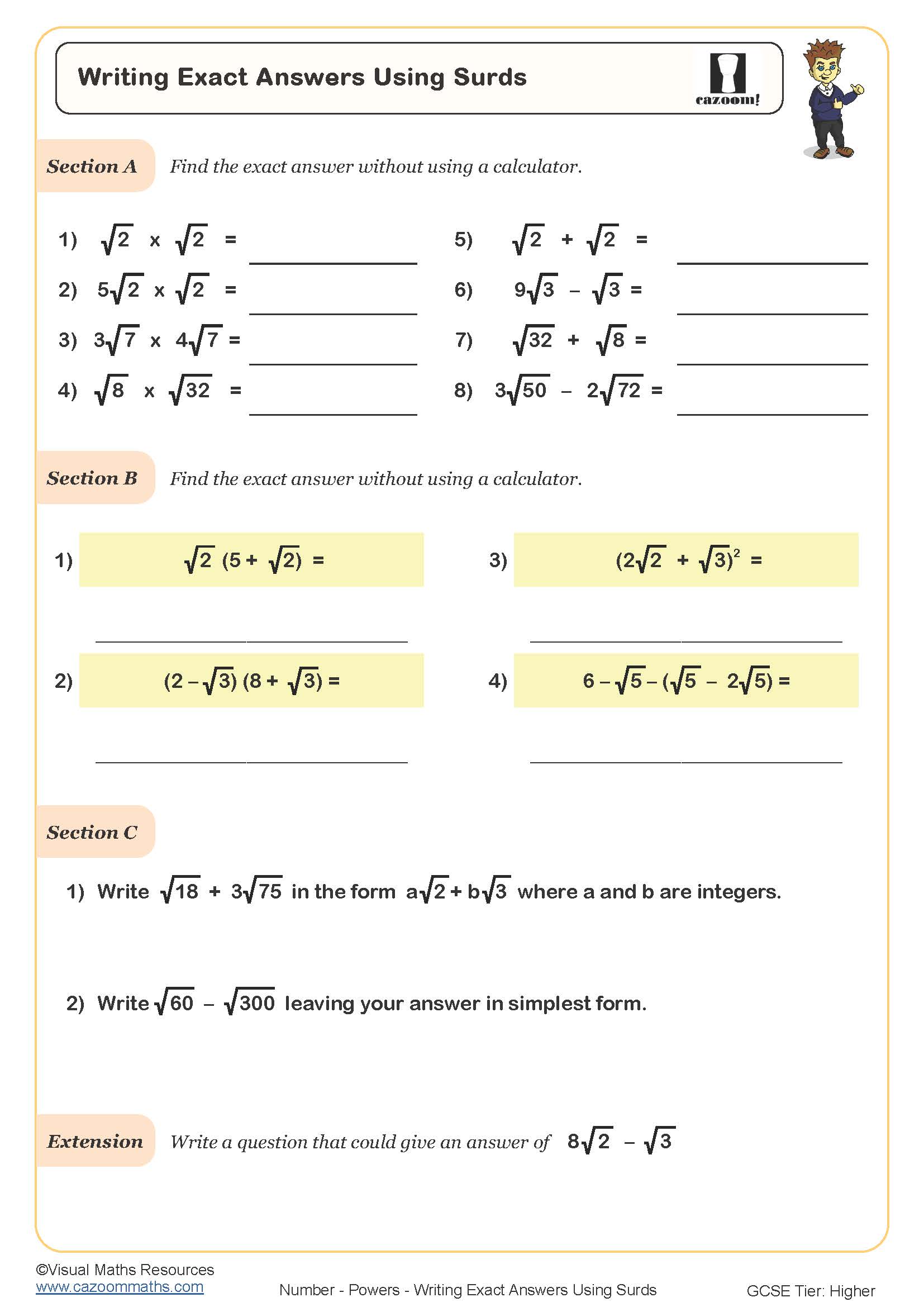
A common misconception occurs when students attempt to multiply surds incorrectly, writing √2 × √3 = √5 instead of √6. Exam mark schemes consistently penalise students who fail to simplify their final answer—leaving √12 instead of 2√3 costs marks even when the method is correct. Understanding that √a × √b = √(ab) is fundamental before tackling more complex rationalisations.
Which year groups study four operations with surds?
Four operations with surds worksheets are designed for Year 10 and Year 11 students following the Higher tier GCSE pathway. This topic typically appears after students have secured understanding of indices and roots in Year 9, building towards the algebraic manipulation required for A-level mathematics. The National Curriculum positions surds within the Higher tier content, meaning Foundation tier students do not encounter these calculations.
Progression across Year 10 and Year 11 moves from basic surd simplification towards increasingly complex multi-step problems. Year 10 students usually begin by simplifying single surds and combining like terms, whilst Year 11 work incorporates rationalising denominators with binomial expressions such as (3 + √2)/(5 - √2). Teachers often revisit this topic during GCSE revision when students tackle non-calculator papers requiring exact answers rather than decimal approximations.
How do you rationalise the denominator of a surd?
Rationalising the denominator removes the surd from the bottom of a fraction by multiplying both numerator and denominator by a strategic expression. For simple cases like 1/√3, multiply by √3/√3 to obtain √3/3. When the denominator contains a binomial such as (2 + √5), multiply by the conjugate (2 - √5) to create a difference of two squares, eliminating the surd term completely through the identity (a + b)(a - b) = a² - b².
This skill connects directly to engineering calculations where exact values maintain precision throughout complex formulae. In electrical engineering, impedance calculations involving alternating current often require rationalised expressions to separate real and imaginary components clearly. Architects use similar techniques when calculating diagonal measurements in design software, where maintaining surd form ensures accuracy isn't lost through premature rounding during multi-stage calculations.
How can these worksheets support learning about surds?
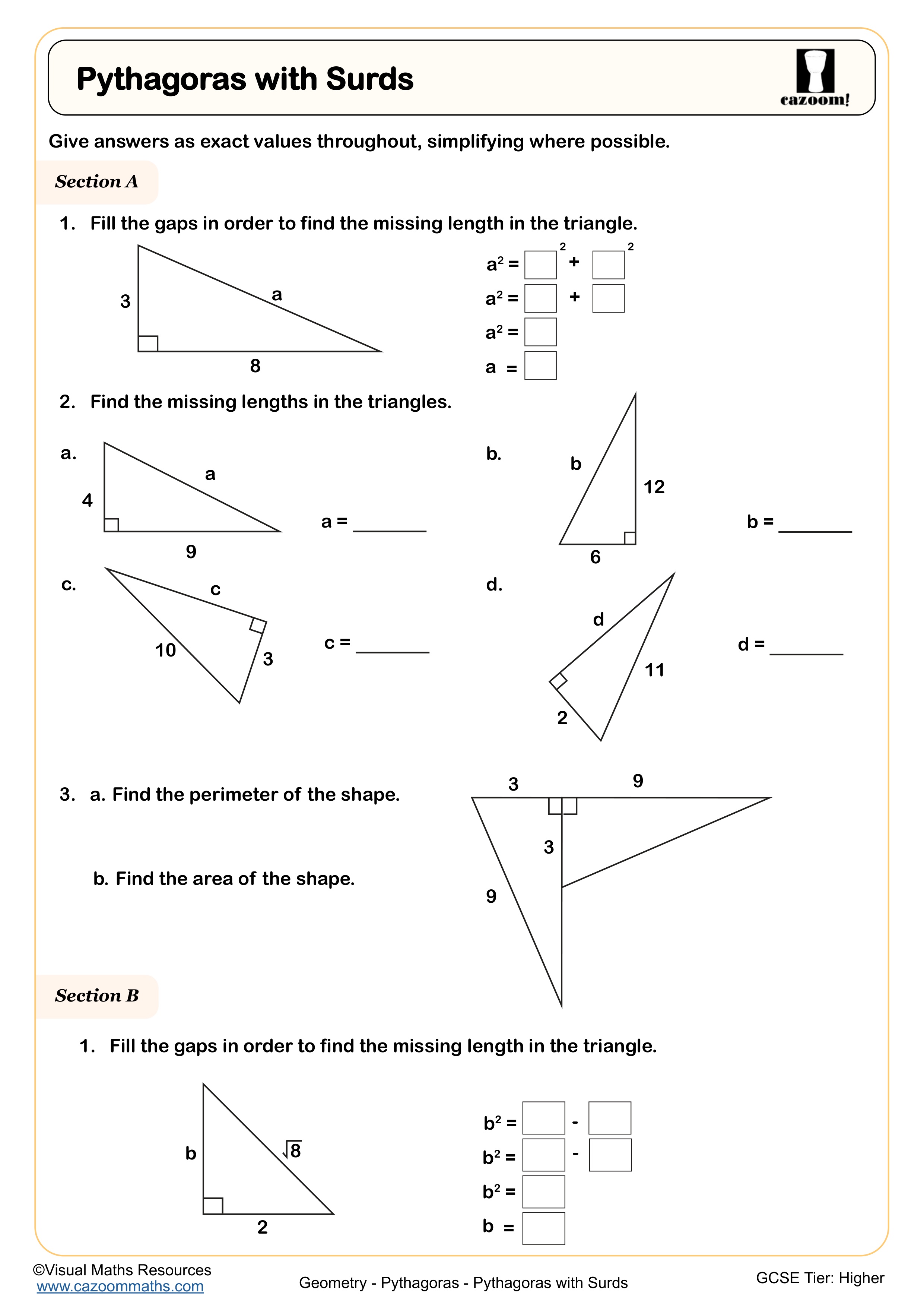
The worksheets provide structured practice moving from straightforward surd simplification through to more demanding problems involving all four operations and rationalisation. Each question type builds on previous skills, allowing students to recognise patterns—such as spotting when to apply the difference of two squares during rationalisation. The included answer sheets show complete working, helping students identify precisely where their method diverges from the correct approach, particularly valuable for self-study or homework tasks.
Many teachers use these resources during targeted intervention sessions with students preparing for Higher tier papers, focusing on the non-calculator questions where surd manipulation appears frequently. The worksheets work effectively for paired practice where students compare methods for rationalising different denominator types, developing flexibility in choosing efficient approaches. During revision periods, teachers often set selected questions as timed practice to build the exam confidence needed when surds appear within coordinate geometry or trigonometry contexts.